Two monitors can share the same refresh rate and still feel very different because smoothness depends on pixel speed, tuning, frame delivery, and variable refresh behavior, not Hz alone.
If you have ever moved from one 144Hz screen to another and wondered why one looked clean while the other looked smeary, that difference is real. Buyers run into this constantly with gaming monitors, ultrawide displays, and even newer portable monitors, because identical Hz ratings can hide very different motion behavior. You will leave with a practical way to judge smoothness before you spend money.
Refresh Rate Sets the Pace, Not the Whole Result
What Hz actually tells you
A monitor’s refresh rate is how many times per second it updates the image, so it sets the maximum update cadence but not the full quality of motion. That matters for gaming monitors because 144Hz, 240Hz, and 360Hz all reduce visible stepping compared with 60Hz, yet none of them guarantee clean motion on their own.
Why the biggest jump is often the first one
Frame persistence drops sharply as refresh rate rises, from 16.7 ms at 60Hz to 4.2 ms at 240Hz, which is why the move from 60Hz to 120Hz usually looks more dramatic than the move from 360Hz to 480Hz. For monitor buyers, that means chasing higher Hz still helps, but the returns shrink if the rest of the display pipeline is mediocre.
Why two 240Hz screens can still look different
Motion smoothness depends on both refresh rate and response time, so two same-Hz displays can feel different in scrolling, mouse movement, and fast camera pans. In practice, one 240Hz panel may finish transitions in roughly 0.3 ms with no meaningful overshoot, while another may take several milliseconds and add blur or bright artifacts, even though both boxes say “240Hz.”

Pixel Response and Overdrive Decide Motion Clarity
Motion blur and ghosting are not the same problem
Motion blur and ghosting are different artifacts. Motion blur is the smear you perceive while your eyes track moving objects, while ghosting is a hardware trail caused by pixels that have not finished changing color before the next frame arrives. That distinction matters when comparing gaming monitors, because a panel can have a high refresh rate and still leave visible trails.
Why the spec-sheet “1 ms” often disappoints
Gray-to-gray response numbers usually describe selected transitions, not every difficult transition you will see in a real game. Dark-to-dark changes are often slower, which is why a monitor can look fine in a bright test clip and then smear badly in a dim map, horror game, or nighttime racing scene.
Overdrive helps until it goes too far
Overdrive can improve pixel transition speed, but aggressive tuning can overshoot the target color and create inverse ghosting, which looks like a bright halo or echo around moving objects. That is why a well-tuned fast IPS panel can feel smoother than a poorly tuned panel with the same Hz rating, and why review data is more valuable than a single marketing number.
Frame Delivery and Operating System Behavior Change the Feel
Smooth monitors still need smooth frame pacing
Variable refresh support and the active refresh mode are visible in the operating system’s Advanced display settings, which matters because a monitor only feels as smooth as the frames it is actually receiving. If your GPU outputs uneven frame times, or your game swings between 75 fps and 140 fps, a 144Hz monitor can still feel choppy without well-behaved VRR.
Mixed-refresh setups are usually fine, but not always
A forum moderator test with a 144Hz QHD primary monitor and a 60Hz 4K secondary monitor reported smooth gaming on the fast display while video played on the slower one. That is a useful real-world reminder for buyers building a gaming desk with an ultrawide main screen and a second productivity panel: mixed refresh rates are not automatically a problem, but workload, driver behavior, and the specific game still matter.

Desktop composition can still create edge cases
Community testing on a recent operating system version suggests mixed-refresh quirks can still appear when a game runs on a non-main display under desktop composition, with behavior that can tie sync to the main monitor instead of the side screen. If a monitor feels oddly stuttery despite the right settings, practical fixes include making the gaming monitor your main display, testing different fullscreen modes, and temporarily disabling extras like HDR while you isolate the problem.
Panel Type and Blur-Reduction Features Matter More Than Many Buyers Expect
Panel choice changes motion character
Panel technology still shapes motion clarity: TN is still fast but weak in color and viewing angles, IPS balances speed and image quality, VA offers strong contrast but often slower dark transitions, and OLED delivers near-instant response. For gaming monitor shoppers, that means “same refresh rate” comparisons across panel types are rarely apples to apples.
The usual weak spot is dark smearing
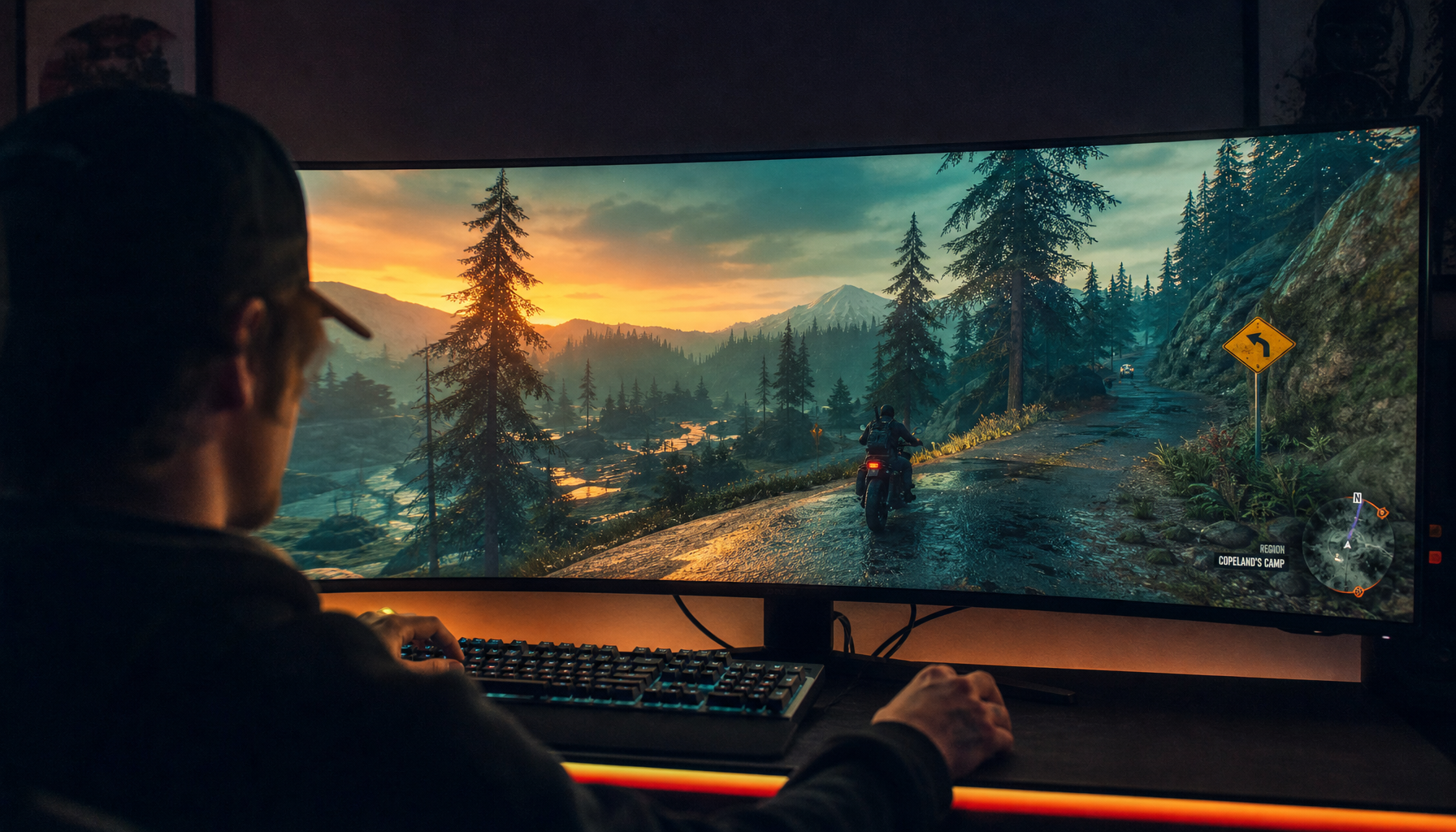
VA panels are the most ghosting-prone LCD type, especially in dark-to-dark transitions, while OLED panels are close to instantaneous and generally avoid that black-smear look. This is especially relevant for ultrawide monitors used for immersive single-player games, where dark scenes, sweeping camera pans, and high contrast make transition weaknesses easy to spot.

Blur-reduction modes can outperform raw Hz in the right use case
Strobe backlights and similar blur-reduction modes can produce excellent motion clarity on LCDs, and 240Hz OLED already looks strong even before additional blur reduction. The tradeoff is that strobing usually reduces brightness and often cannot run with one adaptive sync platform or another adaptive sync platform at the same time, so the “smoothest” setup for a competitive shooter is not always the most flexible setup for general use.
How to Judge Smoothness Before You Buy
What to check in reviews instead of trusting the box
Review data is more useful than headline specs, because you want to see response behavior, overshoot, and dark-scene performance at the refresh rates you will actually use. A gaming monitor that looks clean at its maximum refresh but falls apart at 120Hz or with VRR enabled may feel worse in real play than a slightly slower model with better tuning.
Quick comparison
Use this table when comparing gaming monitors, ultrawide displays, or portable monitors:
Factor |
What it affects |
Better sign |
Warning sign |
Refresh rate |
Motion cadence and frame persistence |
144Hz or higher for gaming |
High Hz with no review data |
Pixel response |
How quickly pixels finish transitions |
Consistently fast transitions across refresh rates |
Slow dark transitions or visible smear |
Overdrive tuning |
Blur reduction vs halo artifacts |
Balanced mode with low overshoot |
Bright inverse ghosting |
VRR behavior |
Smoothness when fps changes |
Stable adaptive sync support |
Flicker, pulsing, or poor low-fps behavior |
Panel type |
Overall motion character |
Fast IPS or OLED for balanced motion |
VA with noticeable black smear |
Blur reduction mode |
Maximum clarity in fast motion |
Good strobing implementation if you play esports titles |
Big brightness loss or no VRR with strobing |
Match the display to the frame rates you can actually hold
Monitor choice should match real system performance, and aiming for about 100 fps or more at your target resolution is a sensible baseline for getting value from a high-refresh monitor. For competitive gaming, that often favors a fast 1440p IPS or OLED panel; for ultrawide gaming, it pushes you to check whether your GPU can sustain the extra pixel load; and for portable monitors, it means a well-tuned 60Hz or 120Hz panel can be a smarter buy than a higher-Hz model your laptop cannot properly drive.
FAQ
Q: If two monitors are both 144Hz, why does one still look blurrier?
A: Because 144Hz only tells you how often the image updates. Pixel transition speed, overdrive tuning, dark-scene behavior, and overshoot determine whether moving objects look crisp or leave trails.
Q: What matters more for smoothness: refresh rate or response time?
A: Neither works well alone. Refresh rate lowers frame persistence, but poor response behavior can erase much of that gain. In most buying decisions, a balanced monitor with strong review data beats a higher-Hz monitor with weak tuning.
Q: Do ultrawide and portable monitors feel less smooth than standard gaming monitors?
A: Not inherently. Ultrawides often feel less smooth when the GPU cannot maintain enough fps at the wider resolution, and portable monitors often prioritize power efficiency over top-end motion tuning. The key is matching the panel and refresh rate to the system driving it.
Final Takeaway
The smoothest monitor is not the one with the biggest Hz number on the box. It is the one that combines enough refresh rate for your games, fast and well-controlled pixel behavior, stable VRR, and frame rates your PC can actually sustain.
- Confirm the real refresh rate in the operating system before judging a monitor.
- Read response and overshoot results at the refresh rates you will actually use.
- Treat “1 ms” claims as incomplete unless reviews show clean motion in dark and bright scenes.
- Match your monitor choice to the fps your system can hold at native resolution.
- If you use two displays, test your game on the main monitor first and retest with HDR or fullscreen changes if motion feels wrong.