A 1500R curve usually feels subtle on a 27-inch monitor and much more obvious on a 34-inch ultrawide because the wider screen puts more of the image into your peripheral vision.
If you have ever switched from a 27-inch gaming monitor to a 34-inch ultrawide and wondered why the same “1500R” label suddenly feels more dramatic, the answer is not just the number on the box. A 34-inch ultrawide is about 31.25 inches wide versus 23.53 inches for a 27-inch 16:9 display, so the sides simply have more room to wrap around you. By the end, you will know when 1500R improves immersion, when it is mostly cosmetic, and how to choose the right curved monitor for your desk and workload.
What 1500R Actually Means on a Monitor
The number is a radius, not a comfort score
A 1500R curve means the screen follows the arc of a circle with a 59-inch radius, and lower numbers are more aggressive than 1800R or 2300R. That tells you the shape of the panel, but it does not tell you how strong the curve will feel once screen size, aspect ratio, and seating distance enter the picture.
For monitor buyers, that is why 1500R can be marketed as a balanced middle ground. A company’s curved monitor guidance places 1500R to 1800R in the common range for work and multitasking because the curve is noticeable without becoming overly tight, while a brand positions tighter curves as more immersion-focused for gaming and media.
Why the same curve does not create the same feel
The same curve radius does not guarantee the same experience because shape alone does not define what you see; panel size, aspect ratio, and where you sit matter just as much. A 1500R curve on a narrower 27-inch screen bends less of your field of view, so it often reads as a mild softening of the edges rather than a wraparound effect.
That is why many buyers describe 1500R differently across categories. On standard 16:9 gaming monitors, it can feel like a light ergonomic tweak; on ultrawide monitors, the wider field of view makes the same curve more immersive because more of the picture reaches into side vision.
Why 27 Inches and 34 Inches Feel So Different
Width changes the wraparound effect
A 34-inch 21:9 screen is much wider than a 27-inch 16:9 display while being almost the same height. In the dimensions cited in the comparison, the 27-inch panel is 23.53 inches wide and 13.24 inches tall, while the 34-inch ultrawide is 31.25 inches wide and 13.39 inches tall. That extra width is the main reason 1500R feels stronger at 34 inches.

In practice, this means the curve on a 27-inch monitor mostly affects how the far left and right edges meet your eyes. On a 34-inch ultrawide, much more of the panel sits off-center, so the screen edges and center stay at a more similar viewing distance, which is exactly where curvature starts to feel useful rather than decorative.
Aspect ratio changes what your eyes are doing
A 27-inch 2560x1440 monitor versus a 34-inch 3440x1440 ultrawide is a useful real-world comparison because the vertical workspace stays close while the horizontal span grows. That shifts the experience from “looking at a screen” to “scanning across a workspace,” especially in games, code editors, timelines, and side-by-side windows.

That is also why a 1500R curve can seem unnecessary on some 27-inch displays but appropriate on many 34-inch ultrawides. The curve brings side edges closer to your field of vision, and that benefit increases as the screen gets wider.
Viewing Distance Decides Whether 1500R Feels Comfortable
Desk depth matters more than many spec sheets admit
A curved monitor only feels right if you sit at a sensible distance. The ergonomic guidance on monitor distance points to roughly 20 to 28 inches from your eyes to the screen for general comfort, while a brand recommends about 39 inches to avoid fatigue on curved displays. Those numbers are not contradictory so much as a reminder that comfort depends on screen size, font scaling, and how much of the panel you want in view at once.
For a 27-inch monitor, a normal desk often places you close enough that 1500R feels mild and easy to adapt to. For a 34-inch ultrawide, that same shallow desk can make the curve feel stronger because the outer edges extend farther into your side vision. If you sit too close, the curve can feel exaggerated; if you sit too far back, some of its benefit disappears.
Tilt and eye line affect comfort as much as curvature
A good monitor setup keeps the screen center about 15 to 20 degrees below horizontal eye level, with the top bezel at or just below eye level. That matters because buyers sometimes blame curvature for discomfort that is actually caused by poor height, bad tilt, or leaning forward to read text.
This is especially relevant for high-refresh-rate gaming monitors and ultrawides on fixed stands. A 1500R screen that is too low, too upright, or too close can create neck and eye fatigue even if the panel itself is well chosen. In a proper setup, the curve should reduce edge strain, not force you into a worse posture.
Is 1500R Better for Gaming or Productivity?
Gaming benefits show up sooner on 34-inch ultrawides
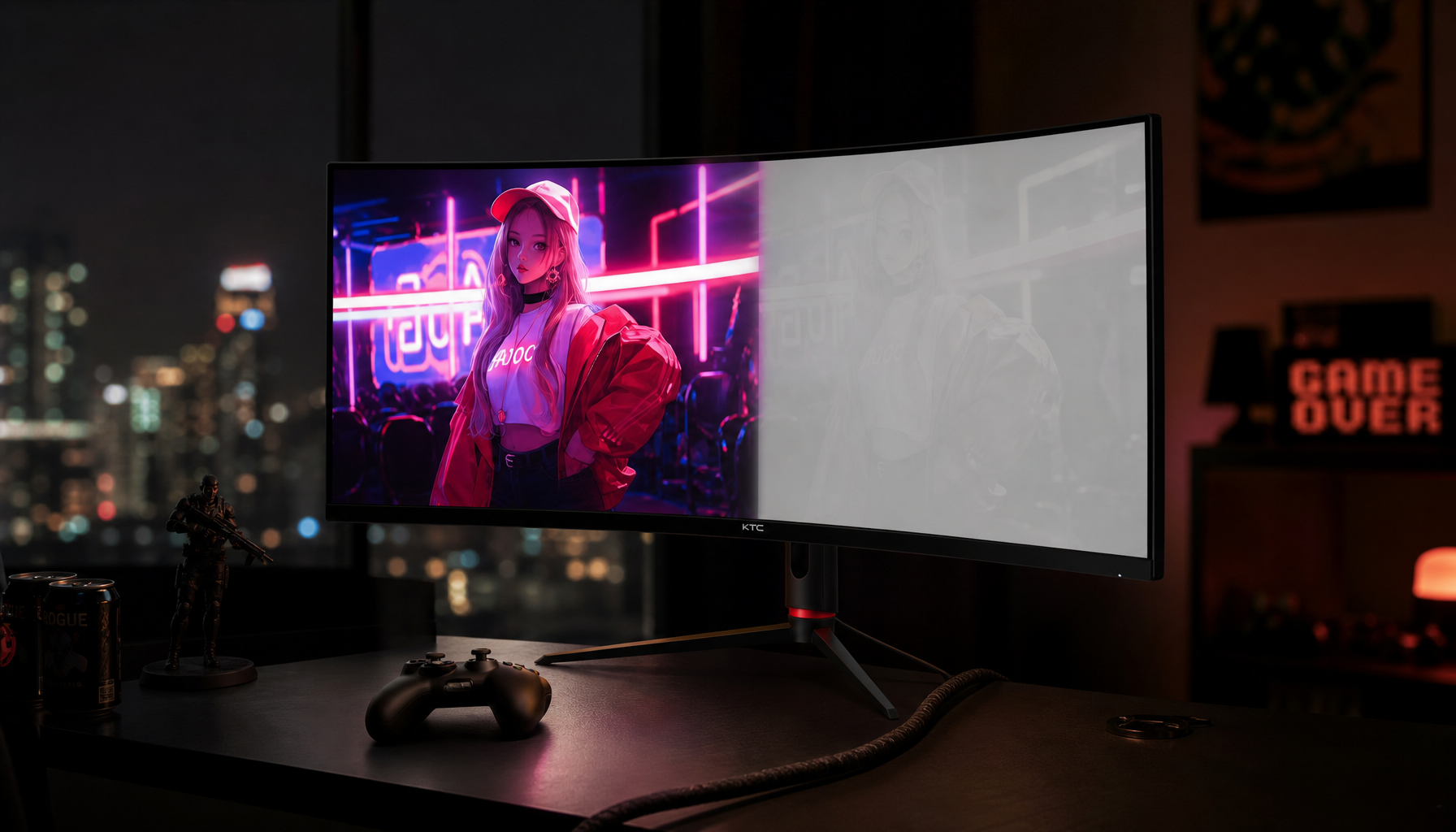
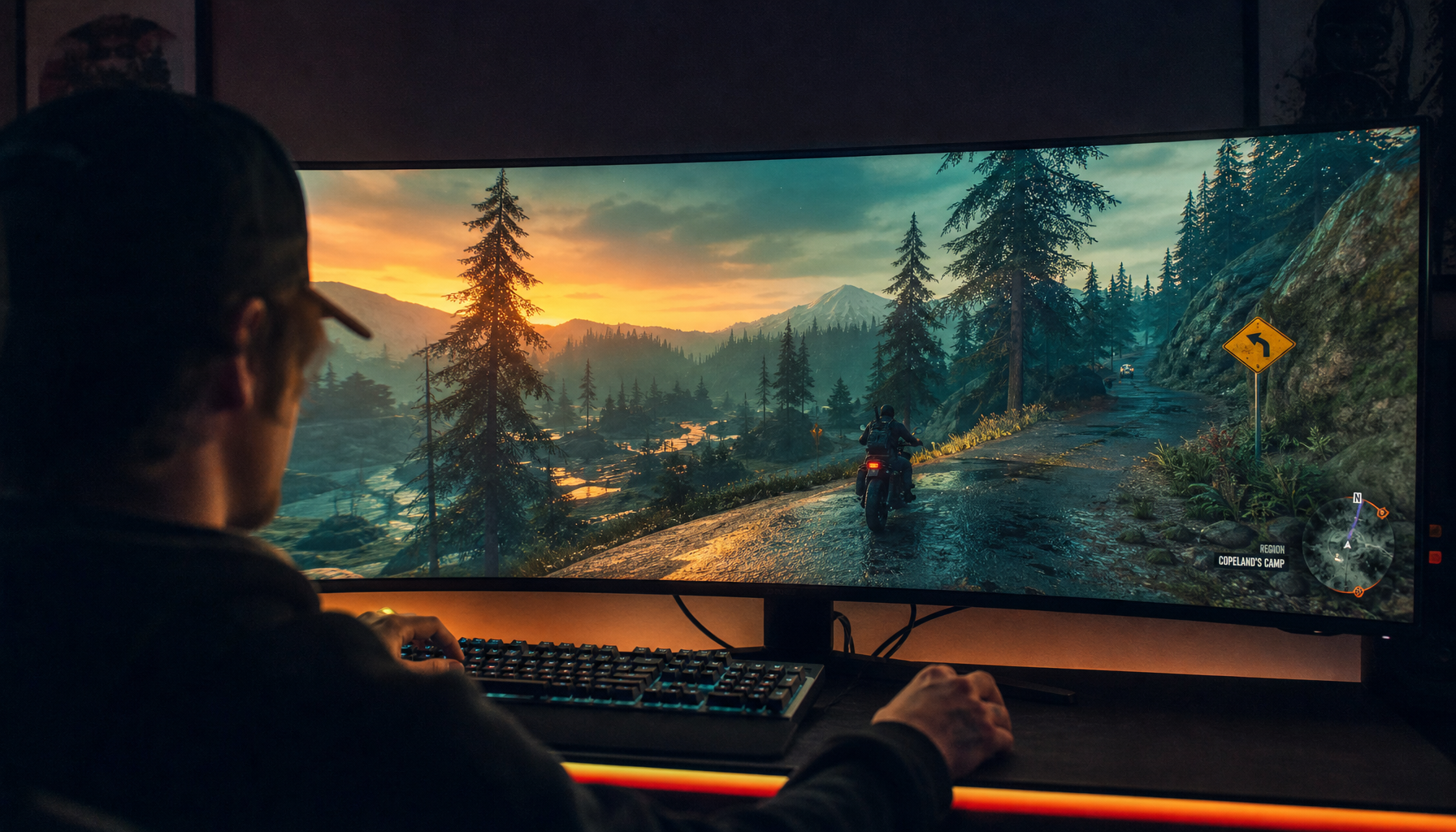
The immersion benefits of curved monitors are easiest to notice in games because your peripheral vision is already engaged. On a 34-inch ultrawide, 1500R helps racing, simulation, open-world, and first-person games feel more continuous across the panel. That is the kind of form factor you see on the a brand 34” 2K 180Hz/1ms 1500R Curved Gaming Monitor, where a 34-inch ultrawide layout makes a 1500R curve easier to notice than it would be on a smaller 27-inch screen. On a 27-inch screen, the same curve usually feels more restrained, which some players prefer for mixed use.
That difference matters if you are choosing between a fast 27-inch 1440p monitor and a wider 34-inch ultrawide. A real buying scenario comparing 27-inch and 34-inch options often comes down to whether you value sharpness and straightforward esports performance more than cinematic width and multitasking space.
Productivity depends on the type of work
For work, curved monitors can support focus and multitasking, especially with spreadsheets, timelines, coding layouts, and side-by-side windows. A 34-inch ultrawide gets more practical value from 1500R because the curve helps keep wide content visually consistent from center to edge.
At 27 inches, the benefit is narrower. The tradeoffs of curved screens become easier to notice in document-heavy work, where straight lines can appear slightly bowed and off-center viewing is less ideal. For someone who spends all day in text, dashboards, and web pages, a flat 27-inch monitor is often the safer pick unless gaming immersion is also a priority.
27-Inch 1500R vs 34-Inch 1500R at a Glance
Factor |
27-inch 16:9 1500R |
34-inch 21:9 1500R |
Typical feel |
Subtle curve |
Noticeable wraparound effect |
Screen width |
About 23.53 inches |
About 31.25 inches |
Screen height |
About 13.24 inches |
About 13.39 inches |
Best match |
Mixed gaming and general use |
Immersive gaming and multitasking |
Curve benefit |
Mild edge comfort |
Stronger peripheral engagement |
Off-center viewing |
Less of an issue |
More noticeable limitation |
Desk sensitivity |
Works on more desks |
Needs better depth and positioning |
Flat alternative risk |
Easier to replace with flat |
More likely to lose ultrawide comfort |
A 34-inch ultrawide has about 34% more screen area than the 27-inch comparison panel in the cited dimensions, which helps explain why the same 1500R spec rarely feels the same in person. You are not just getting more pixels; you are changing how much screen sits away from the centerline of your vision.
That is why curvature should be judged together with size and aspect ratio, not as an isolated spec. A 1500R label on a product page is most meaningful when you already know whether you are shopping for a compact 16:9 gaming monitor or a full-width ultrawide display.
FAQ
Q: Does 1500R make text look sharper on a 27-inch monitor?
A: No. The screen curve does not change text clarity. Sharpness still comes from resolution, pixel density, scaling, and panel quality.
Q: Is 1500R too aggressive for productivity on a 34-inch ultrawide?
A: Usually not, especially if you use wide timelines, spreadsheets, or multiple windows. A company’s guidance for work-focused curved monitors places 1500R to 1800R in the common range, but document-heavy users may still prefer flatter screens.
Q: Should I choose flat over 1500R for a 27-inch gaming monitor?
A: If your use is mostly competitive gaming, office work, and web browsing, flat is still a strong option. If you want a bit more immersion without moving to ultrawide, 1500R on a smaller display can work well, but the difference will be modest.
Final Takeaway
A 1500R curved monitor is usually more convincing at 34 inches than at 27 inches because ultrawide width gives the curve room to matter. If you want the shortest buying rule, think of 27-inch 1500R as a mild enhancement and 34-inch 1500R as a design choice that can materially change immersion and workspace feel.
Use this checklist before you buy:
- Measure your real seating distance and aim for roughly 20 to 28 inches as a comfort baseline.
- Choose 27-inch 1500R if you want a balanced gaming monitor that still behaves like a familiar 16:9 display.
- Choose 34-inch 1500R if you want ultrawide immersion, better side-window visibility, or a more cohesive timeline and spreadsheet view.
- Pick flat instead if your work is heavily text-based and you dislike any bending effect on straight lines.
- Prioritize resolution, refresh rate, stand adjustment, and ports alongside curvature.
- If possible, pair a 34-inch ultrawide with a deeper desk or monitor arm so the curve does not feel forced.