Display uniformity directly affects how easily you notice minimap pings, edge movement, and dark-corner detail, especially on larger gaming monitors and ultrawides. A fast refresh rate helps motion look cleaner, but it does not fix dim corners, tint shifts, or brightness haze at the edges.
Ever miss a minimap warning or fail to catch movement near the side of the screen even though your frame rate feels great? That usually feels like a reaction problem, but on some monitors it is partly a screen-quality problem, especially when edge brightness, black levels, or color tint do not match the center. The goal here is to show which monitor traits actually improve corner awareness in MOBAs and battle royales, and which headline specs matter less than they seem.
Why Uniformity Matters More Than Many Gamers Expect
Edge problems change what you notice first
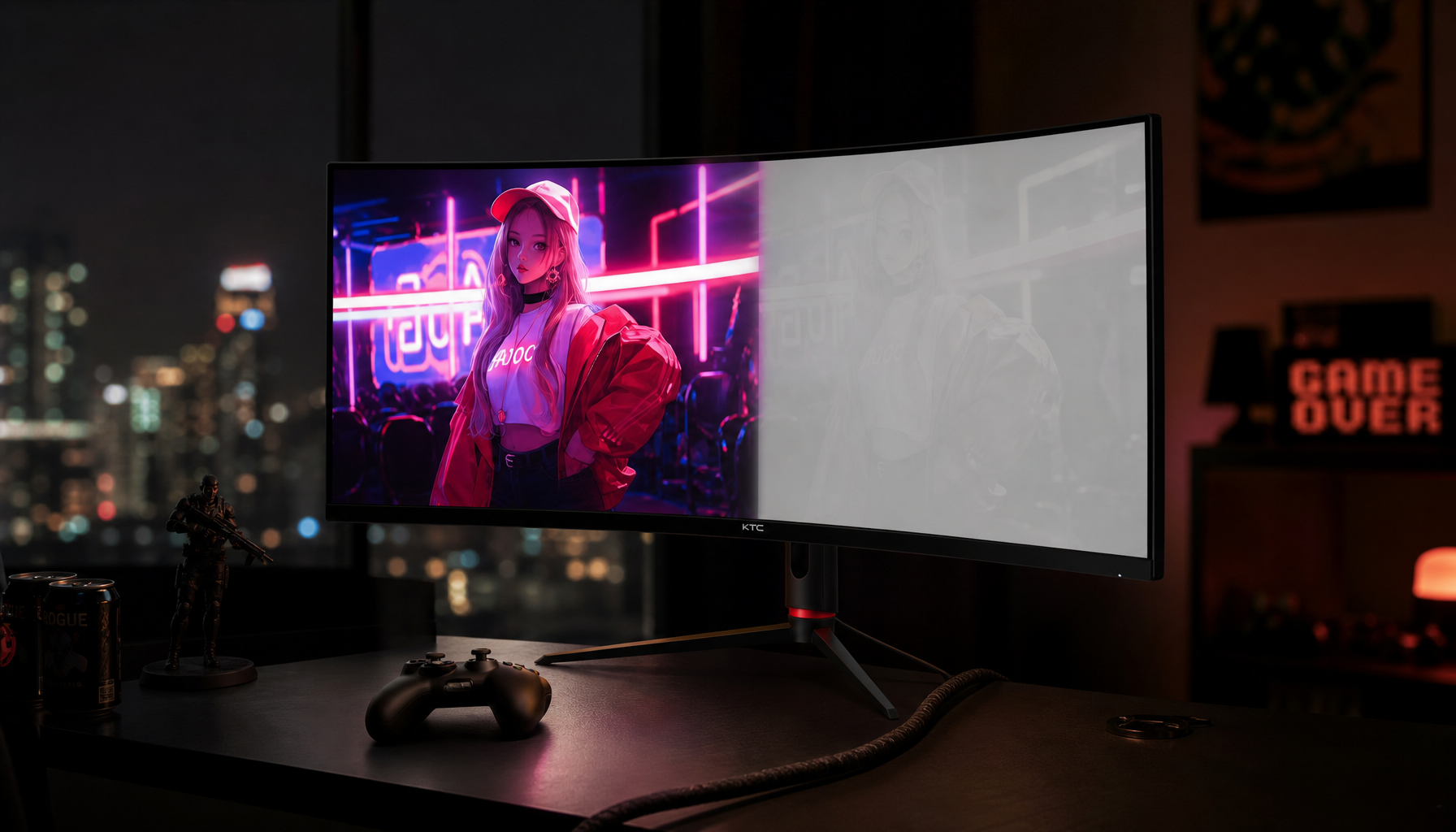
Display non-uniformity is common on many 100+ Hz IPS gaming panels, and that matters in games where useful information sits near the edges: minimaps, ability cooldowns, teammate pings, inventory prompts, and enemy motion entering from a flank. If one corner runs darker, warmer, or hazier than the rest of the panel, subtle cues become easier to miss in peripheral vision even when the center looks fine.

That is why corner awareness is not just about player skill. In a MOBA, a faint jungle movement indicator or warded bush at the edge of your view can lose contrast. In a battle royale, the same problem shows up when loot outlines, storm-edge detail, or player silhouettes sit near a dim or tinted area of the screen. On a monitor used at close range, those inconsistencies are often more obvious because your eyes keep crossing from center to edge during a match.
Calibration can help gamma, but not bad panel uniformity
A poor uniformity problem usually does not have a true calibration fix. One forum case described a screen that only looked correct in a small central zone, with measured gamma around 2.0 and contrast barely reaching 900:1; the workable compromise was keeping the color profile active and using the monitor’s sRGB mode at roughly 180 cd/m². That can improve washed-out dark grays, but it does not make the corners physically match the center.
This is the practical takeaway for monitor buyers: calibration is useful for tone and color management, but it cannot turn a weak panel into a uniform one. If your main complaint is that the corners look darker, redder, yellower, or hazier during long sessions, the real fix is often a better unit or a different panel choice.
Which Uniformity Flaws Hurt MOBA and Battle Royale Play Most
Black uniformity affects dark-scene tracking
Black uniformity is one of the clearest predictors of dark-scene consistency. One review platform treats lower deviation as better and notes that values under 2% are good, with even a 1% difference being noticeable. In dark battle royale scenes, poor black uniformity shows up as clouding, corner glow, or blooming around bright UI elements, which can make enemy movement near the edge harder to separate from the background.

The same source set shows a strong panel split: OLED averaged about 0.203% native black-uniformity deviation across 347 tested monitors, compared with 2.030% for VA, 2.357% for IPS, and 2.995% for TN. That does not mean every OLED is perfect in every respect, but it does explain why OLED often feels clearer in dark edge areas during late-game circles or night maps.
Brightness and tint uniformity affect HUD readability
Corner tint and brightness variation can still fall within manufacturer specifications, which is frustrating for buyers because “within spec” may still be distracting in real use. One company explicitly notes that consumer monitors are not validated in a fully dark room and that corners do not have to match the center exactly. For gaming-focused displays, some light leakage or corner tint on dark content can still be considered normal.
That matters because many competitive players do not evaluate a monitor with a white test slide; they notice it after two hours of scanning a minimap, kill feed, health bars, and corner UI. A forum case involving a monitor model from a brand described a reddish top-left corner, yellowish bottom-right corner, and a brighter right side on gray content, with the user saying peripheral vision kept catching the difference during long sessions. That is the exact kind of issue that makes a monitor feel tiring even if response time and HDR look good on paper.
Do Ultrawide Monitors Improve or Worsen Corner Awareness?
Wider view helps map control, but it changes eye movement
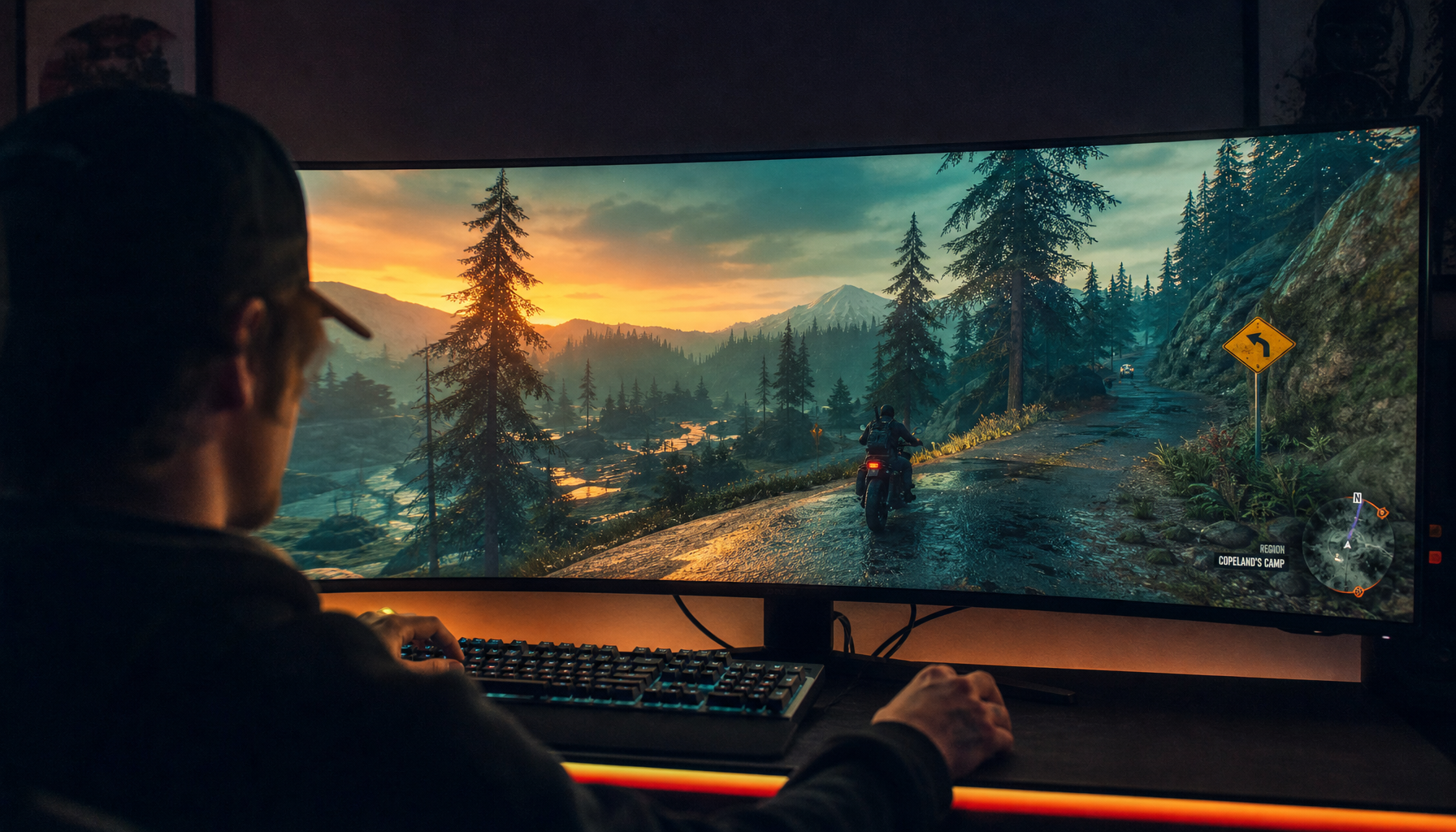
Ultrawide monitors can show about 33% more screen space than a standard display, and in games with good support that extra width can improve battlefield overview. In MOBAs, that means better lane-side awareness and more information about flanks when vision tools are placed well. In battle royales and shooters, wider horizontal coverage can make side-entry movement easier to catch through peripheral vision.
The tradeoff is that more information is only useful if you can comfortably read it. A 21:9 panel may expand the visible world, but it can also push HUD elements farther from the center. That is why ultrawide can feel excellent for world awareness yet worse for constant minimap checks if the game locks the UI to the far corners.

UI layout and game support determine whether width helps
Super ultrawide setups work best when the game lets you rearrange UI elements. In one 32:9 use case, the effective solution was to move hotbars, minimaps, and status elements inward so the center behaved more like a 16:9 workspace. That is highly relevant to MOBAs and battle royales: if the game supports UI scaling or repositioning, you can keep critical information near your natural line of sight while still benefiting from wider world coverage.
If the game does not support that, the extra width can work against you. Some titles also limit ultrawide support to avoid visibility advantages, while others show black bars or stretched images. For buyers, that means ultrawide is not automatically better for corner awareness. It is better when the game supports the aspect ratio, the HUD is sensible, and the panel itself stays uniform near the edges.
What Specs Actually Predict Better Corner Visibility
Size, aspect ratio, and panel type matter before extreme refresh
The 24-inch to 27-inch 16:9 range remains the sweet spot for taking in the whole screen at once. A 24-inch display is often easier for strict competitive play because less eye travel is needed, while 27-inch adds immersion without forcing a huge scan distance. That is important in MOBAs, where many decisions still depend on quickly reading both center action and a corner minimap.

Refresh rate still matters, but the gains flatten out. Moving from 60 Hz to 144 Hz is a major improvement; moving from 360 Hz to 480 Hz is much smaller unless your system can sustain very high frame rates. If you are choosing between a more uniform 240 Hz monitor and a less uniform 480 Hz one, the more balanced panel may produce better real match awareness.
OLED, IPS, and VA each solve a different part of the problem
OLED offers the strongest blacks, fast response, and excellent motion clarity, which makes it a strong choice for dark-scene edge visibility. One publication’s top 2026 pick, a 27-inch 1440p OLED monitor, pairs 480 Hz with a 0.03 ms response time, showing that top-tier motion performance and strong black handling can now exist in the same product tier.
IPS still makes sense for many players because of its wide viewing angles and generally strong color consistency, especially on flat 24-inch to 27-inch displays. VA can deliver better contrast than IPS, but slower transitions can create smearing in rapid motion on some models. For corner-of-screen awareness, the practical order is simple: OLED is strongest in dark uniformity, a good IPS is usually safest for overall balance and viewing angles, and VA needs more careful model-by-model scrutiny if you play fast titles.
How to Shop for a Monitor If Corner Awareness Is a Priority
Start with tests that expose edge weakness
A useful buying process balances visuals, performance, and budget, but if corner awareness is your goal, add a few specific checks. Look for black uniformity results, white or gray-screen uniformity comments, and any mention of tinting, clouding, or edge darkening. For black performance, one review platform’s under-2% guideline is a strong reference point; for bright scenes, pay close attention to reviewer photos and owner reports.
In practice, I would treat uniformity as a gate, not a bonus. If a monitor repeatedly shows corner glow, haze, or tint complaints, I would not buy it for a MOBA or battle royale setup just because it offers a higher refresh rate. A sharp 1440p 240 Hz monitor with clean edges is a better competitive tool than a flashier display that distracts you every time you check the minimap.
Match the monitor to the game and the desk
A publication’s baseline gaming-monitor recommendation centers on a 27-inch flat IPS 1440p 144 Hz+ display, usually in the $250.00 to $500.00 range, and that remains a smart middle ground for many players. It keeps the full screen readable, usually maintains decent pixel density, and avoids the UI sprawl of very large panels. For most desks and most competitive titles, that is still the easiest place to get good corner visibility without overspending.
Ultrawides make more sense when you specifically value extra map coverage, play games with good HUD behavior, and sit close enough to benefit from the side image without feeling like the corners are too far away. Portable monitors are a niche case here, but high-refresh portable options now exist, including a 17.3-inch 300 Hz model in one publication’s 2026 roundup. They are useful for travel setups, though smaller panels usually reduce corner-scanning strain more than they improve immersion.
Comparison Table: Best Monitor Directions for Corner Awareness
Monitor type |
Typical strength for corner awareness |
Main weakness |
Best fit |
24-inch 1080p 240 Hz IPS |
Easy to view whole screen quickly; strong for minimap checks |
Lower sharpness than 1440p options |
Pure competitive MOBA and battle royale play |
27-inch 1440p 144-240 Hz IPS |
Balanced size, clarity, and manageable eye travel |
IPS black uniformity can trail OLED and VA |
Best all-around gaming monitor choice |
27-inch 1440p 240-480 Hz OLED |
Excellent black uniformity, motion clarity, and dark-scene edge detail |
Higher price; panel variance still exists |
High-end competitive and mixed-use setups |
34-inch 3440x1440 ultrawide |
Wider battlefield view and stronger flank awareness |
HUD corners can sit too far out |
Players who want more world coverage and supported games |
49-inch 32:9 super ultrawide |
Maximum world visibility when UI can be moved inward |
Far-corner HUD scanning can be tiring |
Sim, MMO, and selective battle royale use |
17.3-inch high-refresh portable monitor |
Very easy whole-screen view in tight spaces |
Smaller image reduces immersion and detail |
Travel or temporary esports-style setups |
Action Checklist
- Check black uniformity and gray-screen photos before you compare refresh rates.
- Favor 24-inch to 27-inch flat panels if minimap speed matters more than immersion.
- Treat 144 Hz as the baseline and 240 Hz as the competitive upgrade; only chase 360 Hz to 500 Hz if your PC can actually feed it.
- Choose OLED for the best dark-scene edge consistency, or a well-reviewed IPS for a safer price-to-performance balance.
- Buy ultrawide only if your main games support the aspect ratio and let you manage HUD placement.
- Return a monitor quickly if corner tint, haze, or edge dimming keeps pulling your eyes away from the action.
FAQ
Q: Can poor display uniformity really make me miss minimap pings or enemy movement?
A: Yes. If a corner is dimmer, hazier, or shifted in color, subtle UI and motion cues are harder to catch in peripheral vision. This is especially noticeable in MOBAs, where minimap checks are constant, and in battle royales, where dark edge detail matters.
Q: Is ultrawide better for battle royale awareness?
A: Sometimes. A 21:9 screen can improve horizontal coverage and flank awareness, but it can also place HUD elements farther into your peripheral vision. It works best when the game supports ultrawide properly and the UI can be scaled or repositioned.
Q: Should I prioritize refresh rate or uniformity when buying a gaming monitor?
A: After you reach a solid baseline such as 144 Hz or 240 Hz, uniformity becomes a bigger differentiator for corner awareness. A cleaner 240 Hz panel is often more useful than a less uniform 480 Hz model.
Final Takeaway
Corner-of-screen awareness is partly a display-quality issue, not just a player-speed issue. For most buyers, the safest choice is a uniform 24-inch or 27-inch gaming monitor with at least 144 Hz, strong review coverage on black and gray uniformity, and a panel type that matches your content. If you play a lot of dark battle royales, OLED has the clearest advantage; if you want a versatile and more affordable setup, a good flat IPS 1440p display is still the easiest recommendation.