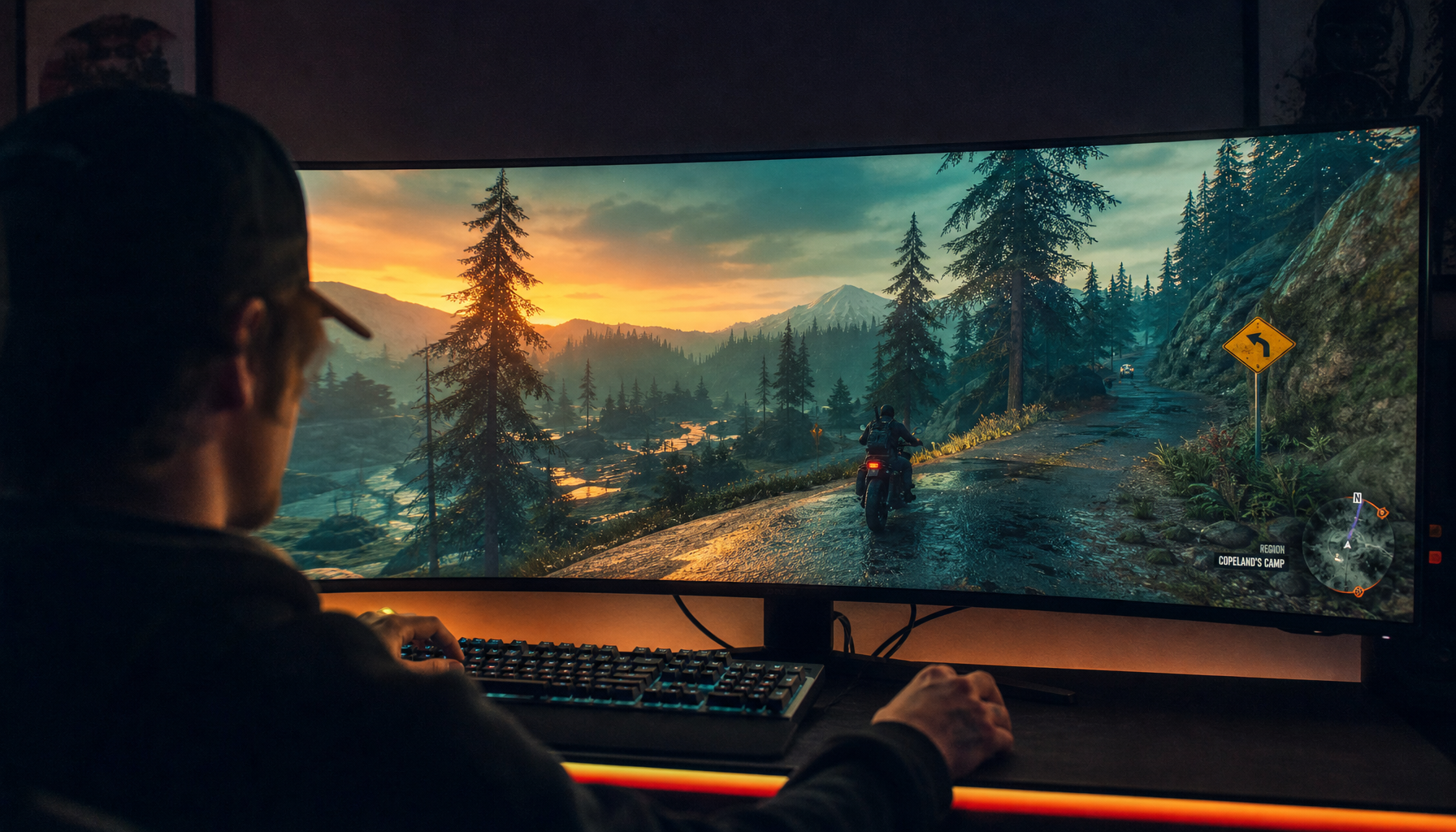
Some console games look better with HDR off because HDR depends on the game’s tone mapping, your display’s real brightness and contrast, console calibration, and room lighting. When any link is weak, SDR can look cleaner, punchier, and easier to read.
Does your console game look gray, dim, or strangely flat the moment HDR turns on? A simple side-by-side test in one dark scene and one bright outdoor scene can quickly show whether HDR preserves shadow detail and highlight texture or just makes the image harder to enjoy. You’ll learn why this happens, when HDR is still worth using, and how to tune your console display without wasting a night in menus.
HDR Is Not Just “Better SDR”
HDR, or High Dynamic Range, is designed to show a wider span between deep shadows and bright highlights than SDR. In a strong HDR setup, sunlight, fire, neon, reflections, and dark interiors can all carry more visible detail. SDR is the older standard with a narrower brightness and color range, but it is also more predictable, widely mastered, and often easier for displays to reproduce cleanly.
That last point matters. A console sending an HDR signal does not guarantee that your monitor or TV can show convincing HDR. HDR commonly relies on higher brightness, wider color, and 10-bit output, while SDR typically sits closer to Rec.709/sRGB behavior and 8-bit color. A comparison of SDR and HDR explains the intended upgrade clearly: HDR can exceed 1,000 nits and preserve more highlight and shadow information, while SDR often lives around 100 to 300 nits. The catch is that “can” is doing a lot of work.
If your display accepts HDR but only reaches entry-level brightness, lacks local dimming, or has weak black levels, it may compress the HDR signal into a duller image. In real play, that can mean a night mission where enemies disappear into lifted gray shadows, or a snowy map where clouds and rooftops lose texture because the highlights are clipped.
Why HDR Sometimes Looks Worse on Console
The Display May Be HDR-Compatible, Not HDR-Capable

Many gaming monitors advertise HDR support because they can receive an HDR signal. That does not mean they have the contrast, peak brightness, color volume, or local dimming needed to make HDR look better than SDR. Basic LCD HDR monitors are especially vulnerable because they may raise the whole backlight to chase brightness, which turns blacks gray and makes midtones look washed out.
A practical monitor-focused calibration article notes that entry-level HDR monitors may accept HDR signals while lacking the contrast control needed for convincing results. That matches what many console players see: SDR mode looks punchier because the display’s SDR tuning is simply better controlled.
A useful example is a 400-nit gaming monitor with no meaningful local dimming. It may show menus and HUD elements brightly, but when a game asks for a 1,000-nit sun reflection and deep cave shadows in the same scene, the monitor has to squeeze that range into limited hardware. SDR avoids that ambitious mapping step, so the image can feel more stable.
The Game’s HDR Implementation May Be Weak
HDR quality changes from game to game. Some titles are built with excellent native HDR grading and useful sliders, while others appear to remap an SDR image into an HDR container or use aggressive tone mapping that harms contrast. Community testing around console HDR has long shown this variation: players praise some games for better lighting and color while criticizing others for gray blacks, overly dark daylight scenes, or difficult calibration.
A long-running console discussion found that HDR implementation varied sharply between games, even among major releases. That is why one title can look spectacular in HDR while another looks as if someone lowered contrast and placed a gray filter over the scene.
The decision is not ideological. If a racing game has bright skies, reflective cars, and well-tuned specular highlights, HDR can add real depth. If a stealth game crushes dark-room detail or makes the HUD painfully bright, SDR may be the better choice because it protects visibility.
Tone Mapping Can Flatten the Image

Tone mapping is the process of translating a game’s intended brightness range into what your screen can actually display. If the game, console, and monitor all apply their own assumptions, the result can be too dark, too bright, or oddly flat. This is why HDR can look less vibrant than SDR even though HDR is technically carrying more image data.
In one HDR monitor comparison, a game with a native HDR profile showed some color benefits but also had darker shadows, flatter exposure, and highlight problems in specific scenes. The same comparison also showed why fair setup matters: the SDR display initially looked worse because its settings had been altered, and a factory reset made the comparison more honest.
That lesson applies directly to console gaming. If your TV switches into a separate HDR picture mode, it may use different brightness, contrast, local dimming, color temperature, sharpening, and black-level settings than SDR. You are not comparing HDR and SDR alone; you are comparing two entire picture pipelines.
The Paper White Setting Is Often the Hidden Problem
Paper White Controls Normal Brightness, Not Sparkle

Many console games include HDR sliders for peak brightness and paper white. Peak brightness controls the top end: sun glints, fire, sparks, muzzle flashes, lightning, and reflections. Paper white controls the brightness of normal white and SDR-like elements: menus, subtitles, maps, HUD markers, text prompts, faces, and many midtones.
If paper white is too high, HDR can look harsh and milky. If it is too low, the game can look dim even when highlights are technically bright. The most reliable setup order is to put the monitor in its most accurate HDR or Game HDR mode, disable unnecessary processing, run the console’s HDR calibration, set the game’s peak brightness, and then adjust paper white for your room.
Room lighting changes the answer. In a bright room, higher paper white can help faces, shadows, and UI panels survive glare. In a dark room, lower paper white often looks more cinematic and reduces fatigue from subtitles or maps. A good test is to load one dark corridor and one sunlit outdoor scene, then adjust until shadow texture is visible without turning blacks gray and clouds still have detail instead of becoming blank white.
Does HDR Hurt Console Performance?
HDR itself is usually not the same kind of performance cost as ray tracing, shadow quality, or volumetric fog. It is mostly a display and output mode involving brightness and color range. On PC, discussion around HDR performance generally points to little or no meaningful frame-rate loss in typical scenarios, although 10-bit HDR can require more display-link bandwidth. The same logic helps explain why console HDR usually affects image presentation more than raw rendering load.
A gaming hardware discussion summarized the practical consensus that enabling HDR generally has little impact on GPU rendering performance compared with changing actual graphics settings. On console, the bigger performance decisions are usually resolution mode, frame-rate mode, ray tracing, shadows, post-processing, and effects density.
That said, competitive players should still test. If HDR mode on your display adds processing latency, forces a different picture preset, makes enemies harder to see, or reduces clarity in dark corners, SDR may be the better match for ranked play. Visual fidelity only helps when it supports the way you play.
When HDR Off Is the Right Choice

HDR off is the right choice when the game looks washed out after calibration, dark scenes lose important detail, highlights clip into flat white patches, skin tones look strange, or HUD elements become distracting. It is also reasonable on basic HDR400-style monitors without effective local dimming, especially in bright rooms where glare already weakens perceived contrast.
SDR is not a downgrade when it gives you better control. It can deliver cleaner blacks, consistent menus, readable maps, and predictable color in games that were not carefully mastered for HDR. Automatic HDR enhancement exists because many older games were built for SDR first, and its purpose is to make supported SDR games appear closer to HDR on capable displays. Even then, automatic HDR enhancement is an enhancement layer, not a guarantee that every game will look more accurate.
For console players, the practical rule is simple: use HDR for native HDR games that give you clear calibration controls and look better in both dark and bright test scenes. Use SDR when HDR adds effort without improving visibility, contrast, or immersion.
How to Tune HDR Before Giving Up

Start with the display, not the game. Choose the most accurate HDR or Game HDR preset, turn off dynamic contrast or fake HDR effects, and make sure the console is connected through a port and cable mode that supports the resolution and refresh rate you want. If your monitor or TV has local dimming, test it on and off because weak local dimming can cause blooming around subtitles or bright HUD elements.
Next, run the console HDR calibration slowly. Do not set every pattern to maximum just because brighter feels better for five seconds. Then open the game’s own HDR menu and match peak brightness to your display’s realistic capability. If you do not know the real number, use conservative settings and judge with live scenes rather than logo screens alone.
Finally, tune paper white in actual gameplay. A good target is comfortable HUD and subtitle brightness with natural-looking faces and readable midtones. If the image still looks gray, flat, or fatiguing after that, turn HDR off and use a well-adjusted SDR mode. That is not failure; it is choosing the better signal path for your display and your game.
Quick Comparison
Situation |
Better Choice |
Why |
OLED or strong Mini LED display in a dim room |
HDR |
Better black control and highlight impact can show the intended range. |
Basic HDR monitor with no local dimming |
SDR |
SDR often keeps contrast and blacks more stable. |
Native HDR game with good sliders |
HDR |
Peak brightness and paper white can be tuned scene by scene by the player. |
Older SDR-first game or weak HDR conversion |
SDR |
The original SDR grade may look cleaner and more consistent. |
Competitive play where visibility matters most |
Test both |
The best mode is the one that preserves enemy visibility and input feel. |
The Practical Answer
HDR is worth using when the display, console settings, game grading, and room lighting work together. If HDR makes a console game look dim, gray, or harder to read, switch it off with confidence, then revisit it game by game after proper calibration. The winning setup is not the one with the biggest logo on the box; it is the one that gives you cleaner contrast, better visibility, and a screen you want to keep playing on.