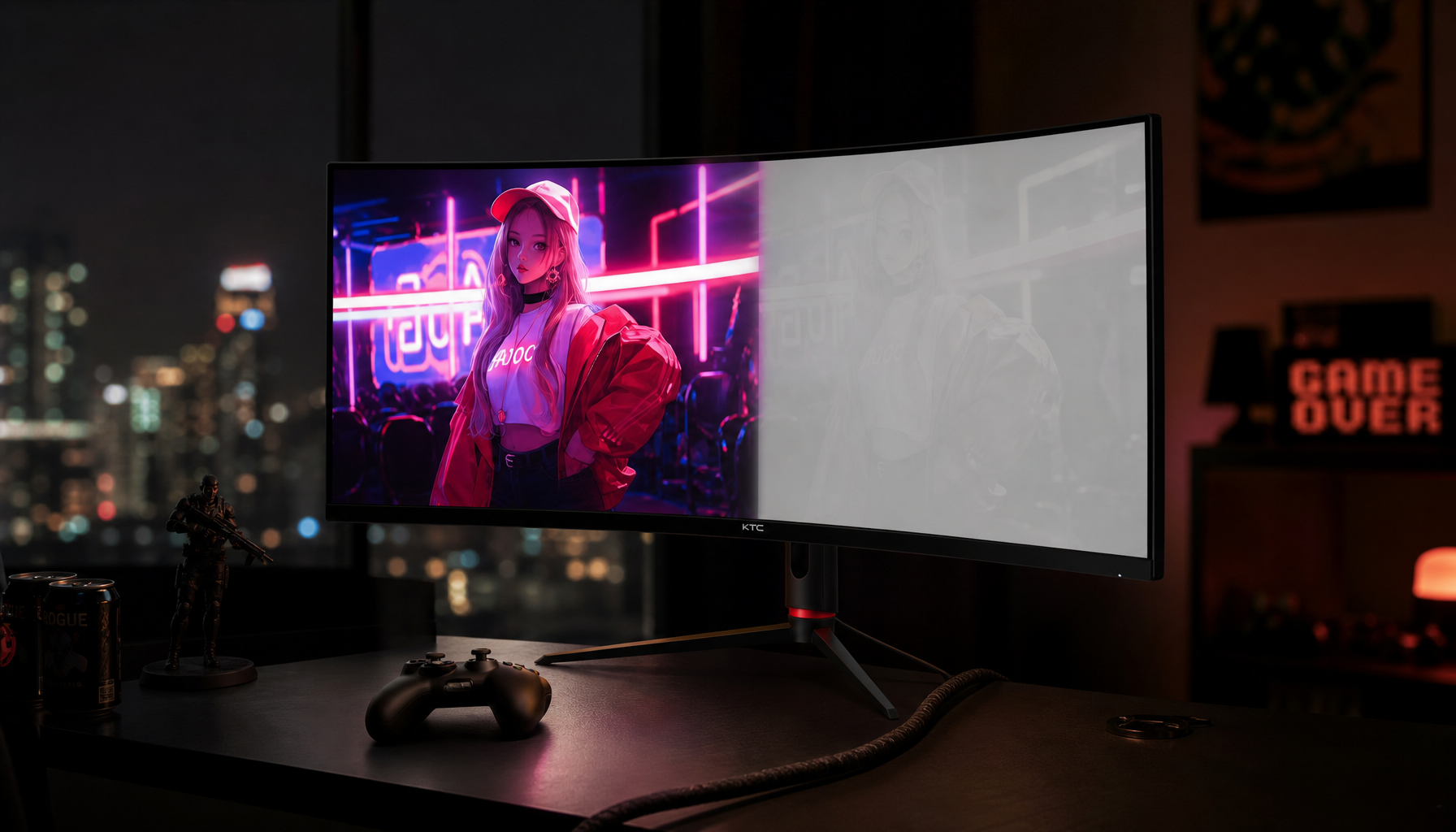
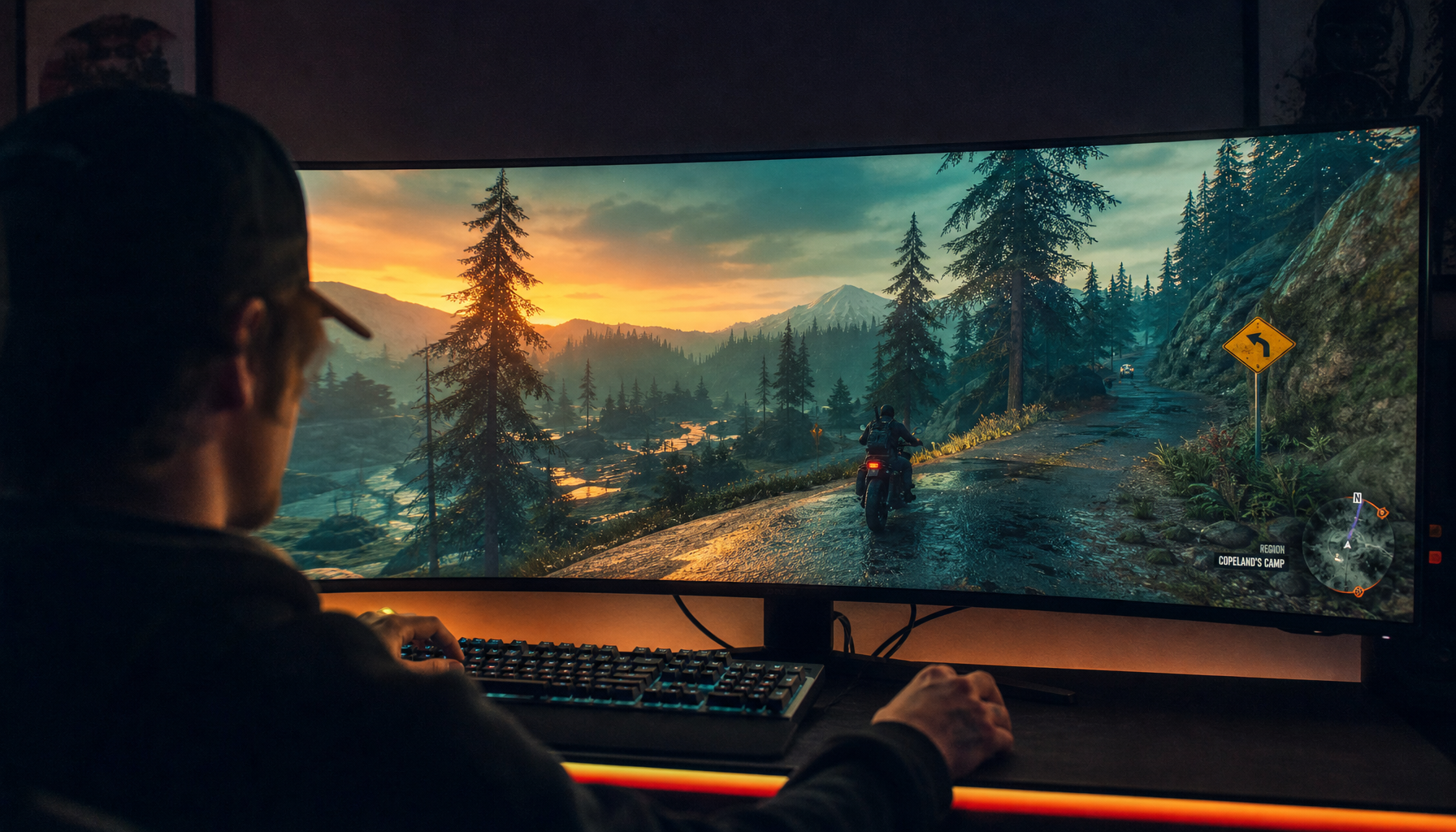
Curved monitors do not automatically cause nausea, but they can trigger it when screen motion, size, curvature, and viewing position create too much visual strain or a motion mismatch.
If you have ever switched to a new ultrawide or gaming monitor and felt fine with video but unsettled when reading text or panning through a game, you are not imagining it. Real-world reports show that discomfort can appear almost immediately on a new display, and the fix is often a combination of monitor choice, refresh behavior, and setup changes. This guide will help you sort out whether the problem is the curve itself, the monitor’s performance, or the way it is positioned on your desk.
Why nausea happens for some users and not others
Nausea from screen-based motion is commonly explained by sensory conflict: your eyes report motion, but your inner ear says your body is still. That mismatch is the same basic reason some people feel dizzy in fast first-person games, while others can use a large curved gaming monitor for hours without trouble. A curved panel can amplify that effect for sensitive users because it pulls more of the image into peripheral vision, especially during quick camera turns, racing games, or dramatic field-of-view shifts.
Curved widescreen displays can also change how your eyes focus across the panel. Research notes on visual fatigue suggest that a curved screen may reduce repeated refocusing compared with a wide flat screen, because more of the display stays at a similar focal distance. That helps explain why some buyers find curved ultrawide monitors easier on the eyes, while others react badly if the curve is too aggressive or the monitor is too large for their seating position.
A user report about an “instant headache” after switching monitors is a useful reminder that discomfort is rarely caused by just one spec. In that case, video looked good, but text was hard to focus on until brightness was reduced. That pattern fits a common buying mistake: people blame the curve first, when the actual trigger may be brightness, panel tuning, text clarity, or the jump to a different gaming-oriented display profile.
Screen size and seating position matter more than many buyers expect
Very wide monitors can push important content beyond your comfortable reading zone. One ergonomic estimate puts usable recognition vision at about 30 degrees to each side of center, or roughly 60 degrees total, before you need more head movement to read accurately. That matters for 34-inch to 49-inch ultrawide monitors, because once text and interface elements stretch too far toward the edges, your eyes and neck work harder even if the panel itself is high quality.
The same source gives a practical way to think about fit. At a viewing distance of about 35 inches, a 34-inch display spans roughly 52 degrees, while a 49-inch display spans about 78 degrees; at 28 inches, those rise to about 64 degrees and 100 degrees. For a buyer sitting close to the desk, that means a large 49-inch curved monitor may feel immersive for gaming but overwhelming for spreadsheets, coding, or web browsing.

Monitor ergonomics also affect visual comfort during long sessions. Height and tilt adjustment help keep the top of the screen around eye level and reduce the need to crane your neck or look upward for extended periods. For users who are already motion-sensitive, poor placement can make a manageable curved monitor feel much worse.
Quick fit guide for curved and ultrawide monitors
Factor |
Lower-risk starting point |
Higher-risk scenario |
Why it matters |
Screen width |
24- to 34-inch display |
49-inch ultrawide at close range |
Wider screens push more content into peripheral vision |
Viewing distance |
About 35 inches for large ultrawides |
About 28 inches or less on very wide panels |
Closer seating increases visual angle and edge strain |
Curvature |
Moderate curve such as 1800R |
Deep curve such as 1000R without proper positioning |
Stronger curves feel more immersive but can feel unnatural off-center |
Desk alignment |
Centered directly in front of you |
Sitting off to one side |
Off-axis viewing can increase distortion and discomfort |
Primary use |
Mixed work and slower games |
Fast camera motion, racing, FPS, flight sims |
Rapid motion is more likely to trigger sensory conflict |
Refresh rate, flicker, and motion quality can be the real trigger
Low refresh behavior can worsen motion discomfort by adding blur, stutter, and tearing. For motion-sensitive gamers, a jump from 60 Hz to 144 Hz or higher often makes camera movement feel more stable because the image updates more often. That does not guarantee zero nausea, but it usually reduces the visual noise that makes fast scenes feel jerky or unnatural.
A company’s eye-strain guidance recommends at least 120 Hz for long-term use, along with flicker reduction and brightness matched to ambient light. This is an important buying point for gaming monitors: a curved panel with poor motion handling can feel worse than a flat panel with cleaner updates, while a well-tuned high-refresh curved monitor may feel more comfortable than expected.
Adaptive sync features reduce tearing and stuttering by matching the monitor refresh rate to the graphics card output. In practice, that matters most when frame rates fluctuate. If your game swings between smooth and choppy motion, the problem can feel like “curved monitor nausea” even though unstable frame delivery is doing most of the damage.

Which monitor traits usually help sensitive users
Parameter |
Better for comfort |
More likely to cause trouble |
Best use case |
Refresh rate |
120 Hz to 165 Hz or higher |
60 Hz with unstable motion |
Gaming and fast desktop motion |
Adaptive sync |
Enabled |
Disabled during variable frame rates |
a platform gaming |
Flicker control |
Low-flicker or flicker-reduction features |
Noticeable flicker or poorly tuned brightness |
Long work sessions |
Resolution |
1440p or 4K on larger screens |
Lower resolution on oversized panels |
Text clarity and office work |
Response behavior |
Clean motion with low smearing |
Blur-heavy motion |
Fast games and scrolling |
The curve itself is not always the problem
Curved monitors are often described as more comfortable for long viewing because they can reduce distortion and present a wider field of view in a more uniform way. That is why many users genuinely prefer a 34-inch curved ultrawide for productivity or sim gaming. The important point is that “better” only applies when the display size, distance, and settings match the person using it.
Curve ratings such as 1800R, 1500R, and 1000R describe how deep the curve is. A smaller number means a tighter curve. For some buyers, a tighter curve helps the screen feel wrapped around their field of view; for others, especially if they sit too close or do a lot of reading, that same wraparound effect can feel visually aggressive.
High-motion content is where sensitivity tends to show up fastest. In a study using a 49-inch curved monitor and a VR headset, both display types produced physiological signs linked to cybersickness, even though the headset caused more disorientation. That does not mean curved monitors are equivalent to VR, but it does confirm that large immersive displays can provoke real symptoms in people who are already motion-sensitive.
How to set up a curved monitor to reduce discomfort
Basic display tuning still solves a surprising number of complaints. Start by lowering brightness to fit the room, setting contrast so blacks and whites look clean instead of crushed or glaring, and shifting color temperature away from a very blue presentation for long evening sessions. Buyers often leave gaming monitors in punchy showroom-style modes that look impressive for five minutes and exhausting after two hours.
Positioning the monitor directly in front of you with the top at or slightly below eye level is equally important. Curved displays are less forgiving when used off-center. If your chair, keyboard, and monitor are not aligned, the edges can look less natural and your eyes may work harder tracking across the panel.

Game settings can matter as much as monitor settings. Motion-sensitive players often do better with motion blur turned off, head bob reduced, and field of view widened into roughly the 90 to 100 range. Those changes reduce the sensation that the world is lurching around the player, which is often what triggers queasiness on a large curved gaming display.
Action checklist
- Sit centered in front of the monitor, not off to one side.
- If you use a 34-inch or larger ultrawide, increase viewing distance before blaming the curve.
- Lower brightness to match the room and avoid the default vivid mode.
- Use 120 Hz or higher when possible, especially for gaming or fast scrolling.
- Turn on adaptive sync if your system supports it.
- Disable motion blur and reduce head bob in games that make you feel uneasy.
- If symptoms continue, test a smaller or less aggressively curved monitor before upgrading again.
What to buy if you are sensitive to nausea or eye strain
A 24-inch to 27-inch monitor with at least 1080p is a practical baseline for work, and 27 inches or larger makes more sense when you need more room for multitasking. If you know you are sensitive to motion or visual overload, that moderate size range is usually safer than jumping straight to a massive ultrawide. A model like a brand’s 24.5-inch FHD 100Hz IPS monitor for work and casual gaming fits that simpler approach with a 24.5-inch FHD IPS panel and 100 Hz refresh rate, which may be easier to tolerate than moving straight to a large curved screen.
Higher resolution and cleaner text rendering help reduce visual strain, especially on larger panels. For office work, web browsing, and long reading sessions, a sharp 27-inch 1440p monitor or a carefully positioned 34-inch ultrawide is often a better comfort choice than a huge 49-inch model that dominates your full visual field.

Motion-sensitive gamers are usually better served by smoothness first: think 144 Hz or higher, adaptive sync, and low-flicker behavior before worrying about dramatic curvature. If you mainly play slower strategy games or use the monitor for productivity, the curve matters less than text clarity, ergonomics, and how the monitor fits your desk depth.
FAQ
Q: Do curved monitors cause more nausea than flat monitors?
A: Not automatically. Curved monitors can feel better for some users because they reduce edge distortion, but they can feel worse if the screen is too large, too close, or paired with fast motion and poor settings.
Q: Are ultrawide gaming monitors more likely to trigger discomfort?
A: They can be, especially at 49 inches or when you sit close to the panel. A wider screen increases peripheral motion and can push text or HUD elements farther from your natural reading zone.
Q: What should I change first if a new curved monitor makes me feel sick?
A: Start with brightness, seating distance, refresh rate, adaptive sync, and in-game motion settings. Those fixes are cheaper and more effective than replacing the monitor immediately.
Final Takeaway
Curved monitors are not inherently nausea-inducing. The real risk comes from a mismatch between immersion and comfort: a screen that is too wide for your desk, too close to your face, too aggressively curved for your habits, or too rough in motion handling for your sensitivity level.
If you are buying a monitor for long work sessions or gaming, treat comfort like a core spec. A centered setup, sensible screen size, high refresh rate, low-flicker performance, and realistic picture settings will usually matter more than whether the panel is flat or curved.