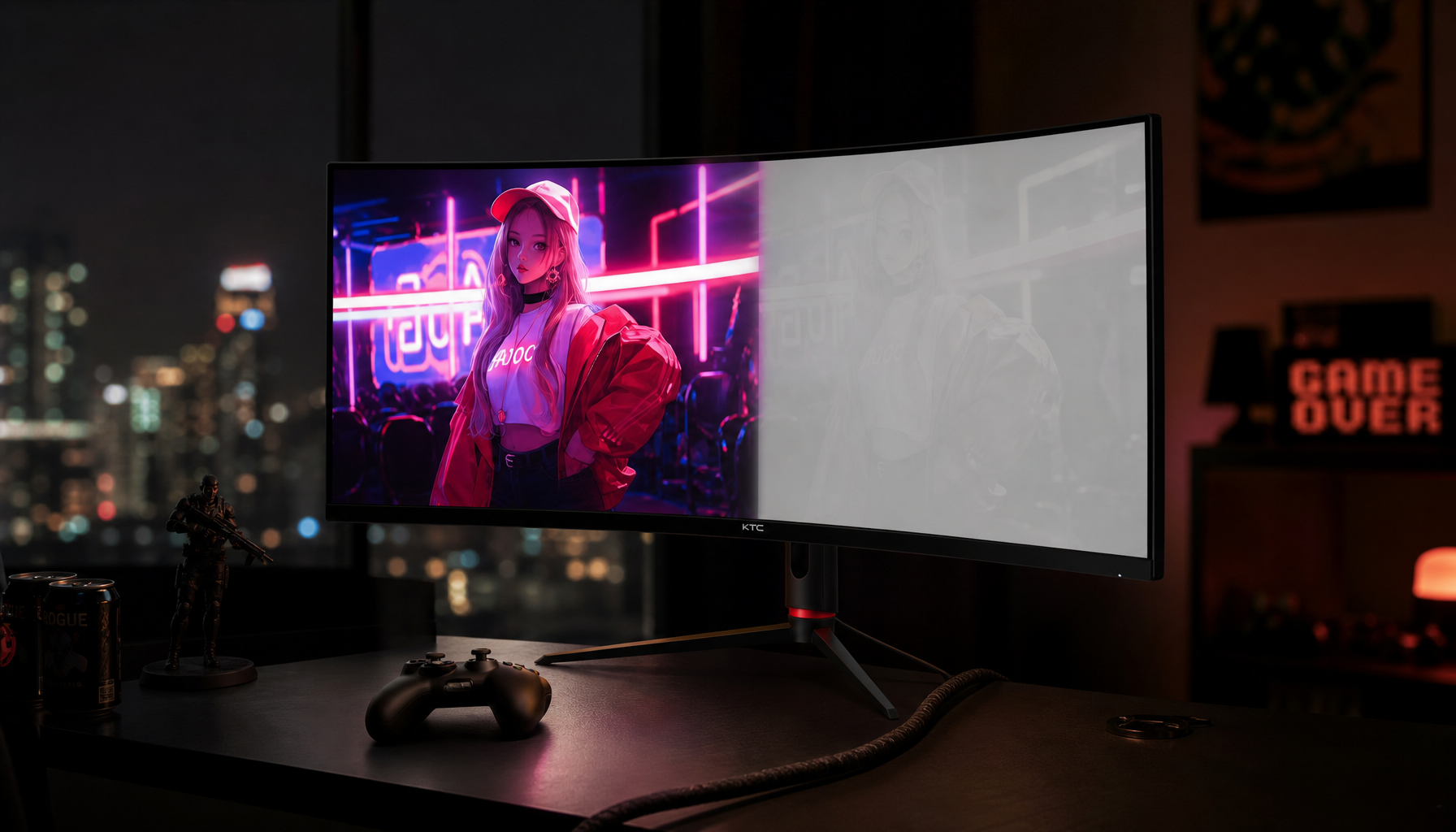
Curvature can slightly improve the feeling of depth on large displays, but it does not meaningfully improve CAD accuracy on its own. For most buyers, resolution, vertical workspace, panel quality, and GPU fit matter more than whether the screen is curved.
Ever rotate a model and feel like the side panels are fighting the viewport, or wonder whether a long straight edge only looks off because of the screen? Real users working in various CAD, 3D, and BIM platforms report that curved displays can feel comfortable and natural on larger screens, but many still prefer flat panels when line confidence matters most. You’ll get a practical buying framework for curved, flat, ultrawide, and high-refresh monitors used for 3D modeling and CAD.
What Curvature Actually Changes
It changes presentation more than precision
On large displays, curved monitors can reduce edge distortion and keep more of the screen within your field of view. That can make a 3D scene feel a bit more wrapped around you, especially on a 34-inch ultrawide or larger, but it does not add new depth cues the way stereoscopic 3D or VR would.

Because curved monitors are designed around a centered viewing position, the benefit is strongest when you sit directly in front of the display at a consistent distance. In practice, that means curvature can improve perceived spatial comfort, but it does not change the geometry of the model or make bad screen specs suddenly good.
The effect is easier to notice on larger ultrawides
In hands-on CAD discussions, a 32-inch 1000R curved monitor was reported as distortion-free in a CAD app, a 3D app, games, and general use over several years. That is useful because it shows the real-world concern is usually not “Will the curve break the software?” but “Will this size, shape, and resolution fit my workflow better than a flat alternative?”
Curvature ratings also matter. A 1000R screen is a much stronger curve than 1800R or 3800R, with the marketing label roughly corresponding to a radius of about 3.3 ft, 5.9 ft, or 12.5 ft. Mild curves tend to disappear during work; stronger curves feel more immersive, but they also raise the odds that some users will notice perspective oddities on straight lines.
Where Curved Monitors Help Most in 3D Work
Ultrawide layouts are often the bigger win
For design-heavy workflows, ultrawide monitors let you keep CAD models, tool panels, layers, and reference assets visible together. That is often the real productivity gain behind curved ultrawides: less window shuffling, fewer hidden palettes, and more room for a model plus documentation on one screen.

A curved panel can make that extra width feel easier to scan during long sessions because the edges sit closer to your eyes. For dense 3D and creative interfaces, that matters more than any claim that curvature directly improves modeling skill.
Long sessions may feel easier, but not everyone notices
A company’s monitor guidance says curvature can reduce refocusing and eye movement during long sessions. That claim lines up with why many gaming monitors and productivity ultrawides use a curve: the larger the panel, the more likely the edge-to-eye distance difference becomes noticeable on a flat screen.
A practical example comes from a 34-inch 3,440 x 1,440 ultrawide with a mild 3800R curve. The owner found the curve barely noticeable in daily use, but still appreciated the extra workspace for dense window layouts. That is a realistic expectation: on moderate curves, layout efficiency is usually more obvious than any dramatic “3D” feeling.
Where Flat Monitors Still Win
Straight-line judgment is still the main objection
In CAD communities, the most common argument against curved screens is that straight lines can feel visually bent or inclined. Not everyone sees that effect, and several professionals report no issue at all, but the concern shows up repeatedly enough that it should influence a buying decision for drafting-heavy work.

That matters most in orthographic views, 2D detailing, technical drawing cleanup, and any workflow where visual trust in long horizontal or vertical edges is critical. If your day is mostly parametric modeling, rendering, and viewport navigation, the tradeoff is easier to accept. If your day is mostly precise linework, flat remains the safer choice.
A flat 32-inch 4K panel is still the safest all-around answer
For CAD buying guidance, higher resolution, larger screens, IPS panels, and precise viewing are consistently prioritized over curvature. A 32-inch 4K monitor at 3,840 x 2,160 gives you more vertical space than a 34-inch 3,440 x 1,440 ultrawide, and that extra height often matters more for CAD drawings than extra width.

A forum discussion reinforces the same point: users repeatedly emphasized that vertical screen height matters, not just diagonal size or the marketing appeal of an ultrawide. That is why flat 32-inch 4K displays remain such a common recommendation for buyers who want one monitor to handle CAD, 3D work, and general productivity without special compromises.
The Specs That Matter More Than Curvature
Resolution and screen height come first
For CAD work, 4K resolution helps reveal detail, reduces zooming, and lowers eye strain. That makes a bigger day-to-day difference than curvature for linework, annotation density, and small UI text.
This is where many buyers make the wrong trade. A curved 34-inch 3,440 x 1,440 screen can feel impressive at first, but a flat 32-inch 4K display often shows finer detail and more usable vertical drawing area. If you spend more time drafting than arranging panels, the flat 4K option usually wins, and a flat high-resolution example like the 27-inch 4K IPS 60Hz low blue light monitor sits on that detail-first side of the comparison, even if a 27-inch panel gives you less canvas than the 32-inch class.
High refresh rate helps motion, but it is not the first priority
In BIM software discussions, gaming monitors were mainly defined by refresh rates of 120 Hz or higher, while users said the benefit for CAD was limited compared with resolution. That is the right framing for most buyers: high refresh is a nice-to-have for orbiting, panning, and occasional gaming, not the core reason to choose a monitor for design accuracy.
There is still a case for 120 Hz or 144 Hz. A company’s CAD guidance notes that higher refresh can make rotating 3D models and panning large drawings look smoother, with less visible blur and ghosting. If you split time between CAD and gaming, a high-refresh display is easier to justify. If this is a pure drafting screen, spend the budget on resolution, anti-glare coating, a good stand, and color consistency first.
Panel quality, ergonomics, and GPU compatibility decide whether the monitor is actually usable
Modern CAD-focused recommendations consistently favor IPS-class viewing, accurate color, anti-glare surfaces, and adjustable stands. A strong curve will not save a panel with weak uniformity, poor height adjustment, or bad text rendering.
GPU fit is equally practical. In one forum thread, the buyer’s graphics hardware limited the choice to 2,560 x 1,600 or 3,440 x 1,440, which changed the decision more than curvature did. Before buying a curved ultrawide or a high-refresh gaming monitor, confirm that your GPU and video outputs can actually drive the panel at native resolution and the refresh rate you want.
Which Display Type Fits Which Buyer?
On April 27, 2026, a review site’s curved-monitor testing still centered on large productivity and gaming displays, with picks like a 45-inch curved productivity display and a 38-inch curved productivity display. That says a lot about where the market sees curvature adding value: broad workspaces, replacement-for-two-monitor setups, and mixed productivity-plus-gaming desks, not niche CAD accuracy alone.
Use the table below as a buying shortcut.
Display option |
Typical strengths |
Main tradeoff |
Best fit |
32-inch flat 4K |
High detail, strong vertical workspace, safer line judgment |
Less immersive, less horizontal room for side panels |
CAD drafting, BIM sheets, mixed 2D/3D work |
34-inch curved ultrawide 3,440 x 1,440 |
Better multitasking, easier palette layout, more immersive viewport |
Less vertical space than 4K, some users dislike line feel |
3D modeling, rendering, and tool-heavy workflows |
38- to 45-inch curved productivity ultrawide |
Can replace dual monitors, large single-canvas workflow |
Expensive, needs desk depth and GPU headroom |
Power users who want one-screen command centers |
49-inch super ultrawide |
Massive width for multi-app layouts and simulation gaming |
Window management, strong curve, head movement, cost |
Advanced users replacing two displays |
16-inch portable monitor |
Easy travel companion for references, chat, or docs |
Too small for primary CAD precision work |
Secondary screen on the road, not the main modeling display |
Portable monitors still have a place, but mostly as sidecars. For modeling and CAD, they work best for reference images, email, spec sheets, or a second viewport while traveling, not as the main display where you judge detail, line quality, and panel layouts for hours at a time.
FAQ
Q: Does a curved monitor actually improve depth perception in CAD?
A: Slightly, in the sense that a large curved screen can feel more immersive and make a model easier to scan from center to edge. It does not add new geometric information, and it usually does not improve accuracy the way higher resolution does.
Q: Is a gaming monitor a good choice for 3D modeling work?
A: It can be, especially if you also game or frequently orbit complex scenes. A 120 Hz or 144 Hz refresh rate makes motion look smoother, but for most CAD buyers it should come after resolution, panel quality, and ergonomics.
Q: Should I avoid curved screens if I work with a lot of straight lines?
A: If your work is drafting-heavy and visual trust in straight edges is a top priority, flat is still the safer pick. If your work leans more toward modeling, rendering, and multitasking, a mild curved ultrawide can be a good fit.
Final Takeaway
Curvature can improve comfort and perceived depth on large or ultrawide monitors, but it is usually a secondary benefit, not the main reason a CAD or 3D workstation becomes easier to use. If you buy a curved display, buy it for workspace layout and viewing comfort, not because you expect it to make geometry more accurate.
- Choose a flat 32-inch 4K monitor if drafting accuracy and vertical screen space matter most.
- Choose a 34-inch or larger curved ultrawide if your apps are panel-heavy and you want one-screen multitasking.
- Treat 120 Hz or higher refresh as a bonus for smoother 3D navigation, not a substitute for resolution.
- Test from your normal seated position, centered on the screen, before committing to a stronger curve.
- Confirm your GPU, video output version, and laptop dock can drive native resolution at the intended refresh rate.
- Prioritize anti-glare coating, height adjustment, and panel quality before paying extra for curvature.