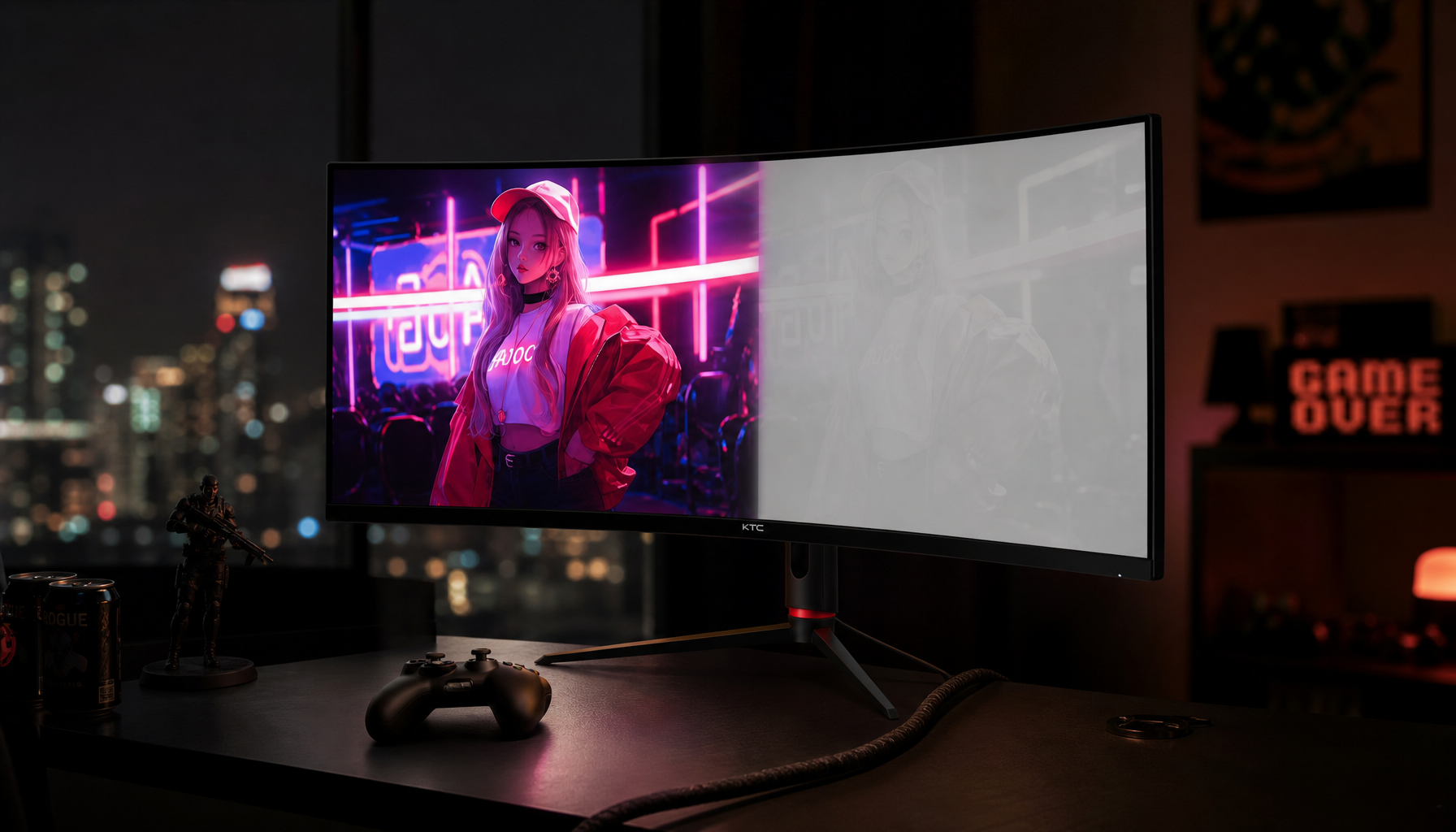
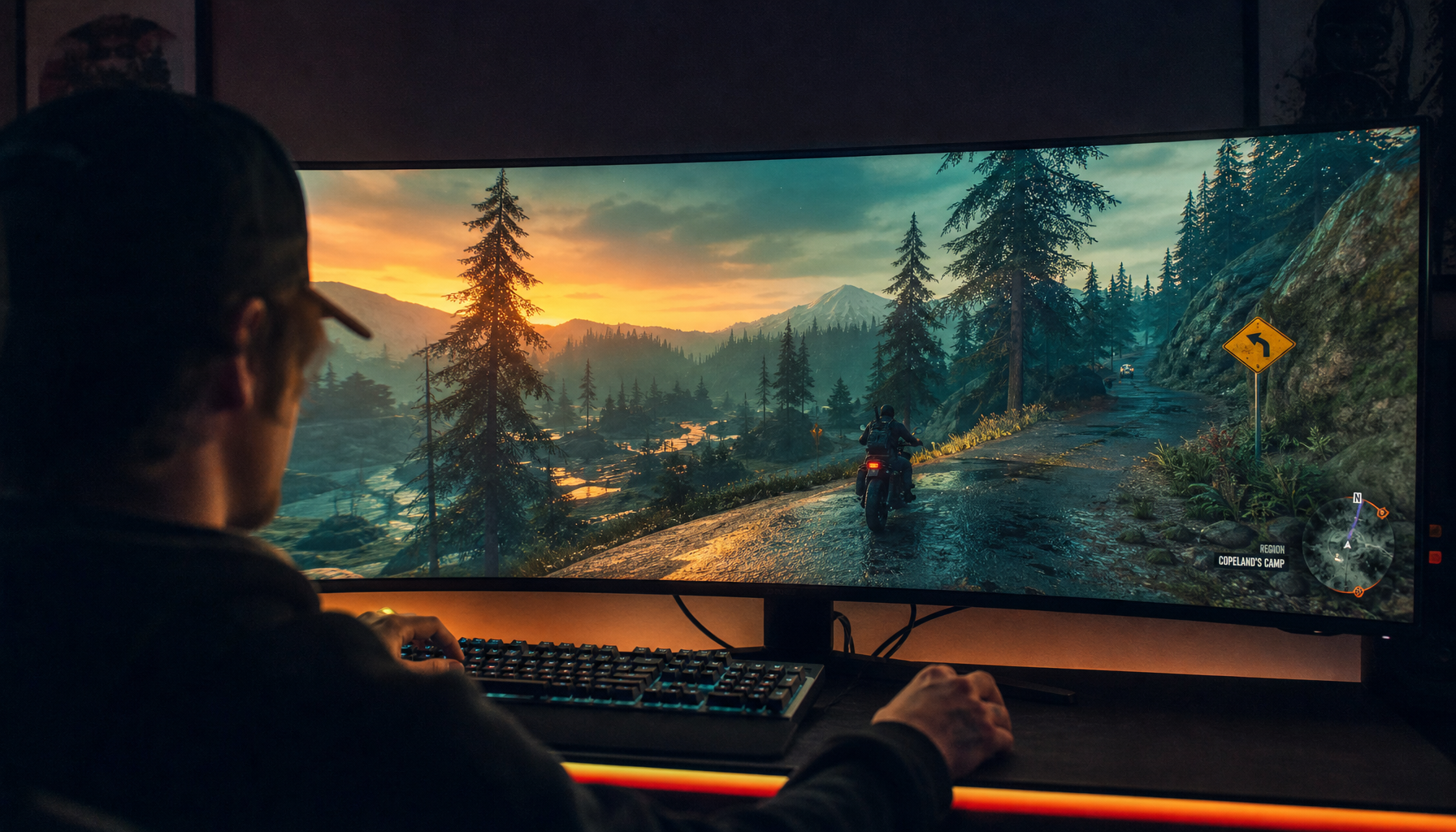
Curved monitors usually feel more immersive when ambient light is low, because the wraparound shape and deep contrast stand out more clearly. In bright offices, glare, reflections, and reduced black depth often matter more than the curve itself.
Ever notice how a curved gaming monitor feels dramatic at night, then oddly ordinary the next morning under office lights? That pattern matches what monitor brands and test labs keep finding: the strongest curved displays shine when room lighting is controlled, while bright-room performance depends much more on brightness and reflection handling. The goal is to help you decide when a curved monitor is actually worth buying, and when a flat panel is the smarter desk tool.
Dark Rooms Make the Curve Easier to Notice
Less ambient light means fewer distractions at the edges
A curved monitor brings the screen edges closer to your field of view, which is the basic reason it can feel more immersive than a flat display. In a dark room, that geometry is easier to appreciate because your peripheral vision is seeing more image and less background clutter from walls, windows, desk lamps, and paperwork.

A wider field of view and reduced edge distortion are most noticeable when you sit centered in front of a single large screen. On a 34-inch ultrawide gaming monitor, that often creates a stronger “wraparound” effect at 9:00 PM than it does at 10:00 AM in an office with overhead lighting.
Contrast matters as much as curvature
An OLED ultrawide shows its deepest blacks in a dark room, which is one reason premium curved gaming monitors feel so cinematic at night. When blacks stay black and highlights stay bright, the curve feels like part of the image instead of just the panel shape.
That same advantage weakens in brighter spaces. A review site notes that some OLED ultrawides still look excellent, but bright-room use can raise black levels, and a company’s monitor guidance also flags that deep-black performance is best appreciated in darker rooms rather than bright offices. In practice, the room lighting can change the perceived immersion almost as much as the monitor itself.
Why Larger and Ultrawide Monitors Benefit More
The curve pays off most on 21:9 and 32:9 screens
An ultrawide monitor gives you more horizontal space and a stronger immersive effect because the screen spans more of your natural viewing arc. That is why curved designs make more sense on 34-inch to 49-inch displays than on smaller 16:9 office monitors, where the edges are already close enough that the curve adds less.

A curved screen is especially associated with ultrawide formats, and that pairing is not an accident. If you are buying a high-refresh-rate display for sim racing, open-world games, or a single-screen multitasking setup, the extra width makes the curvature easier to justify. By contrast, portable monitors are usually flat for a reason: on a smaller panel used at close range, curvature rarely changes the experience enough to offset the simpler design of a flat screen.
Curvature rating changes how aggressive the effect feels
A lower R value means a stronger curve, so an 800R display is more dramatic than a 1,800R model. A brand makes the same point and suggests tighter curves for immersion, while gentler curves are often easier to live with for productivity and precision work.
A slight curve is usually the safer choice for graphics-heavy work, especially if you spend hours lining up windows, comparing documents, or checking straight edges. For most buyers, the sweet spot is not “the most curved monitor possible,” but the curve that matches the screen size and the type of work being done.
Setup |
What the curve improves |
What reduces the benefit |
Best fit |
34-inch ultrawide in a dark room |
Strong wraparound feel, better edge awareness, more cinematic gaming |
None, if you sit centered and control light |
Curved high-refresh monitor |
34-inch ultrawide in a bright office |
Some multitasking comfort |
Reflections, raised blacks, glare from windows |
Flat or gently curved bright monitor |
32-inch 4K desk monitor for office work |
Mild comfort gains |
Little added immersion on standard aspect ratio |
Flat or very gentle curve |
49-inch super ultrawide for mixed work and play |
Major peripheral coverage, fewer window switches |
Desk depth, reflections, off-center viewing |
Curved ultrawide |
Portable second screen |
Easy travel setup |
Small size makes curvature low value |
Flat portable monitor |
Bright Offices Expose the Weak Spots
Glare usually beats geometry
A bright screen and strong reflection handling matter more in well-lit rooms than raw immersion does. A review site specifically notes that even a solid work-focused ultrawide can fight glare in many offices yet still show distracting reflections in a sunny environment, which is exactly where a curved screen can stop feeling special.

A company’s office-monitor guidance reaches the same practical point from another angle: curved panels can reflect light differently, and those reflections can become more noticeable in bright environments. If your desk sits beside a window or under direct ceiling fixtures, the room can flatten the visual advantage of a curved display before the monitor’s refresh rate or contrast even gets a chance to matter.
Productivity gains often come from width, not from the bend
A curved ultrawide can absolutely help multitasking, especially if you keep chat, docs, browser tabs, and dashboards open side by side. But that does not mean the curve itself is doing all the work; often, the extra width is the real productivity upgrade.
That distinction shows up clearly in a hands-on account from an ultrawide owner, who found that multitasking improved mostly because of the ultrawide format, while the curvature could make edge text and straight lines feel awkward. That does not make curved monitors bad for work, but it does mean buyers in bright offices should separate “I want more horizontal space” from “I need a curved panel.”
When a Curved Monitor Is the Right Buy
Choose curved for evening gaming, immersion, and single-user focus
A curved screen is strongest when it fills more of your viewing arc, which is why curved gaming monitors make the most sense for one centered user, larger screens, and lower-light rooms. If you mostly play at night, want a 34-inch ultrawide at 144 Hz or higher, or like the idea of one display for both work and cinematic gaming, a curved panel is usually a smart fit. A 49-inch DQHD 180Hz 1000R curved gaming monitor such as the 49-inch DQHD 180Hz 1000R curved gaming monitor is the kind of display where the curve makes more sense for centered evening gaming than for bright office work.
A 34-inch OLED ultrawide can be excellent for both gaming and productivity, but the best experience still depends on room control. Keep direct light off the panel, sit centered, and treat the curve as a feature that works with contrast and screen size rather than replacing them.
Choose flat for bright offices, shared viewing, and flexible setups
A flat monitor remains the practical choice for basic or space-saving setups and is often the better tool when accuracy, flexibility, and easy placement matter more than immersion. That is especially true for bright office environments, dual-monitor desks, shared viewing, and portable-monitor use.

A brand also notes that viewing a curved monitor from off-center is less ideal, which matters in collaborative workspaces. If coworkers regularly gather around your screen, or if your day is mostly spreadsheets, design alignment, and browser tabs under bright lights, a flat 27-inch to 32-inch 4K display often makes the better long-term office monitor.
FAQ
Q: Do bright office lights cancel out the benefits of a curved monitor?
A: Not completely, but they can reduce them a lot. In bright rooms, glare, reflections, and weaker perceived black depth often become more noticeable than the curve.
Q: Is a curved monitor better for gaming than for office work?
A: Usually, yes. The benefits are easiest to notice in dark-room gaming, especially on 34-inch-plus ultrawide monitors with high refresh rates and strong contrast.
Q: Should I buy a curved monitor for productivity alone?
A: Only if you also want the wide-screen format and you work mostly centered in front of the display. For bright offices, shared desks, or precision-heavy tasks, flat monitors are often easier to live with.
Practical Next Steps
The easiest buying mistake is focusing on the curve first and the room second. Start with your lighting, desk position, and screen size, then decide whether curvature will actually improve how the monitor feels in daily use.
- Check your room at the time you use the monitor most: bright morning office work and late-night gaming can lead to different buying choices.
- If you want immersion, prioritize a 34-inch or larger ultrawide monitor before chasing an aggressive curve.
- If your desk gets direct sunlight, prioritize brightness and reflection handling over OLED black depth.
- If you do mixed work and gaming, target a gentle-to-moderate curve instead of the tightest R rating available.
- If eye comfort matters in evening use, consider a soft backlight behind the display; bias lighting can reduce visual fatigue and improve perceived contrast.
- If you need a travel screen or a shared office display, stay with a flat monitor.