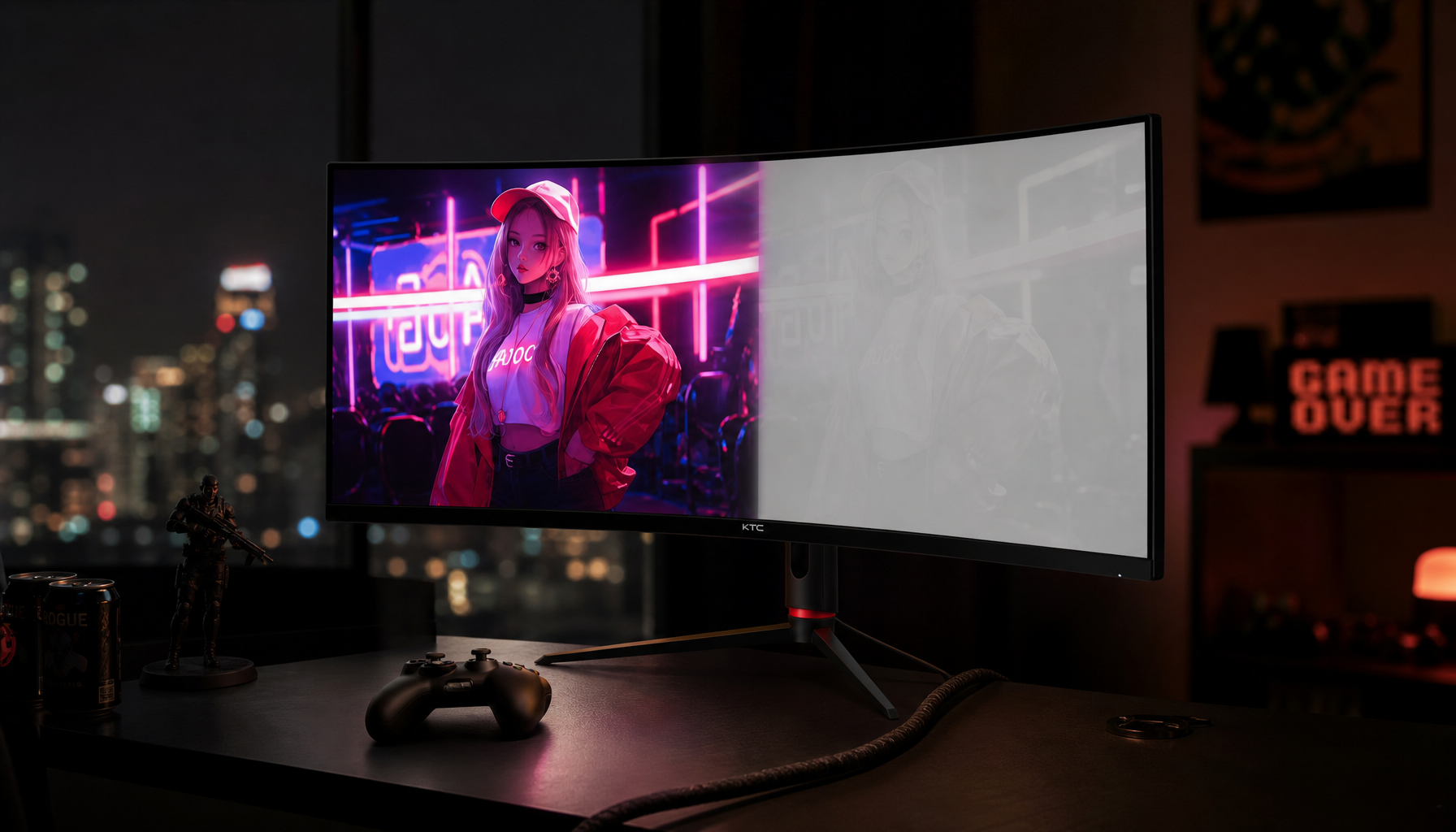
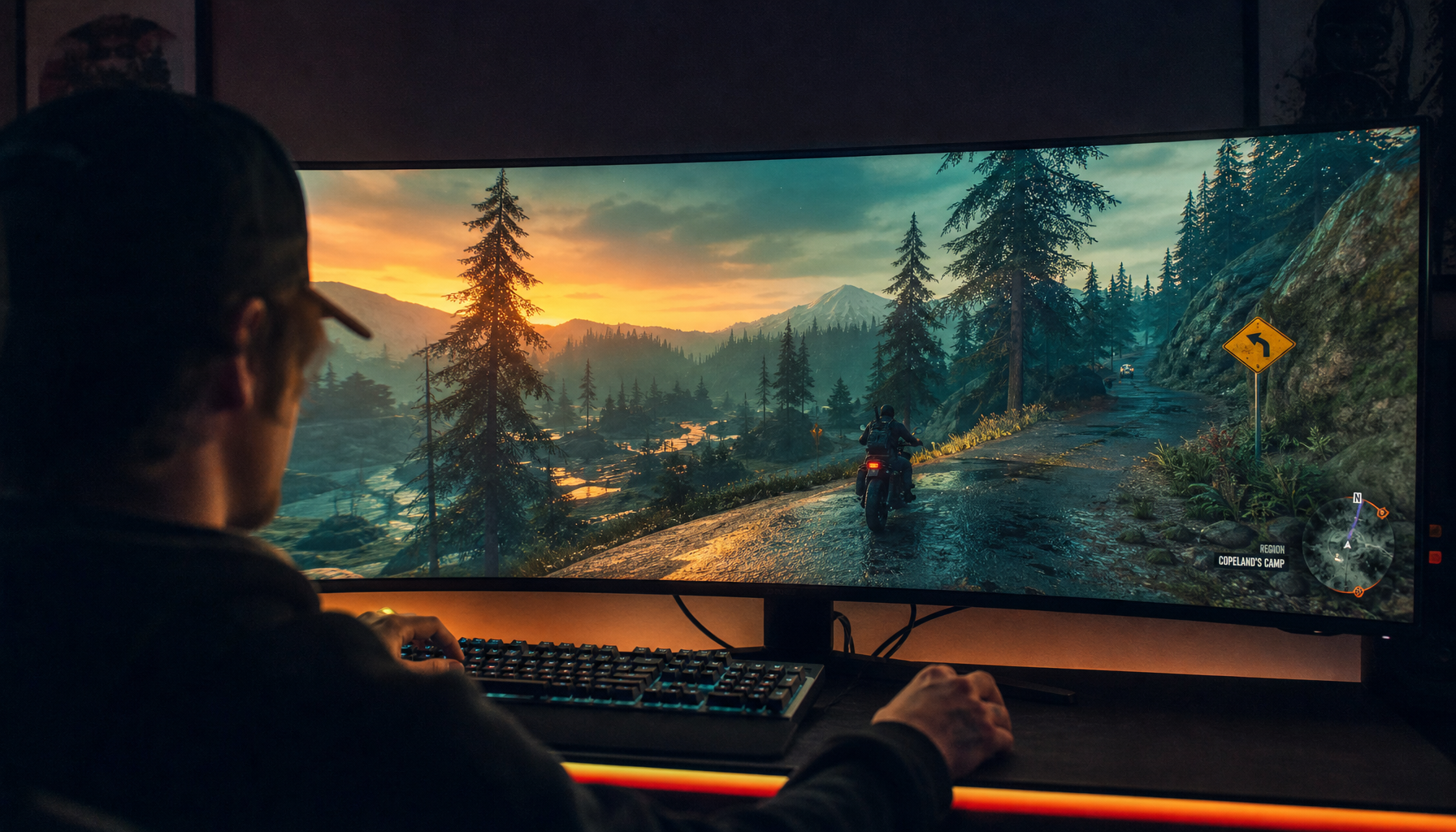
Frame rate sets how often new frames are delivered; panel response time determines whether pixels can finish changing before the next frame arrives. Smoothness feels best when FPS, refresh rate, response time, and overdrive tuning line up without blur, ghosting, tearing, or overshoot.
Frame Rate Sets the Rhythm
A 60Hz display refreshes about every 16.7 ms. A 144Hz monitor cuts that window to about 6.9 ms, while 240Hz drops it to roughly 4.2 ms, which is why higher refresh rates can make aiming, scrolling, and camera pans feel more immediate.
That does not mean the monitor creates smoothness alone. The GPU has to feed enough frames, and the display has to show them cleanly. A 240Hz screen paired with a game running at 90 FPS will not feel like true 240Hz performance.

For most gamers, 120Hz to 144Hz is the practical value zone. Competitive FPS players benefit more from 240Hz and beyond when their system can sustain it. For mixed work and play, a 27-inch 1440p high-refresh display is often a smarter balance than chasing a spec your hardware cannot drive.
Response Time Decides Motion Clarity
Response time is the speed at which pixels change color, usually measured in milliseconds. Slow pixel transitions create ghosting, where motion leaves a faint trail behind moving objects, and that becomes easier to notice in shooters, racing games, and fast desktop scrolling.

A useful target is not just “1 ms” on the box. Many gaming monitors advertise best-case gray-to-gray numbers, while real transitions vary. Published response-time specs are also not always directly comparable because testing methods can differ across brands.
For a clean experience, response time should fit the refresh window. At 60Hz, under 8 ms is usually comfortable. At 144Hz, around 5 ms or faster feels much cleaner. At 240Hz, closer to a 3 ms average is preferred. For esports, low response time matters most when it is paired with low overshoot.
When Pixels Miss the Frame Window
At 144Hz, each refresh arrives about every 6.9 ms. If a panel’s real pixel transition takes 10 ms, the old frame is still partially visible when the next frame appears, so motion looks smeared even though the FPS counter is high.

At 240Hz, the margin is tighter. A display refreshing every 4.2 ms needs very fast pixel behavior to preserve sharp motion. That is why 240Hz OLED and well-tuned Fast IPS or TN panels can feel dramatically clearer than a slower LCD panel with the same refresh number.
This is also where adaptive sync helps. Variable refresh rate support can reduce tearing and stutter when GPU output does not perfectly match the monitor, and monitor buying advice often treats adaptive sync support as a key part of smooth gameplay.
A faster overdrive mode can reduce blur, but if pushed too hard it may create inverse ghosting, which looks like bright or dark halos around motion.

How to Choose for Gaming, Work, and Portable Screens
For competitive play, prioritize refresh rate, real response performance, low input lag, and stable FPS. A 1080p or 1440p 240Hz monitor can be more useful than 4K if it lets your PC hold higher frame rates consistently.
For immersive games, flight sims, productivity, and creator-adjacent work, do not sacrifice everything for raw speed. Resolution, contrast, color quality, panel type, and screen size shape comfort and visual depth. A 1440p 144Hz to 180Hz IPS monitor with a solid 4 ms to 5 ms response time can feel excellent for both work and play.
For portable smart screens and office displays, response time matters less unless you game or edit motion-heavy content. In those cases, prioritize USB-C convenience, brightness, ergonomics, and panel quality first; then look for at least 75Hz to 120Hz if you want smoother scrolling and light gaming.
The best smoothness upgrade is not the biggest number. It is the display that lets your system deliver consistent frames while the panel keeps up cleanly.