Coronas on Fast IPS monitors usually come from pixel overdrive overshoot: the panel pushes pixels too hard to hit faster response times, then passes the target color and leaves bright or tinted trails.
Why Fast IPS Can Show Halos
Fast IPS panels are built to keep IPS color and viewing-angle strengths while improving motion speed, often targeting 1ms-class gray-to-gray response times. That speed comes from aggressive liquid-crystal tuning, and Fast IPS displays still rely on a backlight and liquid crystals rather than self-emissive pixels.
The problem is that not every color transition is equally fast. A gray-to-gray spec may look excellent on the box, but real scenes include dark-to-light, light-to-dark, and saturated color changes that behave differently.
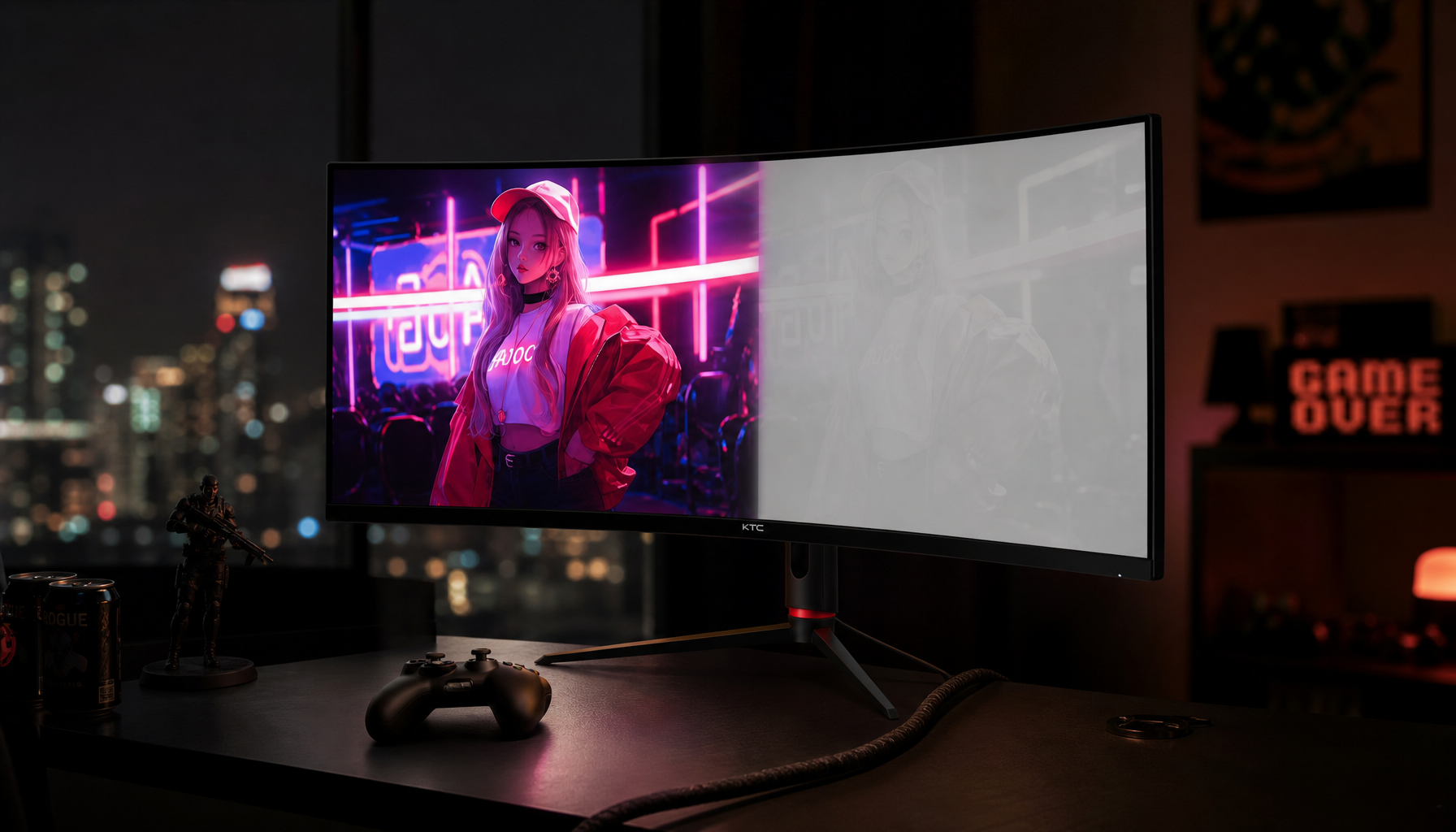
When overdrive is too strong, a pixel does not stop exactly where it should. It overshoots, then corrects itself, which can appear as a pale glow, colored edge, or inverse ghost around a moving enemy, cursor, motion-test object, or high-contrast HUD marker.

Overdrive: The Main Trigger
Overdrive is the monitor setting often labeled Response Time, OD, Fast, Faster, Extreme, or similar. Its job is to apply extra voltage so pixels change state faster.

Used well, overdrive reduces blur and classic ghosting. Pushed too far, it creates coronas. That is why the fastest setting is not always the best setting. Many Fast IPS monitors look cleaner on Normal or Fast than on Extreme, especially at 144Hz, 165Hz, 240Hz, or with variable refresh rate enabled.
Quick tuning steps:
- Start with the middle overdrive mode.
- Test a high-contrast moving object.
- Avoid modes that add bright or colored trails.
- Recheck at your actual game refresh rate.
- Keep VRR and V-Sync settings consistent while testing.
A small amount of blur is often preferable to a sharp but glowing outline, especially in competitive shooters where edge accuracy matters.
Refresh Rate and Response Time Must Work Together
Refresh rate controls how often the monitor receives a new frame. Pixel response controls how quickly each pixel completes its transition. Both affect motion clarity.
For example, 240Hz refreshes every 4.17 ms, while 144Hz refreshes every 6.94 ms. If a pixel transition takes too long, it can spill into the next frame; if overdrive forces it too hard, it can overshoot and form a corona.
That is why a high-refresh Fast IPS panel can still show artifacts. IPS is often better than VA for fast motion because modern IPS transitions are generally quicker and more consistent, while VA panels often prioritize contrast and may smear darker transitions; IPS panels are commonly favored for competitive FPS clarity.
Test patterns exaggerate flaws on purpose, so a visible corona in a motion test may be less obvious in a textured game scene.
Halos Are Not Always Panel Overshoot
Do not confuse Fast IPS coronas with Mini-LED blooming. Blooming happens when a backlight dimming zone lights a larger area than the bright object needs, making small highlights glow on dark backgrounds. Mini-LED can improve HDR, but local dimming zones can still create halo effects around cursors, subtitles, stars, and HUD elements.

There is also a human-vision side. If halos appear around real lights, across multiple screens, or while driving at night, the cause may be optical rather than display-related; halos and glare can come from refractive issues, dry eyes, cataracts, or other eye conditions.

How to Reduce Coronas on a Fast IPS Monitor
The best fix is usually better settings, not a new screen.
Use the overdrive mode that matches your actual refresh rate. If you play with VRR across a wide frame-rate range, avoid the most aggressive overdrive preset unless your monitor has well-tuned variable overdrive.
Lowering brightness slightly can also make bright overshoot less visible in dark rooms. If your monitor has a backlight strobing mode, test it separately because strobing can improve perceived clarity but may add flicker, reduce brightness, or change overdrive behavior.
For buyers, prioritize independent motion testing over headline specs. A balanced Fast IPS monitor should deliver clean response behavior, stable VRR, strong color, and comfortable brightness without forcing you into an artifact-heavy Extreme mode.