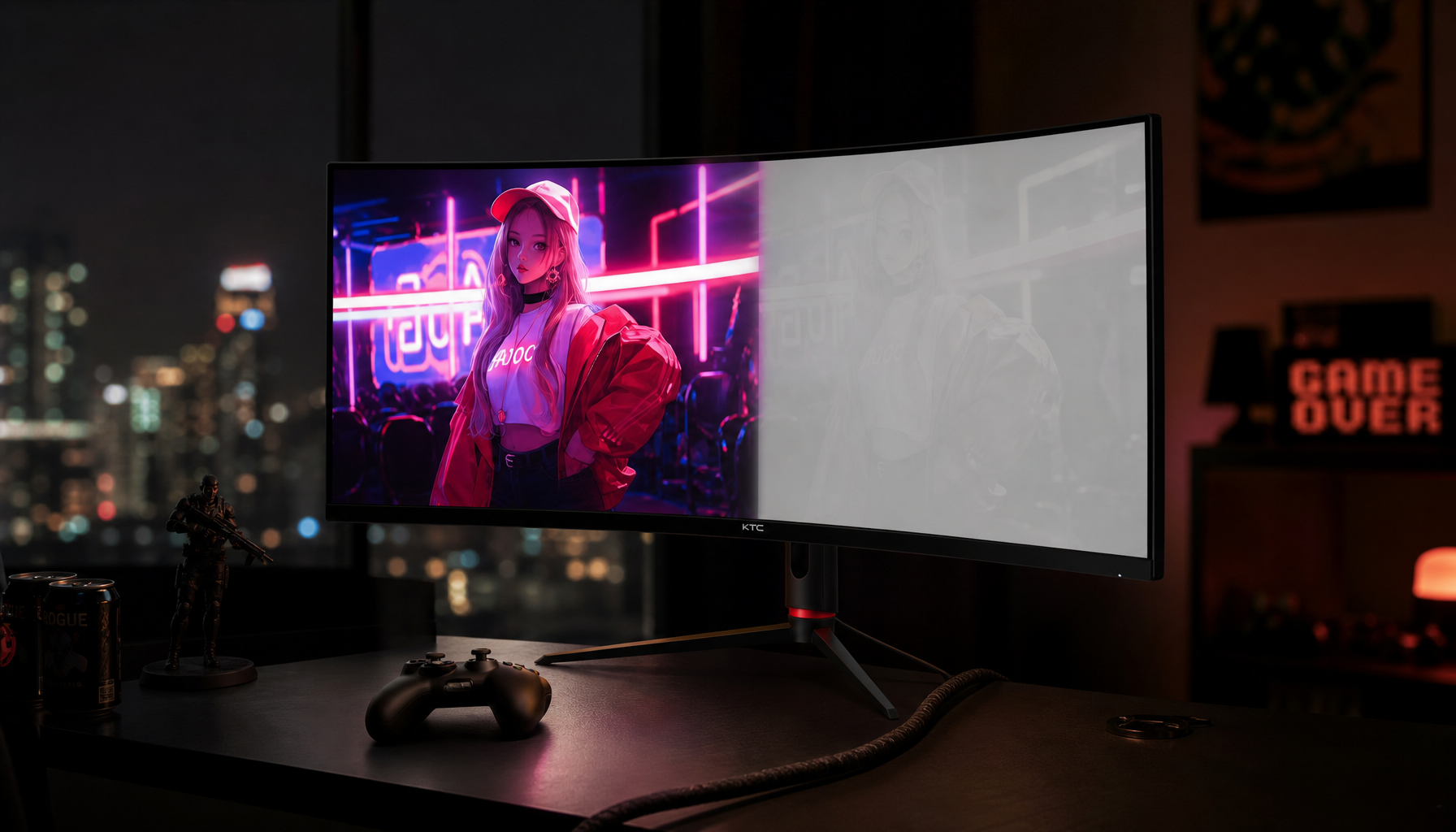
Motion blur reduction lowers brightness because the display deliberately shows each frame for less time, usually by pulsing or blanking the backlight. Less visible light time means less total light reaching your eyes, so the whole screen looks dimmer.
Does your game look razor-sharp in motion blur reduction mode, but suddenly feel like someone turned the monitor down two brightness steps? On real gaming desks, the practical effect is easy to test: text, crosshairs, and fast camera pans become clearer when frame delivery is stable, but comfort depends on whether the room and monitor have enough brightness headroom. Here is why the dimming happens, when it is worth using, and how to tune it without wrecking visibility.
The Core Mechanism: Less Light Time Means Less Brightness
Motion blur reduction, often labeled MBR or backlight strobing, reduces blur by shortening how long each frame is visible. A normal LCD is a sample-and-hold display: it holds a frame on screen until the next one appears. That hold time is a major reason motion looks smeared when your eyes track a moving target.

A high refresh rate monitor already helps because it updates the image more often, making motion smoother and reducing blur. At 60 Hz, a frame lasts about 16.7 ms; at 240 Hz, it lasts about 4.2 ms. Motion blur reduction goes further by making the backlight visible for only part of that refresh window, then darkening it between frames.
That dark interval is the brightness penalty. If a backlight is visible for roughly half as long, the perceived full-screen brightness can drop substantially because your eyes receive less total light over time. The exact loss depends on the monitor’s backlight power, strobe pulse width, refresh rate, panel transmission, firmware tuning, and whether the manufacturer allows brightness compensation.
Why the Whole Screen Gets Dimmer, Not Just Moving Objects
The brightness loss affects the entire screen because most LCD motion blur reduction works through the backlight, not through individual moving pixels. The monitor is not detecting an enemy model, your mouse cursor, or a scrolling spreadsheet and dimming only those areas. It is pulsing the light source behind the whole LCD panel.
This is why a static desktop, a game menu, and a white document all look dimmer when MBR is enabled. The blur reduction system changes display timing globally. The pixels may still hold the same colors, but the light passing through them is shown for a shorter slice of each refresh cycle.
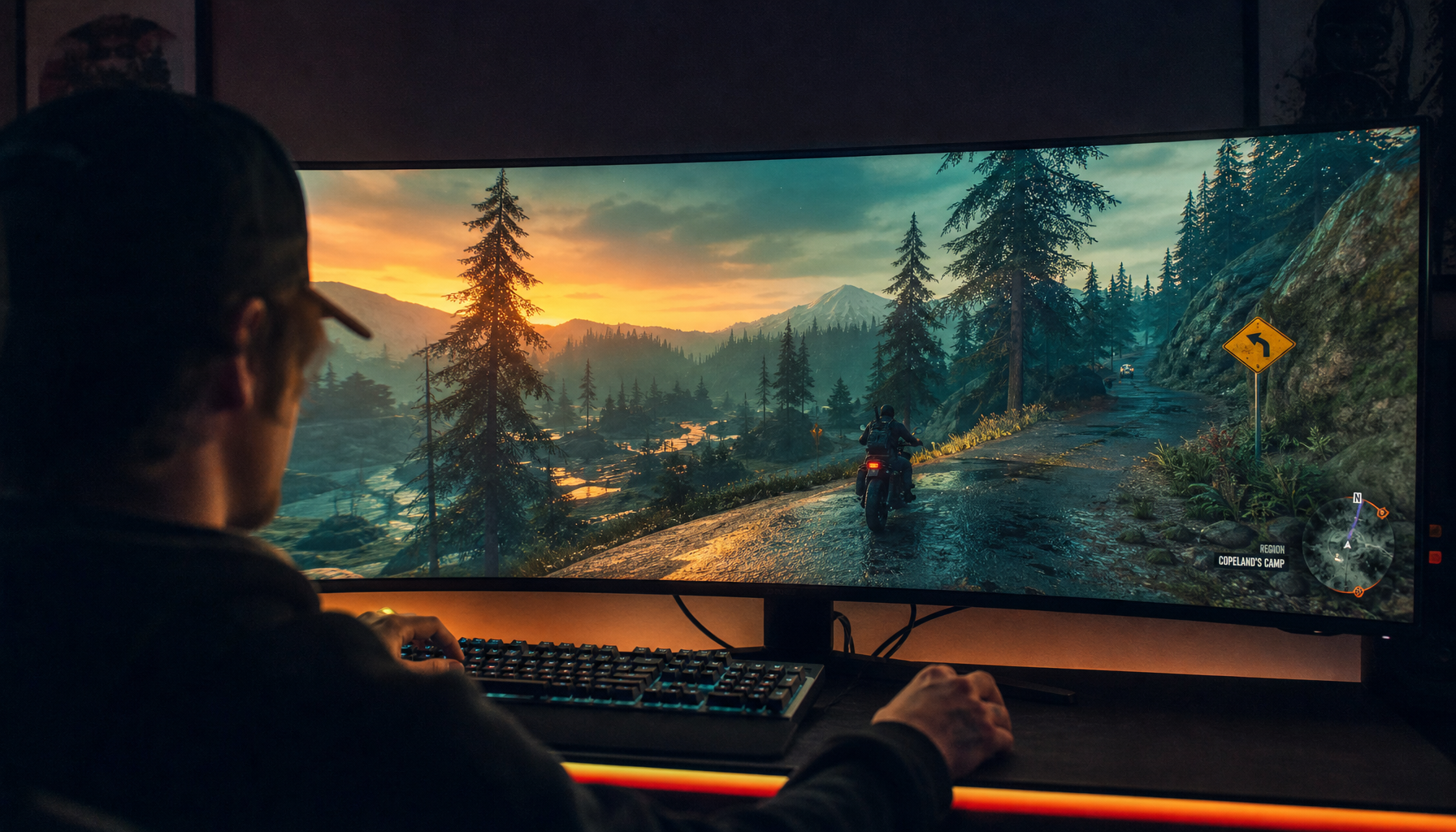
This also explains why large monitors and ultrawides can make the tradeoff more obvious. A 21:9 workspace gives you more horizontal room for windows, timelines, or racing-game scenery, and extra horizontal screen space can be productive and immersive. But when the full panel dims, that larger field of view makes the reduced luminance harder to ignore, especially in bright rooms.
Motion Blur, Ghosting, and Brightness Are Different Problems
Motion blur reduction is often misunderstood because several motion artifacts get grouped together. Motion blur is perceived smearing during movement. Ghosting is a trail or shadow caused by slow pixel transitions. Inverse ghosting is the bright or dark halo that appears when overdrive is pushed too far.
A temporary display artifact like ghosting usually points to pixel response behavior, panel type, or overdrive tuning rather than a lack of backlight strobing. That distinction matters because MBR can reduce sample-and-hold blur while doing little for bad dark-level transitions on a slow VA panel. In some cases, it can even expose poor pixel behavior more clearly because the image is sharper between pulses.
Issue |
What You See |
Main Cause |
Best First Fix |
Sample-and-hold blur |
Smooth smearing while tracking motion |
Frames stay visible too long |
Higher refresh rate or MBR |
Ghosting |
Faint trails behind objects |
Slow pixel response |
Tune overdrive or choose a faster panel |
Inverse ghosting |
Bright halos or overshoot |
Overdrive set too aggressively |
Lower overdrive |
Full-screen dimming |
Entire image looks darker |
Backlight pulse time is reduced |
Raise brightness, adjust room light, or disable MBR |
Why Higher Refresh Rates Still Matter
A brighter MBR experience usually starts with a monitor that has refresh-rate headroom. At 144 Hz, the display has less time per refresh than at 60 Hz, and at 240 Hz it has less time again. That shorter frame window means the strobe timing must be precise, and the panel must finish pixel transitions quickly enough before the backlight pulse.
A gaming monitor can still show motion blur or ghosting even in 2026 because real performance depends on panel type, refresh rate, pixel response, overdrive, and backlight behavior. The box may say “1 ms,” but your eyes care about the full system: frame pacing, pixel transition speed, strobe timing, and brightness reserve.
For example, a 240 Hz display refreshes every 4.2 ms. If the monitor uses a very short pulse to make motion clearer, the image can look dramatically sharper, but the backlight may be visible for only a fraction of that 4.2 ms window. That is excellent for tracking a fast target in a shooter, but it can feel too dim for a sunlit office or a bright game scene.

Why MBR Often Disables VRR
Many monitors make you choose between variable refresh rate and motion blur reduction. VRR adjusts refresh timing to match changing frame output. MBR needs predictable timing so the backlight pulse happens at the right moment after pixel transitions settle.
Variable refresh rate is useful for reducing tearing and improving smoothness, but it does not automatically reduce blur. If your game fluctuates between 170 FPS and 230 FPS on a 240 Hz monitor, VRR may feel smoother. If your game can hold a locked 240 FPS, MBR may deliver cleaner motion.
For competitive play where frame rate is stable, MBR can be worth the dimmer image. For cinematic games, unstable frame rates, or mixed work and gaming, VRR usually feels more reliable.
How to Tune MBR Without Making the Screen Miserable
Start by testing MBR in the environment where you actually use the monitor. A setting that looks perfect at night can look weak beside a window at noon. Brightness comfort is not about keeping the screen permanently low; screen brightness should match surrounding light so your eyes are not fighting either glare or an image that is too dim.

Raise the monitor brightness after enabling MBR, then check whether whites still look clean and whether dark scenes remain readable. If the monitor offers strobe intensity or pulse width, a longer pulse usually gives more brightness with slightly more blur, while a shorter pulse gives sharper motion with more dimming. That is the core tradeoff, and there is no universal best setting.
Next, tune overdrive while MBR is on. Medium or balanced overdrive is often the cleanest starting point. Too little overdrive leaves trails; too much creates overshoot halos. Use a familiar game scene with fast lateral motion, a scrolling text test, or a high-contrast motion test if available. The right setting is the one that keeps edges clear without adding bright artifacts.
Finally, control the room. A monitor that is barely bright enough with MBR enabled will feel better with glare reduced, a desk lamp moved off-axis, or the screen tilted slightly away from reflections. Home-office ergonomics guidance commonly recommends a slight backward tilt and an arm’s-length viewing distance around 20 to 24 inches, and eye-care features become more important when you spend long sessions switching between work and play.
When Motion Blur Reduction Is Worth the Brightness Loss
MBR is most valuable when motion clarity directly affects performance. Competitive shooters, rhythm games, racing games, fast side-scrollers, and any game where you track moving objects benefit most. If you can hold a stable frame rate at the monitor’s strobed refresh rate, the clarity gain can be immediate.
For office productivity, MBR is usually less important. A 24- to 27-inch office display with good resolution, ergonomic adjustment, and comfortable brightness often matters more than strobing. Mainstream business monitor guidance favors practical traits such as IPS image quality, USB-C, ergonomic stands, and warranties, while basic 27-inch panels often serve multitasking better than a blur-reduction mode you rarely use.
For hybrid users, the best setup is mode-based. Keep a bright, color-consistent profile for documents, spreadsheets, design review, and video calls. Use MBR only for games where motion clarity matters enough to justify the dimmer image. System color tools can also help maintain consistency across supported displays, since auto color management is designed to keep color behavior more reliable across apps.
Buying Advice: Look for Brightness Headroom and Real Reviews
If you care about MBR, do not buy based only on “1 ms” claims. Look for independent measurements or user reports that mention strobe brightness, crosstalk, overshoot, and whether MBR works at the refresh rates you plan to use. A monitor can have high peak brightness in normal mode but still look weak when strobing is enabled.
Panel choice matters too. Fast IPS and OLED tend to be safer bets for motion clarity than slow VA, although a well-tuned VA can still be excellent for contrast-focused immersive gaming. TN remains fast but sacrifices image quality compared with modern IPS and OLED options. For work-first buyers, at least 1080p resolution and adjustable ergonomics may deliver more daily value than aggressive blur reduction.
For a performance-driven purchase, think in use cases. A 24- or 25-inch 240 Hz display is practical for esports. A 27-inch 1440p fast IPS monitor is a strong all-rounder. A large ultrawide is immersive for racing, flight, and productivity, but any weakness in motion handling or strobe brightness becomes more visible across that bigger canvas.
The Smart Tradeoff
Motion blur reduction dims the whole screen because it reduces the time the backlight is visibly on. That is not a defect; it is the cost of cleaner motion on most LCD gaming monitors.
Use MBR when stable high FPS and motion precision matter more than brightness. Leave it off when you need maximum luminance, VRR smoothness, accurate desktop work, or all-day eye comfort. A great display is not the one with every mode enabled; it is the one tuned to the task in front of you.