









Some panels show mura or dirty screen effect because tiny physical variations in the display stack create uneven brightness, tint, or texture. Solid gray, white, sky-blue, and spreadsheet-like backgrounds expose those fixed imperfections because there is little image detail to hide them.
What You Are Seeing
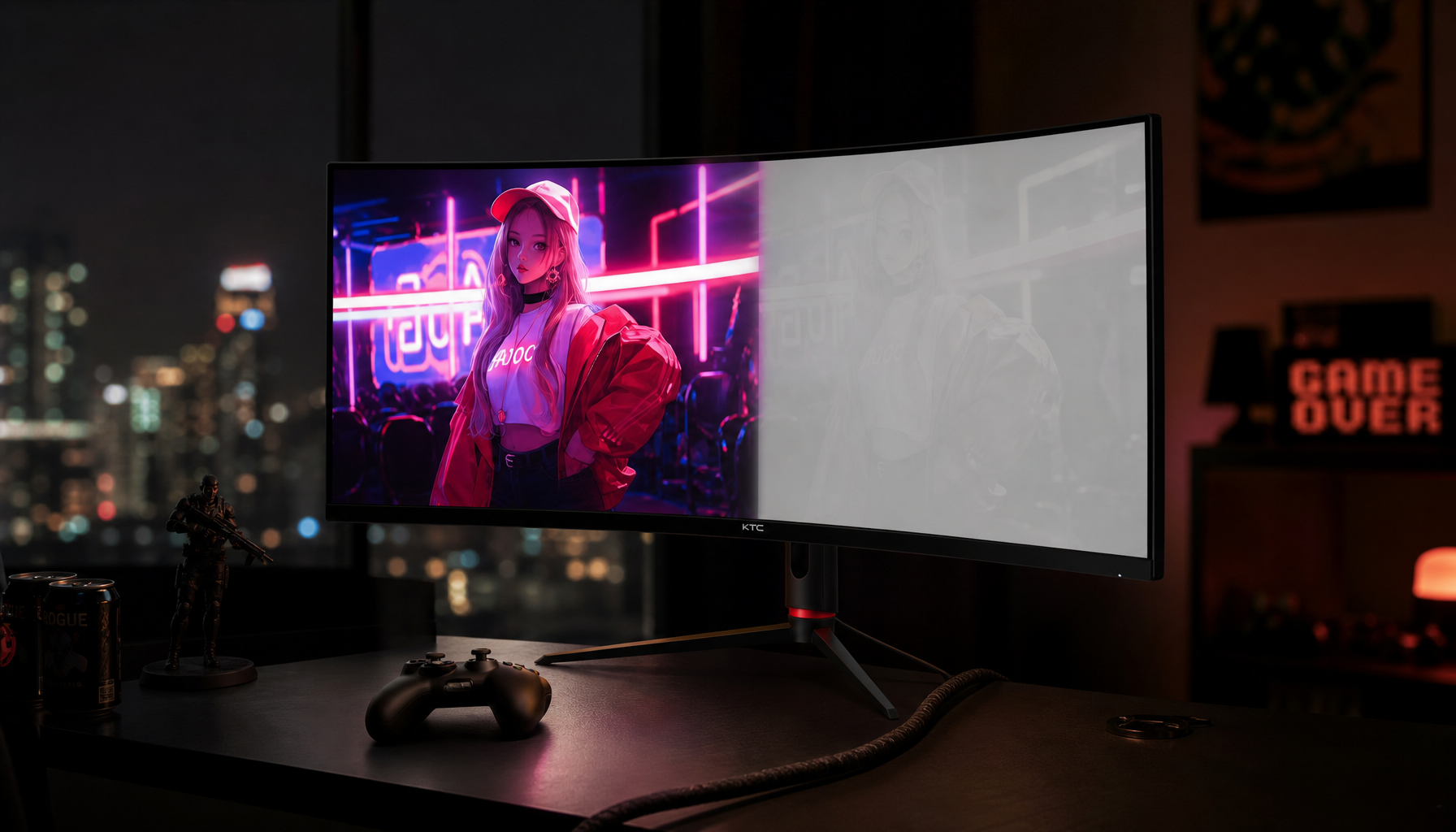
Mura is panel unevenness: faint clouds, streaks, bands, patches, or color shifts that stay in the same screen location. Dirty screen effect, or DSE, is the user-facing version of that problem, where a clean screen looks smudged during flat-color scenes.

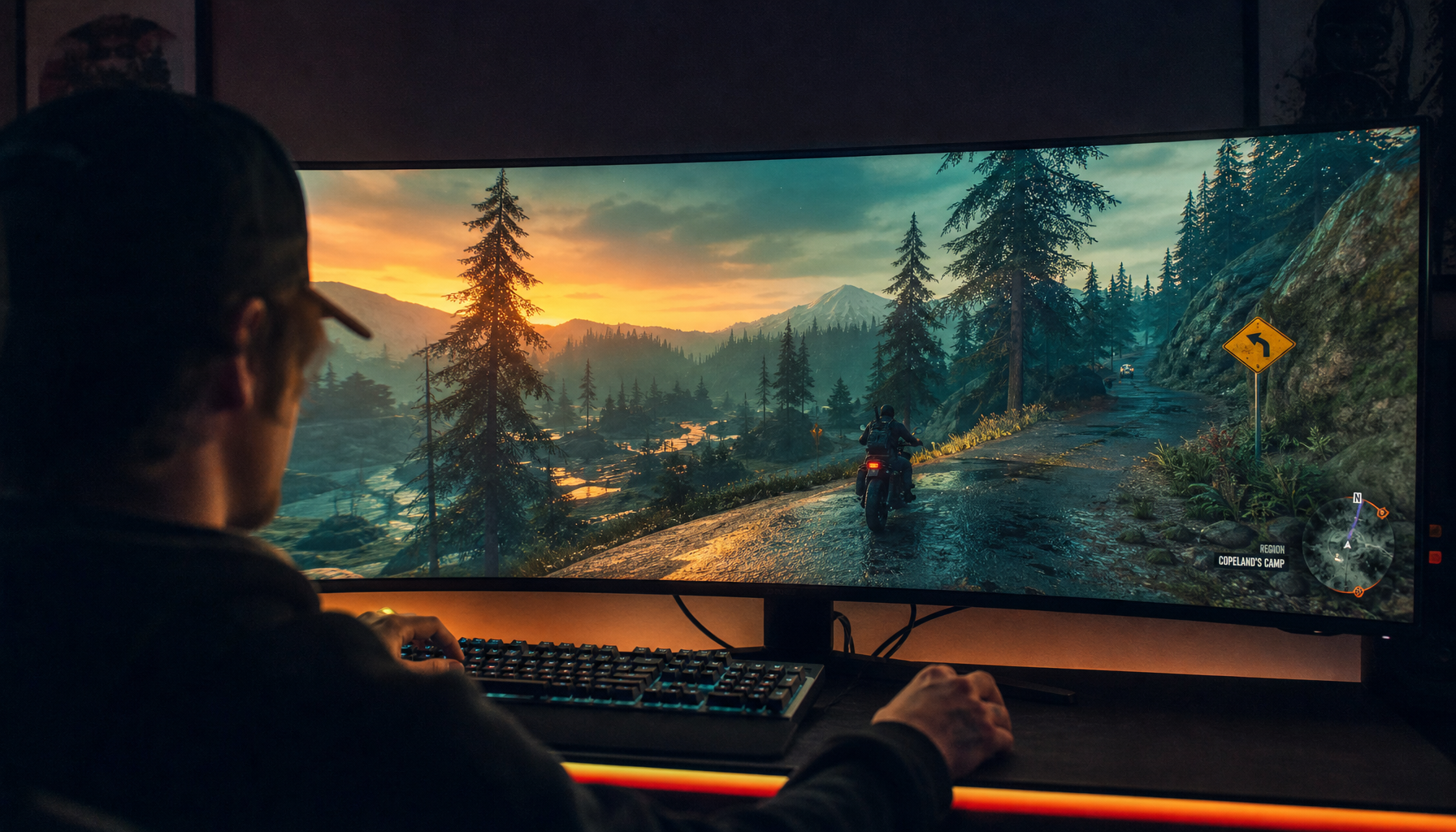
On productivity displays, you may notice it in documents, design canvases, dashboards, or gray app backgrounds. On gaming monitors, it often appears during skyboxes, racing games, sports fields, fog, snow, or slow camera pans.
The key behavior is position. If the mark stays fixed while content moves, it is likely panel uniformity, not a graphics artifact, bad cable, or software overlay.
Why Solid Colors Reveal It
LCD and Mini-LED monitors are layered systems: backlight, diffusers, optical films, polarizers, liquid crystals, coatings, and electronics all have tolerances. Small differences in those layers can create uneven screen uniformity, especially in mid-gray tones where the eye is highly sensitive to contrast.

Common causes include non-uniform backlighting, diffuser variation, liquid crystal alignment differences, assembly pressure, shipping stress, heat, and coating texture. Industrial LCD discussions also point to mechanical stress from bezels, screws, vibration, or warped mounting frames.
OLED avoids traditional backlight DSE because each pixel emits its own light, but it is not automatically perfect. OLED and QD-OLED panels can still show tinting, vertical banding, near-black unevenness, or maintenance-related artifacts.
A faint uniformity pattern can be normal panel variance, while obvious blotches that distract during real work or gameplay are a different buying decision.
Why It Varies From Unit to Unit
Two monitors with the same model number can look different. Panel manufacturing is precise, but not identical at the microscopic level, and final uniformity depends on the full module, not just the panel spec sheet.
That is why premium pricing lowers risk but does not guarantee perfection. User reports around premium displays show that even a replacement unit may still have visible zebra-like shadow patterns, though sometimes less severe than the first sample.
Bigger screens also make uniformity harder. A 32-inch 4K productivity display, a 49-inch ultrawide, or a large Mini-LED gaming monitor gives your eyes more flat area to scan, so low-contrast defects become easier to spot.

For buyers, this is the “panel lottery” in practical terms: the model matters, but the specific unit in front of you matters more.
How to Test Without Overreacting
Test like you actually use the display. A lab-style gray slide can reveal every weakness, but the buying question is whether the defect interrupts your real workflow or immersion.
- Show 50% gray, white, and light blue full screen.
- Sit at your normal viewing distance, not inches away.
- Check SDR and HDR separately if you use both.
- Pan a flat image or game camera slowly.
- Compare another input, cable, and device if possible.

Lower brightness can make some mura less noticeable, especially on desktop monitors used all day. Also disable aggressive dynamic contrast, local dimming extremes, or black-enhancement modes during testing so the monitor is not adding its own uneven behavior.
Can You Fix It?
Usually, true mura or DSE cannot be fully fixed at home because the root cause is physical. Calibration may reduce visibility, but it cannot realign liquid crystals, flatten a diffuser, or undo pressure marks.
For LCDs, practical mitigation means matching brightness to the room, avoiding unnecessary maximum backlight, improving ambient lighting, and keeping heat under control. LCD support notes that mura can involve dark spots or patches and is tied to display uniformity rather than surface dirt.
If the panel is new and the issue is visible in normal games, office apps, or creative work, document it quickly and use the return or warranty window. For a performance display, uniformity is not a cosmetic extra; it is part of the experience you paid for.


%20and%20mura%20are%20terms%20for%20panel%20unevenness,%20creating%20faint%20clouds,%20streaks,%20or%20patches%20on%20your%20monitor.%20This%20guide%20explains%20why%20it%20happens%20on%20solid%20colors,%20what%20causes%20it%20in%20...
)