Standard mode usually does not create black crush by itself. It often removes the extra contrast, gamma shaping, and image “pop” that Vivid mode used to hide a weak near-black setup.
You switch your gaming monitor from Vivid to Standard, load a dark map or a night cutscene, and suddenly the floor, walls, and enemy outlines all merge into one dark mass. Owners of some monitors from a brand and a company have reported that exact pattern in real testing, especially when checking near-black patches instead of bright demo clips. You can use that behavior to figure out whether the problem is a simple preset mismatch, a signal-path issue, or a deeper panel or firmware limitation.

What Vivid and Standard Actually Change
Presets are changing more than brightness
On many monitors, picture presets do far more than raise or lower brightness: they often alter color temperature, gamma or contrast enhancement, edge enhancement, and motion or image processing. That matters on gaming monitors, ultrawides, and even portable monitors because the preset is not just a “look.” It changes how the display maps dark steps near black, which is exactly where shadow detail lives.

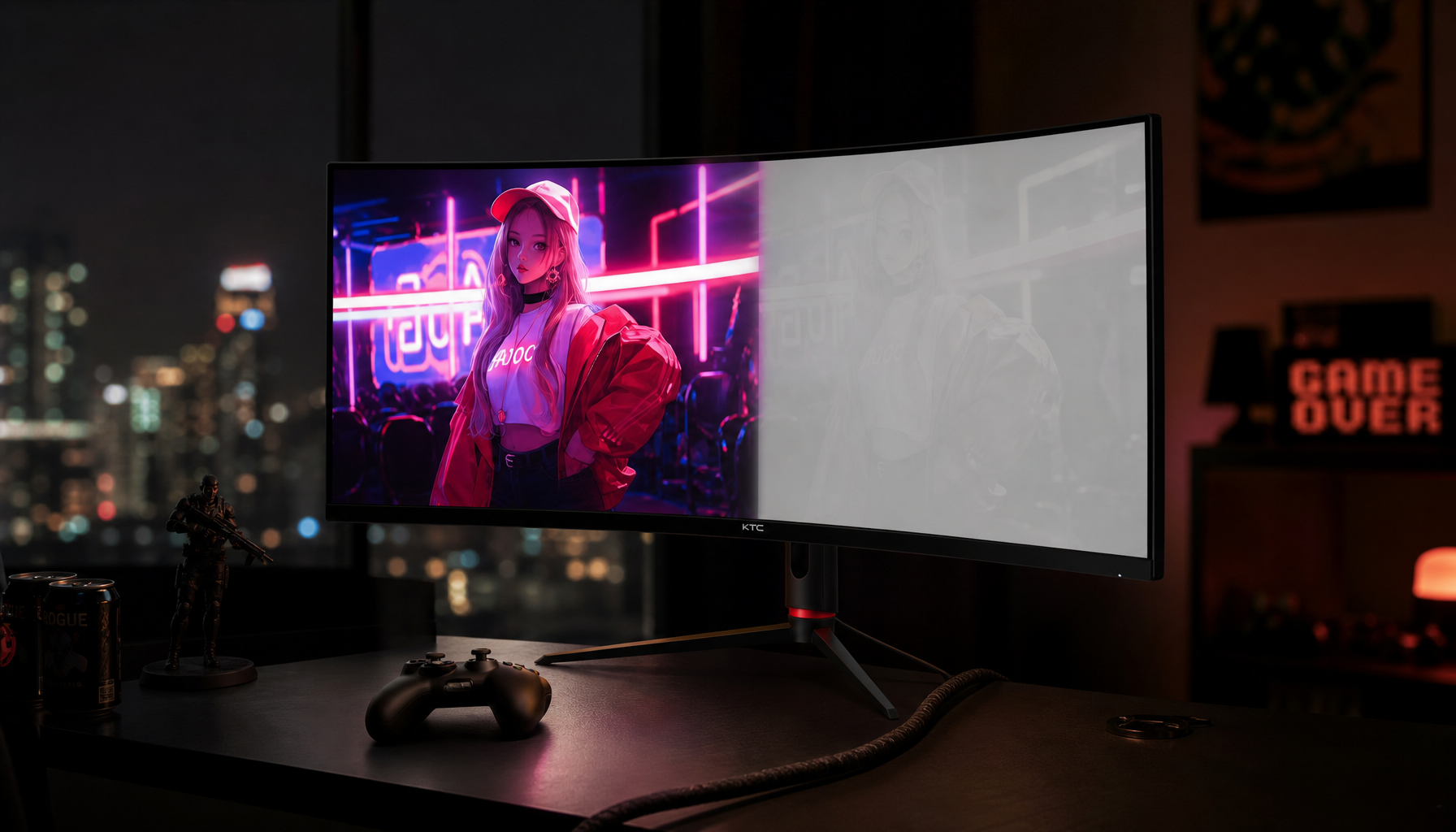
A Vivid or Dynamic-style preset is typically tuned to look impressive on a showroom floor or in a bright room. In practice, that usually means a cooler white point, more aggressive brightness, and stronger contrast. On some displays, that makes dark areas appear more dramatic; on others, it lifts the low end enough that hidden detail looks easier to see, even if the image is less accurate overall.
Why Vivid can make the image look “better” at first
A one-month Vivid-mode test found that the preset pushed brightness, contrast, saturation, and extra processing hard enough to make the picture look punchier immediately. The tradeoff was weaker black quality: dark scenes looked grayer, letterbox bars looked grayish, and blooming around subtitles became more visible. On a monitor, the same basic tradeoff can fool you into thinking Vivid has “better detail,” when it may only be making dark tones brighter or less accurate.
Standard mode usually strips away some of that exaggeration. When it does, the monitor stops flattering the image and starts showing the real behavior of its gamma curve, black floor, and signal mapping. That is why switching away from Vivid can feel like something broke, even when Standard is actually closer to a neutral baseline.
Why Standard Mode Makes Black Crush Easier to Notice
Near-black detail is supposed to be subtle
A calibration-forum discussion of black crush gives a useful reality check: on a gamma 2.2 display, RGB 5,5,5 corresponds to a relative luminance of just 0.0175 out of 100. In plain terms, the first few steps above black are naturally hard to see, especially in a bright room, on a glossy panel, or when your screen is far brighter than your environment. If Vivid mode was boosting those steps, Standard mode can make the display’s real low-end behavior obvious.
A monitor setup baseline used in production work explains why gamma matters so much here. Gamma 2.4 and BT.1886 are both common reference targets for displays in dim rooms, but BT.1886 intentionally lifts the first few steps above black to make shadow detail more visible. If your monitor is locked to a different curve in Standard mode, or if Vivid was effectively lifting shadows through enhancement, the switch can expose lost detail instantly.
“Fixing” black crush the wrong way often hurts contrast
The same calibration-forum thread warns that adding black output offset does not improve native shadow capability. It only adds black and lowers contrast ratio. That is why brute-force fixes such as cranking black level controls, shadow sliders, or brightness until every dark patch is visible can leave a gaming monitor looking washed out.
The goal is not to make every near-black patch scream for attention. The goal is to make the first step above black faintly visible while keeping black itself black. That distinction is the difference between a calibrated monitor and one that looks flat, hazy, or low-contrast.
How to Tell Whether the Problem Is Settings, Signal Range, or the Panel Itself
Test SDR and HDR separately
A user report about one monitor shows why you should never assume one result covers both SDR and HDR. In that case, the user reported severe black crush in dark content, but when HDR was enabled and monitor contrast was set to 67%, all black-level test squares became visible. With HDR off, only box 8 and above were visible unless a shadow-enhancement setting was set to 1. That points to different near-black handling in the SDR and HDR pipelines, not just a vague “bad panel.”
The same thread also shows why gaming monitor troubleshooting can become confusing fast. The user tried factory reset, multiple PCs, multiple ports, a digital input, 120 Hz, 10-bit color, driver reinstalls, and an HDR calibration tool, yet the behavior still changed by mode. If Standard mode looks worse than Vivid, test both SDR and HDR before touching advanced controls, because the display may be mapping them differently.

Some monitors really do have firmware or panel-level limits
A recent black-crush discussion about one monitor is a good example of a case that did not disappear with ordinary tweaking. The reported setup was already fairly disciplined for SDR use: a gaming preset, shadow enhancement off, Brightness 60, Contrast 80, sRGB, 6500K, Saturation 50, Gamma 2.4, and firmware MCM104. Even then, dark-room shadow tests still showed crushed near-black squares, and changing brightness, contrast, gamma, or color space did not fully solve it.
That kind of case matters for buying guidance. If a gaming monitor or ultrawide still crushes near-black detail after a clean baseline setup, the problem may be in the panel’s low-end mapping or firmware behavior rather than your settings. Buyers who care about dark-scene games, horror titles, or movie playback should treat shadow-detail complaints as a serious review criterion, not a minor nit.
Signal-path problems can look like panel problems
A hardware-forum monitor artifact thread is a reminder that some display issues only show up on the physical screen and not in a screenshot. In that case, the user photographed dark borders and shadows around UI elements on a monitor running at native 2560x1440 over a changed connection path. That is not the same symptom as black crush, but it is the same diagnostic lesson: if the panel looks wrong and a screenshot does not capture it, suspect monitor processing, cable behavior, port choice, or source output settings.
A Reliable Baseline for Gaming, Ultrawide, and Portable Monitors
Start with a neutral setup, not with rescue tweaks
A practical calibration starting point is to begin from the monitor’s defaults, keep contrast at its default value, select the correct preset, manually target about 6500K, and aim for roughly 120 cd/m² if you are in a typical indoor room. That advice matters because users often trust OSD bars that appear centered even when the display is far off target; one example in the same discussion showed a white point around 8000K and brightness near 320 cd/m² despite “centered” adjustments.

A production-monitor baseline points to Rec. 709, D65, and gamma 2.4 or BT.1886 as a more defensible starting point than random preset surfing. On a gaming monitor, that usually means choosing a Custom, Creator, sRGB, or similar preset instead of Vivid, FPS, RTS, or a vendor-specific enhancement mode. On a portable monitor with fewer controls, it means leaving contrast alone, disabling dynamic contrast if available, and making sure the source device is not sending the wrong RGB range.
Raise backlight for room conditions, not contrast for fake detail
The same calibration guidance notes that very high screen brightness in a very dark room can increase eye strain and fatigue. That matters because users often respond to darker Standard mode by pushing every brightening control at once. A better approach is to set room-appropriate backlight or brightness first, then judge near-black detail after your eyes adapt for a minute or two.
If you mainly play in a bright apartment during the day, Standard may need more luminance than it does at night. That does not mean you need Vivid’s contrast tricks. It means you should raise panel light output to fit the room while keeping the monitor’s contrast and gamma behavior stable.
Which Modes and Features Matter Most When Buying
Compare the mode behavior, not just the spec sheet
A broad picture-mode comparison shows why “more vivid” is rarely the same as “more accurate.” For monitor buyers, the most important question is whether the display offers one preset that avoids unnecessary enhancement and one set of controls that lets you fine-tune gamma, color temperature, and black behavior without breaking SDR or HDR.
Mode or feature |
What it usually changes |
Shadow-detail effect |
Best use |
Main risk |
Vivid / Dynamic |
Higher brightness, cooler white, stronger contrast, extra processing |
Can make dark detail seem easier to see or can turn blacks gray |
Very bright rooms, store-like environments |
Inaccurate color, eye strain, unstable near-black behavior |
Standard |
Moderate brightness and contrast, fewer extremes |
Often reveals the monitor’s real near-black performance |
General desktop and mixed use |
Can expose black crush that Vivid was masking |
Lower processing, fixed color target, more neutral gamma |
Usually the most honest view of shadow detail |
Content work, buying evaluation, serious setup |
May look dim or flat until the room and brightness are adjusted |
|
HDR preset |
Separate tone mapping and black handling |
May improve or worsen near-black depending on firmware |
HDR games and video |
SDR and HDR can behave very differently on the same monitor |
Features worth prioritizing before you buy
A recent firmware-centered black-crush case shows why firmware history belongs on your monitor checklist. If shadow detail is important, look for a model with a documented Creator or sRGB mode, adjustable gamma, a shadow-control feature that can be disabled cleanly, and user reports covering both SDR and HDR. That is especially important on some high-end gaming monitors, where near-black tuning can vary a lot by firmware.
A discussion of Vivid mode and display lifespan also reinforces a simpler buying rule: do not confuse a maxed-out showroom preset with display quality. Long term, you want a monitor that looks right without running brightness and contrast near their extremes. That usually means a better baseline preset, not a louder one.
FAQ
Q: Why does HDR sometimes show more shadow detail than SDR on the same monitor?
A: Some monitors use a different near-black mapping path in HDR. The one-monitor example showed all black-level test squares visible in HDR at one setting, while SDR still hid the lowest steps. That does not mean HDR is automatically better; it means SDR and HDR need to be checked separately.
Q: Should I raise contrast to fix black crush after leaving Vivid mode?
A: Usually no. Default contrast is the safer starting point because excessive contrast can clip highlights and distort low-end tone mapping. Raise panel brightness for room light first, then verify near-black detail with a test pattern.
Q: How do I know whether the issue is a defect instead of a bad setup?
A: If you have reset the monitor, used a neutral preset, matched white point near 6500K, kept default contrast, verified the signal path, and tested more than one source or cable, persistent crushed near-black detail can point to firmware or panel behavior rather than user error.
Practical Next Steps
If Standard mode suddenly makes your monitor look worse, do not switch back to Vivid and call it solved. Use Standard, sRGB, Creator, or Custom mode as the diagnostic baseline, then test near-black behavior in both SDR and HDR.
Set brightness for your room, leave contrast at default, target 6500K, and try gamma 2.4 or BT.1886 if your monitor offers them. If the first visible black patch still starts far too high, the problem may be a real limitation of that monitor’s firmware or panel mapping, which is exactly the kind of issue worth factoring into a gaming monitor, ultrawide, or portable monitor purchase.