Screen size can affect what you notice at the edges of the screen, but it does not automatically make you react faster. For competitive play, the best results usually come from matching monitor size to viewing distance and prioritizing refresh rate, response time, and low input lag.
If you have ever lost a duel because the minimap, kill feed, and a flank angle all demanded your eyes at once, your monitor may be part of the problem. Competitive displays still cluster around 24 to 27 inches and 240Hz to 360Hz because players need enough screen area to track motion without turning every edge check into a longer scan. You will get a practical way to choose the right gaming monitor size, format, and speed for your desk and game type.
What Screen Size Actually Changes
Motion Detection at the Edges
In actual matches, peripheral vision is strongest for motion and shape detection rather than fine detail, so a larger gaming monitor can help you notice movement near the edges without guaranteeing a faster confirm-and-shoot response. That same field-of-view explainer notes that color recognition drops noticeably around 30 degrees off center, which fits the common experience of seeing a flank first and identifying it second.
For monitor buying, screen size does not automatically make someone a better gamer. What it really changes is how much of the display sits inside your natural field of view at your normal desk distance. If the screen gets bigger but your seating position does not change, you often gain scale at the cost of more eye travel, and that can erase any theoretical edge in reaction-heavy play.

Identification Still Happens Near the Center
A larger panel can make enemies, HUD elements, and map detail look easier to read, but competitive reactions still depend on how quickly you can bring important information back into central vision. That is why many players feel the difference between a 24-inch and 27-inch display more as a scanning issue than a reflex issue.
This is also why standard 16:9 esports monitors remain so common. They keep the action compact enough that edge information, crosshair focus, and UI checks happen within a smaller visual sweep, which is often more useful than simply making the screen larger.
Viewing Distance Decides Whether Size Helps
The Field-of-View Target
In current sizing guidance, a monitor should fill about 30 to 45 degrees of your field of vision, which is why 22- to 25-inch screens are usually recommended at about 20 to 30 in away, while 27-inch screens fit better around 24 to 36 in. That is the practical rule most players miss: a 27-inch monitor can feel fast and natural if your desk is deep enough, but the same panel can feel visually crowded on a shallow setup.
That geometry also explains why 32-inch and larger displays are more divisive in competitive play. They can work well when you sit farther back, but they become harder to scan efficiently if you stay at the same close-up distance you used with a 24-inch or 25-inch screen.

What Players Notice in Real Setups
Anecdotal player testing from a forum’s discussions on FPS monitor size lines up with that geometry. One player preferred a 23.8-inch 240Hz monitor from a brand because even about 1 inch less screen felt noticeable, another reported better consistency and top 1% to 5% accuracy or headshot stats after moving to a 27-inch 144Hz monitor, and another suggested sitting about one screen diagonal away, or roughly 27 in from a 27-inch display.
Those forum reports are not lab studies, but they are useful because they show the real tradeoff competitive players feel at a desk. A size change can help when it improves readability without forcing extra eye movement, and it can hurt when it pushes important information too far into the corners.
Standard 16:9 vs Ultrawide for Competitive Play
When Ultrawide Helps
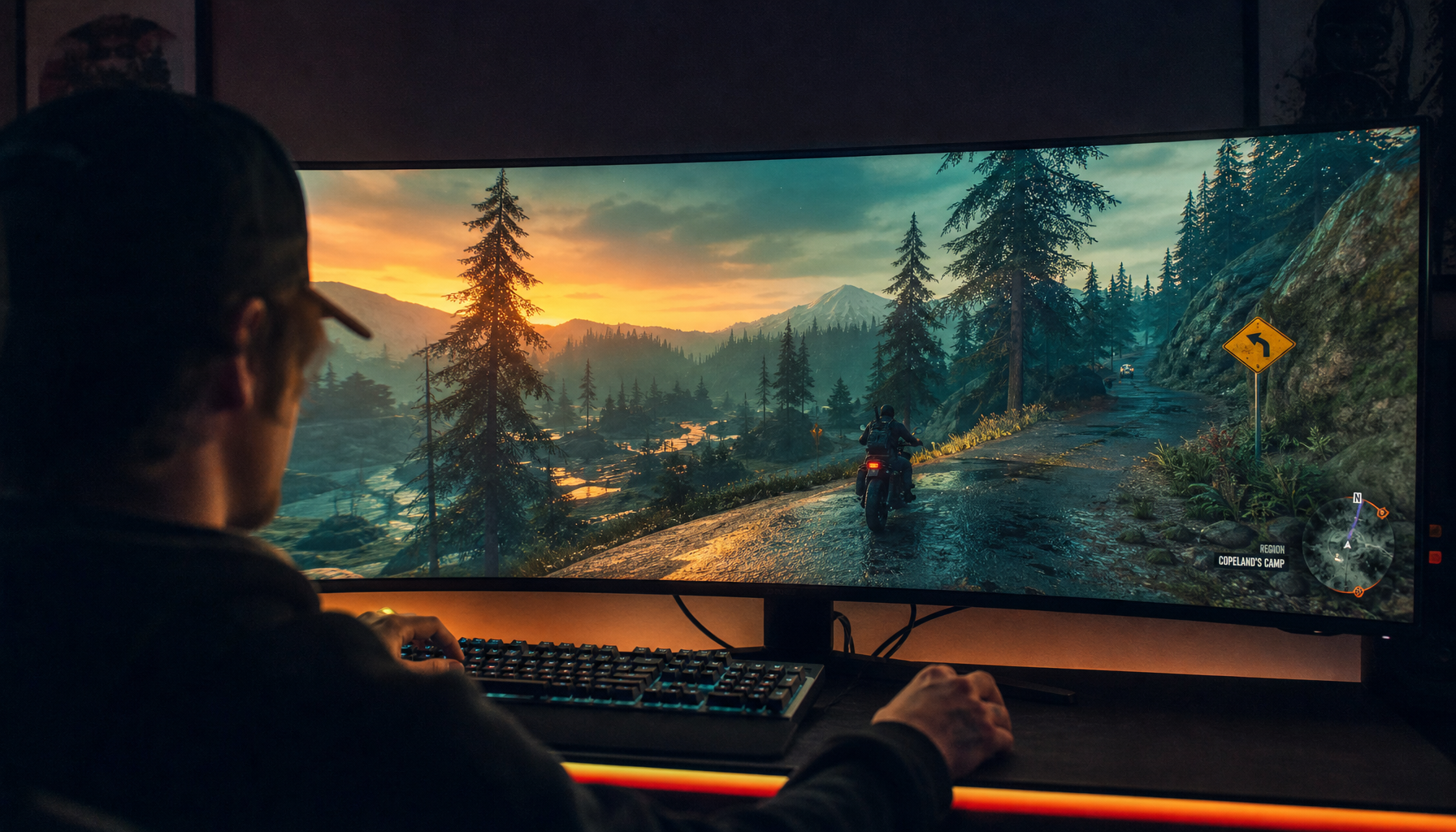
In games that support it well, 21:9 can show more of the game world at one time, which can improve early motion detection at the sides in titles built around map awareness, long sightlines, or environmental scanning. That is more relevant in games like a game, a game, or a game than in a tight arena shooter where most of the meaningful action stays close to the crosshair.

Ultrawide can also make peripheral cues feel more natural because edge motion enters the screen earlier. If your main goal is spotting rotation routes, side movement, or distant silhouette changes, a 34-inch 21:9 panel can expand situational awareness in a way a standard 27-inch display cannot.
When Ultrawide Hurts
Support and fairness rules keep ultrawide gaming aimed more at immersive play than default esports use. Some games crop or stretch the image, some competitive titles limit field of view, and many players still prefer 16:9 because it keeps targets, HUD elements, and edge checks inside a tighter scan path.
That means ultrawide is not a universal reaction-time upgrade. It can increase visible information, but it can also increase the amount of screen you must manage. If a game penalizes 21:9 support or if your desk forces you to sit too close, the extra width becomes a distraction instead of an advantage.
Why Speed Specs Usually Matter More Than Raw Inches
Refresh Rate and Response Time
When players talk about “faster reactions,” response time is the pixel transition speed, while refresh rate is how often the full image updates each second. Slow pixel transitions create ghosting, so a smaller high-refresh display with clean motion often feels more responsive than a larger monitor that smears moving targets. In practice, that is why 144Hz is a baseline for smooth play, 240Hz is a common competitive target, and 360Hz or higher is aimed at players chasing every last visual advantage. A 25-inch FHD esports display such as the a brand 25” FHD 300Hz/320Hz 1ms Vertical Gaming Monitor fits that smaller, high-refresh class many competitive players prefer over larger screens.

Response time matters because motion scenes are constant in competitive games: flicks, strafes, rapid target swaps, and camera turns all demand quick pixel changes. A large monitor does not solve blur on its own, and a blurry large monitor can actually make tracking harder.
Input Lag and Close-Up Clarity
On desk setups, monitors usually keep lower input lag than TVs, with a company citing averages of 11.7 ms versus 12.4 ms at 60Hz and 5.5 ms versus 6.8 ms at 120Hz. That gap is not enormous, but in competitive play it supports the broader point: buying the right display technology matters at least as much as buying a bigger one.
That same monitor-versus-TV comparison also highlights sharpness at close range. A smaller 4K monitor can deliver much higher pixel density than a large TV, which makes text, HUD elements, and fine target edges easier to read from normal seating distance. For a competitive desk setup, the monitor category itself is usually the correct starting point before you even debate size.
Choosing the Right Gaming Monitor Size
Best Fit by Competitive Use
For pure esports, 24- to 25-inch monitors remain the most common size because they keep the whole screen easier to scan and are widely paired with 1080p at 240Hz to 360Hz. If you split time between ranked shooters and general PC gaming, 27 inches is usually the safest middle ground because it adds detail and immersion without the same eye-travel penalty as 32 inches on a normal desk.
For mixed setups, 24 to 27 inches is still the main sweet spot, and the rest of the decision comes down to desk depth, GPU power, and whether your games truly reward extra width. A 32-inch panel makes more sense when you sit farther back or want stronger console and single-player use, while a 34-inch ultrawide is better treated as a specialist option for supported games rather than a default answer to faster reactions.
Comparison Table
Monitor format |
Best use case |
Peripheral vision effect |
Main tradeoff |
Sensible spec target |
24-25 in, 16:9 |
FPS, a game, competitive esports |
Keeps most of the screen inside a tight visual scan |
Less immersive, often lower resolution |
1080p, 240Hz to 360Hz, fast response time |
27 in, 16:9 |
Mixed competitive and everyday gaming |
Good balance of readable detail and manageable edge distance |
Slightly more eye travel than 24-25 in |
1440p, 165Hz to 240Hz, adaptive sync |
32 in, 16:9 |
Hybrid PC and console play, deeper desks |
Larger targets and stronger immersion |
Can slow screen scanning at close range |
1440p or 4K, 144Hz to 240Hz |
34 in, 21:9 ultrawide |
Supported tactical, sim, or open-world titles |
More horizontal information and earlier edge motion cues |
Support varies, more screen to manage |
3440x1440, 144Hz to 240Hz |
49 in super ultrawide |
Specialty immersion, sim racing, multitasking |
Maximum width and awareness in supported games |
Poor default fit for pure esports desks |
High refresh, strong GPU, deep desk |
Practical Next Steps
A better monitor decision comes from testing the full setup, not just reading the box size. Screen size, aspect ratio, seating distance, refresh rate, and response time all work together, so the right choice is the one that lets you hold crosshair focus while still catching edge information naturally.
If possible, test your own habits in a fast title such as a game or your main competitive game. Quick strafes, snap turns, and repeated corner checks will tell you very quickly whether a display feels readable and controlled or whether it forces too much scanning.
Action Checklist
- Measure your normal eye-to-screen distance in inches before choosing a size.
- Start with 24 to 25 inches if your main focus is twitch shooters and your desk keeps you around 20 to 30 in from the screen.
- Move to 27 inches if you want more detail and your seating position is closer to 24 to 36 in.
- Prioritize 240Hz and fast response time before jumping from a 25-inch screen to a 32-inch screen for competitive play.
- Choose ultrawide only if your main games support 21:9 well and your desk lets you sit far enough back to manage the extra width.
- Test HUD readability, edge target pickup, and motion clarity in-game instead of judging by desktop use alone.
FAQ
Q: Will a 32-inch monitor make me react slower?
A: Not automatically, but it often demands more eye movement if you keep the same close seating distance. A 32-inch display works better when you sit farther back or when you play a mix of competitive and cinematic games.
Q: Are ultrawide monitors better for situational awareness?
A: Sometimes. They can expose more horizontal information and help with early motion detection, but the benefit depends on game support, field-of-view rules, and whether the extra width stays comfortable at your desk.
Q: What matters more for competitive play: screen size or refresh rate?
A: For most players, refresh rate, response time, and low input lag matter more once the screen already fits the viewing distance. A well-tuned 24- or 27-inch high-refresh gaming monitor usually beats a larger but slower display for reaction-heavy games.