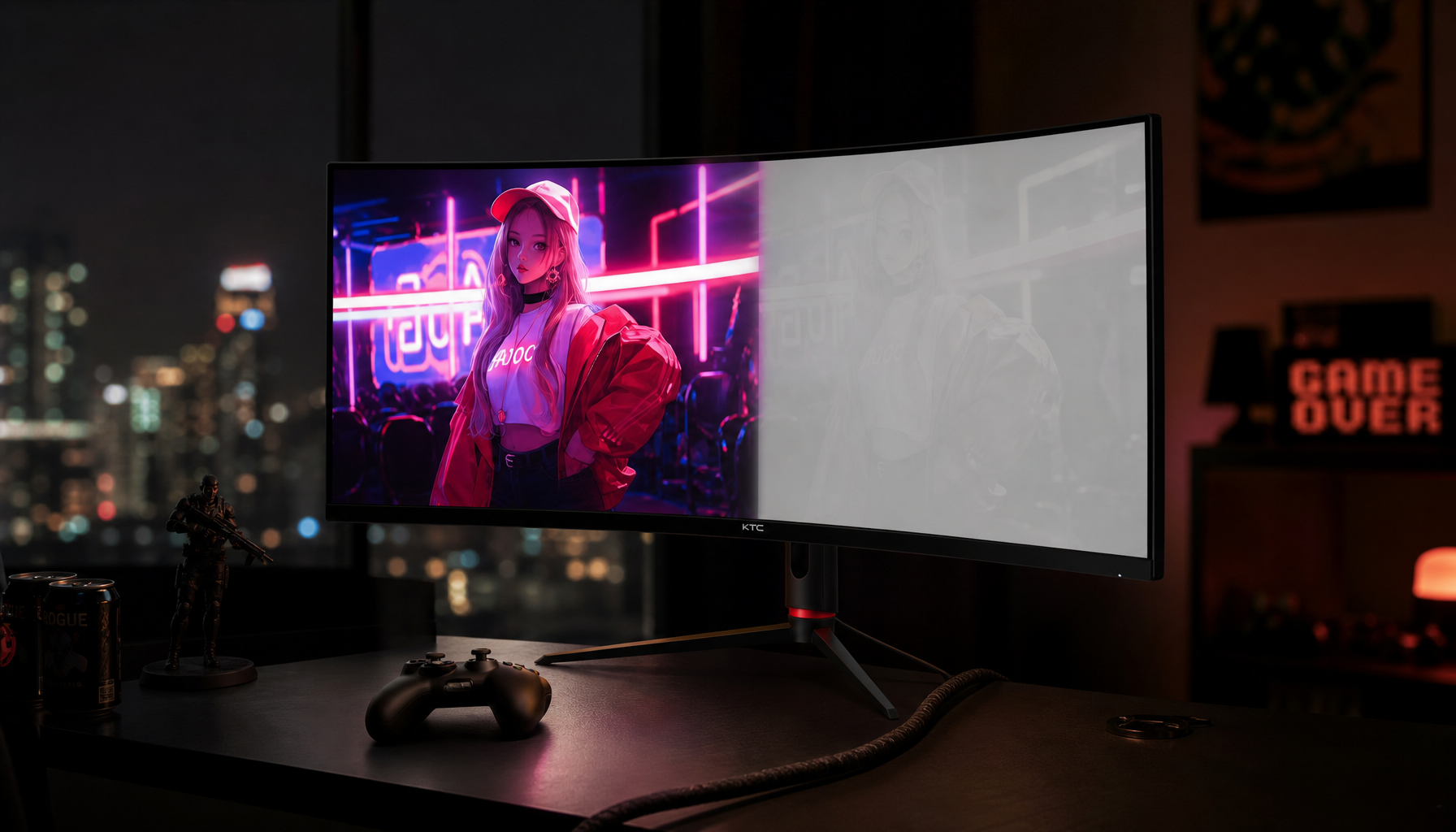
Poor viewing angle stability can make shared-screen gaming feel uneven because the off-center player sees weaker contrast, duller colors, and less detail. A stable image keeps teamwork, readability, and immersion consistent from more than one seat.
When the player on the side keeps asking why their corner looks darker, blurrier, or harder to read, the issue is often the setup as much as the game. A few seating and screen adjustments can fix more than most people expect, especially when a shared 27-inch to 32-inch display is too close or uses a panel that shifts too much off-axis.
Why viewing angle stability matters more in co-op than in solo play
Viewing angle stability is a monitor’s ability to maintain brightness, contrast, and color when you stop looking at it straight on. Display viewing angles matter because screens do not look equally good from every seat, and that matters much more in co-op than in solo gaming. When one player is centered and the second player shifts left or right, the off-center player is usually the first to notice faded blacks, washed-out midtones, and UI elements that look less defined.

That changes how the game feels. In a racing game, the side player may struggle more with track edges in shadow. In a co-op shooter, one player can lose subtle enemy detail in darker scenes. In party games, icons and color-coded prompts may look less distinct. None of that appears on a spec sheet as a co-op disadvantage, but that is exactly how it feels in practice.
Shared-screen gaming also magnifies the issue because both players usually sit closer to the display than they would to a living-room TV. A desk setup or small room often pushes people into sharper side angles, and larger monitor layouts become uncomfortable when the viewing distance is too short and neck movement becomes excessive. The closer the seating and the wider the spread between players, the more valuable stable off-axis image quality becomes.
What poor viewing angles look like during play
The first symptom is usually unfairness, not image quality. One player says the scene looks dimmer, or that red and green cues are harder to separate, or that text near the far edge is harder to read. That is the kind of degradation wide-angle displays are meant to reduce, because once you move outside a screen’s comfortable viewing zone, clarity and contrast begin to fall away.
A simple example shows why. Picture two players sharing a 27-inch monitor placed about 24 in away. The player in the middle sees the image head-on, but the player sitting roughly 18 in to the side is now viewing the screen at a noticeable angle. On a panel with weaker side consistency, that angle is enough to make dark scenes look flatter and colors less reliable. On a stronger panel, the image may still shift slightly, but not enough to disrupt play.
That is why viewing angle stability often matters more on larger, wider, or curved gaming displays. Even if both players are sharing one screen, they are not sharing the same view of that screen.
Which panel types work best for two players on one monitor
For co-op on a single monitor, IPS is usually the most practical sweet spot. Strong viewing angles and reliable color are why so many well-rounded 1440p gaming displays use IPS. In real use, IPS tends to keep the side-seat player’s experience closer to the center-seat player’s view.
OLED and QD-OLED can do even better. Premium monitor picks often treat OLED-class panels as the modern high-end standard for contrast and responsiveness, and they also tend to remain visually stable from wider positions. If you want the strongest shared-screen image and the budget allows it, OLED is hard to beat for co-op immersion.
VA is more mixed. Its deeper blacks can make dark scenes look more cinematic when you sit in the center, but the tradeoff is usually weaker side-view consistency than IPS or OLED. For a solo setup, that can be acceptable. For two players sitting shoulder to shoulder, it becomes a compromise you notice sooner.
TN remains the least attractive option for shared-screen co-op. It can still make sense for a single competitive player chasing pure speed, but once multiple people are viewing from different positions, its narrower viewing behavior becomes a drawback instead of a value advantage.
Screen size, distance, and seating position matter as much as the spec
A wide viewing-angle spec does not rescue a poor setup. Ergonomic monitor positioning generally recommends keeping the screen about an arm’s length away, or roughly 20 to 30 in, with the top of the display at or slightly below eye level. That matters in co-op because moving the screen even a few inches farther back reduces the side angle each player sees, which helps the picture look more consistent for both.
There is a practical tradeoff here. A larger 31.5-inch screen can feel better for split-screen readability and social play, but only if the room lets you sit far enough back. If the desk is shallow and both players are crowded close, a 27-inch IPS display often produces a more balanced experience than a larger VA panel that looks dramatic from the center but degrades from the side.
Height and tilt matter too. A slightly mispositioned monitor can make the top or bottom of the image less comfortable for one player, especially if one person is lower on the couch or leaning back. Small stand adjustments help more than most people expect, and adjustable stands or monitor arms are worth prioritizing for a shared setup.
When one screen is the wrong answer
Sometimes the real fix is to stop forcing two people into one compromised view. Multi-display setups exist for a reason: separate screens remove the off-axis penalty entirely. If your game or platform supports dual-display local play, mirrored displays, or a stretched desktop mode, that can be more comfortable and more competitive than asking one side player to accept a worse image.
That said, one-screen co-op still wins on simplicity, cost, and the social feel of playing in the same visual space. The right question is not whether one screen is good in theory. It is whether your panel type, seating distance, and screen size keep both players inside a usable viewing zone in practice.
How to choose the right monitor for shared-screen co-op
If the goal is balanced local multiplayer, prioritize image consistency before chasing extreme refresh rates. Advice on matching a display to the use case keeps returning to the same principle. For couch co-op, that usually means a 27-inch or 32-inch IPS monitor with solid ergonomics, enough brightness, and a stand that lets you fine-tune height and tilt. If you want the premium option, OLED adds exceptional contrast and stronger side-view stability, but it costs more.
Refresh rate still matters, especially in fighting, racing, and action games, but once you are already in the 144 Hz to 180 Hz range, viewing angle stability can do more for a two-player session than jumping to a much faster panel with weaker off-axis behavior. In other words, the best co-op monitor is not automatically the best esports monitor.
A quick reality check helps before you buy. Sit where player two normally sits, pull up a dark game scene and a bright menu screen, then look for brightness loss, black washout, and color shift. If the side seat looks obviously worse, you are not imagining it. The monitor is telling you it was designed for one ideal viewer, not two equal ones.

A shared screen should create the same game for everyone looking at it. If one player gets rich contrast and the other gets a faded version, the monitor is already shaping the match more than it should.