Ultrawide monitors are popular in flight and racing sims because their extra horizontal view makes cockpits, tracks, roads, and skies feel more natural. FPS players often prefer standard 16:9 monitors because competitive shooters reward high frame rates, low latency, center-screen focus, and predictable game support more than extra width.
Ever tried landing a plane while scanning instruments, runway lights, and side-window scenery, or taking a racing line while judging the car beside you? A 21:9 or 32:9 display can make those moments easier to read, while a 3440x1440 ultrawide also asks the GPU to push about 35% more pixels than 2560x1440. The useful answer is not “ultrawide is better” or “ultrawide is worse,” but which monitor shape fits the way you actually play.
Why Flight and Racing Sims Benefit From Ultrawide Screens
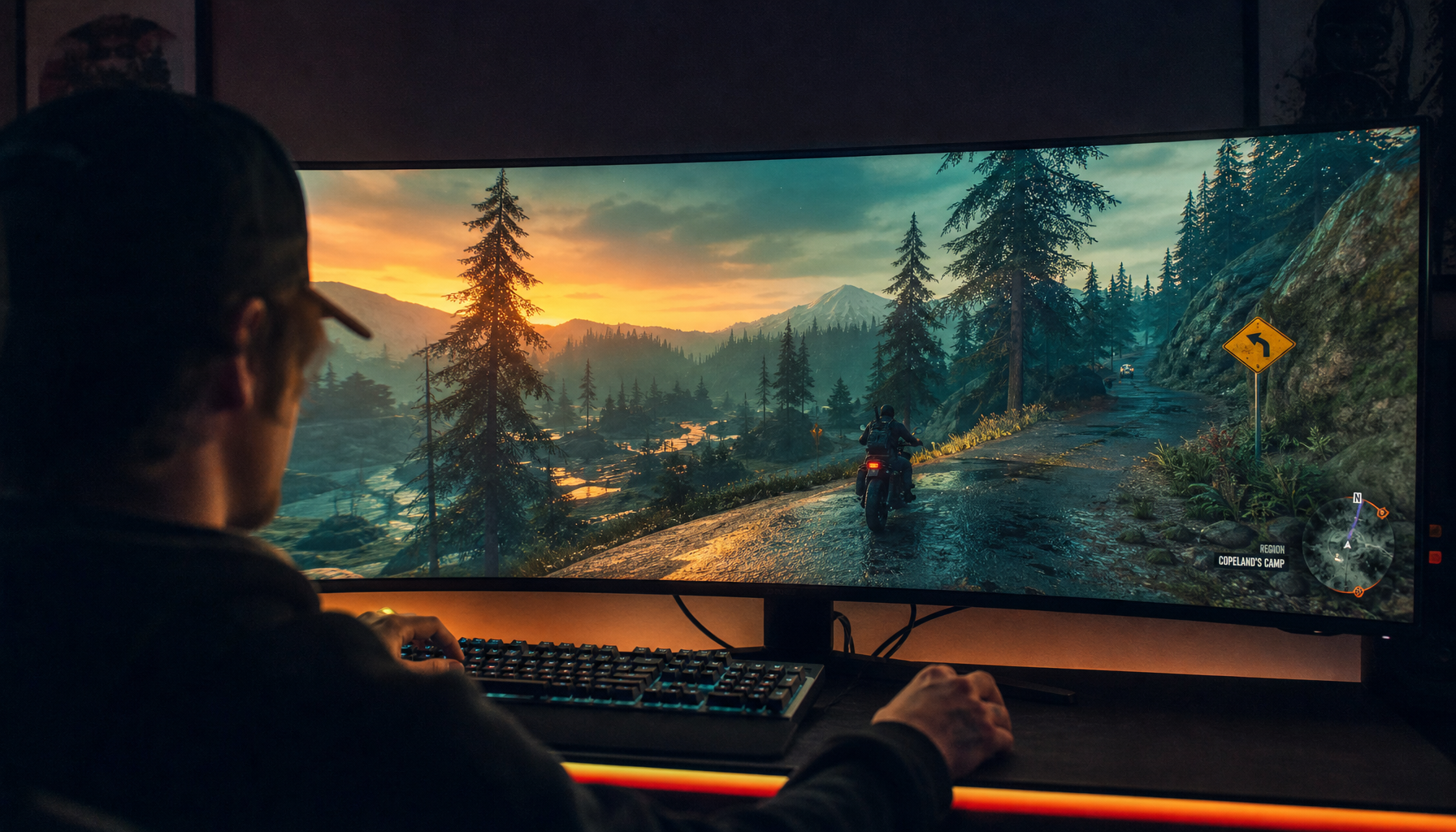
Flight and racing sims are built around spatial awareness. In a flight simulator, a wider screen helps you keep cockpit instruments, the runway, clouds, terrain, and side-window references visible without constantly panning the camera. In racing sims, the extra width makes it easier to judge corner entry, track edges, mirrors, apexes, and nearby cars because ultrawide monitors expand the horizontal view beyond a standard 16:9 screen.
That is why simulator-focused monitor guidance often favors large displays, ultrawide formats, or 32-inch-plus screens where cockpit detail and map readability matter more than twitch response alone. For strategy and sim games, screen real estate is a practical advantage because small text, gauges, menus, maps, and cockpit displays are easier to use when there is more room.
The cockpit effect
A 21:9 ultrawide monitor can feel closer to sitting inside a car or cockpit because the image wraps more of your peripheral vision. A 32:9 super ultrawide goes further, approximating the width of two 16:9 monitors side by side without the bezel gap in the middle. For flight and racing sims, that layout supports the way players naturally scan: center view first, then instruments, mirrors, horizon, traffic, and road position.

This does not mean every sim player needs the widest screen available. A 34-inch 3440x1440 ultrawide is often the practical middle ground because it gives a noticeably wider view while staying easier to drive than 4K or 32:9. A serious sim cockpit can justify 49-inch 32:9, but it demands more desk space, more GPU headroom, and more time spent tuning field-of-view settings.
Why FPS Games Often Favor Standard 16:9 Monitors
Competitive FPS play is different. Most of the action that matters happens near the crosshair, and players win fights by spotting targets quickly, keeping aim stable, and maintaining high frame rates with low input lag. That is why FPS monitor advice often prioritizes 240Hz or higher refresh rates, 1ms-class response, adaptive sync, and sometimes 1080p resolution over a wider panel.
Many competitive FPS players choose 24-inch or 27-inch 16:9 displays because the whole screen is easier to scan without large eye or head movement. In a game like a competitive shooter, a tactical shooter, a battle royale game, or a military shooter, extra side vision may sound useful, but it can also push HUD elements, minimaps, ammo counters, and peripheral motion farther from the center. Some players find that a wider image pulls attention away from the crosshair, which is exactly where most FPS decisions happen.

Ultrawide is not automatically bad for FPS
Ultrawide can still be enjoyable for casual shooters, single-player FPS campaigns, extraction games, and open-world titles. If the game supports 21:9 properly, the extra width can make landscapes, interiors, and cinematic sequences feel more immersive. For single-player shooters, immersion may matter more than standardized competitive framing.
The issue is optimization for ranked or tournament-style play. Some competitive games restrict ultrawide support, lock the view to 16:9, add black bars, or handle the wider image inconsistently to avoid giving one player a wider-field advantage. In those cases, an ultrawide monitor may still work, but it is no longer giving the clean benefit it provides in a flight or racing sim.
The Performance Tradeoff: More Pixels, More GPU Load
Resolution matters as much as aspect ratio. A common 3440x1440 ultrawide display renders just under 5 million pixels, while a 2560x1440 monitor renders just under 3.7 million pixels. That means 3440x1440 ultrawide asks the GPU to process roughly 35% more pixels than standard 1440p before any ray tracing, high texture settings, or anti-aliasing are added.

That extra load matters most in FPS games because high refresh rates only help when the PC can produce enough frames. A 240Hz monitor is wasted if the game is running around 90fps, and the buying advice is simple: match the monitor to the frame rates your GPU can actually sustain. For competitive shooters, lowering resolution from ultrawide 1440p to 16:9 1080p or 1440p can produce smoother frame pacing and lower input latency.
Sims tolerate the tradeoff better
Flight and racing sims also benefit from smooth motion, but their success is not usually measured by split-second flick shots. A racing sim running at a consistent 100fps or more on a 144Hz ultrawide can feel excellent because motion clarity, track flow, and peripheral awareness all work together. A flight sim at a lower but stable frame rate may still feel immersive if the cockpit, terrain, and horizon are readable.
That difference explains the genre split. Ultrawide adds workload, but simulator players often accept that cost because it improves the core experience. FPS players often see the same cost as a competitive liability because every extra pixel can make it harder to hold the high, stable frame rates that shooters reward.
Compatibility, HUD Placement, and Field of View Matter
Aspect ratio is the relationship between a screen’s width and height, with common monitor formats including 16:9, 21:9, and 32:9. A standard 16:9 monitor remains the most widely compatible choice, while 21:9 ultrawide monitors have become common enough that many modern games support them, especially cinematic, racing, simulation, and open-world titles.
Support is not universal. Some games show cutscenes in 16:9 with black bars on the sides. Others stretch the image, place menus awkwardly, or move HUD elements too far toward the left and right edges. In FPS games, stretched edges can make objects or characters near the sides look distorted, which is distracting when precision matters.
Field of view is the hidden setting
A good ultrawide setup depends on field-of-view tuning. In racing sims, a realistic FOV can help scale the cockpit, road, and mirrors correctly. In flight sims, the right setting can reduce the need for constant camera movement while keeping instruments readable. If the FOV is too wide, the image can look warped; if it is too narrow, the ultrawide screen becomes little more than a stretched standard view.
For FPS games, FOV settings are more sensitive. A wider FOV can reveal more space, but it can also make distant targets appear smaller. On a fast 16:9 display, many competitive players prefer a consistent, familiar view because muscle memory, target size, and HUD position are easier to preserve across games and tournaments.
How to Choose the Right Gaming Monitor by Genre
The best monitor choice starts with your main game type, not the most impressive spec sheet. If you spend most of your time in racing sims or flight simulators, a 34-inch 21:9 ultrawide or 49-inch 32:9 super ultrawide can be worth the desk space and GPU load. If your main games are tactical shooters, competitive shooters, or other competitive shooters, a fast 24-inch or 27-inch 16:9 monitor is usually the sharper choice; for example, a 25-inch FHD 300Hz/320Hz 1ms vertical gaming monitor fits that FPS-oriented side of the comparison as a 25-inch FHD, 300Hz/320Hz, 1ms option that prioritizes frame rate and center-screen play over ultrawide immersion.

For mixed use, the balance point is usually a 27-inch 1440p high-refresh monitor or a 34-inch 3440x1440 ultrawide with a refresh rate of at least 144Hz. The first option favors FPS performance and simplicity. The second favors immersion, productivity, racing, flight, and cinematic games while still being usable for casual shooters.
Monitor Type |
Best For |
Main Strength |
Main Tradeoff |
Practical Buying Target |
24-inch 16:9 1080p |
Competitive FPS |
Very high frame rates and easy full-screen scanning |
Less immersive for sims |
240Hz or higher, low input lag, adaptive sync |
27-inch 16:9 1440p |
Mixed gaming |
Balanced clarity, speed, and compatibility |
Less cockpit-like than ultrawide |
144Hz to 240Hz, strong response performance |
34-inch 21:9 3440x1440 |
Racing, flight, open-world games |
Wider view and better immersion |
About 35% more GPU load than 2560x1440 |
144Hz or higher, curved panel, adaptive sync |
38-inch 21:9 3840x1600 |
Premium sim and productivity use |
More vertical room than 34-inch ultrawide |
Expensive and harder to drive |
High-refresh IPS or OLED, strong GPU recommended |
49-inch 32:9 |
Dedicated sim cockpit |
Very wide peripheral view without center bezels |
Large desk footprint and uneven game support |
120Hz or higher, careful FOV setup |
A monitor also has to fit your desk. A 34-inch ultrawide usually needs a deeper desk than a 27-inch display because the edges sit farther out, especially on a curved panel. A 49-inch super ultrawide can dominate a smaller apartment desk, so measure the available width, check stand depth, and consider a monitor arm before buying.
FAQ
Q: Are ultrawide monitors unfair in FPS games?
A: Sometimes they can provide a wider view, but many competitive games control this through locked aspect ratios, black bars, limited FOV, or standardized tournament settings. The bigger everyday issue is not fairness alone; it is whether the game supports ultrawide cleanly and whether your PC can still sustain the frame rate you want.
Q: Is 21:9 better than a triple-monitor setup for racing sims?
A: A 21:9 ultrawide is simpler, cleaner, and avoids bezel gaps, while triple monitors can provide a wider wraparound view for serious sim rigs. For most players, a 34-inch 21:9 or 49-inch 32:9 monitor is easier to set up than three displays because there are fewer cables, fewer alignment issues, and fewer game-specific configuration problems.
Q: Should I buy an ultrawide if I play both racing sims and FPS games?
A: Yes, if racing, flight, open-world, and productivity use matter more than ranked FPS performance. If competitive FPS is your priority, choose a fast 16:9 monitor first, then consider an ultrawide as a second display or a future upgrade for sim-focused gaming.
Practical Next Steps
Use the monitor as a tool for the games you play most. Ultrawide is a strong choice when the game rewards environmental awareness, cockpit readability, and immersion; 16:9 is still the safer choice when the game rewards speed, focus, compatibility, and maximum frame rate.
- List your top three games and label each one as sim, racing, FPS, strategy, or cinematic.
- Check whether those games support 21:9 or 32:9 without stretching, black bars, or broken HUD placement.
- Compare your real frame rates with your target refresh rate; do not buy 240Hz for a game your GPU runs at 90fps.
- Choose 16:9 for ranked FPS priority, 21:9 for mixed gaming and sims, or 32:9 for a dedicated cockpit setup.
- For 3440x1440 ultrawide, budget for extra GPU load because it renders roughly one-third more pixels than 2560x1440.
- Measure desk width and depth before buying, especially for curved 34-inch and 49-inch monitors.
- After setup, tune FOV, HUD scale, and seating distance before judging the monitor.
The practical rule is simple: buy ultrawide for immersion and awareness, buy fast 16:9 for competitive precision, and buy based on your actual GPU performance rather than the highest advertised monitor spec.