Temporal resolution in a monitor describes how finely the display updates motion over time, while pixel sharpness describes how much detail the screen can show in space. A monitor can have excellent static sharpness and still look soft during fast movement if its refresh rate, frame delivery, or pixel response is weak.
Ever drag a window across a sharp 4K screen and notice the text smears until it stops? Moving from 60 Hz to 240 Hz cuts each displayed frame from about 16.7 milliseconds to about 4.2 milliseconds, which can make motion look much cleaner when your PC can keep up. This guide explains how temporal resolution, screen resolution, response time, and motion blur work together so you can choose the right monitor for gaming, work, or travel.
Temporal Resolution vs. Pixel Sharpness
Temporal resolution is about time: how often visual information is updated. In display terms, that usually points to refresh rate, frame pacing, and how quickly pixels can change from one value to another; more broadly, temporal resolution is the resolution of a measurement with respect to time. For a monitor buyer, the practical question is simple: how many fresh, usable images can the screen present each second?
Pixel sharpness is about space: how many pixels are available, how densely they are packed, and how cleanly the monitor renders edges, text, and fine detail. A 27-inch 4K monitor usually looks sharper for documents and desktop work than a 27-inch 1080p monitor because the same screen area contains far more pixels. But that static sharpness does not guarantee that fast camera pans, scrolling text, or a moving enemy in a shooter will remain equally crisp.
The Spatial Side: Resolution and Pixel Density
Resolution is the pixel grid: 1,920 x 1,080 for 1080p, 2,560 x 1,440 for 1440p, and 3,840 x 2,160 for 4K/UHD. Since 4K renders about four times as many pixels per frame as 1080p, it gives more static detail but also asks much more from the GPU.
Pixel density matters because resolution alone does not tell you how sharp a monitor will look at your desk. A 24-inch 1080p display can look acceptable for gaming, while a 32-inch 1080p display can make text and UI edges look coarse. For monitor buying, resolution should be judged together with screen size, viewing distance, and the type of content you use most.
The Temporal Side: Refresh Rate and Motion Updates
Refresh rate is the display update frequency. A 60 Hz monitor can refresh 60 times per second, a 144 Hz monitor 144 times per second, and a 240 Hz monitor 240 times per second. The time between refreshes is about 16.67 ms at 60 Hz, 6.94 ms at 144 Hz, and 4.17 ms at 240 Hz, so higher refresh rates give the monitor more chances to show updated motion.
That is why two monitors with the same pixel resolution can feel very different. A 1440p 60 Hz display may look sharp when still, but a 1440p 240 Hz display can make fast movement easier to track because the image updates more frequently. Temporal resolution improves perceived sharpness in motion, not the number of pixels in a still image.
Why Higher Refresh Rates Can Look Sharper in Motion
Most modern LCD and OLED monitors behave like sample-and-hold displays: they show a frame and hold it until the next refresh. As your eyes track a moving object, that held frame remains visible for a short time, creating perceived blur even when the source frame itself is sharp. Sample-and-hold blur is different from a low-resolution image; it is a timing and persistence problem.

At 960 pixels per second, an object can move about 16 pixels during one 60 Hz frame, about 8 pixels at 120 Hz, about 4 pixels at 240 Hz, about 3 pixels at 360 Hz, and about 2 pixels at 480 Hz. In a real gaming monitor comparison, that is the difference between a nameplate, reticle, or map marker looking smeared during a pan versus remaining easier to follow. The pixels did not become smaller; the motion path became less blurred.

Refresh Rate Needs Real Frames
A 240 Hz monitor is not automatically showing 240 different game states every second. It can only show new information when the PC, console, or laptop actually delivers new frames. If a game runs at 90 FPS on a 240 Hz monitor, many refresh cycles will repeat older frames, so the experience can still be smoother than 60 Hz but will not use the panel’s full temporal capability.
This is why monitor buying should start with the games and hardware you actually use. Esports titles often run well at 144 FPS, 240 FPS, or higher on modern gaming PCs, making 144 Hz to 240 Hz monitors practical. Cinematic AAA games at 4K with high graphics settings may sit closer to 60-120 FPS, where a high-quality 144 Hz or 165 Hz display can be a better match than chasing 360 Hz.
Motion Clarity Is Not the Same as Input Lag
Higher refresh rates can reduce the time between visible updates, which often makes aiming, scrolling, and camera movement feel more immediate. But motion clarity and input lag are not identical. A monitor can refresh quickly and still show motion artifacts if its pixel response, overdrive tuning, or frame pacing is poor.
For practical shopping, look beyond the largest refresh-rate number on the box. Check independent reviews for motion pursuit photos, response-time charts, overshoot behavior, and VRR performance. A well-tuned 165 Hz monitor can look cleaner than a poorly tuned 240 Hz monitor with obvious inverse ghosting.
Response Time, Ghosting, and Overdrive
Response time describes how quickly pixels transition between shades. The common gray-to-gray number gives a rough idea, but it does not fully describe motion clarity because real content includes many transitions, brightness levels, and color changes. Grey-to-grey response time mainly describes transition speed, while visible blur also depends on persistence, overshoot, undershoot, and refresh behavior.
Ghosting happens when pixels cannot complete transitions quickly enough before the next frame appears. You may see a faint trail behind a dark object moving across a bright sky, or a bright smear behind a white cursor on a dark background. This is especially noticeable in fast games, scrolling web pages, and high-contrast UI elements.
Overdrive Can Help or Hurt
Monitor overdrive pushes pixels harder so they reach the target color faster. Good overdrive can reduce ghosting and improve perceived sharpness during motion. Bad overdrive can overshoot the target and create inverse ghosting, where a bright or dark halo trails moving objects.
The best overdrive setting often changes with refresh rate. A setting that looks clean at 240 Hz may overshoot badly at 80 FPS with variable refresh rate enabled. If you use VRR for games with fluctuating frame rates, choose a monitor known for stable overdrive across a wide refresh range, or use a moderate overdrive setting instead of the fastest labeled mode.
Blur Reduction Has Trade-Offs
Backlight strobing and black frame insertion reduce the time each frame is visible, which can improve motion clarity. These modes can be useful for competitive games when the frame rate is stable and matched to the strobe behavior. However, they may reduce brightness, disable or limit VRR, introduce flicker, or show crosstalk if the timing is not well controlled.
For many buyers, VRR plus a high native refresh rate is the more flexible everyday choice. Strobing is worth considering if you play motion-sensitive games at fixed high FPS and are comfortable tuning brightness and refresh settings. It is less ideal for mixed workloads, variable frame rates, or long office sessions where flicker sensitivity matters.
How Temporal and Spatial Resolution Trade Off
Display buying often forces a trade-off between more pixels per frame and more frames per second. 4K improves static detail, text clarity, and workspace, but it also increases rendering load. Lower resolutions make high frame rates easier because the GPU has fewer pixels to draw each frame.
This same relationship appears in other imaging systems: pushing spatial detail can reduce temporal resolution or coverage, while faster updates can require compromises elsewhere. In high-end imaging research, high spatial resolution and high temporal resolution are often balanced against scan time, noise, and coverage; one study notes that higher spatial resolution can reduce temporal resolution in conventional workflows and demonstrates subsecond imaging as a major target for time-sensitive capture high spatial resolution. For monitors, the everyday version is easier to see: 4K at 60-120 FPS may look more detailed when still, while 1440p at 165-240 FPS may look clearer in motion.
A Practical Monitor Comparison
Monitor Priority |
What It Improves |
Best Fit |
Trade-Off to Watch |
Practical Buying Target |
Higher resolution |
Static detail, text clarity, desktop space |
Productivity, creative work, cinematic games |
Heavier GPU load |
4K at 27-32 inches for sharp desktop use |
Higher refresh rate |
Motion smoothness, tracking, perceived motion sharpness |
Competitive gaming, fast scrolling, high-FPS play |
Requires matching FPS |
144 Hz minimum for gaming; 240 Hz for serious esports |
Faster response time |
Less ghosting and cleaner transitions |
Fast games, high-contrast motion |
Poor overdrive can cause halos |
Look for reviewed response behavior, not just “1 ms” claims |
Lower visible persistence |
Fixed-FPS competitive play |
Lower brightness, flicker, possible VRR limits |
Use only if reviews show clean strobe tuning |
|
Higher pixel density |
Sharper static edges and text |
Office work, coding, photo/video timelines |
Scaling and GPU demand |
Match size and resolution to viewing distance |
For a comparison anchor, a 27-inch 4K display such as a 27-inch 4K 160Hz/320Hz 90W gaming monitor sits on the high-detail side while also giving you high-refresh modes to weigh against GPU demands. The useful question is still the same: 4K helps static detail, while 160 Hz or 320 Hz matters most when the source can feed enough frames.

The best choice depends on what bothers you most. If text looks rough, increase pixel density. If motion looks smeared, increase temporal performance. If games feel uneven, focus on frame rate consistency, VRR range, and GPU capability before buying a monitor your system cannot fully drive.
Buying Guidance by Monitor Type
For competitive gaming, prioritize temporal resolution first. A 24- to 27-inch 1080p or 1440p monitor at 144 Hz, 165 Hz, 240 Hz, or higher is often more useful than a 4K 60 Hz panel because tracking, aiming, and camera motion benefit from frequent updates. If your PC can consistently deliver 200+ FPS in the games you play, a 240 Hz monitor can be a meaningful upgrade; if your games usually run around 100-140 FPS, a strong 144 Hz or 165 Hz display is a more balanced buy.
For single-player and cinematic gaming, balance temporal and spatial detail. A 27- or 32-inch 4K monitor at 120 Hz, 144 Hz, or 160 Hz can deliver sharp visuals while still feeling much smoother than 60 Hz. If you use ray tracing or high settings, check realistic FPS benchmarks for your GPU before assuming a 240 Hz 4K monitor will be used to its full potential.
Ultrawide Monitors
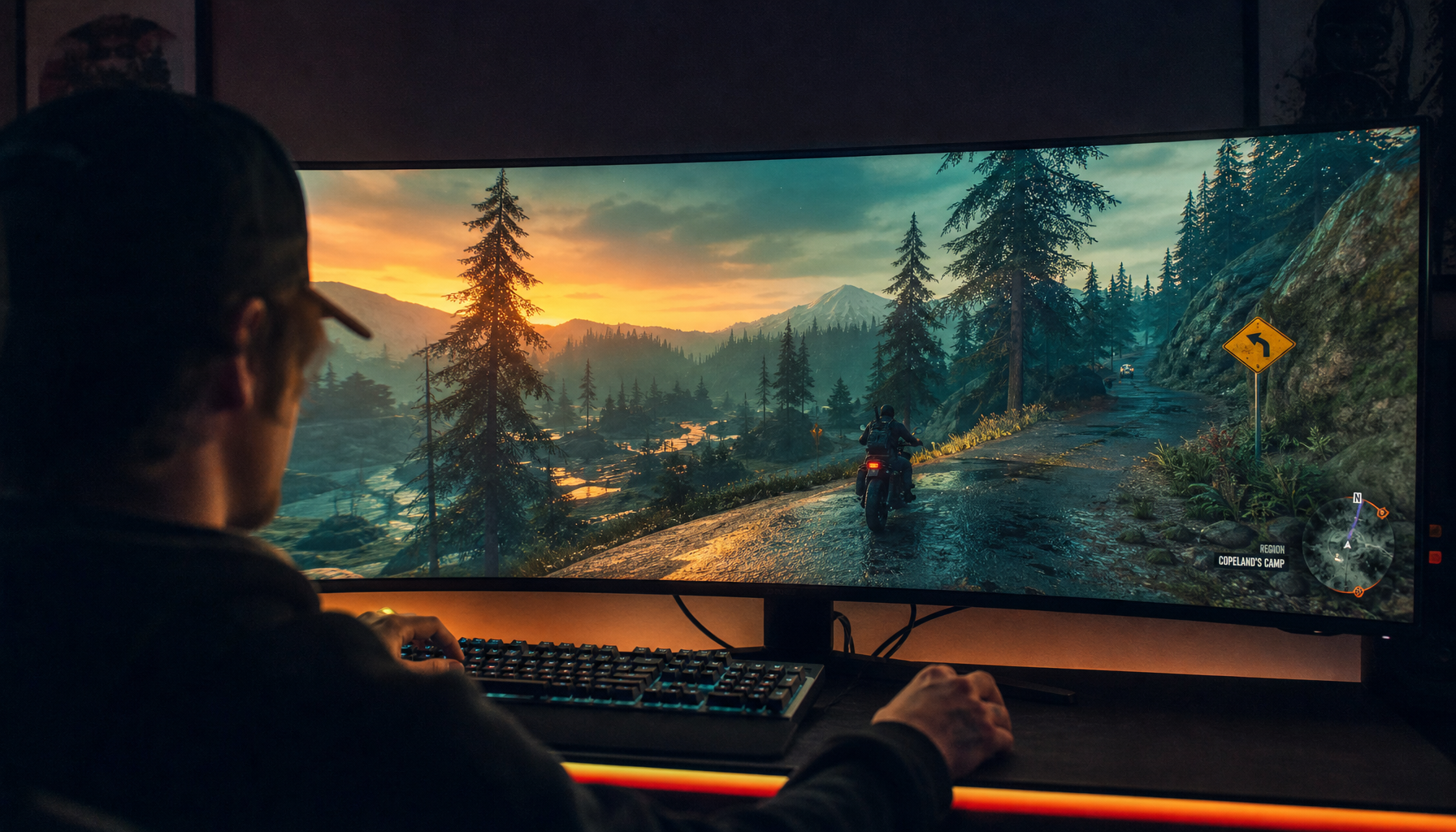
Ultrawide monitors add horizontal field of view and workspace, but they also increase GPU load. A 34-inch ultrawide at 3,440 x 1,440 has more pixels to render than standard 1440p, so maintaining high FPS can be harder. For fast games, a 144 Hz to 175 Hz ultrawide is often a practical middle ground; for sim racing, flight sims, and immersive RPGs, the wider view may matter more than reaching 240 Hz.
Pixel sharpness on ultrawides depends heavily on size and resolution. A large ultrawide with modest resolution can look less crisp for text, even if it has a high refresh rate. If you split your day between work and gaming, look for a panel with enough pixel density for readable text and enough refresh headroom for smooth motion.
Portable Monitors
Portable monitors have different priorities: weight, power draw, USB-C compatibility, brightness, and stand quality matter alongside resolution and refresh rate. A 15- to 16-inch portable 1080p panel can look reasonably sharp because the screen is small, while higher refresh rates are useful for gaming on a laptop or handheld PC. However, many portable setups are limited by cable bandwidth, battery use, and the graphics performance of the connected device.
For travel, do not buy refresh rate in isolation. A 144 Hz portable monitor is only useful if your laptop or handheld can output that refresh rate at the monitor’s native resolution through the available port. For spreadsheets, coding, email, and second-screen use, stable brightness, readable text, and a reliable stand may matter more than 165 Hz.
Static Sharpness Still Matters
Temporal resolution does not replace spatial resolution. A high-refresh 1080p monitor can look excellent in motion but still show less fine detail than a 4K monitor when displaying text, photos, maps, or dense dashboards. Radiology display research gives a useful general principle for monitors: image appearance depends on the full “image chain,” including acquisition data, display hardware, lookup tables, ambient light, glare, viewing angle, and human vision image chain. For consumer displays, the same idea applies: sharpness is not only one spec.
That image-chain mindset is helpful when setting up a gaming or work monitor. A high-resolution display can look worse than expected if scaling is poor, the panel coating is hazy, the viewing angle is off, or the room lighting creates glare. A high-refresh display can look worse than expected if frame pacing stutters, overdrive is too aggressive, or the game cannot sustain enough FPS.
Match the Display to the Source
The professional radiology guidance summarized in the display literature recommends selecting displays based on the original image matrix, with the rule of thumb that display resolution should ideally match the source image matrix to preserve detail display resolution. In monitor-buying terms, you get the cleanest result when the content, GPU output, operating system scaling, and panel resolution work together.
For gaming, that means running at native resolution when possible, using high-quality upscaling when needed, and avoiding mismatched settings that make the image soft before the monitor even displays it. For productivity, it means choosing a resolution and screen size that make text sharp at your normal viewing distance without requiring awkward scaling.
Practical Next Steps
Start with your main use case. For competitive shooters, racing games, and fast action, prioritize 144 Hz or higher, clean response tuning, VRR support, and enough GPU performance to feed the monitor. For office work, coding, photo editing, and mixed productivity, prioritize pixel density, panel clarity, ergonomics, and comfortable scaling, then add high refresh if your budget allows.
Use this decision path before buying:
- Choose resolution by screen size: 1080p for smaller or budget gaming displays, 1440p for a strong balance at 27 inches, and 4K for sharper desktop detail at 27-32 inches.
- Choose refresh rate by actual FPS: 144 Hz is a strong baseline, 165-180 Hz is a useful step up, and 240 Hz or higher makes the most sense when your games can run near those frame rates.
- Check response quality in reviews: do not rely only on advertised “1 ms” claims.
- Decide whether you need blur reduction: useful for fixed high-FPS competitive play, less flexible for general VRR gaming.
- Test your setup after purchase: use native resolution, enable the highest refresh rate in your operating system, turn on VRR if supported, and try a few overdrive modes in the games you actually play.
FAQ
Q: Does higher temporal resolution make individual pixels sharper?
A: No. Higher temporal resolution does not increase the number of pixels or make the physical pixel grid finer. It can make moving objects appear sharper because each frame is held for less time and motion is updated more frequently.
Q: Is 240 Hz always better than 4K for gaming?
A: Not always. For competitive games where your system can produce very high FPS, 240 Hz can improve tracking and motion clarity. For slower, cinematic, or detail-rich games, 4K at 120-144 Hz may provide a better mix of sharpness and smoothness.
Q: Why does my high-refresh monitor still look blurry?
A: Common causes include low game FPS, uneven frame pacing, slow pixel response, aggressive overdrive, sample-and-hold blur, poor scaling, or running below native resolution. Confirm the monitor is set to its maximum refresh rate, test a moderate overdrive mode, enable VRR when appropriate, and compare motion at different FPS caps.