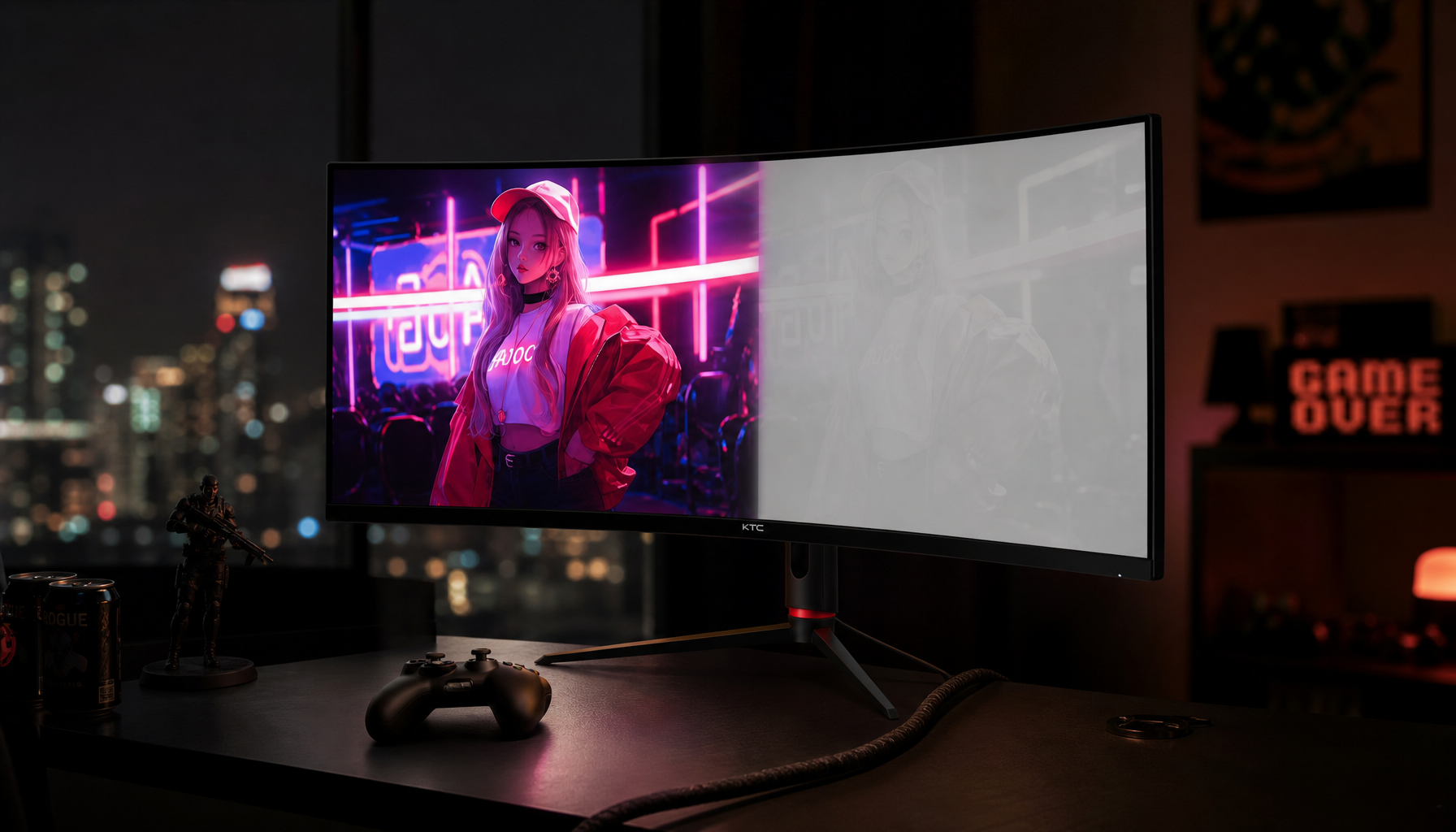
A semi-glossy monitor uses a lighter anti-glare surface that cuts more glare than glossy screens while keeping more clarity and contrast than a heavy matte finish.
If your gaming monitor looks flat every afternoon or your ultrawide turns into a mirror the moment sunlight hits the desk, the screen finish is probably the real problem. That tradeoff shows up in real setups: one user reported that two 27-inch gaming monitors that worked well for five years in a light-controlled room became practically unusable after moving next to a floor-to-ceiling window. You’ll leave with a practical way to choose between semi-glossy, matte, and glossy for gaming, work, and mixed-light rooms.
What “Semi-Glossy” Actually Means on a Monitor
It is a surface treatment, not a panel type
A semi-glossy finish is usually a lighter matte or anti-glare treatment rather than a separate display technology, and monitor guides commonly place it at roughly 13% to 18% haze instead of the roughly 25% often associated with regular matte coatings. In plain terms, that means the surface spreads less incoming light than matte, so the image keeps more of its original crispness.
That surface behavior comes from the coating stack itself: anti-glare and anti-reflective layers change how light hits the monitor, with matte-style textures diffusing reflections and smoother optical films letting more display light pass through. Semi-glossy sits in the middle because it tries to reduce glare without adding the full “paper-like” haze of a stronger matte finish.
Why the label can be misleading
The term “semi-glossy” is broad, and reflection handling still has to be judged monitor by monitor. Two monitors can both be sold as semi-glossy, yet one may behave almost like matte while another looks much closer to glossy under a lamp or a window.
A quick reality check is the screen-off test: clear, mirror-like reflections usually mean glossy, while softer and less distinct reflections usually mean matte or a lighter semi-matte variant. That simple check is useful because product pages often say “anti-glare” without telling you how aggressive the coating really is.

How Semi-Glossy Differs From Matte and Glossy
The real tradeoff is light scatter versus image clarity
The basic split is straightforward: glossy surfaces reflect light more directly, which helps blacks look deeper and highlights look sharper, while matte surfaces scatter that light to reduce glare but add some haze, softness, and loss of color “pop.” Semi-glossy tries to keep more of the glossy look while avoiding the worst mirror effect.
That is why light or medium matte coatings around 15% to 25% haze are often treated as the practical middle ground on desktop monitors. They do not eliminate reflections the way a heavy matte surface can, but they also avoid much of the grain and muted look that some buyers notice on stronger anti-glare coatings.
Side-by-side comparison
Finish |
Typical surface behavior |
Reflection handling |
Perceived image look |
Best room fit |
Best use cases |
Glossy |
Smooth surface, sometimes with very low-haze treatment |
Worst against direct windows and lamps |
Strong contrast, vivid color, sharp edges |
Dark or controlled rooms |
Immersive gaming, media, creator work in controlled light |
Semi-glossy |
Light matte or smoother anti-glare layer |
Better than glossy, weaker than matte |
Clearer than matte, less haze, moderate reflections |
Gaming plus work, 4K desks, many ultrawides |
|
Matte |
Textured anti-glare layer, often higher haze |
Best for glare control |
Least reflective, but slightly grainier or softer |
Bright rooms |
Window-facing desks, office work, travel, competitive play |
The practical difference is most obvious on text and fine details: heavier matte coatings can look slightly grainy on a 27-inch 4K screen, while semi-glossy usually preserves cleaner subpixel edges. For buyers comparing high-refresh 1440p and 4K monitors, that extra clarity can matter as much as color saturation.

Which Finish Works Best in a Bright Room
Matte still wins against harsh daylight
Bright-room complaints are not theoretical; in one window-side setup, a pair of gaming monitors that had been fine in a windowless room became hard to use even for web browsing after the desk moved next to a large window. If your display faces daylight, glossy is usually the wrong starting point no matter how good it looks at night.

Room-fit charts reflect that reality: matte rates far better in bright rooms, while glossy is strongest in dark rooms where its deeper-looking blacks and sharper highlights are not fighting ambient reflections. For office-plus-gaming setups near windows, glare control usually matters more than chasing the most vivid finish.
Semi-glossy is strongest in mixed lighting
Semi-glossy makes the most sense when your room is neither fully dark nor fully sun-blasted, and reflection testing matters because coatings with lower peak direct reflection intensity are easier to live with under lamps or side windows. A useful rule is to treat semi-glossy as a compromise finish, not a magic one.
In practice, semi-glossy works best when the main problem is occasional glare rather than constant direct sunlight. If you can control the worst reflections with desk placement or blinds, semi-glossy often gives a better balance than full matte for a monitor that has to handle both spreadsheets at noon and games at night.
What Changes for Gaming, Text Clarity, and Productivity
Gaming benefits from preserved contrast and edge definition
Screen finish does not change the panel’s native contrast ratio, but it does change perceived contrast, sharpness, and how much room light competes with the image. That is why glossy and semi-glossy screens often make HDR highlights, dark scenes, and fine UI elements look more immediate than a stronger matte coating in the same room.
For high-refresh-rate gaming monitors, that preserved clarity can help fast-moving scenes feel cleaner, especially when you sit close to the screen. The tradeoff is simple: if the room throws visible reflections onto the panel, any gain in contrast can disappear quickly.
Text clarity is where heavy matte coatings lose ground
On dense desktop displays, heavy matte can be more noticeable on high-PPI panels, because the coating’s diffusion can make text and thin lines look slightly fuzzier. Semi-glossy is often easier to live with on a 27-inch 4K monitor or a sharp productivity display where you stare at fonts all day.
That also matters on ultrawides, where you are reading across a much wider field of view. In hands-on testing notes, 3440×1440 or higher was the practical floor for office-friendly ultrawides because lower-density 2560×1080 panels already looked pixelated before coating softness entered the equation.
Productivity comfort is mostly about the room
For work, the “best” finish is usually the one that stops you from fighting reflections for eight hours. Semi-glossy is often the smarter productivity choice when you want cleaner text than matte but cannot fully control your lighting; matte remains safer if your desk regularly faces strong daylight or overhead fixtures.
Special Cases: Ultrawide, OLED, and Portable Monitors
Ultrawides usually favor the middle ground
Many mixed-use ultrawides are easiest to buy with light or medium matte finishes, because the large screen area gives reflections more room to spread while still making text sharpness important. That is the classic semi-glossy use case: one display for work by day and gaming by night.
A fully glossy ultrawide can look excellent in a controlled room, but the larger panel makes every window and lamp more obvious. Matte solves that best, though some buyers will notice the added haze more on a 34-inch to 38-inch screen used at close range.
OLED panels add another wrinkle
Ambient light can raise black levels on OLED screens, and QD-OLED panels are especially sensitive because of how they handle polarizers and room light. That means finish choice is not only about reflections on the surface; it also affects how “black” black still looks once daylight hits the panel.
For OLED gaming monitors in particular, semi-glossy or light matte can be a practical hedge if your room is bright for part of the day. You give up some of the pure glossy punch, but you may get a more consistent picture across real-world lighting.
Portable monitors should lean practical
Portable-monitor reviews repeatedly treat brightness, contrast, and glare control as core buying factors, and glossy portable screens catch glare easily. Since travel displays are used in coffee shops, airport gates, hotel rooms, and shared workspaces, finish matters even more than it does on a fixed desktop setup.

That usually makes matte or semi-glossy the safer choice for portable monitors, especially if the panel is modest in brightness. A mirror-like finish is harder to justify on a screen you cannot always position away from windows or ceiling lights.
FAQ
Q: Is semi-glossy better than matte for gaming?
A: Usually in mixed lighting, yes. Semi-glossy often keeps better perceived contrast and cleaner edges than matte, but matte is still better if your room is consistently bright or the screen faces a window.
Q: Is semi-glossy better than glossy for work?
A: Usually, yes, if you work in normal daytime lighting. Glossy can look more vivid, but semi-glossy is easier to manage for long office sessions because it reduces reflections without adding as much haze as full matte.
Q: How can I tell whether a monitor is semi-glossy before buying?
A: Check for terms like “light matte,” “light anti-glare,” or “low-haze anti-glare,” then look for close-up reviews or reflection photos. A screen-off reflection test is also useful: semi-glossy reflections are usually visible but softer and less mirror-like than glossy.
Practical Next Steps
If you are buying a monitor for a bright room, treat reflection handling as a core spec rather than an afterthought, because real bright-room use can make an otherwise good gaming display frustrating even for basic work. Start with matte if glare is severe, and only move toward semi-glossy if you can control the strongest light sources.
If your setup mixes gaming, browsing, and office work, semi-glossy or light matte is usually the safest default. Choose glossy only when the room is well controlled and you care most about maximum perceived contrast and color punch; choose matte when the room is bright enough that reflections would otherwise dominate the image.
References
- A forum thread on bright-room monitor use
- A brand glossy vs matte monitor finish guide
- A company overview of AG, AR, AF, and related LCD coatings
- A publication’s matte vs glossy screen explainer
- A publication’s anti-glare screen explainer
- A publication’s ultrawide monitor guidance
- A review site’s reflection-testing summary via a retailer
- A publication’s portable monitor roundup
- An organization’s display film and monitor notes PDF