Motion clarity can still fall apart at the edges of your vision because refresh rate only controls how often the screen updates. Your eyes, pixel transitions, frame persistence, contrast, and viewing angle all shape how motion looks outside the center of focus.
Does a 240Hz or 360Hz monitor look razor-sharp when you stare at the crosshair, yet smear when an enemy, cursor, or scrolling window moves near the side of the screen? In practical tuning, switching from “Extreme” overdrive to a cleaner Normal or Fast mode and matching frame rate to refresh behavior often improves usable clarity more than chasing the highest Hz alone. Here is why peripheral blur happens and how to tune a gaming, office, or portable display so motion stays more readable where your eyes actually work.
The Core Reason: High Refresh Rate Reduces Blur, but It Does Not Eliminate Persistence
A high refresh rate gives the display more opportunities to show new frames. At 60Hz, a frame lasts about 16.7 milliseconds; at 144Hz, it lasts about 6.9 milliseconds; at 240Hz, it lasts about 4.2 milliseconds. That is a major improvement, but each frame is still held on screen long enough for your tracking eye to smear motion across the retina. This sample-and-hold problem is one of the central reasons motion clarity is not guaranteed by refresh rate alone.

Peripheral vision makes this more obvious because it is better at detecting motion than resolving fine detail. When your gaze is centered on a target, your fovea handles the detailed image. When movement happens off-center, your visual system is more sensitive to speed, flicker, contrast shifts, and broad motion cues than tiny edges. A monitor that feels clean in the center can still feel smeary when you track a strafing opponent, a fast minimap animation, or a spreadsheet scroll at the edge of a 32-inch or ultrawide screen.
A simple example makes the gap clear. If a bright object crosses the screen at high speed while your eyes follow it, even a 240Hz panel still holds each frame for a few milliseconds. Your eye keeps moving during that hold period, so the object is painted across multiple retinal positions. Higher refresh shortens the smear, but it does not make the frame disappear instantly like a CRT-style impulse display.
Peripheral Vision Punishes Weak Pixel Transitions
Refresh rate is the timing schedule. Pixel response is whether the panel can actually keep up with that schedule. A 240Hz display has roughly 4.2 milliseconds to prepare each frame, but slow gray-to-gray transitions can spill into the next refresh. That leftover transition becomes ghosting, dark smearing, or a pale trail, especially on high-contrast motion. Pixel response time is therefore a motion-clarity spec, not just a marketing number.
This matters more in peripheral vision because you often notice artifacts as broad trails rather than small pixel-level defects. On some VA panels, for example, dark-to-light transitions can be slower than the advertised best-case response time, so a black doorway, shadowed racing line, or dark UI panel may smear when it moves near the edge of your view. IPS panels tend to balance speed and color consistency better, TN can still be fast with image-quality tradeoffs, and OLED’s very fast self-emissive pixel behavior gives it a major motion advantage when the rest of the system is also feeding clean frames.

The practical test is straightforward. Load a repeatable moving scene, then compare overdrive settings while watching the side of the screen, not just the center. If the image has long trails, increase overdrive one step. If it develops bright halos, pale outlines, or color flashes, step back down. For most LCD gaming monitors, a Medium, Normal, or Fast mode usually beats the most aggressive setting because excessive overdrive creates inverse ghosting that peripheral vision catches quickly.
Refresh Rate, Frame Rate, and Frame Pacing Must Work Together
A 360Hz monitor cannot create 360 clean motion samples if the game is running at 110 FPS with uneven frame delivery. Variable refresh rate helps reduce tearing and stutter by matching the monitor to the graphics output, but it does not erase blur from sample-and-hold behavior or slow pixel transitions. The real target is stable motion: high FPS, steady frame pacing, appropriate VRR behavior, and a panel response mode that still looks clean when frame rate drops.
For competitive shooters, that means lowering a few heavy visual settings if they prevent the game from staying near your monitor’s useful refresh range. For office productivity, it means confirming the operating system is actually set to the monitor’s high refresh mode, because a 165Hz display running at 60Hz will scroll like a basic panel. For portable smart screens, it means being realistic about bandwidth, power mode, and device output; a USB-C setup may support the native resolution but not the highest refresh rate unless the cable and host device can handle it.
Situation |
Likely Cause |
Better Move |
Center looks sharp, edges smear |
Sample-and-hold persistence plus eye tracking |
Use higher stable FPS, consider blur reduction if the brightness tradeoff is acceptable |
Trails behind dark objects |
Slow pixel transitions, often dark-level smearing |
Reduce overdrive extremes, test another panel mode |
Bright halos around moving targets |
Overshoot from aggressive overdrive |
Drop overdrive one level |
Smooth but still blurry scrolling |
High refresh without low persistence |
Test strobing or black frame insertion at a fixed refresh |
HDR motion looks messier |
Contrast reveals trails, halos, or local dimming shifts |
Compare SDR Medium/Fast against HDR Medium/Fast |
Strobing Helps Peripheral Clarity, but It Has Real Tradeoffs
Backlight strobing and black frame insertion attack persistence directly. Instead of holding every frame continuously, they shorten the visible duration of each frame, which can make motion look sharper during eye tracking. That is why blur-reduction modes can make side-scrolling games, racing lines, and fast camera pans feel clearer than raw refresh rate alone. Black frame insertion is one common approach to reducing perceived blur on flat-panel displays.
The compromise is that strobing usually lowers brightness and can introduce flicker. It also often works best at fixed refresh rates such as 120Hz or 144Hz, with the game frame rate locked to match. Many monitors cannot combine strobing with VRR, and hybrid modes vary in quality. For a bright office, HDR game, or portable screen used at reduced power, the brightness loss may be more annoying than the blur reduction is valuable.
This is where buying decisions need nuance. A display with a high refresh number may still lose to a lower-refresh monitor with a cleaner strobe mode for motion-focused use. MPRT, or motion picture response time, matters because it reflects perceived motion persistence rather than only pixel transition speed. A monitor with excellent pursuit-photo performance at 144Hz strobing can feel more readable in peripheral motion than a poorly tuned 240Hz panel running sample-and-hold.
HDR Can Make Peripheral Blur Easier to Notice
HDR does not make pixels faster. It can make motion look more vivid by increasing contrast and highlight separation, but it can also expose flaws. Bright objects moving across dark backgrounds reveal trails, halos, blooming, and local dimming changes more clearly than flatter SDR scenes. That is why HDR can indirectly affect motion clarity even though it is not a motion technology.
For competitive play, SDR is often the more reliable mode unless the monitor’s HDR implementation stays clean with your preferred overdrive and VRR settings. For cinematic racing, sci-fi, and open-world games, HDR can be worth it when the display has strong contrast, stable tone mapping, and controlled local dimming. For spreadsheets, coding, and document work, balanced SDR usually feels cleaner and less fatiguing over long sessions.
A good test is to compare the same scene in SDR Normal, SDR Fast, HDR Normal, and HDR Fast. Watch the edges of the screen during panning, not just the center. If HDR makes moving outlines shimmer or glow, the issue may be the monitor’s HDR processing or overdrive behavior rather than the refresh rate.
Screen Size, Aspect Ratio, and Viewing Angle Change the Peripheral Load
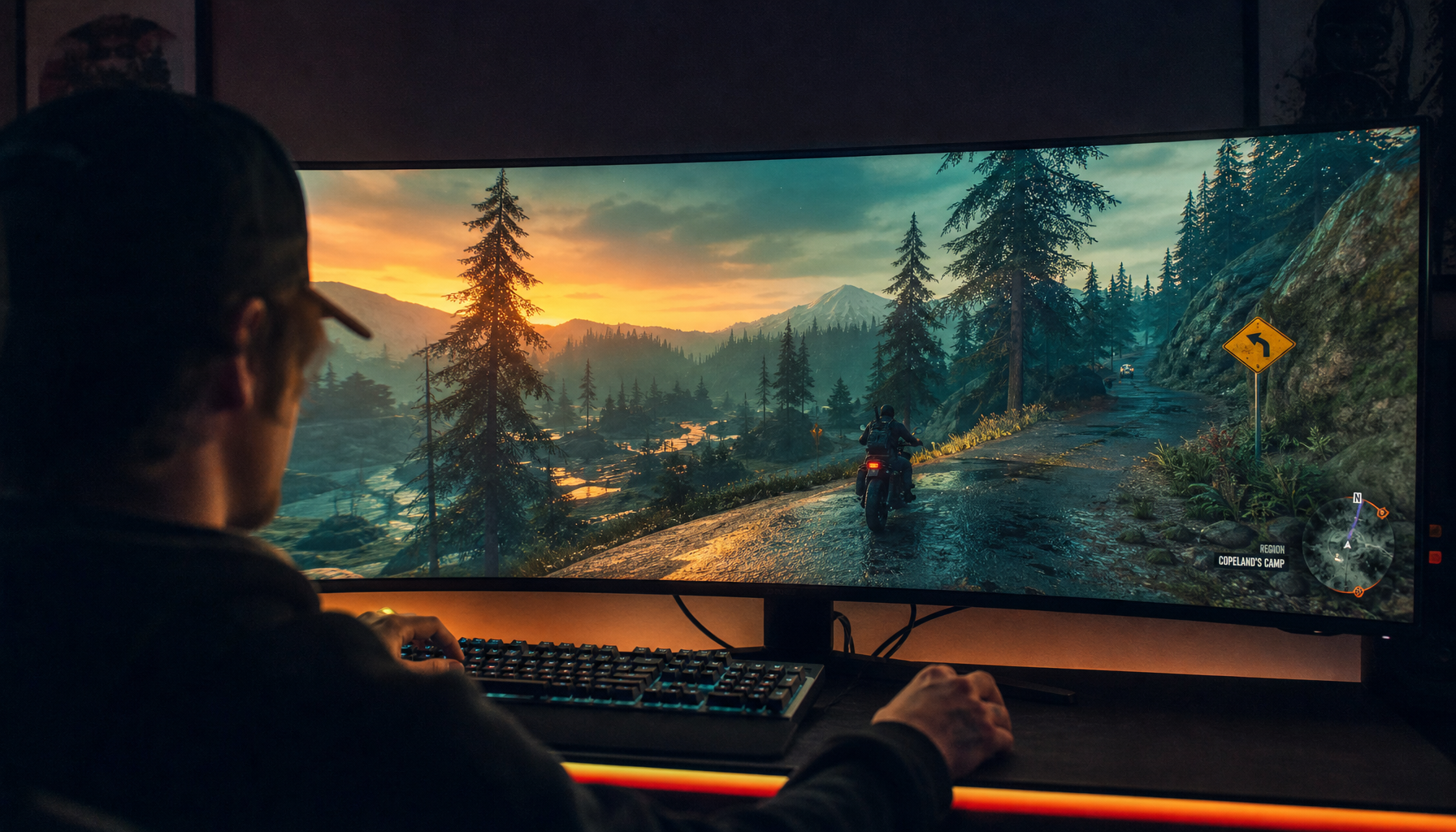
Peripheral degradation is also a geometry problem. A 27-inch 16:9 monitor keeps most action closer to your central field. A 34-inch ultrawide or 49-inch super-ultrawide puts more UI and motion into your side vision. That extra workspace can be excellent for productivity, timelines, dashboards, and immersive racing, but it also makes edge clarity more important. 21:9 monitors can reduce window switching and support side-by-side work, yet they demand better panel consistency because your eyes use more of the screen’s outer zones.

Curvature can help on large displays by keeping the edges more evenly oriented toward your eyes. It will not fix slow pixel response or sample-and-hold blur, but it can reduce the feeling that the far edges are visually detached from the center. For office users, the priority should be comfortable brightness, clear text, ergonomic placement, and the right scale. For gamers, the priority should be stable FPS, low latency, and clean motion settings across the full screen.
A practical desk setup matters. Keep the monitor centered, sit far enough back that you can scan the screen without constant head movement, and avoid pushing ultrawide panels too close. If the edges feel smeary mainly because they are too far into your peripheral field, no overdrive setting will fully solve it.
How to Tune for Better Peripheral Motion Clarity
Start by confirming the monitor is running at its intended refresh rate in the operating system and in-game. Then disable in-game motion blur, because that effect can stack with display blur and make peripheral motion less readable. Reducing or disabling game motion blur is practical because unwanted blur can reduce detail and immersion before the monitor even gets a chance to show a clean frame.
Next, tune overdrive with real content rather than relying on the fastest label. Use Normal or Medium as the baseline, then move up only if trails remain. If halos appear, move back down. Enable VRR when frame rate fluctuates, but remember that some fixed overdrive modes become too aggressive at lower FPS. If you use HDR, compare it against SDR because HDR may reveal artifacts that were hidden before.
Finally, test a blur-reduction or strobing mode only when you can keep frame rate locked to the strobe refresh rate and tolerate lower brightness. For competitive aiming, a clean fixed 144Hz strobe can sometimes feel more useful than a messy unlocked high-Hz mode. For mixed work and play, a fast IPS or OLED with conservative overdrive, stable VRR, and comfortable brightness is usually the better all-day choice.
FAQ
Is 240Hz Enough to Stop Peripheral Blur?
240Hz greatly reduces persistence compared with 60Hz, but it does not eliminate sample-and-hold blur. Peripheral clarity still depends on pixel response, frame pacing, overdrive tuning, brightness behavior, and how far the action sits from your central vision.
Does OLED Fix This Problem?
OLED helps because pixel transitions are extremely fast, so ghosting is much less likely than on many LCDs. It still uses sample-and-hold behavior in normal operation, so persistence blur can remain unless the refresh rate is very high or a low-persistence mode is used.
Should I Use the Fastest Overdrive Setting?
Usually not. The fastest mode often creates overshoot, which looks like bright halos or inverse ghosting. A cleaner Normal, Medium, or Fast setting is often better for real peripheral clarity than the most aggressive label.
Peripheral motion clarity is a system result, not a single spec. Buy for refresh rate, but tune for persistence, response behavior, frame stability, and your actual field of view; that is where a display starts feeling fast instead of merely advertising fast.