Panel bit depth controls how finely a monitor steps between shadow tones, so it directly affects whether dark skies, fog, smoke, and cave scenes look smooth or visibly striped. For immersive gaming, 10-bit output can help, but only when the game, graphics settings, cable bandwidth, refresh rate, and monitor processing all support it cleanly.
Why Dark Scenes Reveal Bit Depth Fastest
Bit depth is the number of tone levels a display can show per red, green, and blue channel. An 8-bit signal has 256 levels per channel, while 10-bit expands that to 1,024 levels per channel, which is why 10-bit supports far more subtle shade transitions.
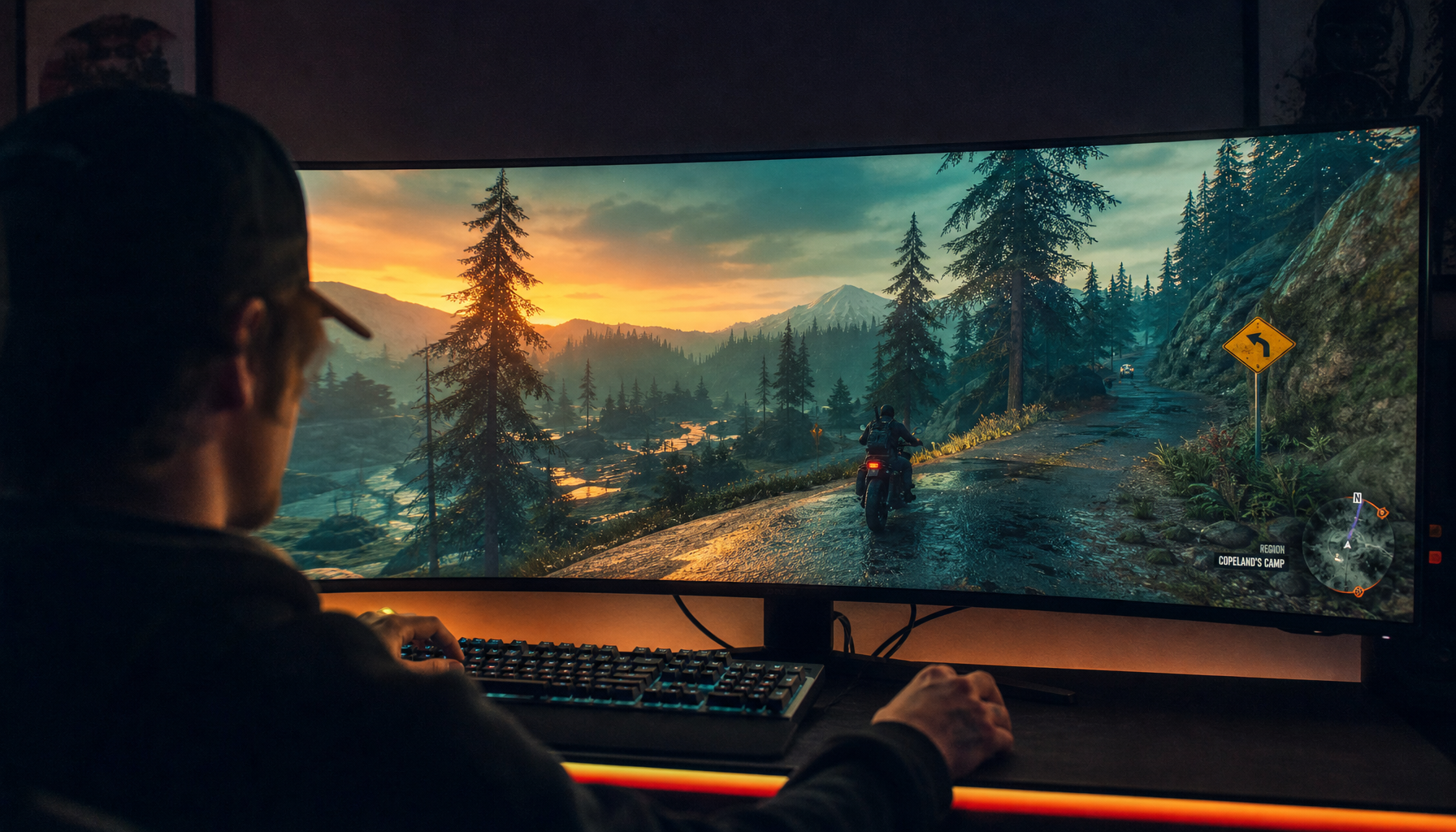
That matters most near black. In a bright scene, small tone jumps are easier to hide. In a moonlit hallway or smoky boss arena, those jumps can become obvious bands across the image.
 A practical way to think about it: 8-bit is often fine for SDR gaming, but HDR and wide-gamut visuals expose the limits faster because they stretch more brightness and color information across the screen.
8-Bit, 8-Bit + FRC, and True 10-Bit
Not every “1.07 billion color” monitor is a native 10-bit panel. Many value-focused gaming monitors use 8-bit + FRC, which rapidly alternates nearby shades to simulate extra tones.
That can still look good. In many midrange gaming and portable displays, 8-bit + FRC reduces visible banding enough for real play, especially at normal viewing distance. True 10-bit is more valuable if you play HDR-heavy cinematic games, edit video, or are sensitive to dithering shimmer.
For quick buying clarity:
- 6-bit class: avoid for dark-scene immersion.
- 8-bit: solid for SDR and competitive play.
- 8-bit + FRC: strong value for smoother gradients.
- True 10-bit: best for HDR, creative work, and premium visuals.
The nuance is that panel bit depth improves shade precision, but it does not fix weak contrast, poor HDR tone mapping, or compressed game assets.
Banding Is Often a Signal Chain Problem
Visible banding is the stair-step effect between shades, and it often shows up in dark gradients, smoke, skies, and gray UI panels. But the panel is only one part of the chain.
 Your monitor may support 10-bit, while your current mode is still outputting 8-bit because the refresh rate is too high for the cable or port bandwidth. For example, some displays can run 10-bit at 120 Hz but drop to 8-bit at 144 Hz or higher.
 HDR can complicate this further. Poor system HDR setup, mismatched RGB Full/Limited range, aggressive dynamic contrast, or inaccurate in-game HDR sliders can make shadows look crushed, raised, or banded.
What to Check Before Blaming the Monitor
Start with the settings that cost nothing. Set the display to its native resolution, confirm the graphics output color depth, and make sure RGB range matches across the graphics settings, monitor, and video player.
Then test the same dark scene in a few modes:
- SDR at maximum refresh rate.
- SDR one refresh step lower.
- HDR with system calibration complete.
- HDR with dynamic contrast disabled.
- A known smooth gradient image.
If banding improves when dropping from 144 Hz to 120 Hz, you are likely seeing a bandwidth or processing tradeoff, not a bad panel. If it appears only in one game or streaming clip, the source may already be compressed or posterized.
 The Buying Decision for Gamers
For competitive shooters, refresh rate and response time usually matter more than 10-bit output. A clean 144 Hz or 240 Hz 8-bit SDR experience can feel better than a compromised 10-bit mode with lag, blur, or washed-out HDR.
For cinematic RPGs, horror games, flight sims, and HDR open worlds, prioritize stronger gradient handling, contrast, and proven HDR behavior. A good gaming monitor should balance resolution, refresh, and panel quality because well-implemented HDR highlights and shadow detail can improve both bright highlights and shadow detail.
The best value target is simple: choose 8-bit + FRC or true 10-bit if you care about dark-scene immersion, but verify that the monitor can keep that color depth at the refresh rate you actually plan to use.