OLED monitors eliminate traditional backlight bleed because they do not use a separate backlight. They can still show other dark-screen flaws, so “no backlight bleed” does not mean perfect black uniformity in every unit.
Ever load a dark game menu at night and see gray corners pulling your eyes away from the center of the screen? Moving from LCD to OLED can remove that specific edge-leak problem at the hardware level, giving you cleaner blacks and stronger dark-scene focus when the panel is healthy. Here’s how to tell real backlight bleed apart from OLED-specific artifacts, test your monitor properly, and decide whether OLED is worth the upgrade.

The Short Answer: OLED Removes Backlight Bleed, Not Every Screen Flaw
A classic LCD monitor creates an image by shining a backlight through multiple layers, and backlight bleed happens when some of that light leaks through the edges, corners, or uneven panel areas instead of being blocked evenly. That is why backlight bleed is usually described as bright patches on dark backgrounds in LED TVs and monitors, especially around the border.
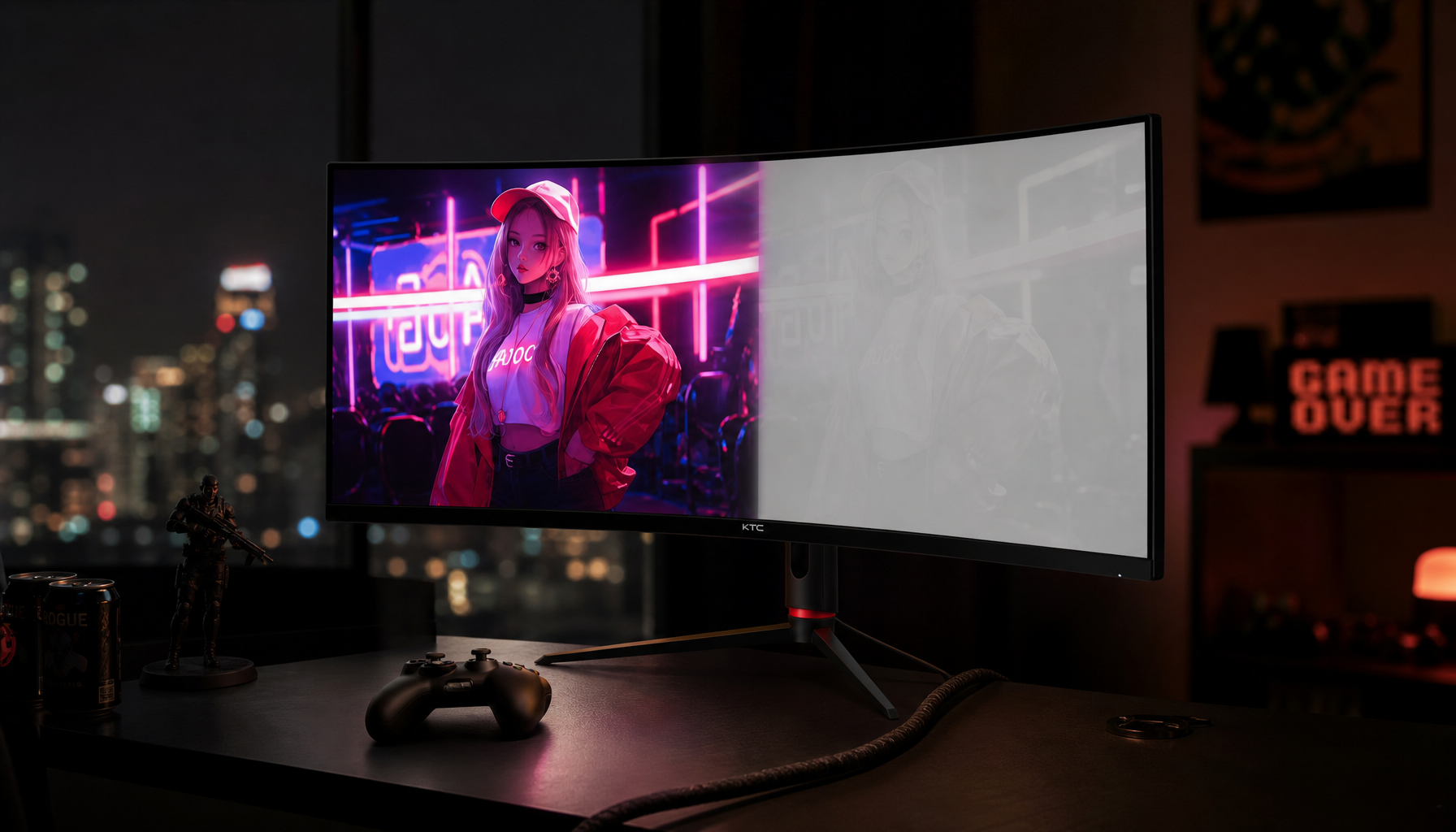
OLED works another way. Each pixel produces its own light, so there is no always-on backlight layer pushing light through the panel. When a pixel is asked to show black, it can turn off rather than merely block light. That is why OLED screens do not have traditional backlight bleed, and why they look dramatically cleaner in dark games, movies, and editing timelines compared with many edge-lit or lower-quality LCD monitors.
The important word is “traditional.” If someone says their OLED has “backlight bleed,” they are usually using the wrong name for another issue. It may be near-black banding, panel uniformity variation, temporary image retention, burn-in, edge brightness inconsistency, or a room reflection. The fix, return decision, and long-term risk depend on which one you are actually seeing.
What Backlight Bleed Really Is
Backlight bleed is not the same as poor contrast in general. It is unwanted light escaping through an LCD panel when the screen should be dark. You usually notice it on a black loading screen, a widescreen movie with black bars, a night scene in a game, or a dark desktop wallpaper viewed in a dim room.
LCD monitors are built as layered systems. The backlight sits behind the liquid crystal layer, and the panel tries to control how much light passes through each area. When the layers are slightly misaligned, compressed, unevenly assembled, or stressed by the bezel, light can leak more strongly through certain spots. LCD and LED displays are vulnerable because they rely on backlighting, while OLED and MicroLED panels do not use that same backlight structure.
In practice, backlight bleed often appears in familiar ways: a bright corner that looks like a flashlight aimed inward, a cloudy patch across a dark scene, or a thin edge glow tracing part of the bezel. On a productivity monitor, mild bleed may disappear when you open a spreadsheet or browser. On a competitive or cinematic gaming display, it can break immersion every time the scene fades to black.

Why OLED Has the Advantage in Dark Rooms
OLED’s real strength is pixel-level light control. Instead of dimming large zones or trying to block a global backlight, an OLED monitor can shut off individual black pixels. That gives it a decisive advantage for starfields, horror games, stealth scenes, dark UI themes, and video editing work where black levels matter.
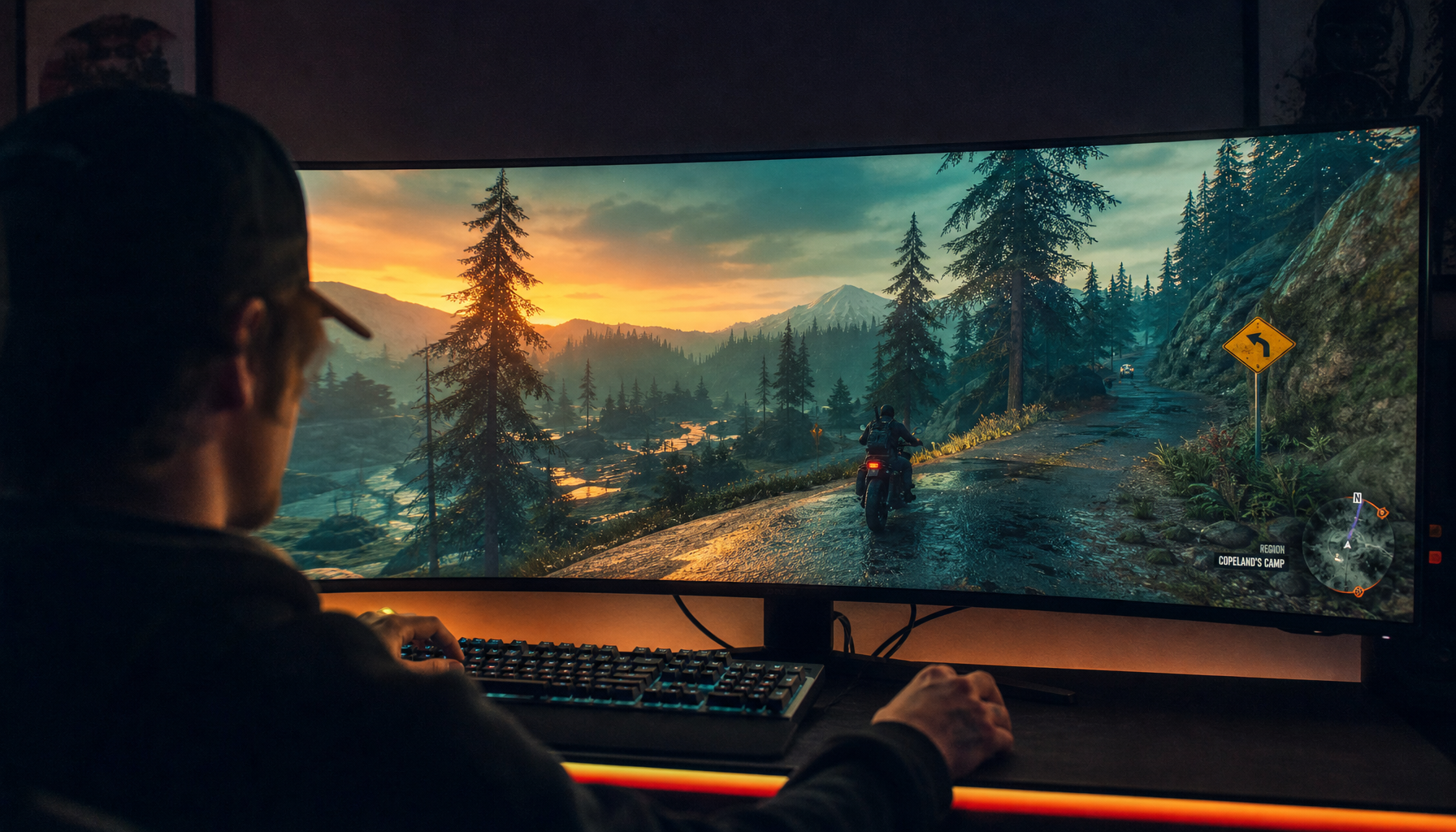
For gaming, the improvement is easy to feel. On an LCD with visible bleed, a dark tunnel may look uneven: one corner is washed out, another is gray, and your eyes keep checking the panel instead of the enemy outline. On OLED, the same scene can hold deep blacks beside bright highlights without the corner leak that makes the image feel lifted.
For office productivity, the benefit is more situational. If your day is mostly documents, dashboards, coding windows, and video calls under normal room lighting, backlight bleed may not affect you much. But if you work late, use dark mode, review media, or keep multiple dark apps open, OLED’s lack of traditional backlight bleed becomes a quality-of-life upgrade.
OLED Can Still Have Edge and Uniformity Issues
OLED is not automatically flawless. Some OLED panels can show panel uniformity issues, banding in near-black shades, reverse vignetting, temporary image retention, or burn-in risk over time. These are not LCD backlight bleed because they do not come from a separate backlight leaking through the edges.
A comparative OLED brightness discussion notes that edge bleeding can describe uneven brightness around an OLED panel’s perimeter, especially as screens become larger and bezels become thinner. That does not contradict the basic fact that OLED lacks traditional backlight bleed. It means the word “bleed” is sometimes used loosely for edge non-uniformity, even when the underlying cause is not a backlight.
This naming problem matters when you are deciding whether to return a monitor. If an LCD has obvious corner flashlights visible during normal movies or games, you may be looking at backlight leakage or panel pressure. If an OLED shows faint vertical bands on very dark gray slides, that is more likely near-black uniformity. If a static taskbar leaves a ghost-like mark after long use, that points toward image retention or burn-in behavior, not bleed.
OLED vs LCD for Bleed, Glow, and Dark-Scene Quality
Display type |
Backlight bleed risk |
Dark-room strengths |
Main trade-off |
TN LCD |
Possible |
Fast response in many gaming models |
Weaker viewing angles and contrast |
IPS LCD |
Possible, plus IPS glow |
Strong color and wide viewing angles |
Dark corners can glow or wash out |
VA LCD |
Possible, often less obvious than IPS in some units |
Higher native contrast |
Viewing-angle shifts and possible smearing |
Mini-LED LCD |
Reduced in some scenes, not eliminated |
High brightness and local dimming |
Blooming or halos around bright objects |
OLED |
No traditional backlight bleed |
True blacks and pixel-level contrast |
Burn-in risk, uniformity variation, brightness limits |
Mini-LED deserves special mention because it is often compared with OLED. A good mini-LED monitor can get very bright and reduce large-area grayness by dimming zones behind dark content. But it is still a backlit LCD. If the dimming zones are too large or the algorithm is aggressive, you can see blooming around subtitles, HUD elements, or a mouse cursor on a black background. OLED avoids that zone-based halo because the light is controlled at the pixel level.
How to Test a Monitor Without Fooling Yourself
A proper test starts with realistic conditions. Do not judge a monitor only from a long-exposure cell phone photo in a pitch-black room at maximum brightness. Cameras exaggerate glow, and maximum brightness is rarely how you should run a monitor for normal desktop use.
Use a full-screen black image or black test page, set the monitor to the brightness you actually use, and sit at your normal viewing distance. A browser-based black screen can help reveal backlight bleed and uniformity issues, especially when checking a new monitor during the return window. After that, test real content: a dark game scene, a movie with black bars, and a dark-mode app you use every day.

For LCDs, look for fixed bright patches that stay in the same place even when you move your head. For IPS panels, also check whether the glow changes as your viewing angle changes, because IPS glow is often mistaken for backlight bleed. For OLEDs, use dark gray screens as well as pure black. Pure black may look perfect because the pixels are off, while very dark gray can reveal near-black banding or subtle panel tint.
When OLED Is the Right Upgrade
OLED is the strongest choice if your biggest complaint is dark-scene distraction. If you play atmospheric games, watch movies at night, edit video, grade images, or simply hate gray blacks, OLED directly solves the backlight-based problem that LCDs can only manage. For example, a 27-inch 2K OLED gaming monitor such as the KTC OLED 27” 2K 240Hz/0.03ms USB-C Gaming Monitor fits this kind of gaming-focused upgrade, but it should still be compared on panel quality, warranty terms, and burn-in protections.
It is also a strong fit for portable smart screens and premium desk setups where perceived contrast matters more than peak full-screen brightness. A smaller OLED portable display can look especially impressive in controlled lighting because black pixels turn off and UI elements appear to float cleanly against the background.

The trade-off is static content discipline. OLED pixels age with use, and static interface elements such as taskbars, bright logos, fixed game HUDs, and persistent window layouts can create uneven wear over time. That does not make OLED fragile for normal use, but it does mean a productivity-first buyer should use sensible habits such as moderate brightness, screen savers, pixel-shift features if available, hidden taskbars, and varied content.
When an LCD Still Makes More Sense
LCD remains practical when you need high sustained brightness, lower price, zero burn-in anxiety, or long daily sessions with static dashboards. If you work eight to ten hours with the same spreadsheet grid, trading platform, security camera wall, or office app layout, a quality IPS, VA, or mini-LED monitor may be the more reliable value.

For LCD buyers, the smarter goal is not “zero bleed under torture-test conditions.” It is “no distracting bleed in normal use.” A mild edge glow that only appears on a black screen at full brightness in a dark room may not matter. A bright corner that shows up in every dark game, every movie fade, and every letterboxed scene is a return-worthy problem.
Lowering brightness, adding bias lighting behind the monitor, checking bezel pressure, and using a return window wisely are still the most practical LCD strategies. If a replacement panel might be worse, keep a good-enough unit that performs well in real content rather than chasing perfection through endless exchanges.
Practical Buying Advice
If your main pain point is backlight bleed, OLED is the cleanest technical answer because it removes the backlight from the equation. Choose it when black-level immersion is central to the way you game, create, or watch. Before buying, check the warranty, burn-in coverage, brightness behavior, text clarity reports, and whether your workflow includes long static elements.
If you choose LCD instead, prioritize a strong return policy and real-world reviews that discuss black uniformity, not just refresh rate and response time. A 240 Hz panel with distracting corner glow can feel less premium than a slower display that stays consistent in the scenes you actually play.
The best monitor is not the one that wins a spec-sheet argument. It is the one that disappears while you work, compete, and unwind. OLED does eliminate traditional backlight bleed completely, but a disciplined buyer still checks for uniformity, burn-in safeguards, and everyday fit before calling it the final upgrade.