Sample-and-hold blur happens because each frame stays visible while your eyes keep tracking motion, so the image smears across your vision even when the monitor refreshes quickly.
Ever track a strafing opponent on a 240Hz screen and still feel the target edges turn soft during a flick? A refresh-rate upgrade can make motion smoother, but the most practical win is learning whether your blur comes from frame persistence, pixel response, or the wrong monitor setting. You’ll leave with a clear way to diagnose the blur and choose settings or hardware that actually improve motion clarity.
What Sample-and-Hold Means
A sample-and-hold display shows a full frame, then holds that frame lit until the next refresh replaces it. Most modern LCD and OLED monitors behave this way during normal operation. The image is technically stable, but your eyes are not. When you follow a moving object across the screen, your eyes continue moving while the displayed frame remains in the old position, so the object spreads across your retina before the next frame arrives.

That is why motion clarity is not just a refresh-rate spec. It is the practical ability to keep fast movement readable, whether that movement is a tactical shooter crosshair adjustment, a racing apex, a scrolling spreadsheet, or a video timeline scrub.
A classic CRT avoided much of this persistence blur because the image was illuminated briefly and then faded. Modern flat panels are thinner, brighter, sharper, and more efficient, but their normal “hold the frame” behavior creates a different motion problem. The panel may be fast enough to change pixels, yet the frame can still be visible long enough for your eye tracking to smear it.
Why High Refresh Rates Help but Do Not Fully Fix It
Refresh rate reduces sample-and-hold blur by shortening how long each frame stays visible. At 60Hz, one frame lasts about 16.7 milliseconds. At 240Hz, it lasts about 4.2 milliseconds. That is a major improvement, and it is easy to feel when moving from a basic office display to a fast gaming monitor. Still, 4.2 milliseconds is not zero, so motion can remain softer than a briefly flashed image.

The practical takeaway is simple: higher Hz reduces persistence blur in proportion to frame time, but it does not erase the sample-and-hold effect. A 360Hz panel improves clarity again, and extreme refresh rates such as 540Hz or 720Hz push persistence lower, but the game also has to deliver matching frame rates to make the extra refresh cycles meaningful. A 300Hz monitor running a game at 120 FPS is not giving you true 300-frame motion detail.
Refresh rate |
Approximate frame hold time |
What you usually feel |
60Hz |
16.7 ms |
Obvious blur during pans and scrolling |
144Hz |
6.9 ms |
Smoother, but still soft in fast tracking |
240Hz |
4.2 ms |
Much clearer, not persistence-free |
360Hz |
2.8 ms |
Strong competitive clarity if FPS keeps up |
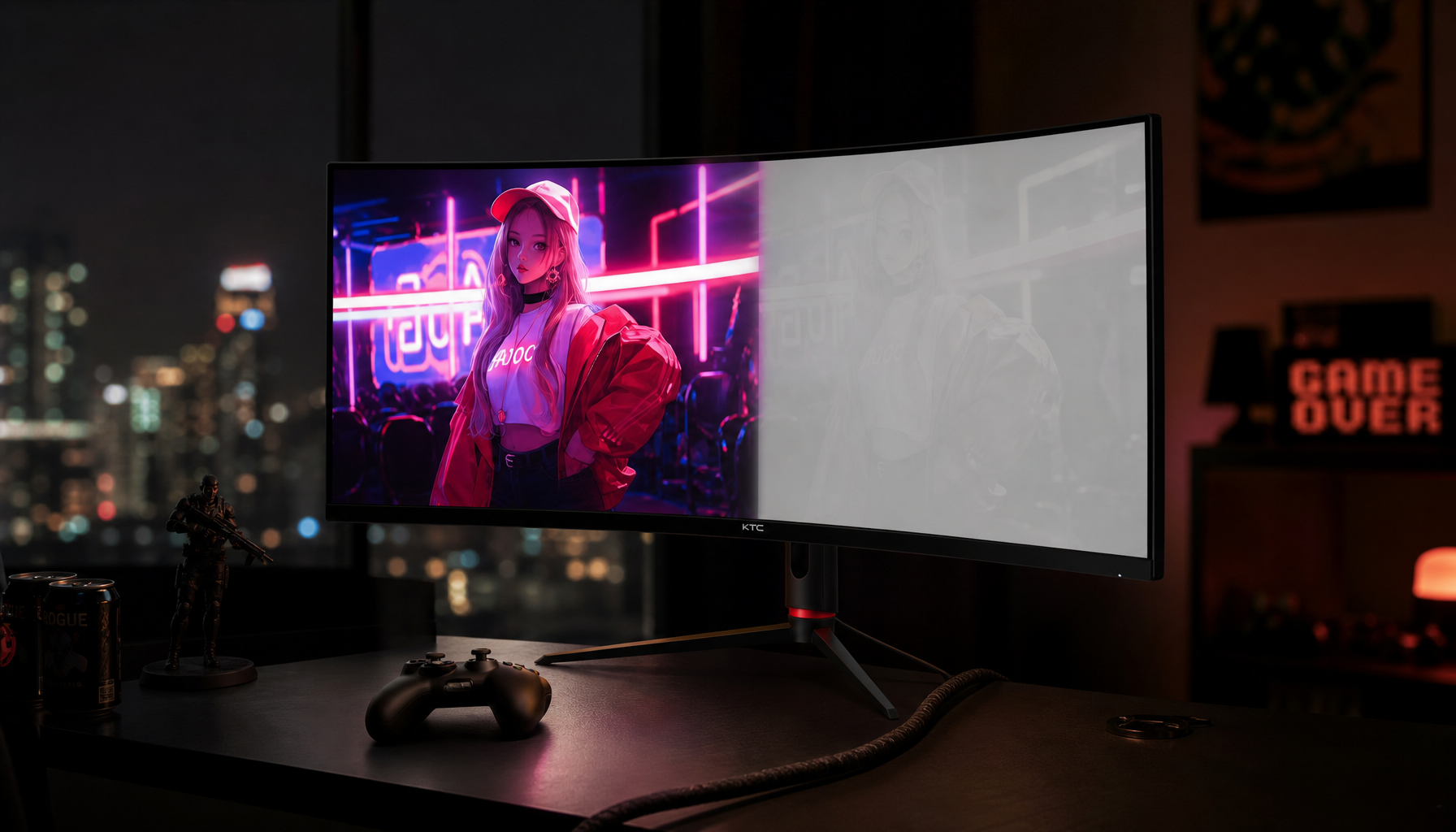
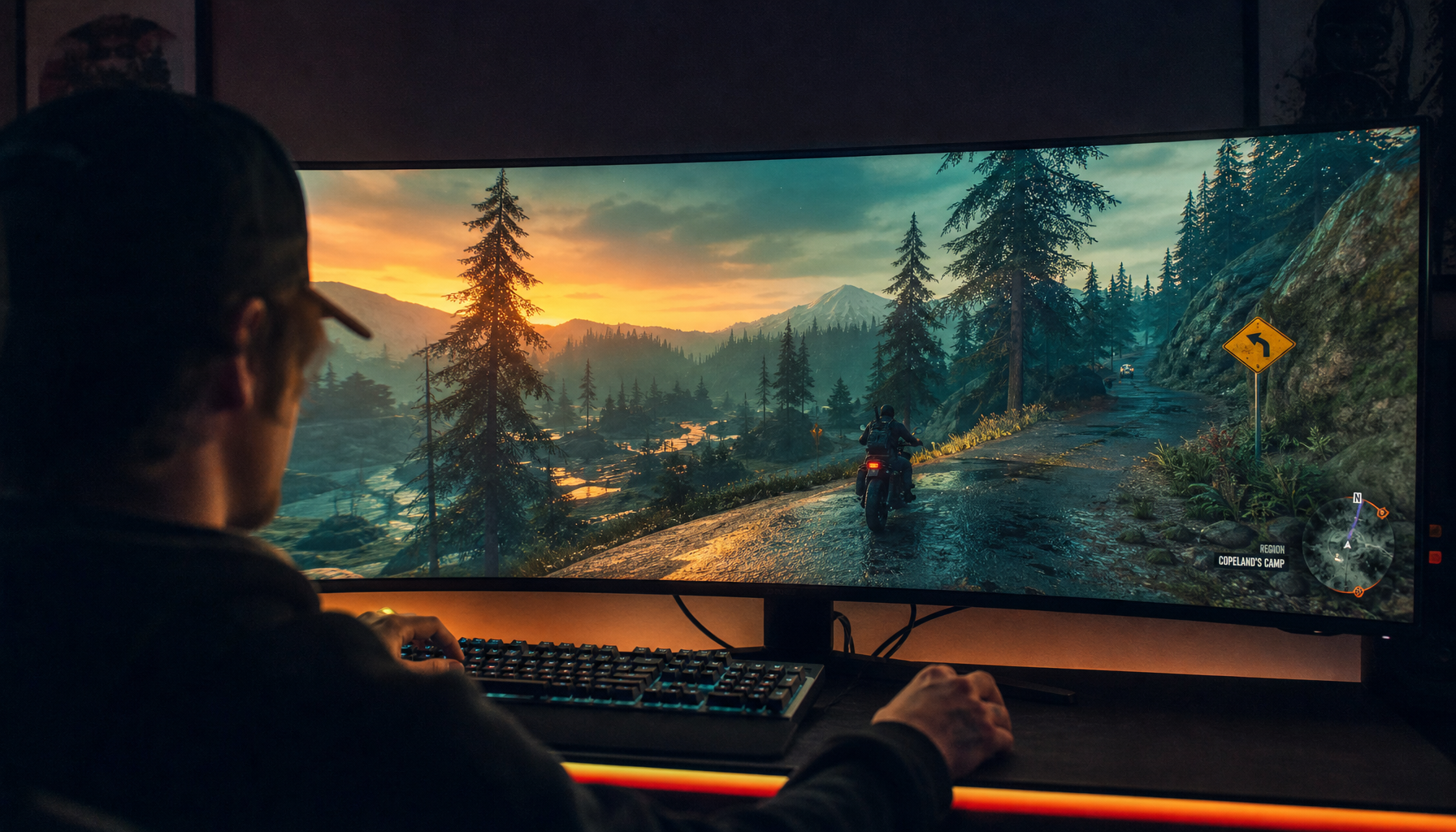
This is also why large curved ultrawides can make blur feel more obvious. The curve is not the root cause, but a wider field of view puts more moving image area into your peripheral vision. A curved gaming monitor can feel more immersive in racing or flight games while also exposing weaknesses in persistence, pixel response, and frame pacing.
Sample-and-Hold Blur Is Not the Same as Ghosting
The most common buying mistake is treating all blur as one problem. Sample-and-hold blur comes from frame persistence and eye tracking. Ghosting comes from pixels changing too slowly, so older image information trails behind the new frame. Both can happen at the same time, but the fixes are different.
A monitor ghosting trail usually looks like a faint duplicate or shadow following an object. Sample-and-hold blur is more like a uniform soft smear across the moving object. If a white cursor leaves a distinct dark trail on a gray background, suspect pixel response. If the whole screen becomes less readable only while your eyes track motion, suspect persistence blur.
Panel type matters here. OLED pixels can transition extremely quickly, which helps eliminate response-time smearing. Fast IPS panels can also perform well when tuned properly. VA panels often deliver strong contrast and deep blacks for the price, but some VA monitors show slow dark-to-dark transitions, which can create black smearing in night scenes or high-contrast game areas.
Why OLED Still Shows Motion Blur
OLED’s fast pixel response is a real advantage, but it does not automatically defeat sample-and-hold persistence. If an OLED operates in normal sample-and-hold mode, each frame is still held until the next refresh. That means a 240Hz OLED can look dramatically cleaner than a slower LCD because pixel transitions are not dragging behind, yet it can still show eye-tracking blur from persistence.
This distinction matters for shoppers comparing “0.03ms” response time claims with “240Hz” or “360Hz” refresh claims. Response time tells you how quickly pixels can change. Refresh rate and frame persistence tell you how long each frame remains visible. For elite motion clarity, you want both: fast transitions and short persistence.
The strongest real-world combination is a high-refresh OLED or QD-OLED running near its maximum refresh rate, especially for competitive games where the PC can sustain the FPS. For office work, that same OLED advantage may be less important than text rendering, brightness behavior, price, warranty, and static-content risk.

Blur Reduction Modes: Powerful, With Tradeoffs
Backlight strobing and black-frame insertion reduce sample-and-hold blur by making each frame visible for a shorter burst. Instead of holding a continuously lit image for the whole refresh window, the display flashes the image and then goes dark or dim between frames. Your eyes receive less stale image information during tracking, so moving objects can look sharper.

The tradeoff is that blur reduction modes often reduce brightness, can introduce flicker sensitivity for some users, and may require a tightly matched frame rate. Some implementations also disable adaptive sync. Strobe-based modes insert dark intervals to reduce persistence blur, while newer approaches try to combine strobing with variable refresh behavior for cleaner motion without giving up tear reduction.
For practical setup, test blur reduction only after your game can hold a steady frame rate. A 240Hz strobe mode with a game bouncing between 170 and 230 FPS can feel worse than a clean VRR setup because frame timing inconsistency becomes visible. If the monitor offers several strobe levels, start with the middle setting, then judge clarity, brightness, and comfort over a 15-minute play session rather than a single test pattern.
How to Tune a Monitor for Clearer Motion
Start by setting the monitor to its maximum refresh rate in the operating system and GPU control panel. This sounds basic, but many displays ship or reset to 60Hz after a cable swap, driver update, or laptop dock change. Use the native resolution as well, because scaling can soften the image before motion blur even enters the conversation.

Next, tune overdrive. A fast response time setting can reduce pixel trails, but the most aggressive mode often creates overshoot, where bright halos or inverse trails appear behind moving objects. In most monitors, “Normal” or “Fast” is more reliable than “Extreme.” The best setting can also change with refresh rate, which is why variable overdrive is valuable on higher-end gaming displays.
Then choose between VRR and strobing based on the game. For unstable frame rates, adaptive sync usually gives the better overall experience by reducing tearing and stutter. For esports titles where the system can hold a locked frame rate, a good strobing mode can improve target readability. A practical cap just below the refresh ceiling can also keep frame pacing steadier; for example, around 130 FPS on a 144Hz display or around 216 FPS on a 240Hz display.
Cable quality is the boring part that still matters. Use a certified video cable that supports the monitor’s full resolution and refresh rate. If a 1440p 240Hz display is connected through an older dock or weak adapter, you may be forced into a lower refresh mode or chroma format that undermines the whole upgrade.
Buying Advice for Gaming, Office Work, and Portable Screens
For competitive gaming, prioritize tested motion handling over headline specs. A 27-inch 1440p monitor at 240Hz or higher is a strong sweet spot if your GPU can feed it. OLED or QD-OLED gives the cleanest pixel response, while fast IPS is usually the safer LCD pick. VA can be excellent for contrast and immersive play, but buy it only when independent motion tests show low smearing.
For productivity displays, motion clarity still matters, but the target changes. Scrolling documents, spreadsheets, dashboards, and code feels better at 100Hz or 120Hz than 60Hz, yet resolution, ergonomics, USB-C, and text clarity usually matter more than chasing 300Hz. Current business monitor testing highlights workflow-first choices, from ultrawide conferencing displays to portable USB-C screens, reinforcing that the best work monitor depends on the job, not one universal spec.
For portable smart screens, be realistic about power, brightness, and refresh rate. A travel display used for email, presentations, and second-screen dashboards does not need esports-grade strobing. It does need readable text, stable USB-C behavior, and a refresh rate that does not make scrolling feel sluggish. If you also use it for gaming from a handheld PC or laptop, favor a model with low input lag, native-resolution sharpness, and honest response-time behavior over marketing claims.
The Cleanest Way to Think About Motion Blur
Sample-and-hold blur is a persistence problem: the frame stays visible while your eyes move. Refresh rate reduces it, pixel response prevents extra trails, and strobing attacks it directly by shortening visible frame time. The best display choice is the one that matches your workload: high-refresh OLED or fast IPS for competitive clarity, well-tuned ultrawide for immersion, and sharp ergonomic displays for long productivity sessions.