Esports coaches in 2026 often struggle with standard gaming monitors that prioritize single-player immersion over analytical workflows. A high-refresh PBP setup lets coaches review VODs with reduced motion blur while monitoring live telemetry and stats side-by-side, creating a more efficient multi-feed analysis station without constant window switching.

The Coaching Bottleneck: Why Gameplay Monitors Fail VOD Review
Standard gaming monitors are built for full-screen, single-feed play, which creates friction during coaching sessions that require simultaneous comparison of multiple sources. Coaches analyzing post-match VODs alongside live stats, heatmaps, or AI-generated telemetry frequently switch between windows or applications, which interrupts focus and raises cognitive load.
This workflow mismatch becomes especially apparent in team review sessions where spotting micro-decisions or mechanical errors demands both spatial context and temporal precision. This guide to effective VOD review highlights how structured analysis of recorded gameplay is a cornerstone of competitive improvement, yet the hardware many teams use was never optimized for that analytical layer.
For most coaching setups, the primary pain point is not raw frame rate during live play but the ability to scrub through footage cleanly while keeping supporting data visible. Without a monitor architecture that supports this natively, coaches lose time and accuracy.
Temporal Resolution: What 400Hz Actually Reveals in a Replay
High refresh rates such as 400Hz provide more than just faster gameplay response. They deliver improved temporal resolution—the ability to display finer changes over time—which helps during video scrubbing and frame-by-frame analysis.
Pixel response times create a “fuzzy zone” of motion blur on lower-refresh panels. Higher refresh rates shrink this zone significantly, making small timing details like micro-stutters or flick-shot mechanics easier to isolate. As explained in research on display behavior, high-speed video analysis of scanout and lag shows how reduced persistence and faster pixel transitions preserve clarity during rapid motion, which directly benefits coaches reviewing high-speed esports clips.
For coaches, this means fewer missed details when pausing or slowing replays. The benefit is most noticeable in 1080p esports titles where frame-level mechanical feedback matters. That said, refresh rate alone does not replace coaching expertise or dedicated analysis software; it simply removes one visual barrier.
For a deeper look at related display behavior, see our article on What Is Sample-and-Hold Blur and Why Higher Refresh Rates Don’t Eliminate It?.
The 'PBP Refresh Tax': Why Standard Panels Fail Esports Coaches
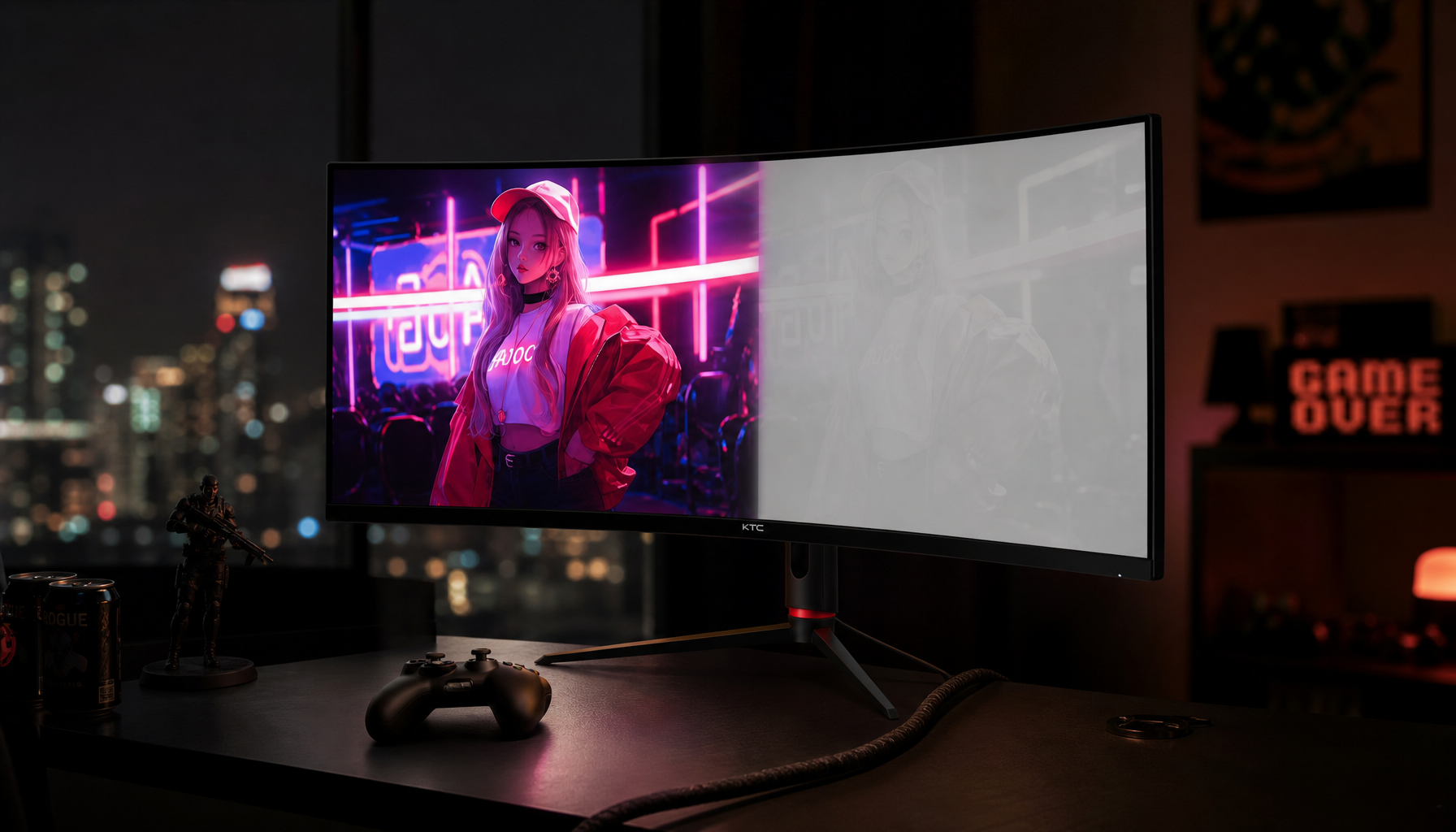
Picture-by-Picture (PBP) mode lets coaches display a VOD on one side of the screen and live telemetry or notes on the other without switching inputs. However, many monitors impose a refresh-rate penalty in multi-input modes because the internal scaler and processing bandwidth are shared.
On a typical 144Hz gaming panel, PBP often drops each feed to around 60Hz. At that level, motion clarity suffers and the fuzzy zone returns, making precise frame analysis difficult. Higher-bandwidth panels, such as those rated 360Hz or 400Hz, provide enough overhead to keep split feeds closer to the 120–144Hz range that professional analysts consider a practical minimum for clean motion.
PBP Refresh Tax and Motion Clarity in Multi-Feed Analysis
Shows how higher per-feed refresh demands can reduce motion clarity during split-screen analysis, especially on standard 144Hz-class monitors. The chart uses broad tiers to highlight relative impact rather than exact refresh thresholds.
View chart data
| Scenario | Low | Medium | High |
|---|---|---|---|
| Standard 144Hz | 3.0 | 2.0 | 1.0 |
| Esports-Pro 400Hz+ | 2.0 | 1.0 | 1.0 |
This “PBP Refresh Tax” explains why many standard panels disappoint in coaching roles. Features like VRR or HDR may also be restricted in split mode, further affecting consistency. Panels with robust scalers mitigate the tax, but actual performance still depends on firmware and signal routing.

Designing the 2026 Multi-Feed Coaching Workstation
Modern esports organizations combine VOD review with large volumes of in-game telemetry and AI-driven insights. A well-designed station therefore needs to keep both the replay and the supporting data visible at once.
For deep post-match analysis, prioritize temporal clarity with a compact high-refresh panel such as the KTC 24.5 inch 360Hz/400Hz OC Fast IPS FHD Gaming Monitor HDR 400 | H25X7. Its bandwidth helps maintain usable refresh in PBP, reducing blur during scrubbing. In live scrim monitoring, an ultrawide layout may better suit dense telemetry overlays without splitting the screen.
Hybrid approaches often work best. Coaches can route one input for 1080p high-refresh gameplay analysis and another for data dashboards. Signal quality matters: use premium DisplayPort or HDMI 2.1 cables and verify that the monitor’s controller sustains the desired rates when both inputs are active. Desk ergonomics also play a role—height-adjustable stands and proper viewing angles reduce fatigue during long review sessions.
Our guide to Vertical vs. Horizontal: How to Build the Ultimate Dual Monitor Productivity Setup offers additional ideas for arranging analysis tools around a primary coaching display.
Evaluating Monitors for Analysis: Beyond the 'Gamer' Specs
Coaches should evaluate monitors using objective motion-clarity metrics rather than marketing focused solely on competitive play. The VESA ClearMR standard provides a Clear Motion Ratio that grades the proportion of clear versus blurry frames, giving a more reliable indicator for analytical work.
Key practical factors include consistent pixel response across refresh rates, support for clean PBP implementation, adequate panel size for multi-view layouts (24–27 inches is common for focused review), and flexible signal inputs. Ergonomic stands that allow height and tilt adjustment help maintain comfortable posture during extended sessions.
A high-bandwidth scaler becomes essential if PBP is central to the workflow. Look for models that retain high refresh when split rather than defaulting to 60Hz. For broader buying context, review The Ultimate Guide to Choosing a Gaming Monitor for Peak Performance, which covers many of the same technical considerations.
Who Should Use a High-Refresh PBP Coaching Monitor?
A high-refresh PBP setup makes the most sense for team performance staff who run dedicated VOD review stations, tournament analysts who must cross-reference live data with replays, and academy coaches evaluating player mechanics at frame level. It is a strong fit when the primary bottleneck is motion clarity during scrubbing or the need to maintain context across multiple feeds without switching applications.
It is less suitable for coaches whose sessions are primarily live-only, those working with very limited desk space, or teams that rely entirely on broadcast-grade software rather than monitor-level multi-view. Budget-conscious buyers should confirm that the chosen panel actually sustains usable split refresh rates before purchase, as not all high-Hz models handle the PBP tax equally well.
When the workflow centers on detailed mechanical review paired with real-time telemetry, the added temporal resolution and multi-feed capability can meaningfully improve session efficiency. In other cases, a simpler single-input high-refresh monitor or a dedicated ultrawide may be the more practical choice.
FAQs
Does a 400Hz refresh rate improve VOD review for coaches?
It can reduce the fuzzy zone of motion blur during scrubbing and frame-by-frame playback, making micro-timing details easier to spot. However, the improvement depends on the monitor’s pixel response consistency and whether PBP mode maintains high enough per-feed refresh. It is most useful for fast-paced esports titles but does not automatically make every coach more effective without proper analysis methods.
How does PBP mode help with multi-feed esports coaching?
PBP displays a VOD replay on one portion of the screen and live stats, heatmaps, or notes on the other without requiring alt-tabbing or a second monitor. This preserves context and reduces workflow interruptions. The main limitation is the refresh-rate tax many panels apply in split mode; higher-bandwidth models minimize that drawback.
What monitor specs matter most for analytical coaching work?
Beyond headline refresh rate, look at motion-clarity ratings such as VESA ClearMR, the ability to sustain high refresh in PBP, input flexibility, and ergonomic adjustability. Consistent pixel response and low persistence matter more for scrubbing than peak single-input Hz. Panel size should balance detail density with desk practicality.
Can a standard 144Hz gaming monitor work for VOD analysis?
It can handle basic review but often drops to 60Hz per feed in PBP, introducing noticeable blur that obscures fine mechanical details. Coaches who frequently use split-screen workflows usually benefit from panels with greater processing overhead.
Should coaches choose 1080p or higher resolution for PBP setups?
1080p at high refresh rates typically offers the best combination of temporal clarity and low system load for fast esports titles. Higher resolutions add data density for telemetry but may require compromises on refresh rate or introduce scaling artifacts in split mode. Test both with your specific analysis tools.
What is the main limitation of using PBP for coaching?
The primary limitation is the refresh and feature penalty caused by shared scaler bandwidth. Many monitors disable VRR, reduce maximum Hz, or limit HDR when PBP is active. Always verify real-world behavior with your chosen signals rather than relying on single-input specifications.