Display input lag does not change the combo window itself, but it changes when you see the result of each input. On a low-lag, high-refresh-rate gaming monitor, cancels, parries, and recovery confirms tend to feel more direct and repeatable.
Ever land a launcher in training mode, press the follow-up on time, and still feel like the game is answering a half-beat late? In practical terms, the difference between a 60 Hz display refreshing every 16.7 ms and a 240 Hz display refreshing every 4.2 ms can decide how quickly your correction appears after a mistimed input. This guide explains what monitor lag does to combo execution and how to choose and configure a display for cleaner timing.
Why Display Input Lag Matters for Combo Execution
The monitor is only one part of the delay chain
In character action games, combo execution depends on a tight loop: press a button, see the move start, confirm the hit, cancel into the next action, and adjust before the enemy state changes. Input lag is the full delay between a button press, trigger pull, or stick movement and the visible result on screen. Display input lag is narrower: it is the monitor-side delay after the display receives a video signal.

That distinction matters because a “slow-feeling” combo can come from several places. The controller may report late, the game engine may buffer or delay input, the graphics processor may queue frames, vertical sync may hold a completed frame, or the monitor may add processing before showing it. A better monitor cannot remove every source of latency, but it can reduce the final delay before the animation, hit spark, parry flash, or enemy stagger becomes visible.
Combo timing is about feedback, not just button speed
A combo window in the game code may stay the same across displays, but your ability to execute it changes when visual feedback arrives sooner. If a launcher follow-up must be confirmed from an enemy’s airborne state, a delayed display makes that state appear later. You may still press the same buttons, but your visual rhythm shifts.

This is why low-lag displays help with cancels, perfect dodges, stance switches, jump cancels, parries, and just-frame follow-ups. They make the screen feel more connected to the controller. The practical benefit is not that the monitor gives you a larger timing window; it helps you see the outcome of each input quickly enough to keep the next input aligned.
Input Lag, Refresh Rate, and Response Time Are Not the Same
Input lag controls when feedback appears
A monitor can advertise fast response time and still feel delayed if its processing path is slow. Display latency is the delay after the monitor receives the frame, while total input lag also includes the controller, polling, processor, graphics processor, game engine, and display update. For combo execution, total input-to-screen delay is what you actually feel.
A simple example: if your character action game runs at 120 frames per second on a computer, but the monitor adds heavy scaling, motion smoothing, or picture enhancement, your inputs may still appear late. That can make a clean cancel route feel inconsistent even though the game is rendering enough frames.
Refresh rate changes how often new frames can appear
Refresh rate determines how often the monitor can show a new frame. A 60 Hz display updates about every 16.7 ms, 144 Hz about every 6.9 ms, 240 Hz about every 4.2 ms, and 360 Hz about every 2.8 ms. Higher refresh rates reduce the average wait for the next visible update when the computer or console can deliver frames consistently.
For combo-heavy play, moving from 60 Hz to 144 Hz is usually more noticeable than moving from 144 Hz to 240 Hz because the frame interval drops by nearly 10 ms. The jump from 144 Hz to 240 Hz is still useful, but the refresh interval improves by about 2.7 ms, so settings such as vertical sync, frame queue depth, and game mode can matter just as much.
Response time affects clarity, not command timing directly
Response time is pixel transition speed. It affects motion blur, ghosting, and overshoot when enemies, camera pans, or sword trails move quickly. A “1 ms” response-time claim does not guarantee low input lag because that number usually describes pixel behavior, not the full input-to-visible-output chain.
In character action games, response time still matters because clean motion makes timing reads easier. If overdrive is too weak, the image may smear during fast camera movement. If overdrive is too aggressive, bright inverse ghosting can make hit sparks and enemy silhouettes harder to read. The best setting is usually the monitor’s balanced or normal overdrive mode, especially when frame rate varies.
How Much Lag Is Noticeable in Tight Combos?
Practical thresholds for action games
For timing-sensitive games, display lag below 10 ms is a strong target for a gaming monitor. Third-party input-lag testing notes that lag may become noticeable around 30 ms, while about 20 ms can already affect reaction-based games. Character action games sit in an awkward middle: they are not always as reaction-driven as competitive shooters, but advanced combo routes often require precise visual reads.
A practical training-room scenario makes this clearer. If you are practicing a launch, air follow-up, jump cancel, aerial relaunch, and finisher, each step depends on seeing the previous state soon enough to continue. A display that adds enough delay to make feedback feel late can push you toward memorized rhythm instead of visual confirmation, which breaks down when enemy weight, hit stun, or camera angle changes.
Vertical sync and frame queues can outweigh refresh-rate upgrades
Display choice matters, but system settings can add larger delays than a refresh-rate upgrade removes. Cited fighting-game tests in the research notes measured low-lag results near 59-61 ms with vertical sync off, compared with about 102-103 ms with in-game vertical sync. Lowering pre-rendered frames to 1 reduced vertical sync latency from 109 ms to 95 ms by cutting down queued frames.

That does not mean vertical sync is always wrong. Screen tearing can distract from execution, especially on large monitors or ultrawide displays where horizontal tears are easy to notice. The better approach is to test vertical sync, adaptive sync, and a frame cap one at a time, then keep the setting that gives stable pacing without making cancels feel late.
Monitor Types: High-Refresh, Ultrawide, and Portable Displays
High-refresh gaming monitors are the safest choice for execution
For computer players who care about combo consistency, a 144 Hz or 240 Hz gaming monitor with low measured input lag is the most reliable baseline. Minimum center-screen lag is partly limited by refresh timing: 60 Hz is about 8.33 ms at the screen center, 120 Hz about 4.17 ms, 144 Hz about 3.47 ms, 240 Hz about 2.09 ms, and 360 Hz about 1.39 ms before other processing is considered.
The important buying point is measured input lag at the resolution and refresh rate you will actually use. A 27-inch 2K 240Hz low-lag gaming monitor such as a gaming monitor can be a useful comparison point against 60 Hz or 144 Hz options, but measured input lag at the mode you use and game-mode behavior matter more than the 0.03 ms response-time spec alone. If you play both computer action games and console action games, check latency behavior at 60 Hz and 120 Hz, not just the maximum refresh rate.

Ultrawide monitors can be excellent, but check processing and scaling
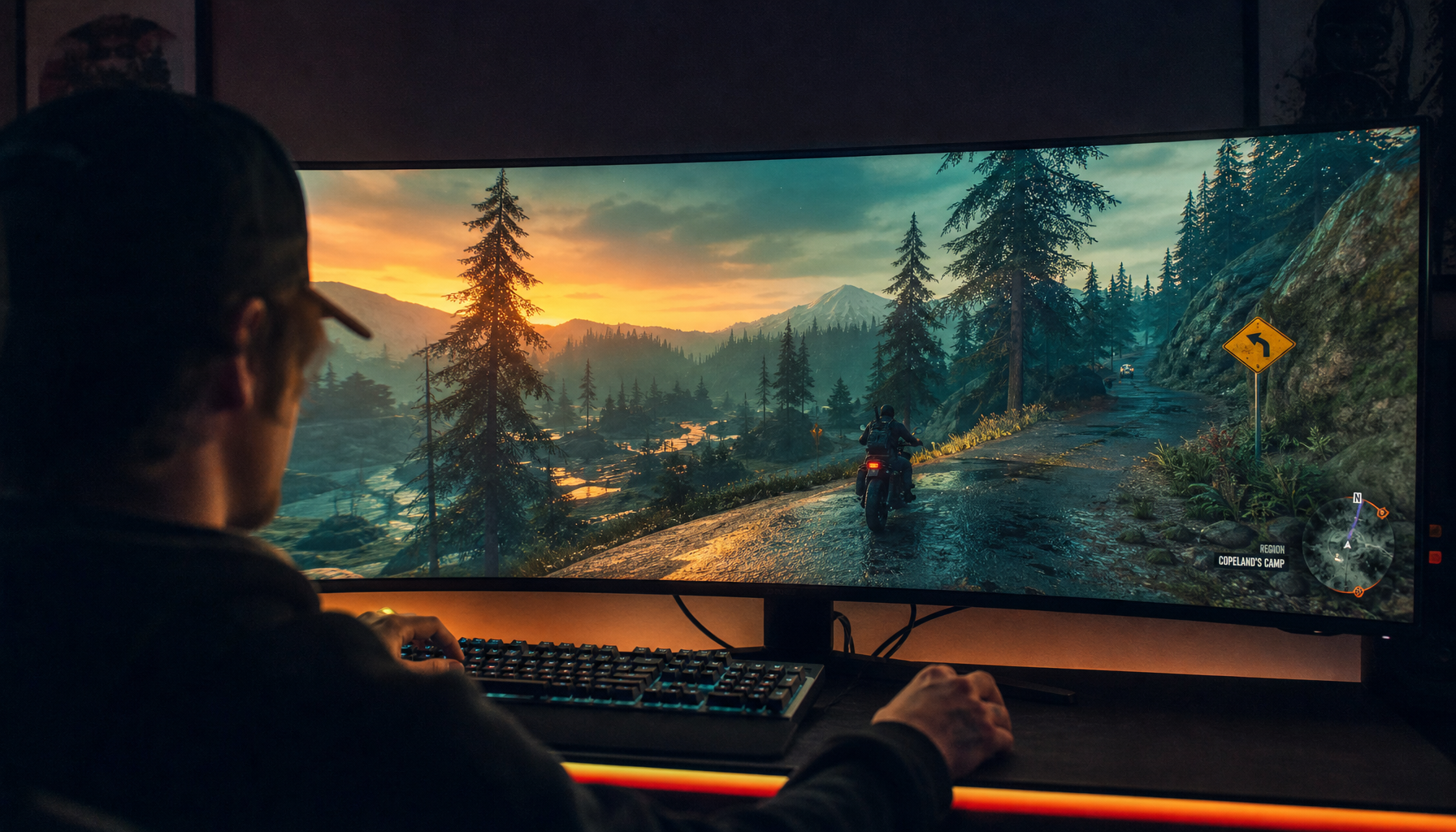
Ultrawide monitors can improve spatial awareness in supported games, especially when the camera pulls back and the UI scales correctly. For combo execution, the risk is not the wider panel itself; it is added processing from non-native aspect ratios, graphics-processor scaling, picture-by-picture modes, or frame interpolation features. Use the monitor’s native resolution when possible and disable extra image processing for action games.
There is also an ergonomics factor. On a large ultrawide, important enemy tells can sit farther from your central vision than on a 27-inch 16:9 display. If you find yourself missing parry flashes at the edges, move the monitor slightly farther back, reduce excessive field-of-view settings if the game allows it, and keep the HUD within a comfortable scan area.
Portable monitors need closer spec scrutiny
Portable monitors are useful for travel, dorm rooms, compact desks, and console setups, but they vary widely in latency behavior. A portable display advertised as gaming-ready should still be evaluated by refresh rate, input lag, native resolution, single-cable video behavior, standard video-input behavior, and whether game mode is available. Battery-powered or hub-style setups can also introduce quirks if the display is running through adapters.
For action games on a portable monitor, prioritize a direct video connection, native resolution, and the highest stable refresh rate supported by your system. If a portable display only supports 60 Hz, it can still be playable, but it gives you a 16.7 ms refresh interval, so reducing processing and avoiding unstable frame pacing becomes more important.
Buying and Setup Priorities for Combo-Focused Play
Compare the specs that actually affect execution
The best display for combo execution is not simply the one with the biggest refresh-rate number or the lowest advertised response time. Total input lag should come first, followed by refresh rate, motion clarity, and then image-processing extras. For most players, a low-lag 144 Hz or 240 Hz monitor will feel better than a display with flashy picture features that add delay.
Use this comparison as a practical shopping and setup filter:
Parameter |
Why It Matters for Combos |
Good Target |
Watch Out For |
Measured input lag |
Determines how soon visual feedback appears |
Under 10 ms for competitive-feeling play; 15-20 ms can still be acceptable |
“1 ms” response-time claims that do not measure input lag |
Refresh rate |
Reduces time between visible updates |
144 Hz minimum for computer action games; 240 Hz if your system can sustain it |
Buying 240 Hz when the game is locked to 60 frames per second |
Frame pacing |
Keeps cancel rhythm consistent |
Stable frame rate with minimal stutter |
Uncapped frame rates that swing widely |
Sync mode |
Controls tearing and queue behavior |
Adaptive sync or carefully tested vertical sync/frame cap |
Vertical sync adding tens of milliseconds in some setups |
Overdrive |
Improves motion clarity |
Balanced/normal mode |
Strong overdrive causing inverse ghosting |
Scaling mode |
Can add processing delay |
Native resolution and direct output |
TV-style processing, graphics-processor scaling conflicts, non-native aspect ratios |
Input connection |
Affects supported modes and stability |
A video-input mode that supports target refresh |
Adapters that limit refresh rate or color format |
Configure the display before judging the game
Many players blame their execution before checking whether the monitor is actually running at its advertised refresh rate. In the operating system, confirm the refresh rate in display settings and in the graphics control panel. On console, check whether the game supports 120 Hz output and whether the monitor’s video input supports that mode.
Then set the monitor to game mode or low-lag mode, turn off motion smoothing and heavy noise reduction, and choose a sensible overdrive level. Display delay compounds with peripheral polling, render latency, refresh timing, scanout, and monitor processing, so small fixes across the chain can add up to a cleaner feel.

Use a repeatable combo test
Pick one route you know well: for example, launcher, air normal, jump cancel, air special, ground restand, finisher. Run it ten times with your current settings, then change only one display or sync setting and repeat. Do not change overdrive, vertical sync, frame cap, and resolution all at once, because you will not know which setting helped or hurt.
A useful test is whether you can visually confirm the next input rather than relying only on muscle memory. If the route feels better but the image tears badly, try adaptive sync or a frame cap just below the monitor’s refresh rate. If the image looks clean but cancels feel late, test vertical sync off, game mode on, and lower frame queue settings where the driver allows it.
Action Checklist for Lower-Lag Combo Execution
Use this checklist before replacing your monitor, because settings can create or remove more delay than many players expect.
- Confirm the monitor is running at its highest supported refresh rate in the operating system, graphics panel, or console video settings.
- Enable game mode, low-lag mode, or instant mode on the display.
- Disable motion smoothing, dynamic contrast, noise reduction, and other TV-style image processing.
- Use native resolution and avoid unnecessary scaling through adapters, capture devices, or picture-by-picture modes.
- Test adaptive sync, vertical sync off, and a frame cap one at a time; keep the setup with the best balance of pacing and responsiveness.
- Set controller or mouse polling to 1,000 Hz when stable, because lower polling intervals can add avoidable input delay.
- Choose balanced overdrive instead of the strongest setting if inverse ghosting makes hit sparks, enemy outlines, or parry effects harder to read.
FAQ
Q: Is 240 Hz necessary for character action games?
A: No, but it can help if the game and system can deliver enough frames. A strong 144 Hz low-lag gaming monitor is already a major upgrade from 60 Hz because the refresh interval drops from 16.7 ms to about 6.9 ms. A 240 Hz monitor lowers that interval to about 4.2 ms, which feels smoother, but poor sync settings or frame queues can erase much of the benefit.
Q: Does a 1 ms response-time monitor guarantee better combo timing?
A: No. Response time affects pixel transitions, which changes motion clarity and ghosting. Combo timing depends more on total input-to-screen delay, including game processing, graphics rendering, sync behavior, and monitor latency. A monitor with a realistic 3-5 ms pixel response and very low input lag can feel better than a “1 ms” display with slow processing.
Q: Can a portable monitor be good enough for action games?
A: Yes, if it has low input lag, a stable direct video connection, and the refresh rate you need. A 60 Hz portable monitor can be playable for casual action-game sessions, but a 120 Hz or higher portable gaming display will usually feel more responsive for tight cancels and parries. Avoid judging the display until you verify that it is running at native resolution with game mode enabled.
Key Takeaways
Display input lag affects combo execution by delaying the feedback you use to confirm hits, cancels, parries, and recovery states. It does not rewrite the game’s timing windows, but it changes how directly your inputs appear on screen, which can make advanced routes feel consistent or slightly late.
For most players, the best practical target is a low-lag 144 Hz or 240 Hz gaming monitor, configured in game mode, running at native resolution, with unnecessary processing disabled. Before buying a new display, verify refresh rate, sync settings, frame pacing, overdrive, and scaling. If those are already optimized and combos still feel delayed, then measured monitor input lag should move to the top of your upgrade list.