A monitor’s backlight spectrum sets its color potential, while calibration determines how faithfully those colors match the intended target.
Does your game look electric and vivid, while skin tones in photos look sunburned and spreadsheets feel oddly blue? A focused check of color mode, gamut coverage, white point, and brightness can quickly show whether the issue comes from the screen’s light source or its settings. Here is how to judge that relationship clearly and choose a display for gaming, creative work, office productivity, or portable use.
Backlight Spectrum, Explained Simply
On most LCD monitors, the pixels do not create light by themselves. A backlight shines through liquid crystal cells and color filters, and the final image depends heavily on the spectral mix of that light. A basic white LED backlight may be efficient and affordable, but it often has a narrower color range than advanced systems that use enhanced phosphors, Quantum Dot films, Mini LED local dimming, or RGB LED designs.

That spectrum matters because color filters can only work with the light they receive. If the backlight has weak red output, the panel cannot magically produce rich, accurate deep reds. If the green and red peaks are narrow and well controlled, the display can often reach wider gamuts such as DCI-P3 or print-oriented RGB color with more convincing saturation. Quantum Dot technologies are widely used for this reason: they help LCDs produce more focused red, green, and blue light than basic white LED backlights.
OLED is different because each pixel emits its own light rather than relying on a separate backlight. That can deliver excellent blacks and contrast, but LCD remains competitive because it is often more affordable, very bright, and available in many sizes for desks, esports setups, and travel screens.
Color Accuracy Is Not the Same as Wide Color
Color gamut describes the range of colors a display can reproduce. Color accuracy describes how close those colors are to the reference values the content expects. A monitor can be wide-gamut and inaccurate, just as a standard-gamut office monitor can be impressively accurate inside sRGB.
This distinction matters in real buying decisions. A 27-inch gaming monitor advertised with vivid DCI-P3 color may make landscapes and neon effects look more immersive, but if it lacks a good sRGB mode, web images and office graphics can look oversaturated. Wide-gamut LCDs also need gamut conversion, gamma correction, and uniformity control to reproduce color accurately instead of merely producing more color.
For example, if you edit a product image for an online store on a wide-gamut monitor with no sRGB clamp, a red backpack may look normal on your screen but too intense on standard office laptops. The backlight gave the monitor the ability to show strong red, but the display pipeline failed to map ordinary sRGB content correctly.
Why the Backlight Spectrum Sets the Ceiling
Think of the backlight as the monitor’s color fuel. The panel, firmware, and calibration decide how cleanly that fuel is used. A better spectrum can expand the monitor’s possible color range, improve HDR color volume, and make saturated hues easier to separate. It does not guarantee accuracy by itself.
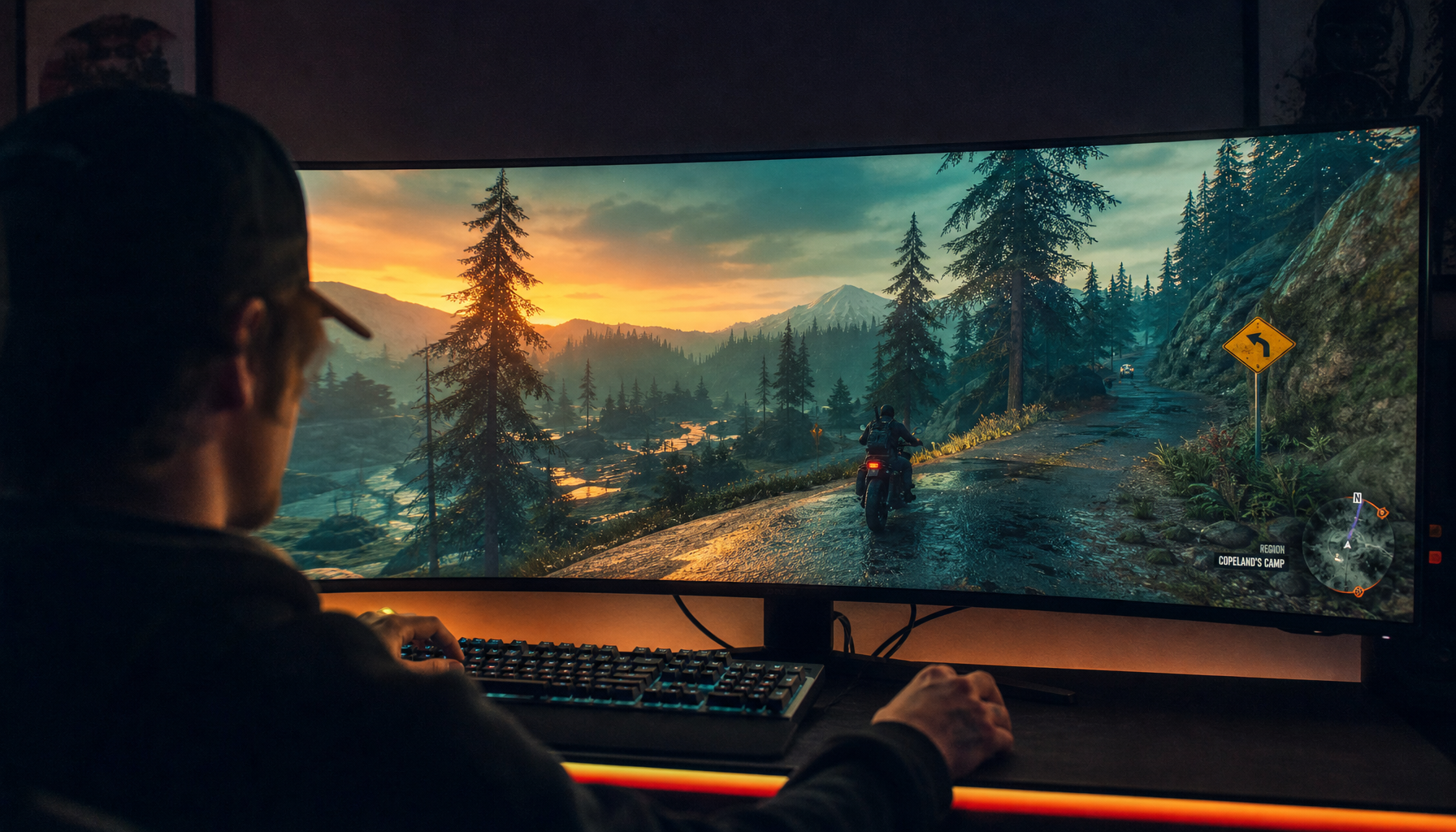
For gaming, this is why some wide-gamut displays make night scenes, fire, foliage, and lighting effects feel more dimensional. Wide color gamut can improve immersion by making lighting, shadows, sunsets, and environmental details appear closer to developer intent, especially when the game and operating system handle color correctly.

For office work, the benefit is more restrained. A balanced IPS display with accurate sRGB, stable viewing angles, and comfortable brightness may be more useful than an aggressively saturated panel. For photo and video work, the backlight spectrum becomes decision-critical because print-oriented RGB color, DCI-P3, and HDR workflows demand more color range than a basic sRGB monitor can provide.
The Chain From Light to Accurate Color
A display’s color result comes from several linked stages. The backlight spectrum provides the raw wavelengths. The color filters or emissive subpixels shape those wavelengths into red, green, and blue primaries. The panel type affects viewing-angle stability and contrast. The monitor’s electronics control gamma, white point, color modes, and tone mapping. Calibration then measures and corrects the screen’s behavior.
That is why panel type still matters. IPS panels are commonly favored for color-sensitive work because they maintain color and brightness more consistently off-axis than TN panels. VA panels often provide stronger contrast, which can help movies and dark games, but color shifts can be more noticeable from the side. OLED delivers deep blacks and strong contrast, while Mini LED LCDs can offer high brightness and more precise backlight control for HDR.
For a buyer, the practical test is simple: do not judge color accuracy from vivid mode in a showroom or from the brightest preset on a product page. Look for measured gamut coverage, Delta E results, factory calibration claims, and useful color modes.
Gamut Coverage vs. Area Claims
Monitor marketing often compresses color into one impressive number, but not all color numbers mean the same thing. “72% NTSC” is a classic example. It may suggest sRGB-class color, yet it does not prove the display actually covers the same sRGB coordinates.
Color gamut is usually represented as a triangle on a chromaticity diagram, and two triangles can have similar area while failing to overlap properly. Coverage is more useful than area because it tells you how much of a target space the monitor can actually reproduce. For web, office, and most games, high sRGB coverage matters. For HDR games, modern video, and many creator workflows, DCI-P3 coverage becomes more important. For photography and print-oriented work, print-focused RGB coverage can matter more than flashy gaming saturation.

Spec Claim |
What It Helps You Know |
What It Does Not Prove |
99% sRGB |
Strong fit for web, office, SDR gaming, and general content |
Accuracy without calibration |
90%+ DCI-P3 |
Better potential for HDR video and modern game color |
Correct sRGB display behavior |
95% print-focused RGB |
Better fit for photo and print workflows |
Good motion performance |
72% NTSC |
Rough color-range signal |
Full sRGB coverage or accuracy |
Backlight Spectrum and White Balance
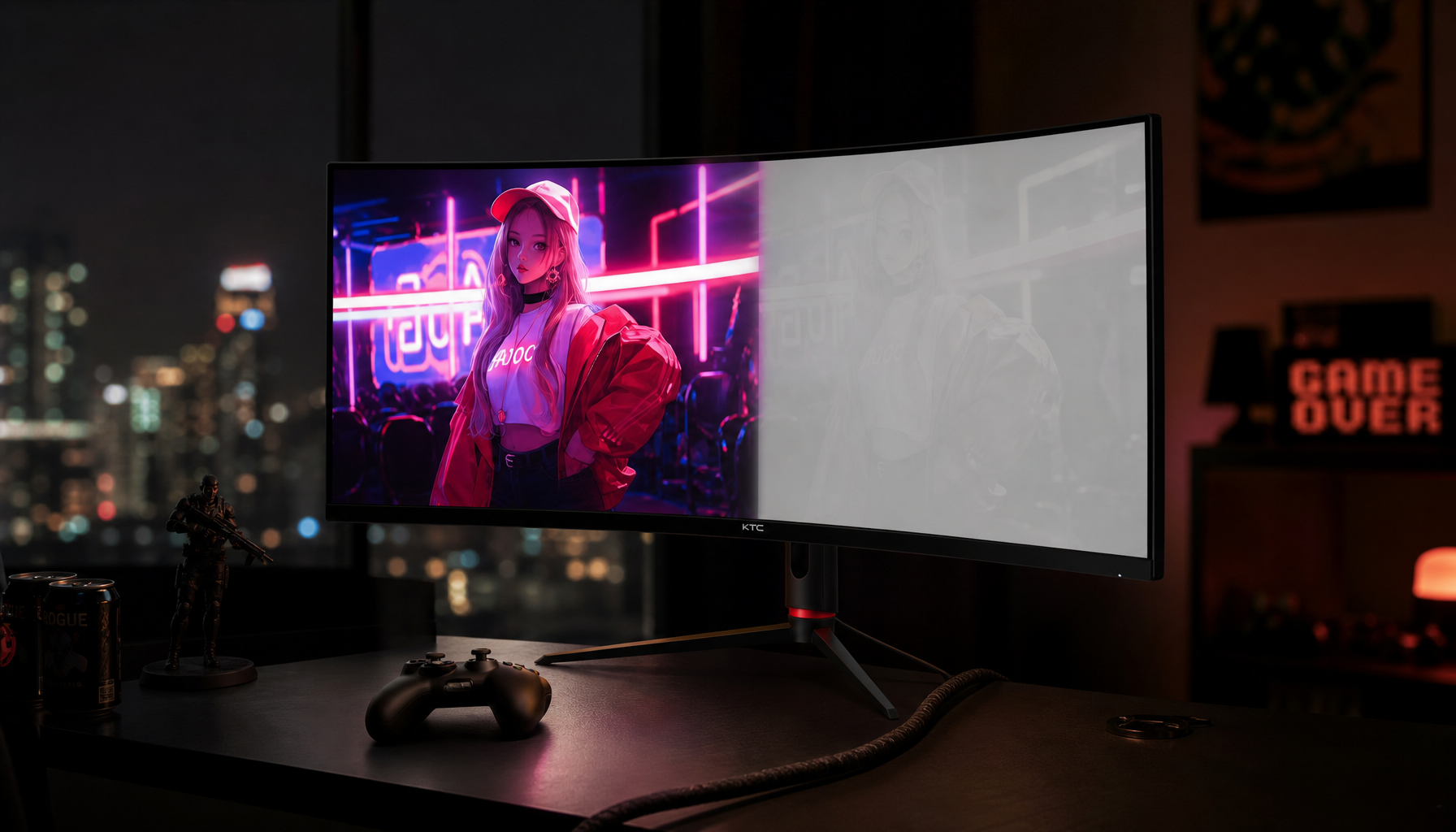
White balance is where many displays reveal their personality. A cool backlight can make whites look bluish. A warm preset can make neutral gray look yellow. A wide-gamut display in the wrong mode can push skin tones too red and grass too neon.
The common target for general monitor calibration is D65, roughly 6500K, with gamma around 2.2 for standard SDR work. You do not need to memorize the science to use it well. Open a neutral gray test image, disable blue-light reduction, avoid direct sunlight on the screen, choose Standard, Custom, User, or sRGB mode, then set brightness to match the room instead of maxing it out.
For a real-world desk setup, a creator using a 27-inch 4K IPS monitor for photo-editing software, a laptop screen for email, and a portable USB-C monitor for travel should make one calibrated, uniform display the reference. The other screens are useful for sanity checks, not final color decisions.
What Gamers Should Prioritize
Competitive gamers should not buy color at the expense of speed. Refresh rate, response time, input lag, and adaptive sync still decide whether the screen feels responsive. But color is not cosmetic. Better shadow distinction, cleaner hue separation, and accurate UI colors can make game information easier to read.
A balanced gaming target is a fast IPS or OLED monitor with strong sRGB coverage, a usable sRGB mode, and meaningful DCI-P3 coverage if you play HDR or cinematic titles. Gaming monitor advice consistently points users toward matching the display to the PC, game type, and desk setup rather than chasing one headline spec.
If you mostly play esports, a 24- or 27-inch high-refresh display with low blur and decent sRGB accuracy is the smarter value play. If you play RPGs, racing games, flight sims, or visually rich single-player titles, a 27- or 32-inch 1440p or 4K wide-gamut display can deliver a more immersive return.
What Creators and Office Users Should Prioritize
For photo, design, and video work, the backlight spectrum should support the color space you actually deliver. A photographer preparing web galleries needs excellent sRGB behavior. A print-focused editor may need print-oriented RGB coverage. A video creator working in HDR or modern streaming workflows should care about DCI-P3, HDR brightness, and tone mapping.

Photo editing monitors should be factory-calibrated and color-accurate because editing decisions need to translate across screen, print, and other outputs. A 1440p monitor is a reasonable baseline, while 4K gives more detail for inspecting sharpness, retouching, and timeline work.
Office users should lean toward readability and comfort. A monitor for working from home benefits from matching screen size with resolution, because pixel density affects text clarity. A 27-inch 4K IPS display is often a strong productivity choice, while a 24-inch 1080p monitor remains a value option for smaller desks.
Practical Buying Advice
Start with your color target, then choose the panel and backlight technology around it. For everyday productivity, prioritize accurate sRGB, 4K text clarity if budget allows, good ergonomics, and USB-C if you use a laptop. For gaming, combine refresh rate and response time with a credible sRGB mode and wide gamut only where your content benefits from it. For creative work, demand measured coverage, factory calibration, and reviews that include Delta E rather than relying on marketing language.
HDR deserves extra skepticism. A display can accept an HDR signal without delivering a powerful HDR image. HDR monitor recommendations often emphasize brightness, contrast, gamut, and certification because HDR depends on all of them at once. In practice, OLED and Mini LED monitors usually make HDR look more convincing than basic edge-lit LCDs.
Backlight spectrum gives a monitor its color potential; calibration, gamut control, panel quality, and real measurements determine whether that potential becomes trustworthy. Buy for the color space you use, keep sRGB honest, and treat vivid mode as entertainment mode rather than evidence of accuracy.