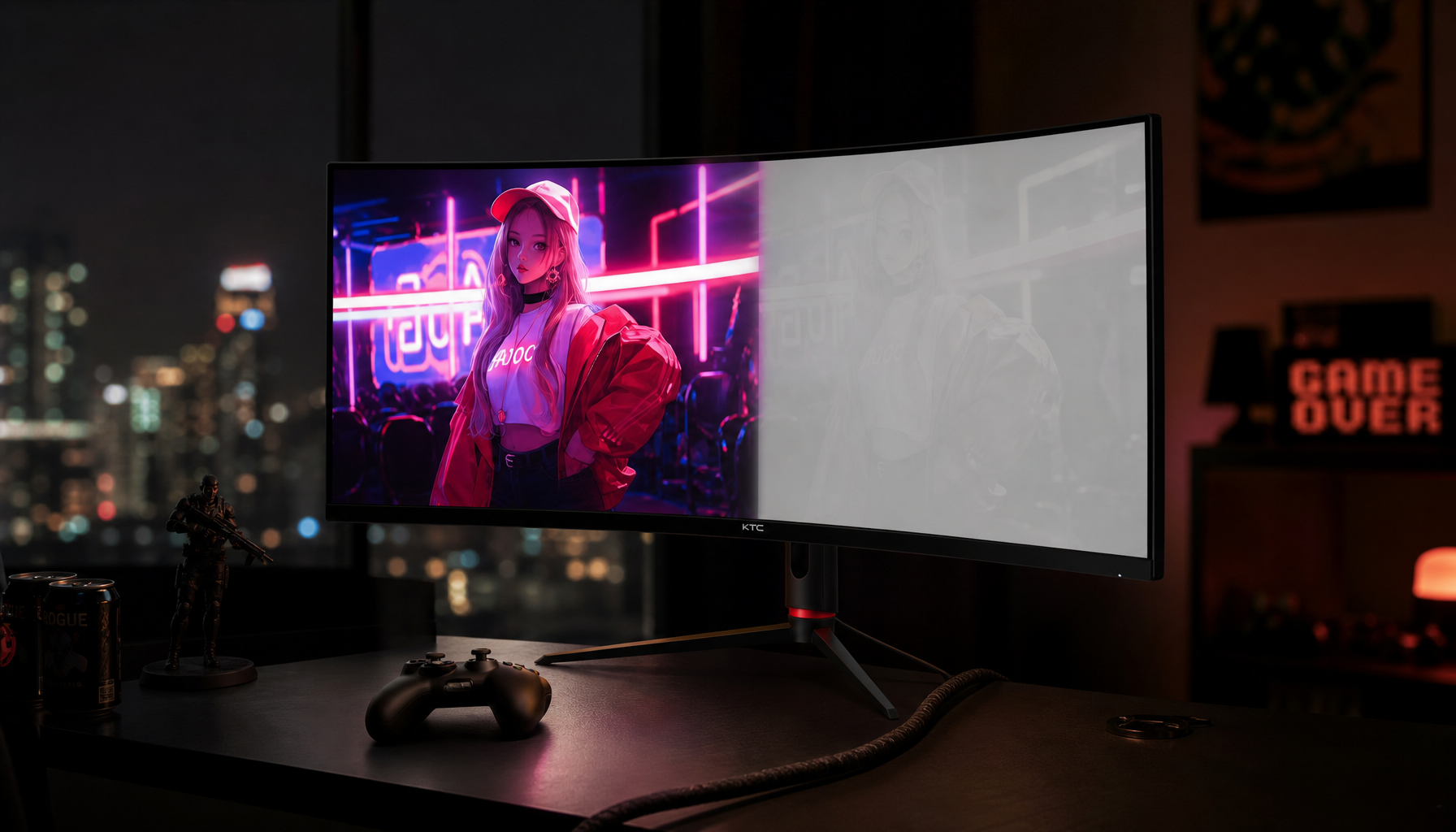
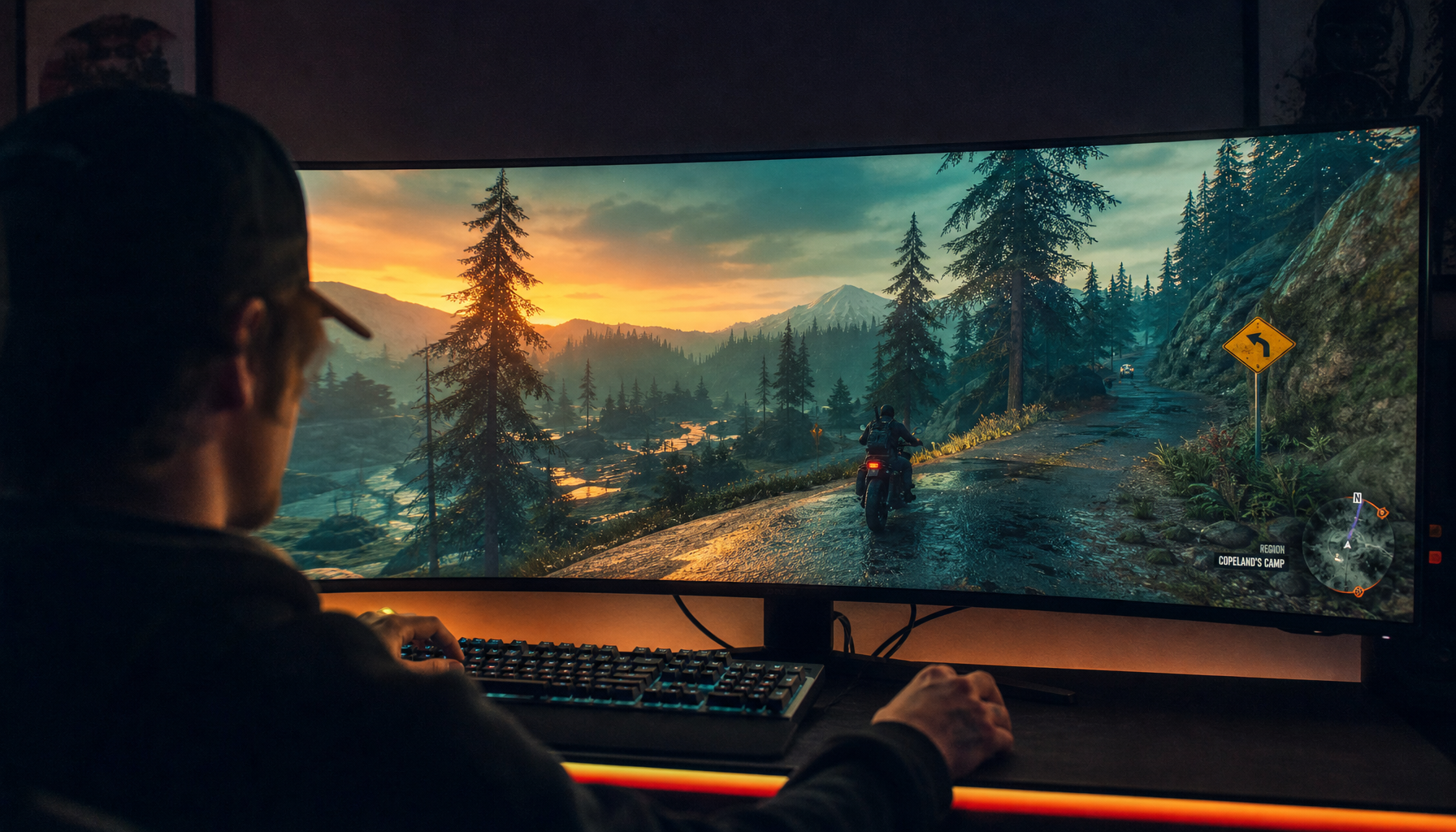
HDR looks convincing when black stays black while highlights still punch through; peak brightness alone cannot save a washed-out shadow floor.
Does your expensive HDR monitor make night scenes look gray, foggy, or strangely flat even when the spec sheet advertises high nits? In real gaming, editing, and desk setups, cleaner blacks make enemy silhouettes, movie shadows, UI contrast, and specular highlights feel more dimensional. This guide explains how to judge black level, brightness, panel type, room lighting, and certification claims before buying or tuning an HDR display.
The Simple Reason: HDR Is Contrast, Not Just Brightness
HDR means high dynamic range, and “range” is the key word. A monitor needs bright highlights, but it also needs a low black floor so the distance between dark and bright parts of the image feels large. If black is elevated, the whole image loses depth, even if small highlights can hit impressive nit numbers.
A fireworks scene is the easiest example. A 1,000-nit burst against a dark sky looks spectacular only if the sky remains near-black. If the sky rises to charcoal gray because of backlight bleed, weak native contrast, poor local dimming, or room reflections, the firework still measures bright, but your eye reads the scene as flatter.

VESA DisplayHDR certification exists because generic “HDR support” is not enough. A monitor can accept an HDR signal yet lack the contrast hardware to show it convincingly. That is why a certified DisplayHDR logo matters more than vague marketing language like “HDR ready.”
Black Level Defines the HDR Baseline
Black level is the darkest luminance a display can produce. A lower black level gives the image a deeper foundation, which increases perceived contrast before peak brightness even enters the conversation. For gaming monitors, this is why OLED and strong Mini-LED displays often feel more immersive than basic edge-lit LCD monitors with similar advertised brightness.
A practical way to think about it is simple. If one display reaches 1,000 nits but its blacks glow visibly in a dark room, and another reaches a lower peak but keeps blacks clean, the second display may look more premium in horror games, space scenes, cinematic RPGs, and night racing. Your eye does not judge the highlight in isolation; it judges the highlight against the surrounding darkness.
OLED panels are repeatedly favored by enthusiasts for dark content because pixels can turn off individually. VA LCD panels usually beat IPS for native black depth, while IPS often trades contrast for viewing angles and speed. That does not make IPS bad, but it does mean IPS HDR needs help from effective local dimming to avoid gray-looking dark scenes.
Peak Brightness Still Matters, But It Has a Job
Peak brightness is the maximum light output a display can hit, usually measured in nits. It matters for sun glints, explosions, reflections, snow, bright skies, and HDR mastering headroom. HDR monitor guidance for creators notes that HDR becomes more compelling around 1,000 nits and that displays below 600 nits are limited for demanding HDR work.
The catch is that peak brightness is only impressive when the monitor can control where that brightness appears. A bright Mini-LED display can make HDR highlights aggressive and room-friendly, but if its dimming zones are too large or poorly controlled, bright UI elements can bloom into dark surroundings. A lower-brightness OLED may avoid that blooming entirely, but it may be less effective in a sunny office or with large bright scenes.

Display Trait |
Strength |
Weakness |
Best Fit |
OLED |
Pixel-level blacks and no backlight bloom |
Lower full-screen brightness on many models |
Dark-room gaming, movies, creative review |
Mini-LED LCD |
High HDR brightness and strong impact |
Possible blooming or haloing |
Bright rooms, HDR games, mixed media |
VA LCD |
Better native contrast than many IPS panels |
Slower dark transitions on some models |
Budget dark-scene viewing |
IPS LCD |
Speed, color consistency, wide availability |
Elevated blacks and glow in dark rooms |
Productivity and competitive gaming |
Why Gray Blacks Break Immersion Faster Than Dim Highlights
A dim highlight can still look acceptable if the image has structure. Gray blacks damage the entire frame. In a stealth game, raised blacks make caves look milky. On an office monitor, black text and dark UI panels lose snap. On a portable smart screen, reflections can lift blacks so much that HDR looks like a brighter SDR preset.
This is also why black uniformity matters. Even if the center of the screen is dark, cloudy corners, backlight bleed, or IPS glow can pull your attention out of the content. In a dark survival-horror game or a space sim, one glowing corner can be more distracting than a slightly lower peak highlight.
Black-looking-gray problems often come from a mix of panel limits, brightness set too high, weak contrast settings, dynamic modes, source range mismatch, and room reflections. The first fix is not always buying a new monitor. Lower brightness for dark-room use, check RGB full-range output, disable aggressive power-saving modes, and test local dimming settings before judging the panel.
The Room Can Raise Your Black Level
Even excellent panels lose perceived contrast when light hits the screen. A glossy display may preserve black depth better in a controlled room but show sharper mirror-like reflections. A matte display may reduce hard reflections but can scatter light across the panel, making blacks look lighter.
This is especially relevant for QD-OLED monitors. For QD-OLED monitors, front or side RGB lighting can lift blacks toward purple or gray. Rear bias lighting is usually the better move because it reduces eye strain and improves perceived contrast without shining directly on the screen.
A simple desk test works well. Load a dark scene, turn off side lights, then place a soft D65 bias light behind the monitor. If blacks look deeper and shadow detail remains visible, the issue was partly environmental. If the screen still looks cloudy, the panel or dimming system is likely the limiting factor.

Shadow Detail: The Other Side of Deep Blacks
Deep blacks are not useful if the monitor crushes all dark detail into a single block. The goal is not “as dark as possible.” The goal is clean separation between near-black tones. You should still see fabric folds, cave walls, dim UI outlines, and background shapes without lifting the entire black floor.

Some high-end HDR display owners have found that very strong black performance can still hide SDR shadow detail when the profile is not tuned well. A practical method is to use black-level test patterns and real dark video while adjusting the display profile, because test charts alone do not always reveal how faces, clothing, and scenes will look in normal viewing.
Crushed black levels are the opposite failure from gray blacks. Gray blacks reduce depth; crushed blacks erase information. For HDR gaming, check both by testing a dark hallway and a bright sky in the same game. If the hallway is gray, lower the black floor or improve lighting control. If the hallway is pure black with no visible texture, adjust gamma, HDR calibration, or in-game black-level sliders.
How to Buy for Real HDR, Not Spec-Sheet HDR
Start with panel behavior, then certification, then brightness. A generic HDR label only tells you the monitor accepts an HDR signal. It does not prove strong contrast, dimming quality, color volume, or shadow handling.
VESA warns that pseudo-specifications and unofficial logos can mislead buyers, including claims around nonofficial tiers. For value-focused shoppers, this matters because the cheapest “HDR” monitor may behave like a bright SDR display with wider color. For performance-driven buyers, certification is not the whole story, but it is a useful filter.
For a dark gaming setup, OLED is the cleanest answer when burn-in risk, room brightness, and budget make sense. For a bright office or mixed work-and-play desk, a strong Mini-LED monitor can deliver more sustained punch, especially for productivity by day and HDR games at night. For budget buyers, a VA panel with good native contrast may provide better dark-scene satisfaction than a similarly priced IPS display with weak blacks.
Practical Setup Advice for Better Perceived HDR
Use HDR only when the content benefits from it. Many desktop environments and SDR apps can look wrong when forced through HDR all day. For gaming, enable HDR in the operating system, the monitor menu, and the game, then use the game’s calibration screen to set black and white points carefully.
Do not max brightness just because the monitor can. In a dark room, excessive brightness can make blacks appear worse by comparison and increase eye fatigue. In a bright room, brightness helps fight ambient light, but direct light on the screen still raises the black floor. Move lamps behind the display, avoid sunny windows in front of the panel, and choose screen coating based on your actual room.
For Mini-LED, test local dimming in real content. High settings often improve HDR contrast, but they can create halos around subtitles, cursors, or bright HUD elements. Medium dimming may be the better daily setting for office work, while high dimming may be worth enabling for full-screen games and movies.
Pros and Cons of Prioritizing Black Level
Prioritizing black level gives you stronger perceived depth, cleaner dark scenes, better cinematic immersion, and more convincing HDR highlights because bright elements have a darker reference point. It also helps productivity displays feel more precise, especially with dark themes, code editors, timelines, and photo interfaces.
The tradeoff is that the best black-level technologies have constraints. OLED can be outstanding in controlled rooms but may need burn-in care and may not sustain full-screen brightness like the brightest LCDs. Mini-LED can be powerful and versatile, but dimming behavior varies widely. VA can offer strong value, but motion handling and viewing angles may trail premium OLED or fast IPS options.
The Buying Rule That Holds Up
If the room is dim and immersion is the priority, buy for black level first. If the room is bright and HDR impact must survive daylight, buy for controlled brightness and strong local dimming. If the monitor is mostly for office productivity with occasional HDR, avoid paying only for peak nits and look for balanced contrast, accurate modes, and easy switching between SDR and HDR.
Peak brightness creates the sparkle. Black level creates the stage. The HDR display that feels expensive is the one that controls both, but when you have to choose, deeper, cleaner blacks usually do more for perceived quality than a bigger brightness number.