Some monitors disable or lock overdrive during Adaptive Sync because one fixed pixel-boost setting can look clean at high refresh rates but create ugly overshoot when the refresh rate drops. The safest monitors either use variable overdrive or force a conservative preset while VRR is active.
Does your game look smooth with Adaptive Sync on, but the “Response Time” or “Overdrive” menu suddenly turns gray? In hands-on display tuning, the practical answer is simple: you can usually identify whether VRR smoothness or stronger pixel acceleration matters more within a few minutes by using a motion test and one demanding game scene. This article explains why the lockout happens, when it is a smart design choice, and how to choose the best setting for gaming, work, and portable screens.
The Core Conflict: Variable Refresh, Fixed Pixel Tuning
Adaptive Sync lets a monitor change its refresh rate in real time to match the GPU’s frame output, reducing tearing and stutter when frame rates fluctuate. If your GPU renders at 58 FPS, the display may refresh near 58 Hz; if performance rises to 120 FPS, the panel follows. That flexibility is excellent for immersion, especially in shooters, racing games, open-world titles, and high-motion video.
Overdrive solves a different problem. Monitor overdrive pushes pixels to change states faster, reducing the smeared trails that appear when LCD pixels cannot transition quickly enough. It is also called response time overdrive or Response Time Compensation, and it usually appears in the monitor’s OSD as Off, Normal, Fast, Extreme, Response Time, Trace Free, AMA, or a similar label.
The catch is timing. A 144 Hz monitor refreshes about every 6.94 ms, while a 60 Hz monitor refreshes every 16.67 ms. The same aggressive overdrive voltage that helps a pixel finish its transition cleanly at 144 Hz can push that pixel too far at 60 Hz, creating inverse ghosting: bright halos, dark coronas, or colored trails around moving objects. When Adaptive Sync is active, the monitor may move across that whole range constantly, so a single static overdrive mode becomes harder to trust.
Why Manufacturers Lock Overdrive During Adaptive Sync
The main reason is artifact control. Adaptive Sync behavior changes the display’s refresh timing continuously, while fixed overdrive assumes a more predictable refresh interval. If a monitor maker knows its “Fast” or “Extreme” mode overshoots badly at lower VRR rates, locking the setting can prevent users from creating a worse image than the default.
This is common on value-oriented Adaptive Sync monitors because many do not have the processing table or hardware tuning needed for clean overdrive at every refresh point. A display may have been tuned well at its advertised maximum, such as 165 Hz or 240 Hz, but not equally well at 48 Hz, 60 Hz, or 75 Hz. In that case, the firmware may choose a middle response-time setting and remove manual control while VRR is enabled.
There is also a support and certification angle. Adaptive Sync displays vary widely by panel, scaler, firmware, and validation level. Locking overdrive during VRR reduces the number of bad combinations a buyer can accidentally create, especially on monitors marketed to plug-and-play users rather than display tweakers.
Variable Overdrive Is the Better Solution
Variable overdrive, sometimes called adaptive overdrive, changes the overdrive strength as refresh rate changes. Instead of using one voltage behavior from 48 Hz to 240 Hz, the monitor applies different tuning for different refresh zones. That is why premium monitors with dedicated VRR hardware have historically been prized for motion consistency, and why some newer Adaptive Sync displays advertise adaptive overdrive as a key feature.

The difference is easy to picture. At 240 FPS on a 240 Hz screen, pixels need to move very quickly before the next refresh. At 80 FPS inside a VRR window, the monitor has more time before the next scanout, so the same hard push may be excessive. Variable overdrive lowers the push when the frame rate drops, keeping motion clearer without turning halos into the new distraction.
VRR tuning advice often lands on a conservative middle overdrive mode because that is the best compromise across a changing refresh range. On a 240 Hz monitor, for example, a frame cap around 237 FPS can keep the system inside the VRR window and reduce ceiling behavior, but it does not magically fix overshoot at lower frame rates. Good variable overdrive is still the cleaner engineering answer.
Monitor behavior |
What it means in practice |
Best for |
Overdrive adjustable with VRR off only |
Manual control returns when Adaptive Sync is disabled |
Users who prefer fixed-refresh esports tuning |
Overdrive locked with VRR on |
Firmware forces one preset to limit artifacts |
General gaming with fewer bad settings |
Variable overdrive with VRR |
Overdrive changes with refresh rate |
Best motion consistency across fluctuating FPS |
No visible overdrive option |
The monitor hides tuning or lacks the feature |
Office displays and basic portable screens |
Should You Disable Adaptive Sync to Get Overdrive Back?
Sometimes, but not by default. If you play competitive titles at a stable high frame rate, disabling Adaptive Sync and using a stronger overdrive mode can make sense. A player holding 240 FPS on a 240 Hz panel may prefer fixed refresh, low latency, and the clearest available overdrive preset, especially if tearing is minimal or acceptable.
For most players, Adaptive Sync is still the stronger everyday choice. Tear-free gaming matters most when frame rates fluctuate, which is exactly what happens in demanding big-budget games, battle royale drops, busy racing scenes, and graphically rich RPGs. If your FPS moves between 70 and 140 on a 144 Hz display, VRR usually improves the experience more than a slightly faster overdrive mode.
The decision changes if the locked VRR overdrive looks bad. If you see pale halos around crosshairs, dark trails behind text, or shimmering outlines around fast-moving enemies, the monitor’s forced preset may be too aggressive for your frame range. In that case, test VRR off with a lower manual overdrive setting, then compare it against VRR on in the same scene.
How to Test the Right Setting
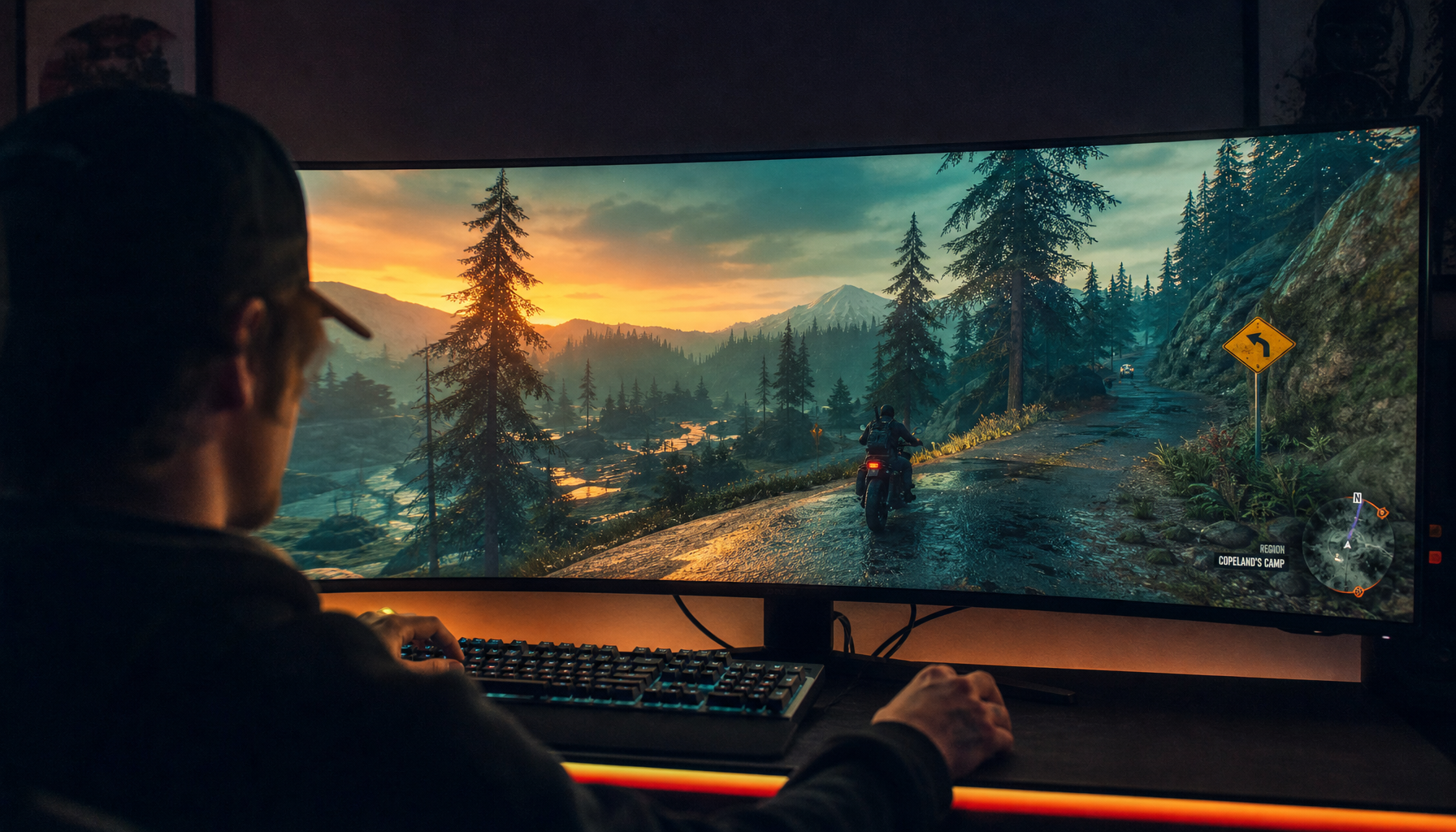
Start with the monitor at its highest supported refresh rate in your system or GPU control panel, then enable Adaptive Sync in both the monitor OSD and the graphics driver. Use a repeatable motion pattern such as a ghosting test, then load a real game scene with fast horizontal movement, such as strafing past fences, trees, signs, or high-contrast UI elements.

If the image has soft trailing behind objects, overdrive is too weak. If the trail appears as a bright or dark outline that seems to lead or ring the object, overdrive is too strong. Overdrive testing should be visual and practical because monitor model, panel type, refresh rate, and firmware can change the result dramatically.
For office productivity, content work, and portable smart screens, the priority is different. You usually want stable text, low eye strain, accurate brightness, and predictable battery life more than maximum pixel acceleration. If your portable display locks overdrive when VRR is active, that is rarely a problem for spreadsheets, coding, writing, dashboards, or video calls. If you notice cursor trails or video blur, try disabling Adaptive Sync first, then check whether a mild response-time mode becomes available.
Pros and Cons of the Lockout
A locked overdrive menu can feel restrictive, but it is not automatically a flaw. It may be the monitor protecting image quality across unpredictable frame pacing. For value displays, that can be a reliable choice because it avoids the worst-case combination of low refresh rate and extreme overdrive.
The downside is loss of control. Enthusiast users may want separate profiles for esports, cinematic games, desktop work, and console play. When the OSD locks the response-time menu, you cannot tune around a panel’s weaknesses unless you disable VRR or use a different input mode. That is why monitor reviews that measure motion handling across refresh rates are more useful than spec sheets claiming a single “1 ms” response time.
Buying Advice: What to Check Before You Pay
Look for reviews that test overshoot at multiple refresh rates, not just maximum refresh. A 180 Hz display that looks clean at 180 Hz but overshoots heavily at 60 Hz may disappoint if your GPU often lands in the lower VRR range. For gaming-first buyers, variable overdrive is worth prioritizing when the budget allows.
Also check the VRR range. Adaptive Sync ranges can vary by monitor, and Low Framerate Compensation can help when FPS drops below the minimum range by repeating frames, but it may still expose brightness shifts or overdrive weaknesses on some displays. A wider, well-tuned range is more valuable than a headline refresh rate you rarely reach.
For a balanced setup, enable VRR, use driver-level V-Sync when recommended by your GPU workflow, and cap FPS slightly below the monitor’s maximum refresh rate. On a 240 Hz monitor, that often means a cap near 237 FPS. Then use a medium or normal overdrive mode if the monitor allows it. If it does not, judge the locked preset by motion clarity, not by whether the menu looks flexible.
Quick FAQ
Is a locked overdrive setting a sign of a bad monitor?
Not always. It can mean the monitor lacks variable overdrive, but it can also mean the manufacturer chose a safer preset for VRR. The real test is whether motion looks clean across your actual FPS range.
Is “Extreme” overdrive best for gaming?
Usually no. Extreme modes often look impressive in marketing but can create overshoot. Medium, Normal, or Fast is often the better real-world setting, especially with Adaptive Sync active.
Do OLED monitors have the same issue?
OLED pixels respond much faster than typical LCD pixels, so traditional overdrive concerns are reduced. VRR flicker, brightness behavior, and frame pacing can still matter, especially on high-contrast scenes.
A monitor that disables overdrive during Adaptive Sync is usually choosing consistency over manual control. For immersive play, keep VRR on unless the locked preset produces visible halos; for competitive fixed-FPS gaming, test VRR off with a carefully chosen overdrive mode and let your eyes judge the motion, not the marketing label.