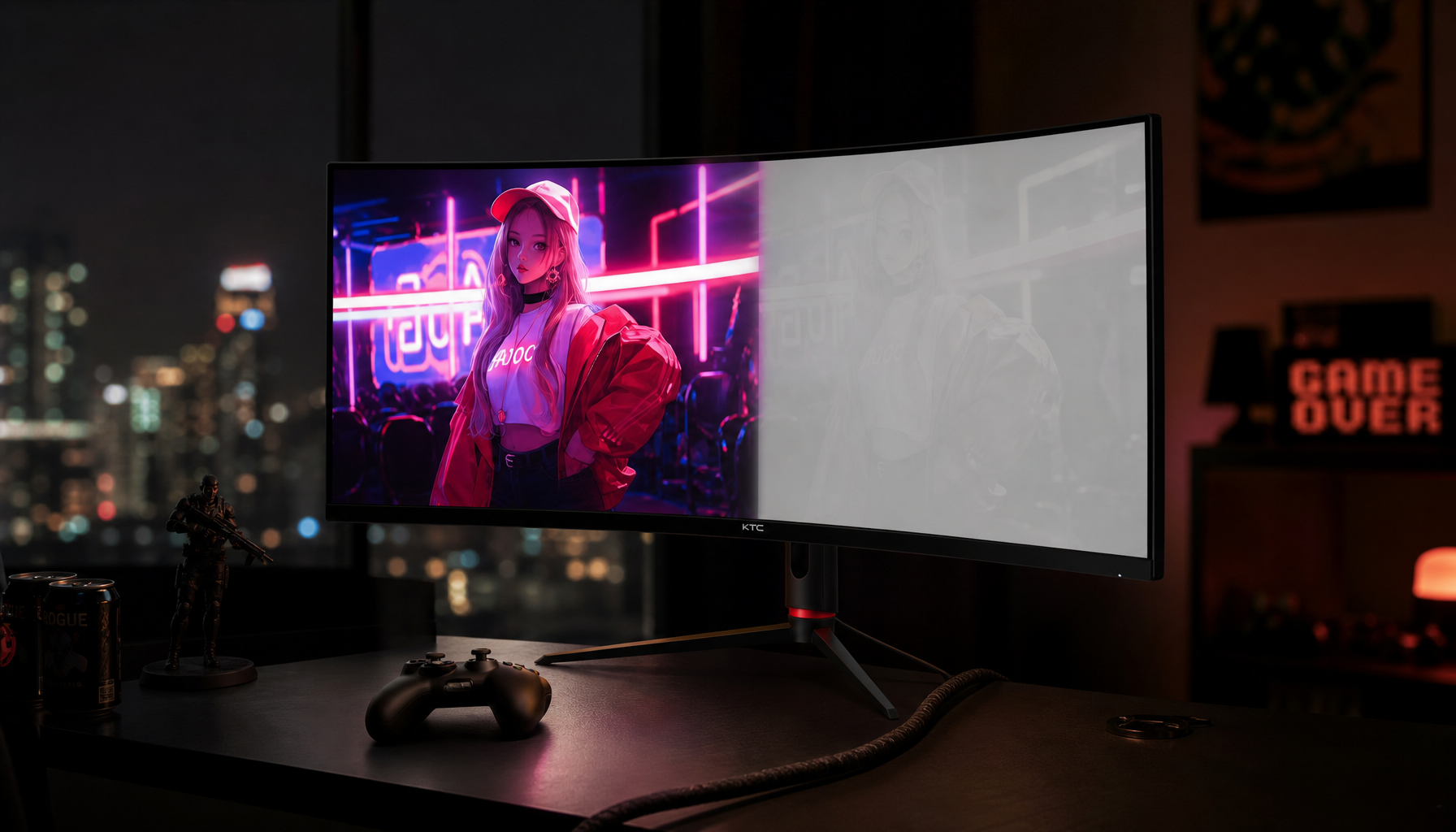
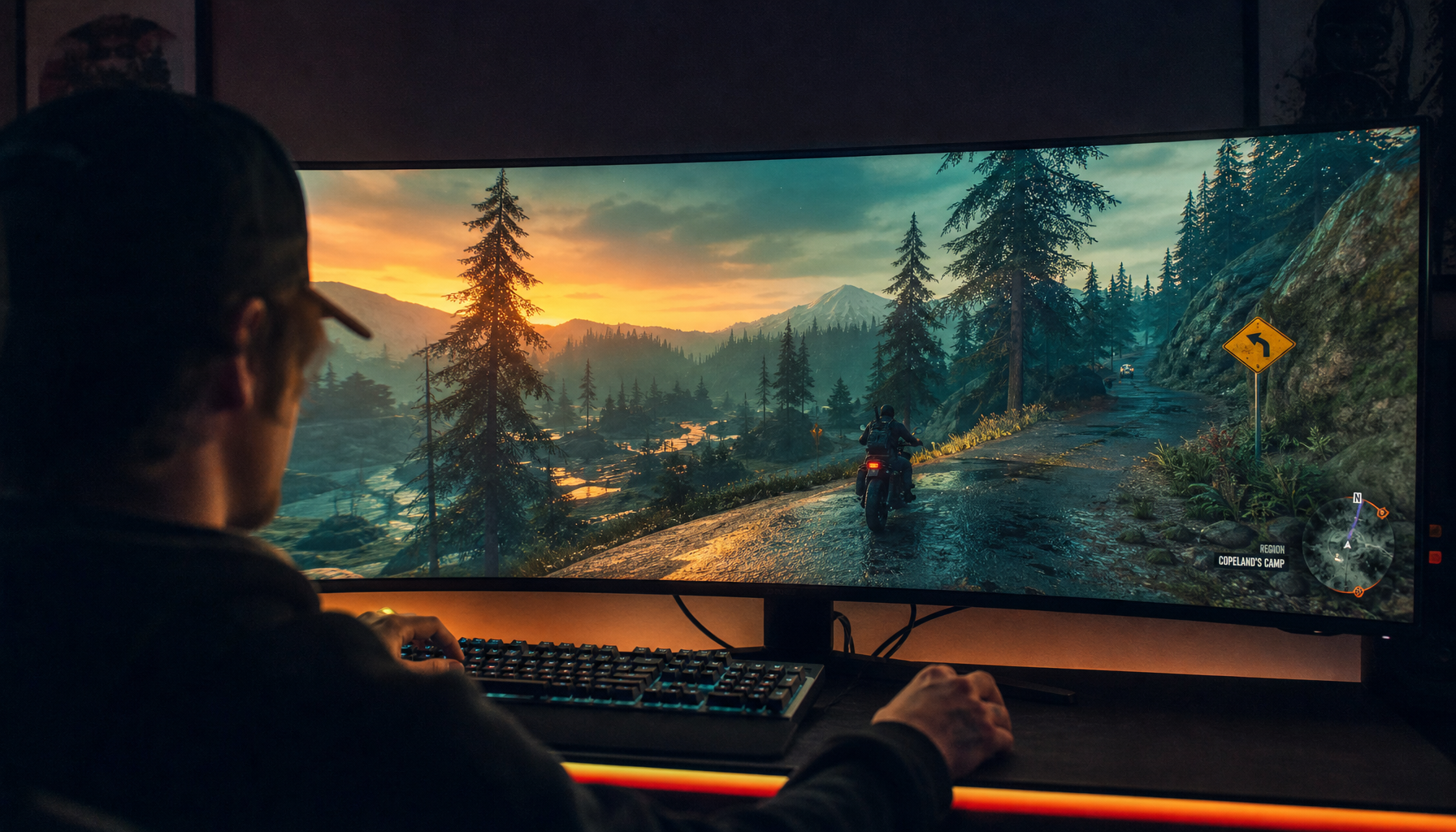
HDR looks better in dim rooms because your eyes can perceive deeper blacks, cleaner shadow detail, and stronger highlight contrast when ambient light is controlled. Bright rooms add glare and reflections that raise the visible black floor, making even capable HDR monitors look flatter than their specs suggest.
Ever launched a night mission, space scene, or dark streaming sequence and wondered why your “HDR” monitor looks cinematic at night but gray and dull near a sunny window? A room-aware setup can preserve shadow visibility, reduce eye strain, and make HDR games or movies look closer to what the panel can actually deliver. You’ll learn why this happens, which display types handle it best, and how to tune your setup without chasing misleading brightness numbers.
HDR Performance Depends on Contrast, Not Just Brightness
HDR is often marketed around peak brightness, but the real value is contrast: the visible distance between the darkest blacks and the brightest highlights. A monitor can accept an HDR signal and still fail to show convincing HDR if its hardware cannot control black levels, local dimming, color depth, and peak luminance well enough; HDR support alone is not the same thing as real HDR image quality.

In a dark room, your display’s black level is easier to perceive. If an OLED pixel turns fully off, the surrounding darkness helps that black stay visually black. If a mini-LED monitor has strong local dimming, the dim zones look more controlled because the room is not adding reflected light back onto the panel. That is why a cave, cockpit, nighttime city, or horror-game corridor can feel more dimensional after sunset.
In a bright room, the same panel has to fight ambient light. Window glare, side lighting, glossy reflections, and even a bright wall behind you can lift the perceived black level. The monitor may still be producing the same electrical signal, but your eyes no longer see the same contrast. The result is familiar: black becomes charcoal, shadows lose separation, and HDR highlights feel less explosive because the whole image floor has been raised.
What Dark Rooms Reveal Better
Dark rooms favor displays that can control light precisely. OLED is the clearest example because self-lit pixels can switch independently, producing very deep blacks and strong perceived contrast; OLED panels are therefore especially compelling for cinematic gaming, movies, and high-contrast visual work.
Mini-LED can also perform extremely well in dim environments, especially when it has many well-controlled dimming zones and strong peak brightness. Its advantage is punch: bright spell effects, headlights, fire, reflections, and sun glints can hit harder than on many OLED monitors. The tradeoff is that local dimming is still zone-based, so a bright object on a black background may create blooming or halos if the dimming system is not precise enough.
VA LCD panels can be a value-oriented middle ground for dark scenes because they usually offer stronger native contrast than typical IPS panels. IPS remains excellent for color consistency, wide viewing angles, and productivity, but many IPS displays show elevated blacks or glow in dark rooms. For a gaming setup, this matters when you are tracking movement in shadow-heavy maps; for office work, it matters less unless you use dark themes all day.
Display type |
Dark-room HDR strength |
Bright-room challenge |
Best fit |
OLED |
Deep blacks, pixel-level contrast, fast motion |
Reflections and possible image retention with static UI |
Immersive gaming, movies, creator review |
Mini-LED LCD |
High peak brightness and strong highlights |
Blooming depends on zone control |
Mixed gaming, HDR media, brighter rooms |
VA LCD |
Good native contrast for the price |
Slower response on some models |
Budget dark-scene gaming and media |
IPS LCD |
Consistent color and viewing angles |
Blacks can look gray in dim rooms |
Office, coding, general productivity |

Why Bright Rooms Flatten HDR
A bright room does not merely make the screen harder to see; it changes how contrast is perceived. Monitor lighting guidance notes that room lighting affects comfort and image appearance because the eye constantly adapts to differences between the screen and surroundings; gentle background illumination can reduce harsh screen-to-room contrast during long sessions.
The problem is worse when light hits the front of the display. Reflections overlay the image with room detail, which is especially damaging to dark HDR scenes. Imagine a 1,000-nit explosion in a game: it should stand out against a black night sky. If daylight from a window turns that sky into reflective gray, the explosion still looks bright, but it no longer feels as deep or dramatic.
This is why some high-brightness LCD or mini-LED monitors can outperform OLED in brighter rooms. OLED wins black-level control in the dark, but a strong mini-LED display can push enough brightness to preserve visibility when the room is not controlled. For a desk near a window, the best HDR monitor is not always the one with the deepest theoretical black; it may be the one with higher full-screen brightness, effective anti-glare behavior, and enough local dimming to keep contrast intact.
The Spec Trap: HDR400, HDR1000, and “HDR Ready”
HDR labels are useful starting points, not final proof. Display standards often bundle brightness, color, bit depth, and transfer behavior, and HDR video standards commonly involve richer tonal steps and wider color handling than SDR pipelines.
The buying trap is that two monitors with similar HDR labels can look very different. One HDR1000 monitor may have dense local dimming and excellent tone mapping; another may hit a peak brightness number briefly but wash out shadows or show halos. HDR400 can be better than SDR on some content, but it often lacks the dramatic contrast many buyers expect from HDR.
Practical monitor guidance says buyers who care about HDR should look higher than entry-level HDR claims, and DisplayHDR 600 or better is a more meaningful target than vague “HDR compatible” language. Even then, panel type, dimming behavior, screen coating, and room lighting can decide whether that rating feels premium in daily use.
Dark Room Does Not Mean Pitch Black
A fully dark room can make HDR look intense, but it is not always the most comfortable choice. If your monitor is much brighter than the surrounding wall, your eyes work harder as they adapt between bright UI elements and a dark environment. That can make long gaming, coding, or editing sessions feel sharper at first and more fatiguing later.
Bias lighting solves this without ruining HDR. A soft light behind the monitor raises the background just enough to reduce visual strain while keeping direct light off the panel. For a practical setup, place a dim, neutral light behind the display, avoid lamps aimed at the screen, and keep the wall behind the monitor subtly brighter than the rest of the room.

For SDR desktop work, many users are comfortable with moderate brightness rather than maximum output. For HDR games or movies, let the HDR mode handle highlights, but avoid using HDR as your all-day office mode if spreadsheets, email, and browser tabs look washed out or harsh. Office productivity is often better in SDR with stable brightness, clean text rendering, and a calibrated color mode.
Settings That Make HDR Better by Room
Start by stabilizing the signal. Preset switching can cause black screens because monitors and GPUs may reapply HDR state, color mode, refresh behavior, scaling, or tone mapping; display presets are often deeper technical changes than simple color filters.
For a gaming monitor, keep native resolution, high refresh rate, and adaptive sync consistent where possible. Use separate adjustments for brightness, black equalizer, gamma, or color temperature instead of constantly jumping between presets that change HDR, refresh rate, and gamut at the same time. This keeps the experience responsive and reduces the chance of disruptive blanking when switching from work to play.

Gamma deserves attention in SDR and SDR-like desktop use. Gamma 2.2 is the dependable baseline for most computer work and many games, while 2.4 can look richer for movie playback in a dim room. If shadows disappear, do not immediately crank brightness; first check whether gamma, black level, or the game’s HDR calibration is crushing near-black detail.
For portable smart screens, the room match matters even more because many models have lower peak brightness than full-size desktop monitors. Dynamic Contrast Ratio can improve perceived contrast by adjusting brightness scene by scene, but DCR can also distort color or make images look artificially vivid. Use it for casual video or travel gaming, and turn it off for photo editing, design review, or any color-sensitive work.
How to Choose for Your Space
If your main setup is a controlled gaming room, prioritize OLED or a high-quality mini-LED display with strong local dimming. OLED gives the most direct dark-room immersion, especially for single-player games, movies, and high-contrast visuals. Mini-LED is better when you want stronger peak brightness, less concern about static desktop elements, or a display that also works well during the day.
If your desk sits in a bright office, near windows, or under overhead lights, choose brightness, reflection handling, and practical ergonomics more aggressively. A monitor with excellent contrast in lab conditions can disappoint if your environment is uncontrolled. In that case, curtains, monitor placement, matte coating, and bias lighting may improve perceived HDR more than upgrading one certification tier.
If you split time between gaming and productivity, do not force HDR into every task. The HDR monitor market is growing because gaming, entertainment, creator work, and hybrid work all benefit from better displays, with HDR monitors increasingly positioned around contrast, color, and premium use cases. The smart move is to use HDR when content is mastered for it, then return to a comfortable SDR mode for long office sessions.
FAQ
Does HDR use more gaming performance?
Usually, HDR is much less demanding than settings such as ray tracing, but the exact impact depends on the game, GPU, operating system, and display pipeline. Treat it as a feature to test per title rather than assuming a fixed frame-rate penalty.
Why does HDR sometimes look washed out on a computer?
Washed-out HDR often comes from non-HDR desktop content, poor tone mapping, incorrect calibration, or a monitor that accepts HDR but cannot display it with enough contrast. Run the operating system’s HDR calibration, check the game’s HDR settings, and use SDR for regular desktop work if it looks cleaner.
Is a dark room always best for HDR?
A dim, controlled room is usually best, but pitch black is not mandatory. Soft bias lighting behind the monitor can keep HDR contrast strong while making long sessions easier on your eyes.
HDR rewards control: control of black level, control of reflections, control of brightness, and control of when HDR is actually enabled. Build the room and settings around the panel, and even a value-focused display can look more immersive, reliable, and performance-ready.