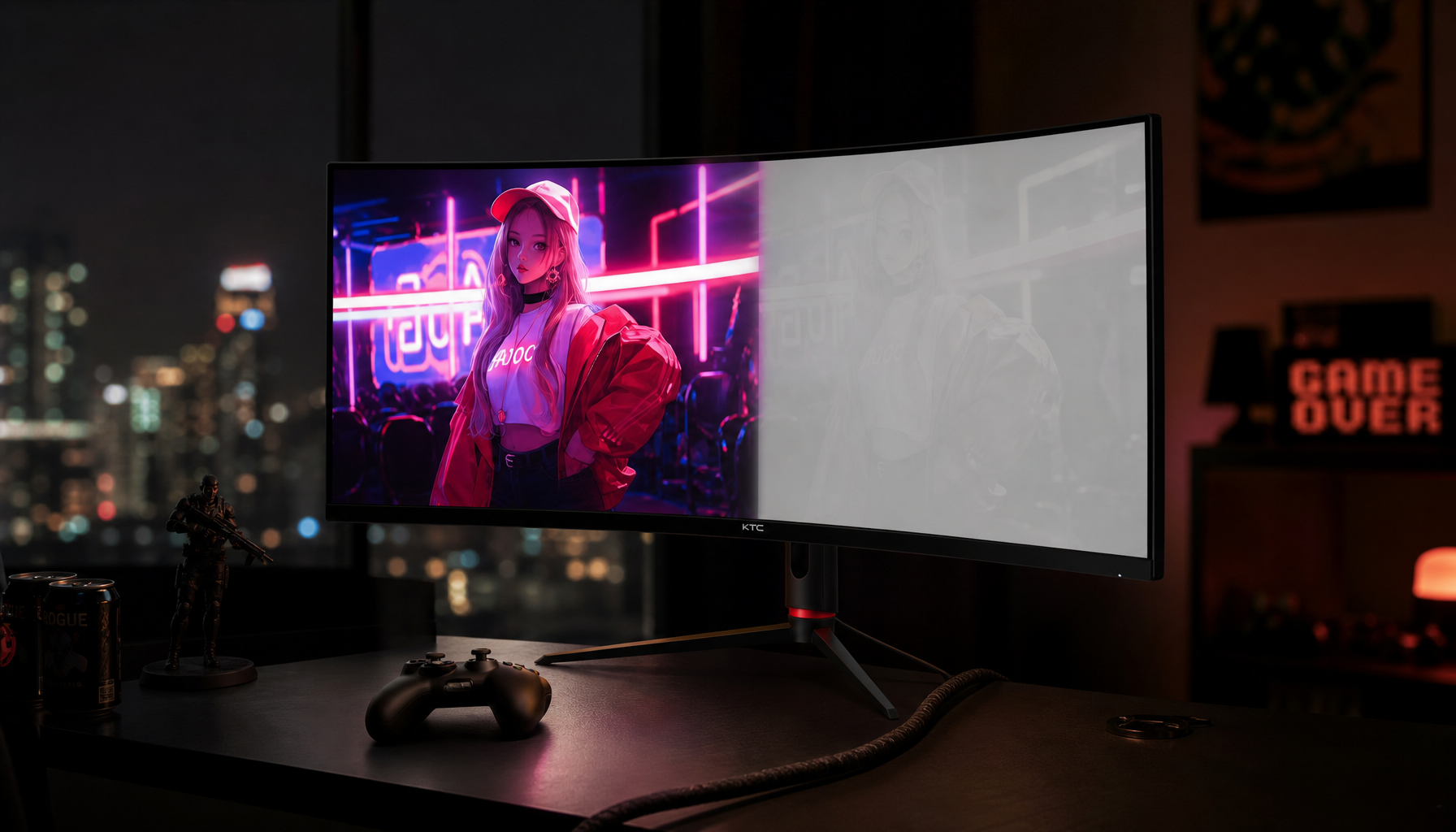
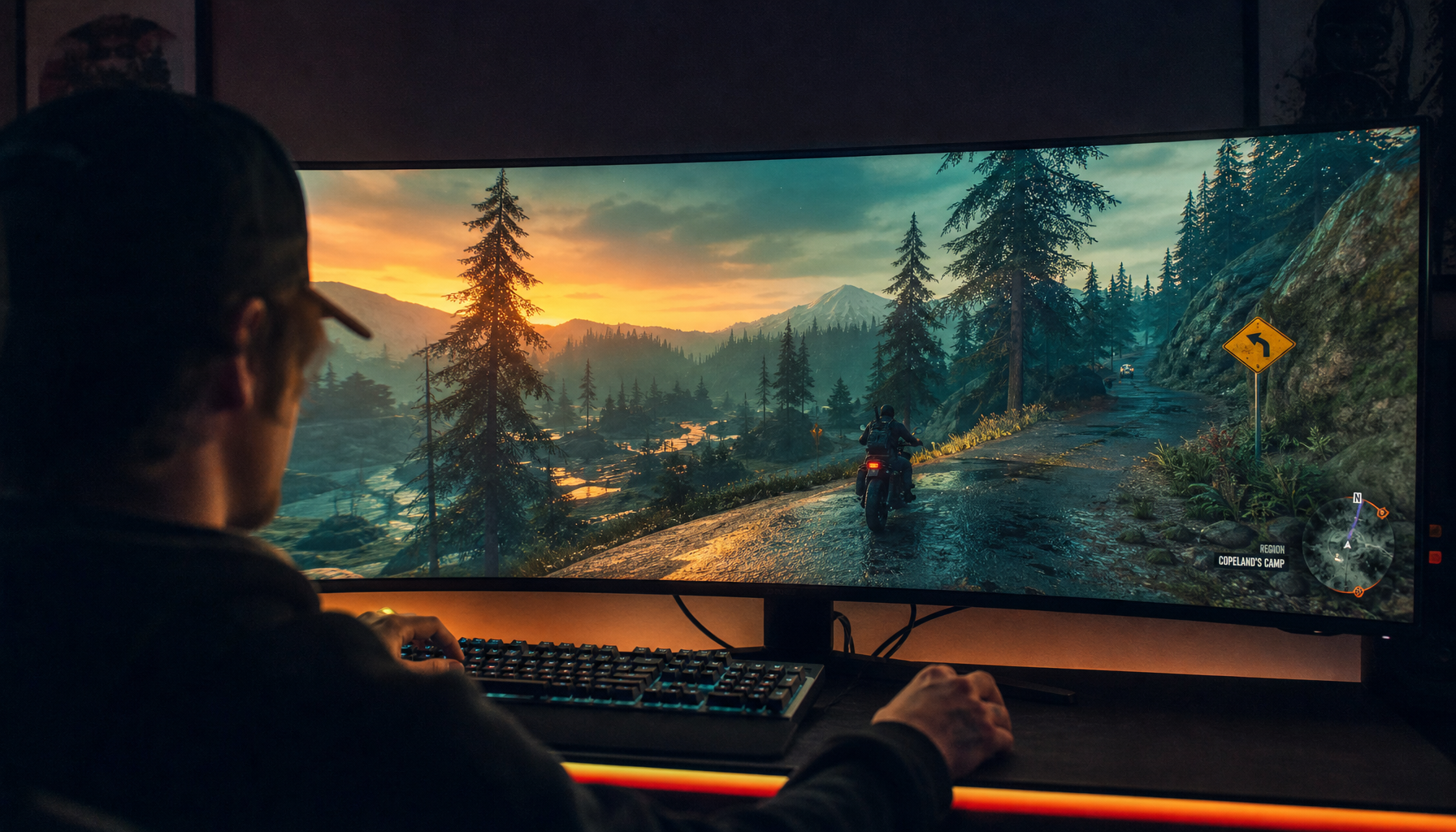
Bright colors can seem to glow or bleed when display light output, panel limits, room lighting, and human vision combine to exaggerate high-contrast edges.
Does a red health bar, white cursor, or neon subtitle look like it is spilling into the dark scene beside it? A quick brightness, black-screen, and room-light check can usually separate a settings problem from backlight bleed, IPS glow, blooming, or true color bleed before you waste time on the wrong fix. Here is how to diagnose what you are seeing and tune your screen for cleaner, calmer, more immersive output.
The Short Version: Glow Is Not One Problem
On high-brightness monitors, glow around colors can come from several different mechanisms. An LCD monitor creates its image by using liquid crystals to control light from a backlight, so imperfect light blocking can show up as haze, edge glow, or brighter patches in dark scenes; this is built into the way a liquid-crystal display works.
The confusing part is that users describe several effects with the same words. Backlight bleed usually appears near edges or corners. IPS glow shifts when you move your head. Mini-LED blooming forms halos around bright objects because local dimming zones are larger than individual pixels. Color bleed, in the stricter picture-quality sense, means one color appears to contaminate a neighboring color boundary.
Why High Brightness Makes the Effect Worse
Brightness is usually measured in nits, and advertised peak brightness is not the same thing as the best everyday setting. A monitor should be bright enough to preserve detail without becoming the main light source in the room, because excessive screen-to-room contrast makes glow and fatigue easier to notice, especially in dark scenes and dark-mode interfaces monitor brightness.
A practical example: if a white document on your monitor looks brighter than a sheet of white paper on your desk, the screen is probably overdriving your visual environment. For office work, many users get cleaner results by tuning the room first, then lowering the monitor until white looks like usable paper instead of a billboard.
High brightness also exposes panel non-uniformity. A corner that is only mildly brighter than the center at moderate brightness can become obvious at 100% brightness on a black loading screen. One IPS quality-control discussion cites edge brightness differences around 15% to 20% on some 27-inch IPS panels, which is enough to be visible in dark-room checks and distracting for sensitive users edge brightness differences.
Backlight Bleed: When Light Escapes Around the Panel
Backlight bleed is unwanted light leakage from an LCD backlight, usually around the corners or edges. It is most visible on black or very dark images, because those are the moments when the LCD layer is trying to block light while the backlight is still active behind it backlight bleed.
In daily use, mild bleed may disappear into spreadsheets, browser pages, and bright game maps. It becomes more obvious in space games, horror titles, movie letterbox bars, and dark startup screens. If you only see the issue on a 100% black test image in a fully dark room, it may be within normal LCD behavior. If it distracts you during real content at your normal brightness, it is a stronger return or exchange candidate.
IPS monitors are especially popular because they deliver strong color and wide viewing angles, but their layered construction can make uneven light more noticeable. One panel-manufacturing explainer describes IPS backlight bleed as uneven illumination from the backlight, often caused by panel-layer alignment, pressure, or manufacturing tolerance uneven illumination.
IPS Glow Is Different From Backlight Bleed
IPS glow is angle-dependent haze, usually strongest when viewing dark content from off-center positions. If you lean left, right, closer, or farther away and the glow shifts, you are probably seeing IPS glow rather than fixed backlight bleed.
This matters because the fix is different. Backlight bleed is usually a panel-uniformity issue. IPS glow can often be reduced by lowering brightness, sitting farther back, raising ambient light, and viewing the screen more squarely. On a 34-inch ultrawide, even a centered user may view the far edges at an angle, so sitting roughly 2 to 2.5 ft back can improve edge consistency.
Mini-LED Blooming: A High-End Tradeoff
Mini-LED displays can look spectacular in HDR because their backlight is divided into many local dimming zones. The advantage is strong contrast, with bright highlights and darker shadows at the same time. The drawback is blooming: a white cursor, subtitle, star, or HUD element can create a soft halo because the lit dimming zone is larger than the object itself.
This is not the same as classic backlight bleed. Blooming moves with the bright object. Backlight bleed stays in the same physical area of the screen. If a white mouse pointer carries a faint cloud across a black desktop, you are seeing local dimming behavior, not a loose bezel.
Mini-LED’s upside is that it can deliver HDR impact without OLED burn-in risk, while the downside is that bright-on-black details may halo. Standard IPS is often better value for competitive esports where speed and visibility matter most, while Mini-LED makes more sense for cinematic HDR games and movies.
Display Type |
Why Colors May Seem to Glow |
Main Advantage |
Main Tradeoff |
Standard IPS LCD |
Backlight bleed or IPS glow on dark scenes |
Wide viewing angles and strong color |
Weaker blacks than VA or OLED |
VA LCD |
Dark smearing or clouding in some panels |
High native contrast |
Narrower viewing angles than IPS |
Mini-LED LCD |
Blooming around small bright objects |
Strong HDR brightness and local contrast |
Haloing depends on dimming zones |
OLED |
Usually no backlight bleed |
Per-pixel black control |
Burn-in risk and peak brightness limits |
True Color Bleed: Less Common, But Real
True color bleed is when large color areas appear to contaminate adjacent areas, such as a red block tinting the border beside it or colored stripes appearing where boundaries should be clean. Compared with backlight bleed and blooming, this is less common on modern monitors, but it matters for designers, video editors, UI builders, and anyone who relies on crisp color separation.
The practical test is simple. Open a clean test image with large adjacent blocks of red, green, blue, cyan, magenta, yellow, white, and black. If color seems to spill across borders in the same location regardless of brightness, room lighting, and viewing angle, the panel may have inherent color uniformity or subpixel behavior that settings cannot fully correct.
For color-sensitive work, calibration helps with white point, gamma, and color balance, but it cannot fully repair physical panel non-uniformity. Calibration guidance frames monitor calibration as a way to improve color accuracy for creative work, which is useful, but it should not be mistaken for a cure for every hardware defect color accuracy.
Why Red Often Feels More Aggressive in Dark Mode
Not all glowing colors feel the same. Red text, red HUD elements, and saturated red warning labels can look harsher against black because the eye responds differently to color contrast under low-light viewing.
A 2024 study tested dark-mode reading with five text colors under very low ambient illumination and found that text color significantly affected visual fatigue, with red producing the greatest fatigue and yellow the least under the tested negative-polarity conditions visual fatigue. The screen luminance in that study was controlled at a low level, so it does not prove that every bright gaming monitor behaves the same way, but it does support a familiar field observation: red-on-black can feel punchy for alerts and exhausting for sustained reading.
For gaming HUDs, red is still useful for danger, damage, and urgency. For office dashboards, terminal themes, spreadsheets, and long reading sessions, yellow, soft white, or carefully desaturated accent colors usually age better over a long workday.
Room Lighting Can Make or Break the Result
A bright monitor in a dark room exaggerates every flaw. The screen becomes the dominant light source, your pupils keep adapting between the display and the surrounding wall, and dark areas can look more uneven than they would in a balanced workspace.

Bias lighting is gentle light behind or around the monitor that reduces the brightness gap between the screen and its surroundings, which can reduce visual discomfort and improve perceived contrast bias lighting. For a gaming setup, a neutral light behind the monitor often makes blacks feel deeper because your eyes are no longer fighting a bright rectangle in a black room.

For productivity, avoid placing a lamp or window reflection directly on the panel. Glare cannot be fixed with calibration. Move the lamp, rotate the monitor, use blinds, or place the display perpendicular to windows before increasing brightness.
A Practical Diagnosis Workflow
Start with your normal use case, not a torture test. Set the monitor to the brightness you actually use for gaming, editing, or office work. Open a dark scene, a white document, and a full-screen neutral gray image. If the glow appears only on black, think backlight bleed, IPS glow, or blooming. If it appears on gray or color boundaries, think uniformity or color bleed.
Next, move your head. If the glow changes strongly with viewing angle, IPS glow is likely. If it stays fixed in a corner, backlight bleed is more likely. If it follows a bright object, especially on a Mini-LED display, blooming is the better diagnosis.
Then adjust the environment. Add soft room light or bias lighting, lower brightness, and retest. If the issue becomes acceptable in real content, you have a workable setup. If it remains obvious during normal use, document it with a cell phone photo at fixed exposure and compare it with another unit of the same model if possible.
Settings That Usually Help
Lowering brightness is the first move because it reduces the amount of light available to leak, bloom, or fatigue your eyes. Contrast should be adjusted separately; pushing contrast too hard can crush shadow detail and make bright edges look harsher. Gamma changes midtones, so a gamma setting near 2.2 is a sensible baseline for general web, gaming, and office use.
Disable HDR for SDR desktop work if it makes whites too bright or blacks unstable. HDR is excellent when the content, monitor, and local dimming behavior are all working together, but it can make ordinary desktop apps look overly intense. For dark-mode productivity, use less saturated accent colors and avoid red text for long passages.
When to Return, Exchange, or Upgrade
A return makes sense when the glow is visible during normal content, from a normal seated position, at a reasonable brightness setting. It is less compelling when the issue appears only in a fully dark room, at maximum brightness, on a pure black image you would rarely use.
If you are buying for competitive gaming, a fast IPS panel may still be the best value because motion clarity, refresh rate, and visibility matter more than perfect black levels. If you are buying for cinematic HDR gaming, Mini-LED can be worth the premium, provided you accept some blooming. If you are buying for deep blacks and clean high-contrast UI edges, OLED is the cleanest answer for bleed, though burn-in risk and brightness behavior still matter.
The display industry is also moving quickly. LCD, OLED, Micro-LED, microdisplays, e-paper, and laser displays all sit inside the broader “new-type display” category described in one industry overview, and competition across these technologies is pushing better brightness, contrast, and manufacturing consistency new-type display. For buyers, the practical takeaway is not to chase one spec in isolation. Brightness without contrast control can make glow worse; contrast without viewing stability can hurt productivity; color gamut without uniformity can disappoint creators.
Final Calibration Mindset
Treat glow as a system problem: panel technology, brightness, local dimming, color choice, and room lighting all contribute. The best display setup is not the brightest one; it is the one where whites look controlled, blacks stay believable, colors hold their edges, and your eyes can stay locked into the work or game without fighting the screen.