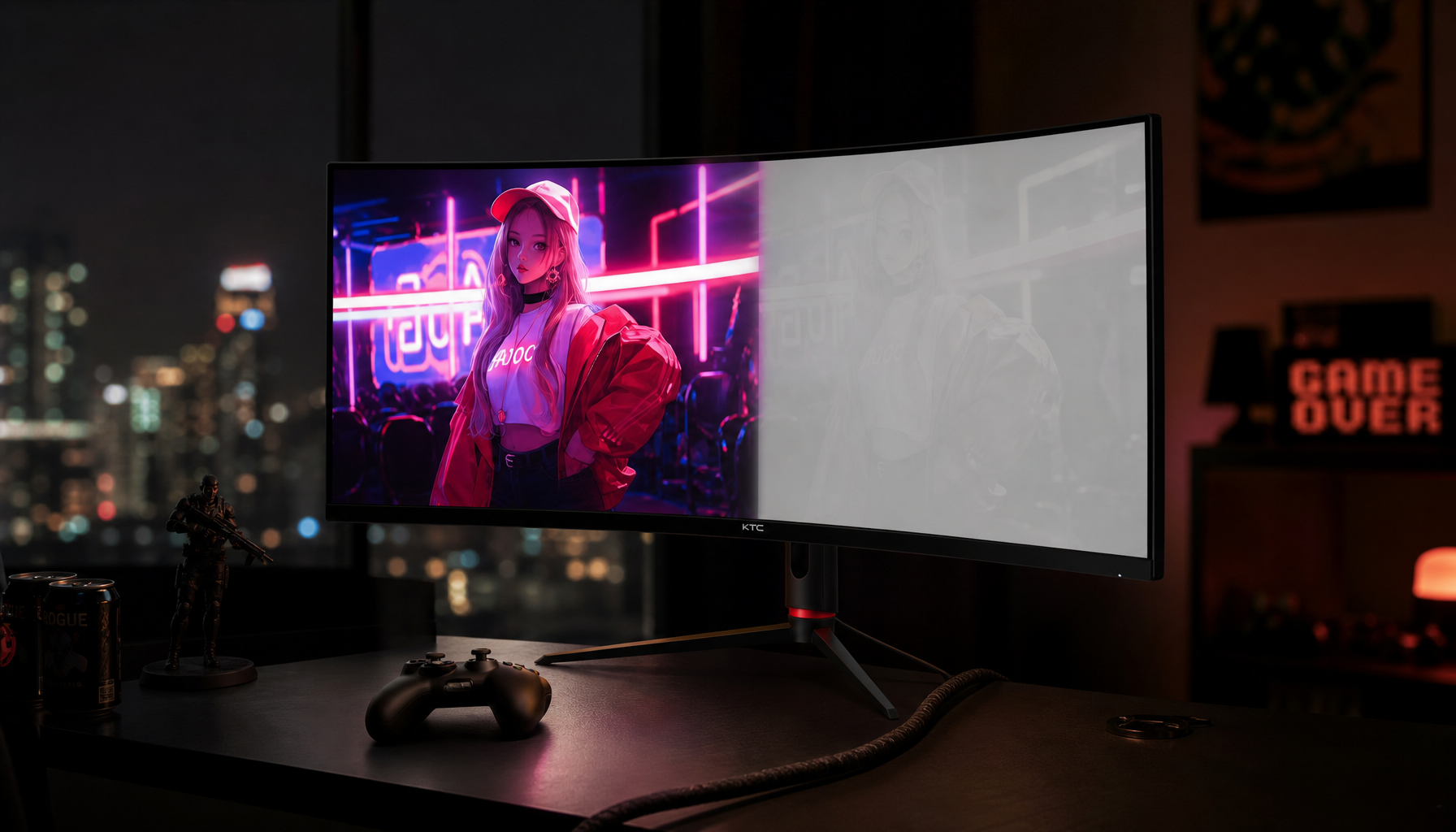
Black levels can shift because a brightness control may also affect backlight output, OLED pixel behavior, gamma, HDR tone mapping, local dimming, power saving, and display presets.
Does your monitor look clean in a bright office, then turn gray, crushed, or oddly tinted when you lower brightness at night? Careful adjustment can preserve shadow detail, reduce eye strain, and keep games, spreadsheets, and video from looking consistent across your daily setup. Here is how to identify the real cause and set brightness without sacrificing black depth.
Why Black Levels Move When Brightness Changes
On many displays, the brightness slider controls the floor of the image: how close dark gray sits to true black. That is why brightness adjustment primarily sets black level, while contrast is more about near-white highlight detail. If brightness is set too low, dark grays disappear into black; if it is too high, blacks lift into charcoal gray and the whole image loses depth.
The complication is that modern monitors rarely expose one pure brightness control. Gaming monitors, office displays, portable screens, mini-LED laptops, and OLED panels often combine brightness with power limits, preset modes, dynamic contrast, local dimming, HDR behavior, and graphics-card color output. When you move a slider from 80% to 30%, you may be changing more than luminance.
A practical example is a dark game map. At 80% brightness, you may see texture in a tunnel wall. At 20%, the same wall may become a flat black patch because the display’s near-black steps are compressed. On another monitor, lowering brightness may make the tunnel look milky instead because the panel or firmware lifts shadow tones to preserve visibility.
Brightness, Contrast, Gamma, and Black Level Are Not the Same
Brightness is best understood as the control that moves the dark end of the image. Contrast controls the bright end. Gamma controls the path between black and white, especially midtones and shadows. For daily SDR work, a stable gamma target near 2.2 is the normal baseline because it keeps web pages, dashboards, office apps, and most games visually predictable.
This distinction matters because a black-level problem can look like a brightness problem when it is really a gamma problem. If shadows look crushed after lowering brightness, raising brightness may help, but it may also make black backgrounds gray. If the display offers gamma modes, the better fix may be returning gamma to a neutral setting and then adjusting brightness for the room.
In hands-on calibration work, the fastest test is a black-level pattern. You should be able to barely distinguish the first few near-black boxes from the black background. If all the boxes vanish, brightness or gamma is too aggressive. If every box glows too clearly and the background looks washed out, the black floor is lifted.

Panel Technology Changes the Result
LCD monitors use a backlight shining through liquid crystals, so lowering brightness usually reduces the backlight output. The black level depends on how well the panel blocks that light. IPS displays often have wider viewing angles and good productivity usability, but their blacks can look lighter in dark rooms. VA panels usually deliver stronger native contrast, which can make black-level shifts less obvious, though dark response time can vary by model.
OLED behaves differently because OLED monitors use self-emissive pixels. Each pixel produces its own light, so true black can be pixel-off black. But near-black grays can still shift because red, green, and blue subpixels may not scale evenly at low drive levels. That is why some OLED screens look neutral at medium brightness but show a green, pink, or blue tint on dark gray backgrounds at low brightness.
Mini-LED displays add another layer. They use many dimming zones behind the LCD panel. Lowering brightness can change how aggressively those zones dim, which affects black depth, haloing, and shadow visibility. A dark movie scene may look punchier with local dimming high, while a spreadsheet in dark mode may show uneven patches if dimming zones react to bright text and dark cells.

Display Type |
Why Blacks Shift With Brightness |
Best Practical Check |
IPS LCD |
Backlight leakage becomes more visible in dark rooms |
Test dark gray patterns at your normal seating distance |
VA LCD |
Gamma and black crush may change perceived depth |
Check shadow detail in games and movies |
Mini-LED LCD |
Local dimming changes zone behavior |
Compare SDR and HDR with the same content |
OLED |
Near-black subpixel balance can shift |
Test full-screen dark gray at daily brightness |
Presets Can Quietly Change Black Levels
A display preset is often much more than a color mood. Presets may change brightness, contrast, gamma, black level, color temperature, gamut, overdrive, HDR tone mapping, local dimming, adaptive sync, and refresh behavior. That means switching from Standard to Game or Movie can change black levels even when the brightness number looks similar.
For example, Movie mode may lower brightness and deepen midtones for a dim room, which can make daytime scenes look rich but make office text dull. Game mode may raise shadow visibility to help players see enemies in dark areas, but it can flatten cinematic contrast. Vivid mode may increase saturation and contrast, making blacks look punchy at first while reducing grayscale accuracy.
The smarter approach is to create one stable base mode. Keep native resolution, refresh rate, HDR state, and adaptive sync consistent for daily use, then adjust only brightness and color temperature when possible. Display modes optimize visibility and comfort for different tasks, but they can also hide deeper changes that affect black levels.
HDR and Local Dimming Can Make the Slider Feel Unpredictable
HDR changes the rules because the display is no longer just mapping SDR black to white in a simple way. HDR can alter tone mapping, peak brightness behavior, dynamic range, and the electro-optical transfer curve. On many monitors, the SDR brightness slider, HDR brightness control, and in-game HDR calibration all interact.
This is why a monitor can look correct on the desktop, too dark in an HDR game menu, and lifted in a streaming app. The display is not necessarily broken; it may be applying different tone maps for different signal states. If you keep toggling HDR for non-HDR content, black levels may appear inconsistent because the monitor is repeatedly changing operating modes.
For gaming, set the monitor first. Use a stable SDR mode for SDR games, and only enable HDR for true HDR content. Then run the game’s own HDR calibration or brightness screen. In competitive play, raising in-game shadow visibility can be useful, but it should be a deliberate visibility choice rather than a hidden monitor preset side effect.
Auto Brightness, Power Saving, and Content-Adaptive Dimming
Auto brightness can shift black levels because it changes screen luminance in response to the room or the image itself. Some operating systems and laptop firmware can also use content-adaptive brightness control, where the display changes output based on what is on screen. A mostly dark document, a bright web page, and a full-screen video can trigger different behavior.
That is useful for battery life, especially on portable displays and laptops, but it is bad for consistency. If you are editing photos, comparing dark UI themes, grading video, or playing a game where shadow detail matters, automatic brightness can make the same black tone appear different minute by minute. Display settings include brightness and color controls that are worth checking before blaming the panel.
Portable monitors add one more constraint: power delivery. A USB-C portable screen may dim at high brightness if the host port cannot supply enough power, or it may behave differently on battery versus wall power. Reviews of portable displays regularly flag brightness, connectivity, and power behavior as core buying factors because portable monitors vary widely in real-world usability.
Room Lighting Changes Your Perception of Black
A black level that looks excellent in a bright office can look washed out in a dark room. Your eyes adapt to the environment, so the same monitor setting can feel too dim during the day and too bright at night. Reflections also lift perceived blacks because room light bounces off the panel surface.

For typical productivity work, brightness should be set for the room rather than maxed out for spec-sheet impact. Monitor brightness is measured in nits, but the right number depends on your lighting, panel coating, work type, and comfort. A creator working in SDR usually benefits more from stable color accuracy and controlled lighting than from chasing maximum peak brightness.
A simple field test works better than guessing. Open a blank white document and hold a sheet of white paper next to the screen under the same room light. If the screen looks like a glowing light panel, lower brightness. If it looks dull and gray compared with the paper, raise it. Then check a dark-gray test image to confirm that shadows are still separated.
How to Stabilize Black Levels Without Losing Performance
Start by choosing a neutral display mode such as Standard, sRGB, Creator, or Custom. Avoid Vivid for calibration because it often changes too many variables at once. Set contrast near the factory default unless you see clear clipping in bright test patterns. Then adjust brightness until white feels comfortable in your room and near-black detail is still visible.
For office productivity, consistency beats spectacle. Use moderate brightness, neutral color temperature, native resolution, and operating-system scaling for readability. If your monitor supports ICC or ICM profiles, use them for color consistency, but remember that profiles cannot fix physical black-level limits, local dimming artifacts, or OLED near-black tint.
For gaming, keep refresh rate, adaptive sync, and HDR state stable before tuning brightness. If the game has its own black-level or gamma screen, use it after the monitor is already set. A dark-room RPG and a bright competitive shooter may need different in-game settings, but they should not require a full monitor mode change every session.
For OLED, lower desktop brightness is not just about comfort. Prolonged high brightness with static UI can increase wear risk, while built-in protections such as pixel shifting, screen savers, and panel cleaning help manage longevity. For mixed office and gaming use, a restrained SDR desktop with HDR reserved for HDR content is the most balanced path.
When Black-Level Shift Signals a Problem
Some shifting is normal. LCD backlights, OLED subpixels, local dimming zones, and HDR tone mapping all behave differently as brightness changes. But sudden dim states, sliders that move without changing actual luminance, repeated black screens, or brightness that only recovers after unplugging and reconnecting power point toward firmware, driver, cable, dock, or power-management issues.
A practical troubleshooting pass should document the exact mode, input, refresh rate, HDR status, power source, graphics mode, and preset. Then test the same image in SDR, with auto brightness disabled, in one neutral display mode. If the issue disappears, the cause was likely a setting interaction. If it remains across inputs and devices, panel behavior or firmware becomes more likely.
The strongest setup is not the brightest setup. It is the one where black stays black, shadow detail remains visible, text stays crisp, and your display does not change character every time the room, content, or power state changes. Tune brightness as part of a display system, and your monitor becomes a reliable performance tool instead of a moving target.