Mac users often notice softer text on 4K monitors because macOS scaling frequently relies on fractional modes that introduce subtle blurring. A 27-inch 5K display solves this by enabling perfect integer scaling that matches the Retina standard macOS is built around.

The Science of Pixel Density: Why macOS Targets 218 PPI
Apple designed macOS around a target pixel density of roughly 218 pixels per inch for desktop viewing distances. This Retina standard keeps interface elements and fonts sharp without forcing users to sit unusually close.
At 27 inches, 5K resolution (5120x2880) lands exactly at 218 PPI. The same screen size at 4K delivers only 163 PPI, while 1440p drops to 109 PPI. Higher density directly improves edge definition on text, which matters most during long reading or coding sessions.
For many MacBook users, the difference becomes noticeable after several hours at the desk. Lower-density panels force the system to stretch or compress pixels, reducing the crispness that Retina displays are known for. See our guide on choosing monitors for productivity and healthier workspaces for more context on how pixel density affects daily comfort.
Why 5K is the Gold Standard for macOS Scaling and HiDPI
The core advantage of 5K on a 27-inch panel is integer scaling. A 5120x2880 image maps perfectly at 2x to a 2560x1440 logical workspace, with every UI pixel rendered by exactly four physical pixels. This 1:1 physical mapping eliminates interpolation artifacts.
Pixel Mapping Clarity: 5K Integer Scaling vs 4K Fractional Scaling
5K delivers exact 2x integer mapping on macOS, while 4K requires 1.5x fractional scaling that can soften thin fonts and fine lines.
Show data table
| Resolution | Scaling Mode | Pixel Mapping | Relative Clarity |
|---|---|---|---|
| 5K (5120x2880) | Integer 2x | Exact 4:1 | 100 |
| 4K (3840x2160) | Fractional 1.5x | Interpolated | 72 |
In contrast, 4K panels need fractional scaling to reach a usable workspace size. macOS renders at a higher internal buffer then downsamples, which can place thin font strokes between physical pixels. The result is a slight shimmer or softness that becomes tiring during extended writing or development work.
M4 and M5 chips also carry a hardware render limit that further restricts high-resolution HiDPI modes on 4K screens. The 5K layout avoids these constraints by design, keeping text edges stable even when scrolling or animating interfaces.
The 4K Compromise: When is a 27-inch 4K Monitor 'Good Enough'?
Many users find 4K acceptable when their work mixes visual tasks with occasional text. Photo editing and video review tolerate fractional scaling better because the eye focuses less on single-pixel font edges.
Tools like BetterDisplay can force higher internal resolutions and reduce some softness, though they add setup steps and minor performance overhead. Budget-conscious buyers who spend fewer than six hours daily on dense text may prefer saving the difference for other upgrades.
If your workflow stays primarily visual rather than code- or document-heavy, the practical gap narrows. Still, anyone sensitive to font shimmer during long sessions tends to notice the improvement once they switch to a true 218 PPI panel.
KTC H27P3: A Professional 5K Workspace Without the Studio Display Premium
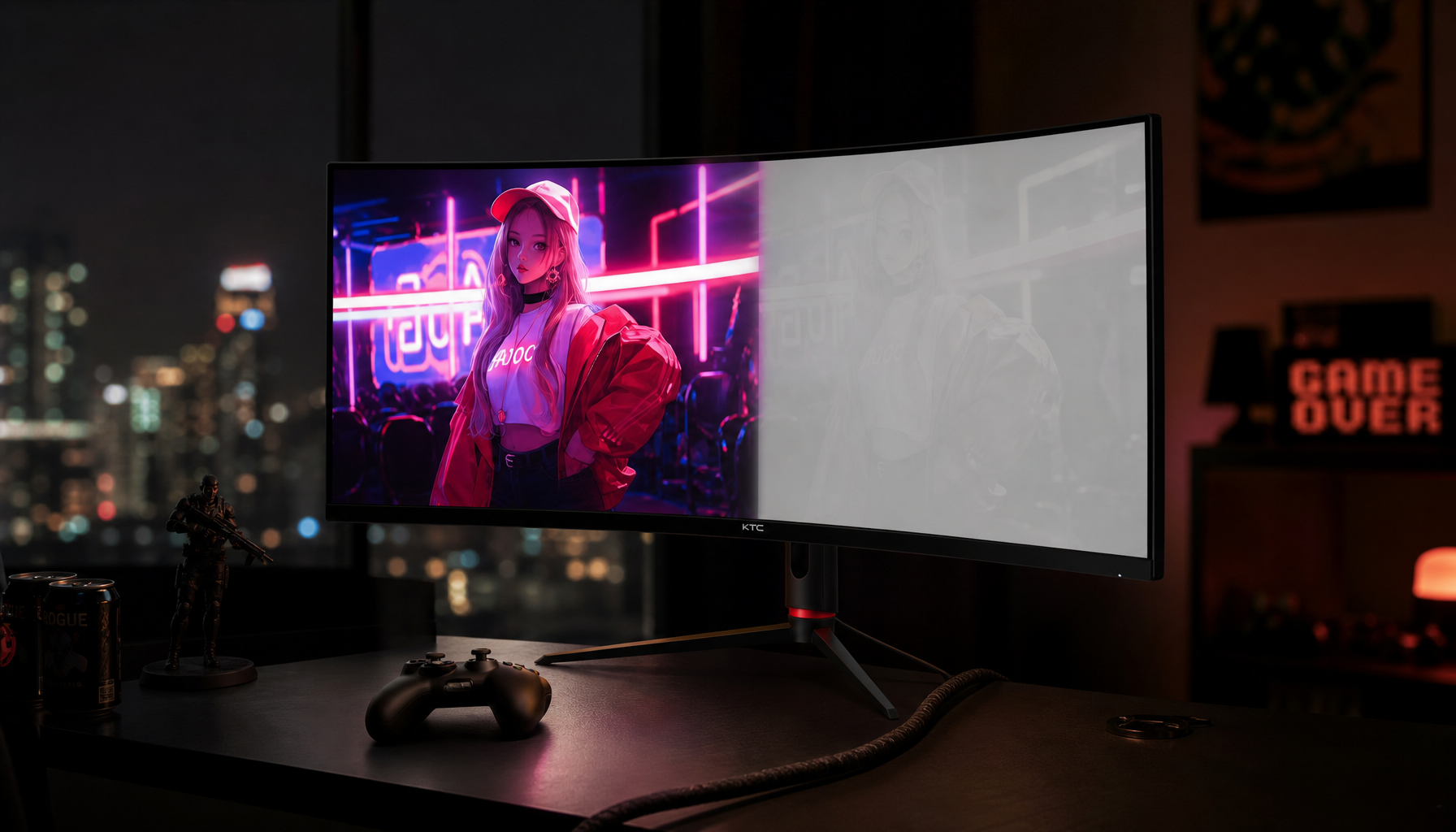
The KTC H27P3 brings 5K resolution to a 27-inch IPS Black panel with 2000:1 contrast and 99% DCI-P3 coverage. These specs support accurate color for design work while delivering the pixel density needed for sharp macOS text.
Its dual-mode operation lets the panel run at 5K 60 Hz for daily productivity or drop to 1440p at 120 Hz when lighter gaming or motion is preferred. The aluminum quick-release stand keeps desk setup simple, and the panel meets the same color and brightness targets found on higher-priced professional displays.
Shop the full 27-inch monitor collection or browse dedicated office monitors to compare options that match your desk space and port requirements.
The Decision: Choosing Between 5K Clarity and 4K High-Refresh
Prioritize 5K when you spend six or more hours reading or writing code each day. The objective pixel mapping reduces eye strain that fractional scaling can create over time.
If evening sessions focus on high-frame-rate gaming or HDR video, a 4K 160 Hz monitor such as the KTC M27P6 offers smoother motion and stronger contrast in dynamic content. Text-heavy users who occasionally game can stay on the H27P3 and use its 120 Hz 1440p mode without losing sharpness.
The trade-off is straightforward: 5K protects long-term reading comfort, while high-refresh 4K favors motion fluidity. Most Mac professionals who value font clarity select the higher-resolution path and add a separate display only if competitive gaming becomes primary.
Maximizing Your Mac Setup: Cables, Settings, and Wake-from-Sleep Tips
Connect the H27P3 or any 5K monitor using Thunderbolt 4 or DisplayPort 1.4 with DSC enabled to maintain full resolution and color. HDMI 2.0 connections often fall back to lower modes on macOS.
Some users report a 6–8 second wake-from-sleep delay on first connection; recent firmware updates have reduced but not eliminated this behavior. Keeping macOS and monitor firmware current minimizes the pause.
Third-party utilities such as MonitorControl restore hardware brightness and volume keys. Enable “HiDPI” modes in display settings and test both “looks like 1440p” and native options to confirm the sharpest text rendering for your specific apps.
Is 5K noticeably sharper than 4K on a 27-inch Mac display?
Yes for text-dense work. The perfect 2x integer scaling on 5K keeps font edges aligned to physical pixels, while 4K fractional scaling often softens thin lines and UI elements.
Does 27-inch 5K require special cables or ports?
A Thunderbolt 4 cable or DP 1.4 cable with DSC support is required to reach full 5120x2880 resolution and 10-bit color from recent MacBooks.
Will a 4K monitor look blurry on macOS?
Not for everyone. The softness appears mainly in fractional scaling modes used for a 1440p-like workspace. Users focused on video or design often find it acceptable, while coders and writers tend to prefer the clarity of 5K.
Is the KTC H27P3 compatible with M1 through M4 Macs?
Yes. Any Mac with Thunderbolt or USB-C video output can drive the panel at 5K 60 Hz when using a compatible cable.
Should I choose 5K or wait for future AI upscaling features?
Current macOS versions do not apply system-wide AI upscaling to fix 4K fractional blur. 5K remains the most reliable route to native Retina text quality today.