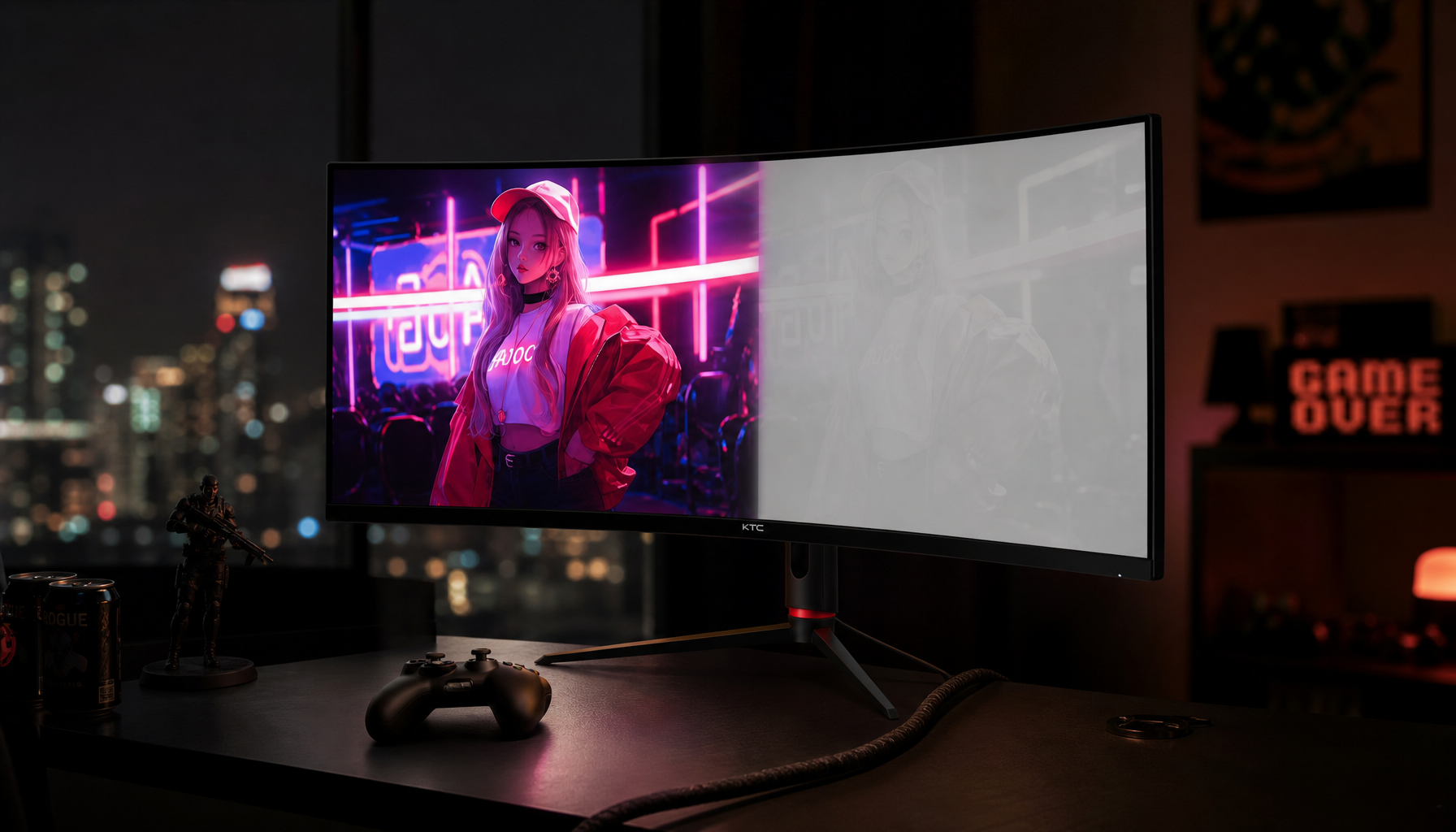
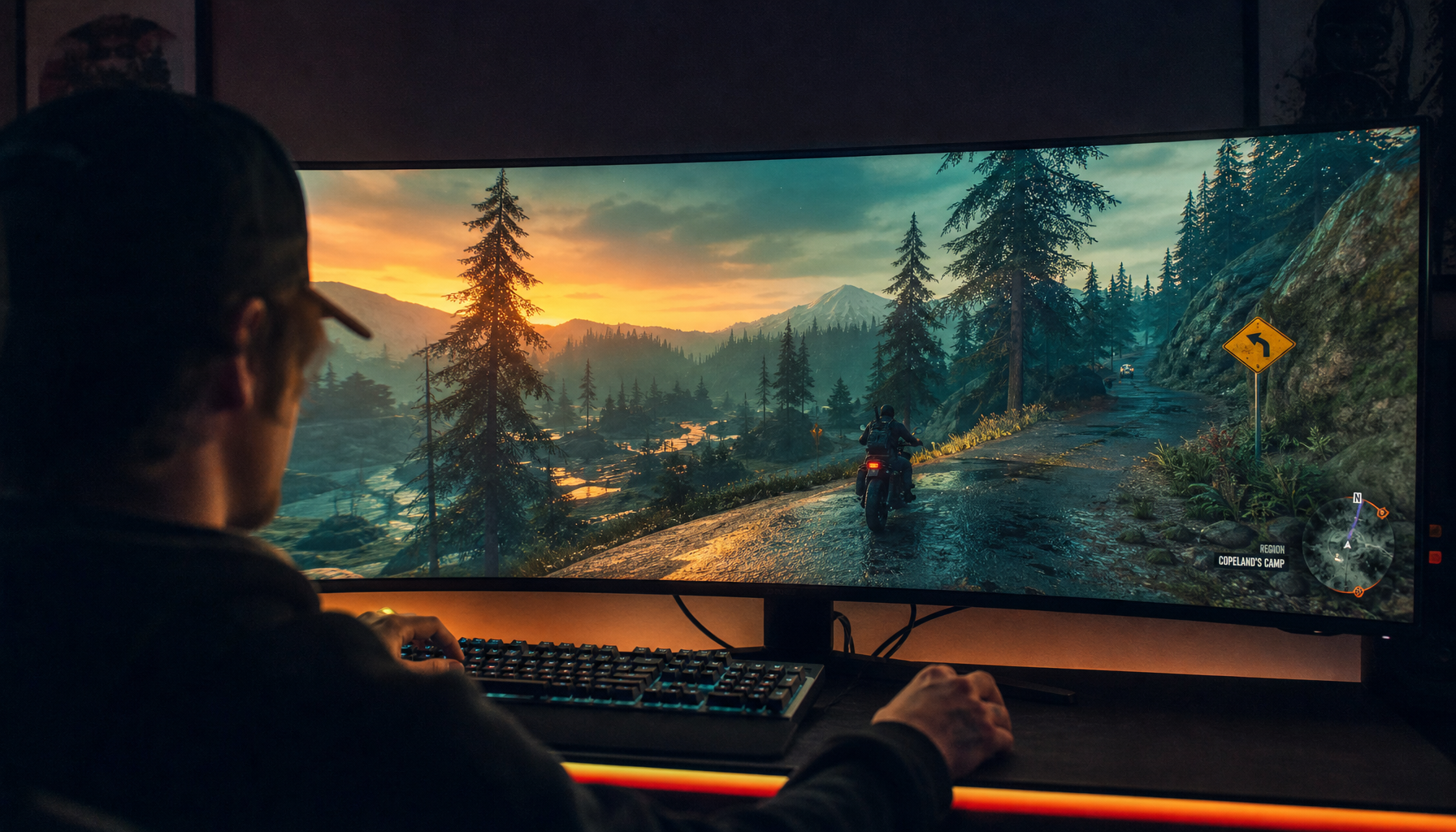
Viewing distance changes how much motion blur, pixel structure, text softness, and on-screen detail your eyes can resolve. Sit closer for detail and immersion, sit farther for comfort and full-screen awareness, then tune refresh rate, response time, and scaling so clarity holds up in motion.
Is fast gameplay turning into a smear, or does spreadsheet text look sharp until you start scrolling? A practical distance change of just a few inches can make targets easier to track, reduce eye travel, and keep text readable without leaning in. Here is how to set your monitor distance for sharper motion, cleaner detail, and a setup that works for gaming, office work, and portable screens.
Why Viewing Distance Changes What You See
Viewing distance affects perceived clarity because your eyes do not judge a display by specs alone. They judge how much of your field of view the screen occupies, how large each pixel appears, how fast objects move across your vision, and how hard your eyes must work to refocus. That is why a 27-inch 1440p monitor can look crisp at a normal desk distance but less impressive across a room, while a large low-resolution display can look coarse when pulled too close.
For workstation comfort, monitor placement guidance recommends placing the screen directly in front of you and generally 20 to 40 inches from your eyes. That range is not just an ergonomic rule; it is also a clarity control. At the close end, pixels, overdrive artifacts, and strobe crosstalk become easier to notice. At the far end, fine text, small UI elements, and distant targets in games become harder to separate.
Motion blur is especially sensitive to distance because it is partly perceived, not just measured. A monitor can have a fast response-time spec and still look blurry if your eyes are tracking a moving object while each frame remains visible too long. A closer screen increases the visual angle of that movement, so blur can feel more obvious. A farther screen can make the same blur look less aggressive, but it may also shrink important details.
Motion Blur, Ghosting, and Clarity Are Not the Same Thing
Motion blur is the soft smear you perceive when moving content loses definition. On modern LCD and OLED displays, a major cause is sample-and-hold behavior: each frame stays visible long enough that your eyes smear the image while tracking motion. Motion Blur Reduction features try to improve perceived motion clarity by strobing the backlight or inserting dark intervals, which shortens how long each frame is visibly held.

Ghosting is different. It appears as faint trails behind moving objects when pixels cannot transition quickly enough from one shade to another. A VA gaming monitor may show dark smearing in shadowy scenes even at a good distance, while an IPS monitor with overly aggressive overdrive may show bright inverse trails. Sitting farther away can make these trails less visible, but it does not fix the panel behavior.
Static clarity is different again. It is about pixel density, resolution, text rendering, scaling, and focus comfort. A 24-inch 1080p monitor at about 24 inches can look clean for competitive play because the whole screen stays easy to scan. A 32-inch 1080p display at the same distance may show larger pixels and softer text. Move the 32-inch screen farther back, and perceived pixel structure improves, but small text may need scaling.
The Distance Sweet Spot for Gaming Monitors
For competitive FPS, the goal is not maximum immersion. It is full-screen awareness. You want the crosshair, minimap, health, ammo, and corner movement inside comfortable central and near-peripheral vision. Research notes on 24.5-inch FPS setups place the practical range around 20 to 30 inches, with many players settling near 24 inches because it balances target visibility and HUD awareness.
That matches real desk behavior. A 24- or 25-inch display at roughly arm’s length lets most players see the full screen without head movement. Move closer than about 20 inches and your field of view expands, which can make targets feel larger but pushes HUD information outward. Move much farther than 30 inches and fine target detail may shrink, especially at 1080p.
For 27-inch gaming monitors, a 24- to 32-inch distance is usually more natural. At 1440p, that distance keeps the image sharp without forcing your eyes to sweep too far across the panel. For 32-inch monitors, expect closer to 30 to 40 inches if your desk allows it. If the desk is shallow, a monitor arm can recover several inches by moving the panel toward the rear edge.

Distance also changes how blur-reduction modes feel. A strobing mode that looks impressively clear at 28 inches might feel harsh or flickery at 20 inches because the screen fills more of your vision. Practical troubleshooting for low-blur modes also shows that many monitors restrict those modes to specific refresh rates, require adaptive sync to be disabled, or behave differently depending on display connection, HDR, and GPU setup.
Office Clarity: Text, Scrolling, and Eye Fatigue
Office work exposes another kind of blur. Instead of tracking enemies, you are reading dense text, comparing columns, scanning dashboards, and scrolling long pages. If the screen is too far away, you lean forward and squint. If it is too close, your eyes work harder to converge and refocus, and the edges of a large screen may require more eye movement than necessary.
A reliable starting point is arm’s length. For most 24-inch office monitors, 20 to 28 inches works well. For 27-inch displays, 24 to 32 inches is more comfortable. For 34-inch ultrawides or dual-monitor setups, 30 to 36 inches often feels better because the horizontal span is wider.

The key office move is to adjust scaling before moving closer. If text is too small on a 27-inch 4K monitor, increase system display scaling rather than pulling the monitor toward your face. That preserves posture and keeps motion during scrolling easier to follow. For long sessions, workplace guidance also notes that extended screen viewing can contribute to dryness and fatigue because people blink less while looking at displays, so distance should be paired with periodic far-focus breaks.
A simple productivity test works better than guessing. Open a document, a spreadsheet, and a browser page. Sit upright with your shoulders relaxed. If you can read body text without leaning and scan the full width without rotating your neck, your distance is close. If scrolling text smears heavily, lower in-app motion effects, raise refresh rate if available, and check overdrive rather than assuming distance is the only cause.
Portable Smart Screens Need a Different Rule
Portable displays are often used closer than desktop monitors because they sit beside a laptop, on a small stand, or in a travel workspace. That can make text look crisp, but it also makes motion artifacts and brightness mismatch more visible. A 15- to 16-inch portable screen may be comfortable at 18 to 24 inches, while a larger 17- to 18-inch portable panel may need a little more distance if used as a primary display.
The biggest mistake is treating a portable smart screen like a tablet while using it like a monitor. If it is showing documents, code, chat, or a timeline all day, raise it closer to eye level and use a separate keyboard and mouse. Laptop users often sit too close because the keyboard is attached to the display; separating input from screen position gives you the freedom to place the panel where clarity and posture both improve.
For portable gaming, distance should follow screen size and content. A smaller 1080p portable screen can look sharp up close, but fast camera pans may reveal sample-and-hold blur. If the screen supports higher refresh rates, enable the maximum stable refresh rate. If it has a blur-reduction mode, test it at the refresh rate the panel supports cleanly, not just the highest advertised mode.
What Research Adds Beyond Desk Rules
Display distance is not only about comfort; it changes performance depending on the task. A dissertation on display size and timed visual-cognitive work found that the smallest display performed worse under short viewing-time conditions, while differences disappeared when participants had longer viewing time. In practical terms, a small portable display may be fine for email, but when you need fast recognition under pressure, larger or better-positioned screens help.
Depth and spatial perception also matter for immersive screens. In simulated visual displays, researchers found that perspective-based cues such as linear perspective, foreshortening, and texture gradient were more effective than cues like relative brightness, and some cues became less effective as viewing distance increased. For gaming and simulation displays, that supports a practical point: sitting at a distance where perspective and environmental detail remain readable can improve spatial confidence.
Projection-screen research adds another useful distinction. In a study of projection viewing, shorter viewing distances improved text proofreading performance, while viewing distance mattered less for film-watching tasks where audio and general video context carried more of the experience. That lines up with monitor use: text-heavy tasks need readable visual angles, while cinematic play can tolerate more distance if the screen remains immersive.
Practical Setup Recommendations
For a 24- or 25-inch esports monitor, start at 22 to 26 inches. Keep the top third of the screen at or slightly below eye level, then adjust in-game UI scale before leaning closer. Use medium overdrive first, because extreme overdrive can trade normal ghosting for inverse trails.
For a 27-inch mixed-use monitor, start around 26 to 30 inches. This is the high-value zone for 1440p productivity and gaming because the screen is large enough for multitasking but not so wide that you lose awareness. If you play competitive shooters, sit a little closer; if you edit documents or code for hours, sit a little farther and increase text scaling.
For a 32-inch or ultrawide display, start around 32 to 40 inches if your desk allows it. A deep desk or monitor arm matters here. If you cannot get enough distance, reduce brightness, increase scaling, and consider a gentle curve for ultrawide formats so the edges feel more consistent.
For blur reduction, distance is only one lever. MBR quality depends on stable frame rate, refresh rate, pixel response, and implementation quality. Many modes reduce brightness and may add flicker, so the best setting for a 30-minute match may not be the best setting for an eight-hour workday.
Use Case |
Typical Screen |
Good Starting Distance |
Clarity Priority |
Competitive FPS |
24-25 in |
22-26 in |
Full-screen awareness and motion tracking |
Mixed gaming and work |
27 in |
26-30 in |
Detail, comfort, and balanced immersion |
Creative or data work |
32 in |
32-40 in |
Readable workspace without neck rotation |
Ultrawide productivity |
34-38 in |
30-40 in |
Edge visibility and multitasking comfort |
Portable smart screen |
15-18 in |
18-26 in |
Text scaling, posture, and glare control |
The Tradeoff: Closer vs. Farther
Sitting closer improves apparent detail, makes small targets larger, and can make a high-resolution display feel worth the upgrade. It also increases immersion, especially in racing, simulation, and story-driven games. The downside is higher eye travel, more visible pixel structure on lower-density displays, and more obvious blur artifacts during fast motion.
Sitting farther back softens the visibility of pixel structure and can reduce the intensity of perceived motion artifacts. It also helps with large displays because the whole screen fits more comfortably in view. The tradeoff is that small text, distant enemies, and fine UI elements may become harder to resolve, so scaling and game HUD settings become more important.
The best distance is the one where you stop compensating. You should not be leaning forward to read, turning your head to check the minimap, or lowering your standards because the spec sheet says the monitor should be fast. Set the distance first, then tune refresh rate, overdrive, scaling, brightness, and blur reduction around that position.
A Fast Calibration Method
Sit in your normal posture and extend your arm. If your fingertips land near the screen, you are in the right starting zone for many 24- to 27-inch desk monitors. Then run two tests: scroll a dense webpage at your normal reading speed, and track a moving object in a game or motion test. If text is readable when still but smears badly in motion, adjust refresh rate, overdrive, and blur-reduction settings. If everything is sharp but your eyes feel strained, move the display back a few inches or reduce brightness.

For serious gaming, test at the refresh rate you actually use. A monitor advertised at 360 Hz may only support a strobing mode at lower fixed refresh rates, and VRR may need to be disabled. For serious office work, test at the font size you actually use, not a demo page. Real clarity is measured during your workflow.
Final Word
Viewing distance is a performance setting, not just an ergonomic preference. Put the screen where your eyes can track motion, read detail, and hold posture without effort, then let refresh rate, response tuning, scaling, and blur reduction do their jobs. A sharper display experience starts with inches, not specs.