Ultrawide gaming can give a real advantage in supported games by showing more horizontal space, but it is not a universal competitive upgrade. For many players, the bigger benefits are immersion, comfort, and multitasking, while serious esports still depends more on refresh rate, response time, input lag, and stable frame rates.
Ever feel like enemies, apexes, or cockpit instruments are sitting just outside the edge of your screen? A 3440x1440 ultrawide monitor renders about 34% more pixels than a 2560x1440 display, so the experience can feel wider and richer, but it also asks more from your graphics card. The practical question is not whether ultrawide looks impressive; it is whether your games, GPU, desk, and competitive goals can actually use it.
What Ultrawide Gaming Actually Changes
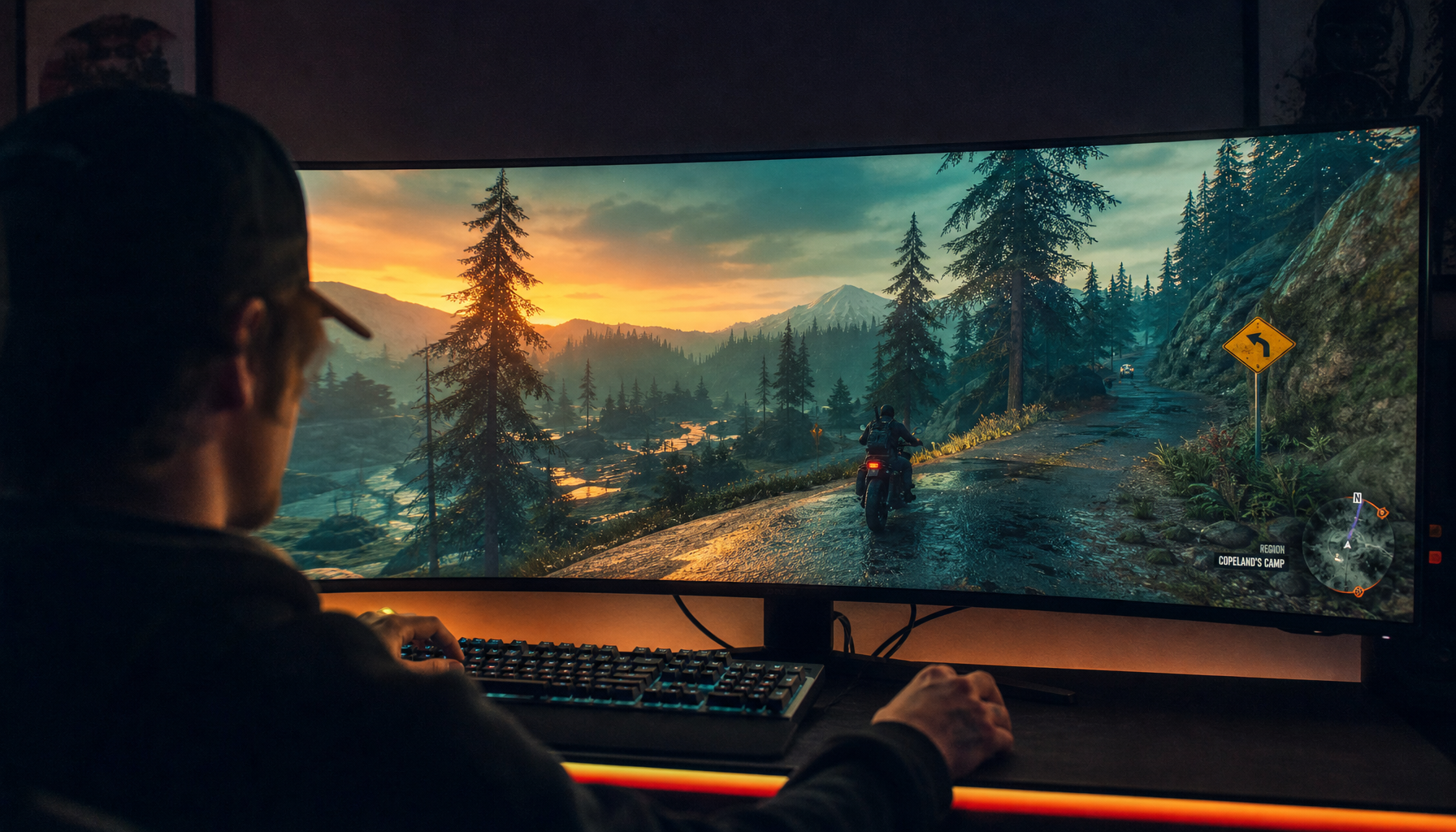
An ultrawide gaming monitor mainly changes the shape of the image. A standard gaming monitor usually uses a 16:9 aspect ratio, while common ultrawide models use 21:9, and super ultrawide models use 32:9, which is roughly like placing two 16:9 screens side by side without a center bezel. That extra width can make a racing cockpit, flight sim dashboard, open-world landscape, or first-person environment feel more natural because more of the scene occupies your side vision.
The key technical point is field of view. In games, field of view refers to the observable game world visible at one time, and many PC games increase horizontal FOV as the aspect ratio gets wider. When a game uses proper “Hor+” scaling, the vertical view stays stable while the monitor reveals more to the left and right, which is exactly the scenario where ultrawide can become more than just visual flair.

Aspect Ratio Is Not the Same as Skill
A wider monitor does not improve aim, reaction time, or game knowledge by itself. If a game simply stretches a 16:9 image, locks FOV, uses black bars, or pushes the HUD too far toward the screen edges, the competitive benefit can shrink or disappear. That is why ultrawide value depends heavily on game support, not just monitor size.
For example, a 34-inch 3440x1440 ultrawide can feel meaningfully different from a 27-inch 2560x1440 display in a supported racing game, because side mirrors, road curvature, and nearby cars may be easier to track. In a tactical shooter with locked aspect ratio rules or a tiny center-focused HUD, the same monitor may feel impressive without making you play better.

Where Ultrawide Can Create a Real Gameplay Advantage
The clearest advantage appears in games that properly expand horizontal view. A widescreen gaming database tracks support across widescreen, ultrawide, multi-monitor, and 4K categories, including whether a game is native, Hor+, pillarboxed, stretched, or dependent on fixes such as .ini edits or hacks; that kind of ultrawide support is what determines whether extra screen width turns into useful information.
This matters most when peripheral awareness changes decisions. In racing games, seeing more of the track and neighboring cars can help with positioning. In flight simulators, more cockpit and skyline visibility can reduce camera switching. In open-world and first-person adventure games, ultrawide often improves spatial awareness and immersion, even if it does not produce a measurable win-rate boost.
Best-Fit Game Genres
Ultrawide is strongest when the game benefits from horizontal context rather than pinpoint center-screen precision. Racing, flight simulation, space simulation, open-world exploration, survival games, strategy games, and cinematic single-player titles usually make better use of a 21:9 or 32:9 monitor than strict esports titles.
A practical example is a flight simulator at 3440x1440, where wider cockpit visibility is useful but the graphics workload is high. A gaming publication notes that a flight simulator benefits from ultrawide cockpit and skyline views, but reaching around 60 FPS at that resolution requires a very powerful graphics card. That illustrates the core tradeoff: the extra view is valuable only if the system can keep motion smooth.
When It Helps Competitive Play
Ultrawide can help competitive play when three things are true: the game supports Hor+ or native ultrawide, the wider image does not distort the HUD, and your frame rate stays high enough for the monitor’s refresh rate. In that situation, extra peripheral information can help you notice movement, vehicle position, or environmental cues earlier.
But it is rarely a shortcut. If a player drops from a smooth 240 Hz 16:9 setup to an inconsistent ultrawide experience with frame dips, the wider image may hurt more than it helps. Competitive advantage is not only what you can see; it is also how quickly and consistently the monitor shows each new frame.
The Frame Rate Tradeoff: More Width Means More Pixels
Ultrawide gaming is more demanding because the graphics card has to render more pixels. A 3440x1440 ultrawide panel has nearly 5 million pixels, compared with about 3.7 million pixels on a 2560x1440 monitor, which creates about a 34% higher GPU workload; that GPU workload can reduce FPS if your system is already near its limit.

This is why a monitor purchase should be matched to your GPU, not just your desk space. If your PC already struggles to hold 144 FPS at 2560x1440, moving to 3440x1440 will usually make high-refresh gaming harder unless you lower settings, use upscaling, or upgrade the graphics card. The difference is especially noticeable in ray-traced games, large open worlds, and simulators with heavy scenery.
Refresh Rate Still Matters More for Esports
For serious competitive shooters, a fast 16:9 monitor can be the better buy if your budget forces a choice. A 24-inch or 27-inch display at 144 Hz, 240 Hz, or higher with low input lag and strong pixel response may give a cleaner competitive experience than a larger ultrawide that your GPU cannot drive consistently.
That does not mean ultrawide is bad for competitive gaming. It means the priority order changes by use case. If you mostly play ranked shooters, prioritize refresh rate, response time, input lag, and frame pacing first. If you split time between shooters, racing, simulation, open-world games, and productivity, a high-refresh ultrawide can be a strong all-around display.
Compatibility: The Hidden Dealbreaker
Not every PC game handles ultrawide cleanly. Some titles support 21:9 gameplay but show 16:9 cutscenes, some add black bars, some stretch the image, and others place interface elements too far into the corners. The issue is especially common in older games, smaller indie titles, and some competitive games where standardization matters more than cinematic presentation.
This is why checking game support before buying is practical, not obsessive. A gaming publication highlights that not all PC games support ultrawide resolutions, and unsupported titles may show black bars on the sides. If your top five games include two that are pillarboxed or have broken HUD scaling, the monitor may feel less useful than the spec sheet suggests.
HUD Behavior Can Change the Experience
HUD placement is one of the easiest details to overlook. A game can render beautifully at 3440x1440 yet still put health, ammo, minimap, chat, or quest prompts so far from the center that you move your eyes too much during play. A widescreen gaming database tracks HUD behavior with labels such as Proper, Optimized, Hindrance, and Tiny, which is helpful because “supports ultrawide” does not always mean “feels good on ultrawide.”
Cutscenes are another limitation. Some games switch back to 16:9 during cinematics, even when gameplay works in 21:9. A technology publication notes that games such as a major open-world western game and a fantasy action RPG can involve ultrawide compatibility limitations, including black bars in certain situations. That may not affect competitive performance, but it can affect how premium the display feels.
Monitor Options Compared
The best monitor choice depends on whether you value competitive precision, immersion, productivity, or one-screen flexibility. A 32:9 super ultrawide is dramatic, but it is not automatically better than a 21:9 ultrawide or a fast 16:9 gaming monitor.

For example, a 49-inch DQHD model such as the a 49-inch DQHD 180Hz 1000R curved gaming monitor belongs in the 32:9 class readers should evaluate carefully for GPU load, game support, desk space, and HUD behavior before treating the extra width as an advantage.
Monitor Type |
Common Shape |
Best For |
Competitive Upside |
Main Tradeoff |
24-inch to 27-inch 16:9 high-refresh monitor |
16:9 |
Esports, ranked shooters, budget gaming |
Easier to drive at high FPS; strong focus on refresh rate and response |
Less horizontal view and less immersive |
34-inch ultrawide |
21:9 |
Racing, simulation, open-world games, mixed gaming and work |
Can show more horizontal game world when properly supported |
About 34% more GPU load than 2560x1440 |
49-inch super ultrawide |
32:9 |
Flight sims, racing rigs, multitasking, panoramic play |
Very wide peripheral context in compatible games |
Expensive, large, heavy, and often harder to drive |
Portable gaming monitor |
Usually 16:9 |
Travel, console setup, second-screen use |
Practical for compact setups and temporary play |
Smaller image, fewer ultrawide benefits |
Dual-monitor setup |
Two separate panels |
Streaming, chat, guides, productivity |
Keeps game on a standard esports display while adding workspace |
Center bezel and less seamless than one ultrawide |
Curved vs. Flat Ultrawide
Curvature does not add resolution, refresh rate, or panel area. It changes viewing geometry by bringing the screen edges closer to your eyes, which can make wide panels feel easier to scan. A curved ultrawide can be more comfortable than a flat ultrawide because a wide flat panel places the far edges at a sharper angle from your seated position.

The curve rating matters. A 1000R curve is tighter than 1500R, and 1500R is tighter than 1800R; rough viewing-distance matches are about 3.3 ft for 1000R, 4.9 ft for 1500R, and 5.9 ft for 1800R. Typical desk distances are closer to 27-32 inches for gaming, so a curved monitor’s viewing geometry should be considered alongside desk depth, chair position, and eye level.
Buying Checklist for Competitive Ultrawide Gaming
Before buying an ultrawide gaming monitor, match the panel to the games and performance target you actually use. A beautiful 34-inch or 49-inch display is a poor fit if your favorite title locks to 16:9 or your GPU cannot hold the refresh rate you paid for.
- Check your top five games for native ultrawide, Hor+ scaling, HUD behavior, and cutscene behavior.
- Decide your FPS target first: 144 FPS, 165 FPS, 240 FPS, or another realistic goal based on your GPU.
- Compare pixel load: 3440x1440 is much heavier than 2560x1440, and 32:9 is heavier again.
- Prioritize low input lag, fast response time, and adaptive sync if you play ranked shooters.
- Measure your desk depth and width, including space for speakers, keyboard angle, and mouse movement.
- Verify monitor arm or mount weight limits before buying a heavy 34-inch or 49-inch display.
- Choose curvature based on seating distance, not appearance alone.
FAQ
Q: Can an ultrawide monitor help me see enemies sooner?
A: Sometimes. If the game uses proper Hor+ or native ultrawide support, the monitor can show more horizontal space, which may help you notice movement at the edge of the scene. If the game locks FOV, adds black bars, or uses competitive restrictions, you may not see more than you would on a 16:9 screen.
Q: Will ultrawide lower my frame rate?
A: It can. A 3440x1440 ultrawide display has nearly 5 million pixels, while 2560x1440 has about 3.7 million, so the graphics card has more work to do. If your PC is already near its limit, expect to lower graphics settings or use upscaling to maintain the same FPS.
Q: Is 21:9 or 32:9 better for gaming?
A: For most players, 21:9 is the safer choice because it balances immersion, game support, desk fit, and GPU demand. A 32:9 super ultrawide is excellent for racing, flight sims, and multitasking, but it is more expensive, physically larger, and more likely to expose compatibility issues.
Final Takeaway
Ultrawide gaming is partly aesthetic, but not only aesthetic. In properly supported games, a 21:9 or 32:9 monitor can expand horizontal view, improve peripheral awareness, and make simulation, racing, and open-world games feel more natural. That is a real benefit, especially when the HUD behaves well and your GPU can keep frame rates high.
For pure esports, however, ultrawide is not the first upgrade to chase. A high-refresh 16:9 gaming monitor with low input lag and stable FPS is usually the more dependable competitive choice. The smartest path is simple: buy ultrawide if your favorite games support it and your system can drive it; stay with a fast 16:9 monitor if your priority is maximum consistency in ranked competitive play.