An ultrawide aspect ratio does not directly reduce a monitor’s refresh rate or pixel response time. What can change is the frame rate your PC can actually deliver, because wider ultrawide resolutions often ask the GPU to render many more pixels per frame.
You bought a wider gaming monitor expecting smoother immersion, but the same game suddenly feels heavier, less snappy, or harder to keep near 144Hz. A 3440x1440 ultrawide pushes almost 5 million pixels per frame, about 34% more than a 2560x1440 display, so the performance difference can be very real. Here is how to separate monitor speed from GPU workload and choose an ultrawide display that still feels fast.
The Short Answer: Aspect Ratio Is Not the Refresh-Rate Limiter
A monitor’s aspect ratio is simply the proportional relationship between screen width and height, such as 16:9, 21:9, or 32:9; it is not itself a speed specification. A display aspect ratio describes shape, while refresh rate describes how many times per second the panel updates, so a 21:9 monitor can be 60Hz, 100Hz, 144Hz, 165Hz, 240Hz, or higher if the panel, scaler, and input connection support it.
That also means the wider shape does not automatically worsen response time. Pixel response time is about how quickly pixels change from one state to another, while refresh rate is the screen’s update cadence; a high-refresh monitor can still look blurry if its pixel transitions are slow, and a fast-response panel can still feel limited if the GPU is producing low FPS.
The catch is that many ultrawide gaming monitors also use higher resolutions. A standard 2560x1440 monitor has about 3.7 million pixels, while a 3440x1440 ultrawide has almost 5 million pixels, so the ultrawide display can require substantially more GPU work in the same game scene. That is why an ultrawide may feel slower even when the monitor’s rated Hz and response-time spec did not change.

Refresh Rate, Response Time, FPS, and Input Lag Are Different
Refresh rate is measured in Hz and tells you how often the monitor can update the screen image; a 60Hz display updates 60 times per second, while 144Hz and 240Hz displays can update far more often when fed enough frames. Higher refresh rates reduce the time between visible updates, which is why aiming, camera pans, scrolling, and window movement feel smoother on high-Hz gaming monitors.
FPS is the number of frames your GPU renders. Hz is the monitor’s capacity to show updates. If a 3440x1440 ultrawide is rated at 144Hz but your GPU averages 92 FPS in a demanding game, the monitor is still a 144Hz display, but you are not seeing 144 unique frames every second.

Response time is separate again. A panel with slow pixel transitions can smear motion even at a high refresh rate, especially in dark scenes on some VA panels or when overdrive is tuned poorly. Minimum input-lag timing also improves as refresh rate rises: examples from high-refresh gaming guidance show about 8.33 ms at 60Hz, 4.17 ms at 120Hz, 3.47 ms at 144Hz, 2.09 ms at 240Hz, and 1.39 ms at 360Hz for the refresh interval itself, but total feel also depends on the game engine, GPU queue, display processing, sync mode, and controls.

Why an Ultrawide Can Feel Slower in Real Games
The most common reason is pixel workload. A 3440x1440 ultrawide has about 34% more pixels than 2560x1440, and a 32:9 super ultrawide can be closer to running two standard 16:9 screens side by side. That extra workload can reduce in-game FPS unless the graphics card has enough headroom.
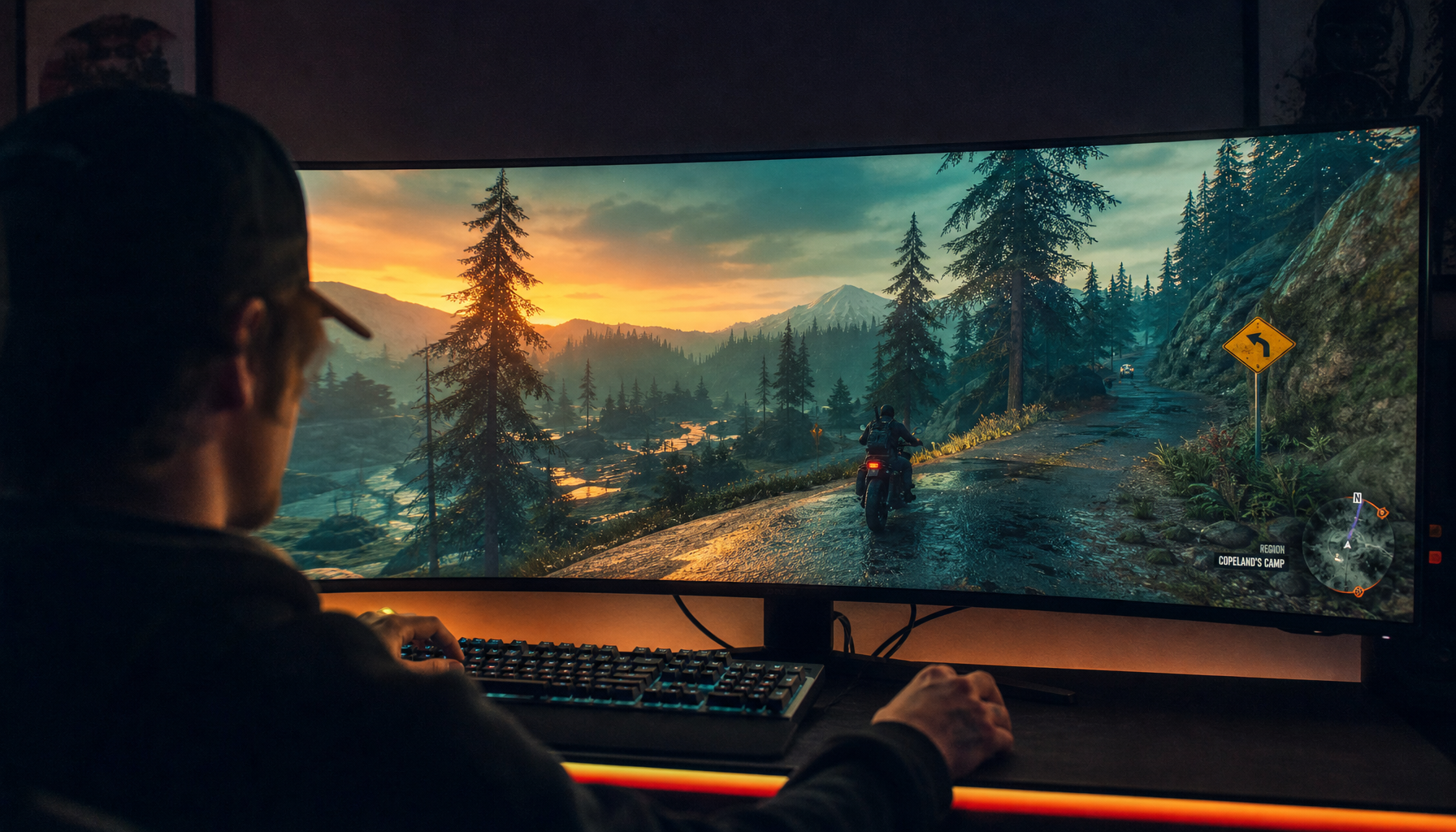
This matters most in GPU-limited games: open-world titles, racing games with heavy reflections, cinematic RPGs, flight simulators, and games with ray tracing. A shooter that runs at 180 FPS on a 2560x1440 16:9 monitor might land closer to the 120-140 FPS range on a 3440x1440 ultrawide after the resolution change, depending on the GPU and settings. The monitor did not become slower; the system is producing fewer frames.
There is also a field-of-view effect. Many games show more horizontal scene detail on a 21:9 display, which improves immersion but can add rendering cost. In competitive games, some titles restrict ultrawide support or use fixed framing for fairness, so checking game support matters as much as checking the monitor spec sheet.

Ultrawide vs Standard Widescreen: What Actually Changes
A standard 16:9 gaming monitor is often easier to drive at a given refresh rate because it usually has fewer pixels at the same vertical resolution. A 21:9 ultrawide gives a broader view and more desktop space, while a 32:9 super ultrawide can replace a dual-monitor setup for racing, simulation, productivity, and multitasking.
The shape also changes how size feels. For the same diagonal measurement, wider aspect ratios can have less total screen area than narrower ones; one comparison lists a 23-inch 4:3 display at about 1.76 sq ft and a 23-inch 16:9 display at about 1.57 sq ft. For buyers, that means a 34-inch ultrawide does not feel like a taller 34-inch 16:9 display; it feels closer to a wider, more cinematic work and gaming surface.
Monitor Type |
Common Resolution |
Pixel Workload |
Typical Strength |
Main Performance Risk |
16:9 QHD |
2560x1440 |
About 3.7 million pixels |
Easier high-FPS gaming |
Less horizontal immersion |
21:9 Ultrawide |
3440x1440 |
Almost 5 million pixels |
Wider view, stronger immersion |
Lower FPS on midrange GPUs |
21:9 High-Res Ultrawide |
3840x1600 |
About 6.1 million pixels |
More vertical space than 3440x1440 |
Needs a stronger GPU for high Hz |
32:9 Super Ultrawide |
5120x1440 |
About 7.4 million pixels |
Dual-monitor-like workspace |
Very demanding at high settings |
Portable 16:10 or 16:9 |
Varies |
Usually lower |
Travel, second-screen use |
Often lower Hz or weaker overdrive |
Specs That Matter More Than Aspect Ratio
Start with the exact native resolution and refresh rate together, not the aspect ratio alone. A 3440x1440 165Hz ultrawide is a different buying decision than a 2560x1080 200Hz ultrawide or a 5120x1440 240Hz super ultrawide, because each one creates a different balance of sharpness, GPU load, and motion clarity.
Next, check response-time behavior beyond the headline number. A “1 ms” claim may reflect a best-case mode, aggressive overdrive, or a motion-blur-reduction mode that has tradeoffs. Look for reviews or owner tests that discuss overshoot, dark-level smearing, variable refresh behavior, and whether the monitor stays clear at practical settings rather than only at its fastest advertised mode.
Also verify the connection. High refresh rates at ultrawide resolutions may require the right display connection or cable mode, plus a cable and GPU output that support the bandwidth. This matters especially for laptops, portable monitor setups, docking stations, and gaming handhelds, where the port may be the real cap even when the panel is capable of more.
How to Test Whether the Monitor or GPU Is the Problem
If an ultrawide feels less responsive, test refresh rate and FPS separately. A browser-based refresh test can report the display’s measured Hz, frame rate, pixels per frame, and pixels per second; for accuracy, it may recommend waiting at least 30 seconds and closing other apps, tabs, and windows before testing.
Then test a real game with an FPS overlay. If the display reports 144Hz but the game averages 85 FPS at native ultrawide resolution, the issue is game performance, not the monitor’s refresh rating. Drop resolution scaling, shadows, ray tracing, volumetric effects, or anti-aliasing first; those settings often recover smoother motion without ruining the ultrawide advantage.
Action Checklist for Ultrawide Buyers
- Confirm the monitor’s native resolution and maximum refresh rate at that resolution.
- Match the GPU to the pixel count, not just the diagonal size; for a 5120x1440 DQHD 180Hz ultrawide such as a 49-inch DQHD 180Hz 1000R curved gaming monitor, verify your GPU can sustain your target FPS before assuming the monitor is the limiting factor.

- Check whether your favorite games support 21:9 or 32:9 properly.
- Look for response-time testing that mentions overshoot, smearing, and overdrive modes.
- Verify display-connection bandwidth before buying cables, docks, or adapters.
- Use adaptive sync if your FPS varies below the monitor’s maximum Hz.
- Test with native resolution first, then tune graphics settings to hold your target FPS.
FAQ
Q: Does a 21:9 ultrawide monitor automatically have lower Hz than a 16:9 monitor?
A: No. Aspect ratio does not determine refresh rate. You can buy 21:9 ultrawide gaming monitors with high refresh rates, but your PC must render enough FPS at the monitor’s native resolution to fully benefit from that Hz rating.
Q: Why does my 144Hz ultrawide feel less smooth than my old 144Hz monitor?
A: The likely reason is lower FPS at the higher ultrawide resolution. If you moved from 2560x1440 to 3440x1440, the GPU is rendering about 34% more pixels per frame, so you may need lower graphics settings or a stronger graphics card to stay near 144 FPS.
Q: Is response time more important than refresh rate for ultrawide gaming?
A: They solve different problems. Refresh rate controls how often the monitor can show updates, while response time affects how cleanly pixels transition between frames. For a gaming ultrawide, prioritize both: a high refresh rate, well-tuned overdrive, low input lag, and enough GPU performance to feed the panel.
Practical Next Steps
If you are choosing between a standard 16:9 gaming monitor and an ultrawide, do not treat aspect ratio as a hidden refresh-rate penalty. Treat it as a resolution and GPU-load decision. For competitive shooters, a 16:9 240Hz or 360Hz display may still be the cleaner choice if maximum FPS and lowest latency matter most; for racing, simulation, RPGs, productivity, and immersive single-player games, a 21:9 or 32:9 ultrawide can be worth the extra GPU demand.
The practical target is simple: buy the width you want, then make sure your GPU, display connection, game support, and panel response behavior can support the refresh rate you expect to use. A fast ultrawide can feel excellent, but only when the whole display chain is fast enough.