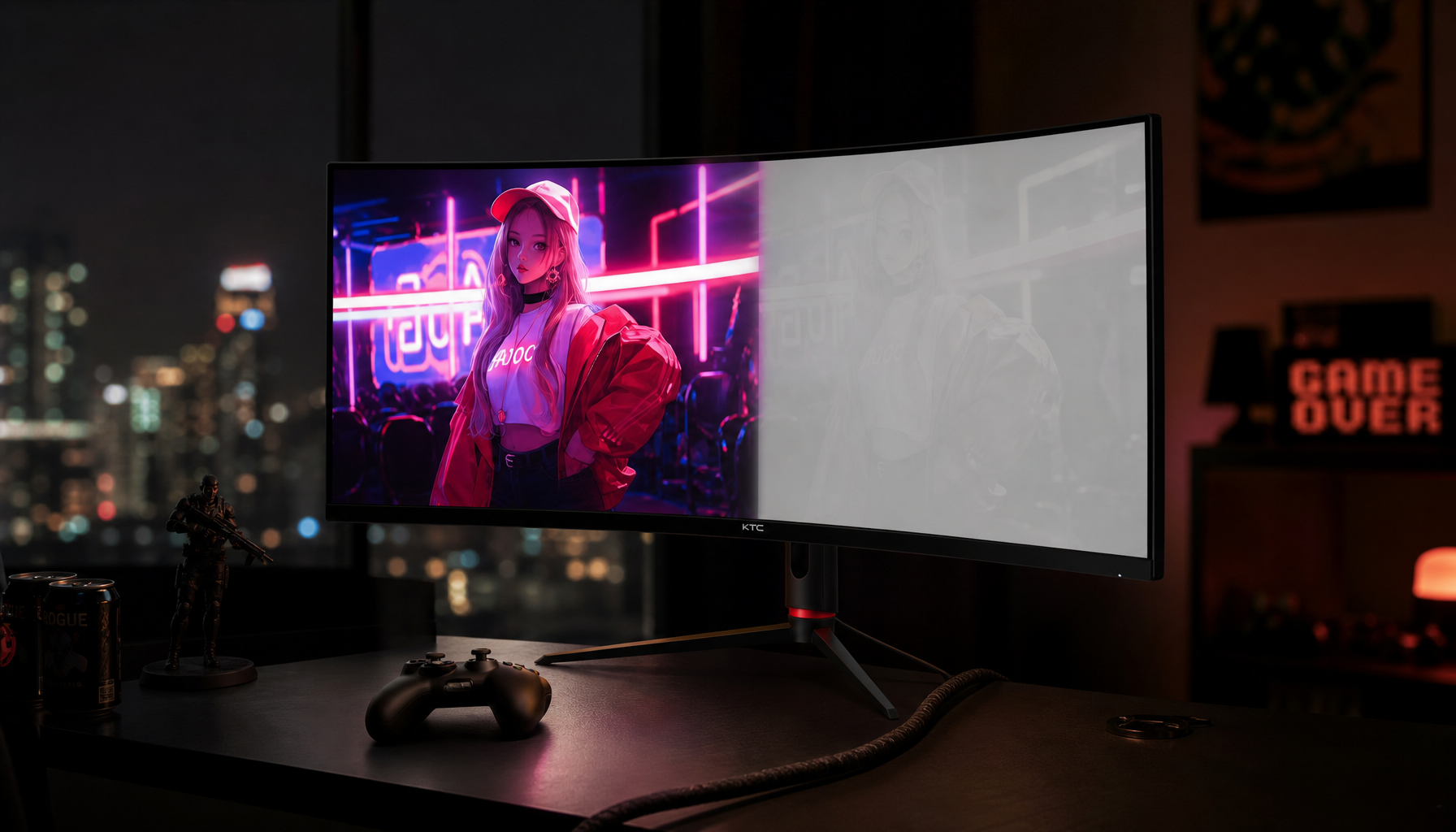
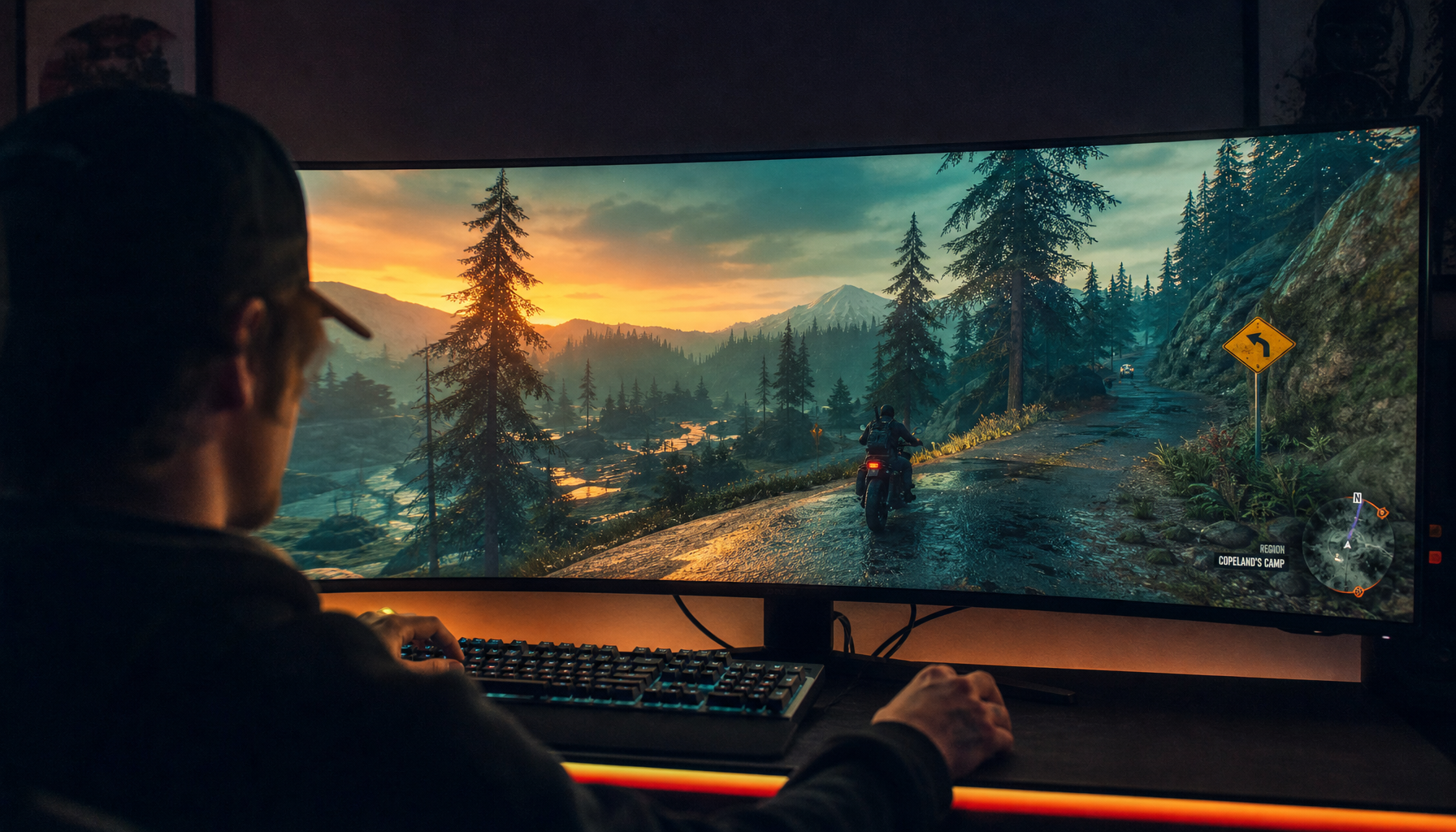
The RTX 50-series GPUs deliver enough rendering power that the display itself often becomes the limiting factor in HDR gaming and creative workflows. Peak brightness frequently matters more than pixel response time for cinematic titles, path-traced highlights, and bright-room use, while ultra-fast response remains essential for competitive esports in dark environments. The right choice depends on your primary content, room lighting, and whether you mix gaming with long productivity sessions.

The RTX 50 Display Bottleneck: Why HDR Bandwidth Matters Now
RTX 50-series cards introduce DisplayPort 2.1b with UHBR20 bandwidth reaching 80 Gbps. This removes the need for Display Stream Compression in many 4K HDR scenarios, eliminating compression artifacts that previously softened highlights or introduced subtle banding (NVIDIA RTX 50-series announcements).
The practical result is that your GPU can now push sustained high-luminance detail at high frame rates. The bottleneck therefore shifts from raw compute to the monitor’s ability to reproduce those bright specular highlights without clipping or losing contrast. For most RTX 50 owners upgrading from older cards, this means a display certified for high peak luminance delivers more visible improvement than simply chasing another 20–30 Hz of refresh rate.
If your current monitor tops out below 600 nits in HDR mode or relies heavily on dynamic tone mapping, you are likely leaving GPU performance on the table. Checking your current display’s VESA DisplayHDR tier is a quick first step before buying new hardware.
Peak Brightness vs. Pixel Response: The Technical Trade-off
Brightness and response time address different limitations. Peak brightness, measured in nits, determines how intensely specular highlights—sun glints, neon signs, sparks—appear in HDR content. Pixel response time, often expressed as gray-to-gray (GtG) in milliseconds, governs how quickly pixels change state and therefore how much motion blur or smearing you see during fast camera movement.
VESA DisplayHDR 1400 certification requires 1400 cd/m² peak luminance with strict local-dimming performance, delivering significantly more highlight “punch” than DisplayHDR True Black 600, which prioritizes near-perfect blacks at the expense of maximum brightness (VESA DisplayHDR tiers). In path-traced games such as Cyberpunk 2077 with RTX 50 hardware, those extra nits prevent bright areas from clipping to flat white and preserve detail that the GPU is now capable of rendering.
OLED panels typically achieve 0.03 ms GtG response, essentially eliminating pixel-level persistence. This advantage shines in competitive titles where every millisecond of clarity helps tracking. However, OLED panels can trigger Auto Brightness Limiter (ABL) behavior in large bright scenes, reducing overall luminance to protect the panel. Mini-LED arrays maintain more stable average picture level (APL) across mixed-brightness frames.
The trade-off is therefore content-dependent. For single-player narrative or creative HDR mastering, sustained luminance often improves perceived quality more than marginal response gains. For twitch-based esports, the reverse holds. Most hybrid users notice the difference within the first hour of switching between titles.
Mini-LED vs OLED for RTX 50-Series: Where Each Wins
A decision map for HDR workflows and gaming scenarios. Peak brightness tends to matter most in bright-room HDR, cinematic highlights, and path-tracing scenes with sustained luminance demand; OLED response time matters most in esports, dark-room play, and motion-critical use. The practical choice can flip around the $600–700 boundary depending on whether luminance headroom or pixel response is the priority.
View chart data
| Scenario | Bright room HDR | Cinematic HDR | Path-tracing highlights | Esports motion | Dark room gaming | Hybrid use |
|---|---|---|---|---|---|---|
| Mini-LED HDR1400 | 3.0 | 3.0 | 3.0 | 1.0 | 2.0 | 3.0 |
| OLED 0.03ms | 1.0 | 1.0 | 1.0 | 3.0 | 3.0 | 2.0 |
When Peak Brightness Wins: The Cinematic & Creative Case
In path-traced open-world games, RTX 50-series cards generate frequent specular highlights that require 1000+ nits to render without clipping to flat white. Mini-LED panels certified to HDR 1400 maintain those highlights even in bright ambient conditions where OLED panels can wash out or trigger aggressive ABL dimming. The result is more consistent “pop” across varying scene brightness, which many players describe as the single biggest visual upgrade when moving from SDR or lower-tier HDR.
Hybrid users who spend eight hours editing video or coding with HDR UI elements also benefit. Mini-LED carries zero risk of static-image burn-in, removing the need for pixel-shifting routines or screen savers that can interrupt workflow. In bright rooms without blackout curtains, the higher sustained luminance overcomes ambient glare more effectively than OLED’s deeper blacks alone.
A common friction point is the “toggle tax”—manually adjusting local dimming or HDR modes when switching tasks. For users who keep HDR enabled full-time, a high-zone Mini-LED reduces daily menu diving compared with panels that require frequent recalibration to avoid ABL in mixed content.
When Pixel Response Takes Priority: The Competitive Edge
Fast-twitch esports titles reward every fraction of a millisecond of clarity. OLED’s near-instant 0.03 ms GtG response minimizes motion blur during rapid strafing or flick shots, giving a tangible edge in Valorant, Apex Legends, or CS2. In completely dark rooms, the infinite contrast and 0.0005 cd/m² black level of True Black certified OLED panels also deliver shadow detail that no local-dimming array fully matches without some blooming around bright UI elements (TFTCentral OLED vs Mini-LED HDR comparison).
For horror games or space simulators played in controlled lighting, the absence of blooming around cockpit lights or distant stars preserves immersion that even well-engineered Mini-LED can occasionally disrupt. These advantages remain even at high frame rates pushed by RTX 50 hardware, because the pixel transition speed directly reduces perceived persistence.
That said, many competitive players still run bright-room or mixed-use setups. In those cases the brightness advantage of Mini-LED can outweigh marginal response gains once frame rates exceed 200 fps, where human visual limits begin to compress the benefit of sub-millisecond transitions.

Mini-LED vs. OLED: Choosing Your RTX 50 Pairing
The decision often comes down to a $600–$700 practical boundary. Below this range, a high-zone Mini-LED typically delivers better overall value for HDR impact and longevity. Above it, the incremental gains in either technology become more specialized.
Hybrid users—gaming plus productivity—usually prefer Mini-LED to avoid any burn-in concern with static taskbars or browser windows. Pure dark-room cinematic gamers who never play in daylight often favor OLED for its perfect blacks and motion clarity. Bright-room gamers or those running path-traced single-player titles see the largest uplift from sustained 1400-nit peaks.
Check your room first: if you cannot control ambient light, Mini-LED’s luminance headroom usually matters more. If your desk is in a light-controlled space and you mainly play competitive titles, OLED’s response and contrast deliver clearer advantages. Both technologies now support the bandwidth of RTX 50-series cards, so the choice is driven by content and environment rather than connectivity limits.
For additional background on panel differences, see our MiniLED vs. OLED: Which Display Technology Wins for Gaming in 2025? guide and the article on local dimming zones.
Making the Decision: Your RTX 50 Monitor Roadmap
Match the monitor to your dominant use case rather than chasing maximum specs. For cinematic, path-tracing, or bright-room HDR workflows, the KTC M27P6 (27-inch 4K 160 Hz HDR 1400 Mini-LED) provides the luminance consistency that lets RTX 50-series rendering shine without frequent ABL intervention. Its 1152-zone local dimming and full ergonomic stand also suit long creative sessions.
For competitive esports or dark-room cinematic gaming where motion clarity and perfect blacks are non-negotiable, the KTC G27P6 (27-inch 1440p 240 Hz OLED with 0.03 ms response) remains the stronger performer. Its near-instant pixel transitions and True Black contrast reduce blur and preserve shadow detail in low-light titles.
Budget-conscious 1440p users who still want strong HDR impact should consider the KTC M27T6S (27-inch 200 Hz HDR 1000 Mini-LED). It offers a practical middle ground that avoids bottlenecking an RTX 50 card while staying under the $300 mark. All three models support the full bandwidth of DP 2.1b, so you are not sacrificing connectivity.
Before purchasing, verify your desk space, typical lighting, and primary game genres. A quick self-check is to note whether you notice washed-out highlights more often than motion blur; the former points toward Mini-LED, the latter toward OLED. This single observation usually predicts satisfaction better than spec sheets alone.
Frequently Asked Questions
Does turning on HDR reduce response time on RTX 50-series monitors?
HDR itself does not inherently slow pixel response. Any perceived lag usually stems from added input lag, local-dimming processing, or mismatched refresh rates rather than the HDR signal. Disabling unnecessary post-processing features often restores full responsiveness while keeping brightness benefits intact. See our dedicated guide on whether HDR slows gaming monitor response time for testing steps.
Is Mini-LED or OLED better for HDR content creation with an RTX 50 GPU?
Mini-LED panels certified to HDR 1400 generally suit creative mastering better because they maintain stable luminance across large bright areas without triggering aggressive ABL. This consistency aligns more closely with ITU-R BT.2100 standards used in professional HDR grading. OLED excels at absolute black levels but can dim overall brightness in mixed scenes, which may require additional calibration for accurate color-critical work.
How important is DisplayPort 2.1b when pairing a monitor with RTX 50-series cards?
It becomes important once you want uncompressed 4K HDR at 160 Hz or higher. The 80 Gbps bandwidth removes the need for DSC, preventing compression artifacts in high-luminance areas. Monitors without DP 2.1b can still function but may force lower refresh rates or visible compression in demanding HDR workflows.
Can a high-brightness Mini-LED replace an OLED for dark-room gaming?
It can for many users, especially if blooming around bright UI elements does not distract you. However, OLED’s infinite contrast and zero blooming still provide a clearer advantage in purely dark environments with frequent high-contrast scenes. The choice depends on whether you value highlight impact more than absolute black depth.
What budget level makes the technology choice flip for RTX 50 users?
Around $600–$700 street price, the incremental gains shift from general HDR performance to specialized strengths. Below this range, Mini-LED typically offers better value for most mixed or bright-room use. Above it, buyers can afford to optimize strictly for either motion clarity or maximum luminance depending on their exact workflow.
Should I prioritize refresh rate or peak brightness when upgrading from an older monitor?
Prioritize peak brightness if you play single-player or open-world titles that make heavy use of HDR highlights. Refresh rate remains more critical for competitive multiplayer where frame-rate consistency directly affects tracking. With RTX 50-series power, most users notice brightness improvements sooner than marginal refresh gains above 160 Hz.