For most simulation players, extra pixels improve what you can read, judge, and enjoy over long sessions. Once a display already feels smooth, higher resolution usually adds more value than pushing refresh rate much further.
Do gauges look soft, distant signs blur together, or cockpit labels force you to lean in even though the game already feels smooth? In many sim setups, the better upgrade is the one that makes dashboards, terrain, mirrors, and menus easier to read at a glance, not the one that trims a tiny amount of motion delay. This guide explains how to choose resolution, screen size, and refresh rate for flight sims, racing sims, city builders, and other slower-paced simulation games.

The Core Reason: Simulation Games Reward Detail Before Speed
Higher resolution improves sharpness, text clarity, texture detail, and distant-object visibility more than it improves raw responsiveness, and that tradeoff matters more in simulation games than in competitive esports. In a racing cockpit, a flight deck, or a management sim filled with panels, your eyes constantly parse fine information: braking markers, instrument clusters, mini-maps, mirrors, weather cues, and layered UI. When those elements look sharper, the game becomes easier to read and more believable, which directly supports both immersion and decision-making.

Refresh rate controls motion smoothness and responsiveness, but once you reach a solid baseline such as 120 Hz or 144 Hz, most simulation players gain less from going much higher. The jump from 60 Hz to 144 Hz is large and obvious, while the move from 144 Hz to 240 Hz is much smaller and is aimed more at highly competitive play. That matches real sim use: smooth camera pans and steering inputs matter, but they are not usually as decisive as they are in twitch shooters.
Why Higher Resolution Changes the Simulation Experience More
You Spend More Time Reading the World
1440p carries about 78% more pixels than 1080p, which is why cockpit text, trackside boards, distant apexes, and layered HUD elements often look meaningfully cleaner without the heavy hardware cost of 4K. In sim racing, that can mean spotting a braking board slightly earlier or reading a dash page without filling in blurred edges. In flight sims, it can mean clearer avionics and better terrain definition. In strategy and city-management sims, it keeps dense information legible instead of turning it into a soft blur.
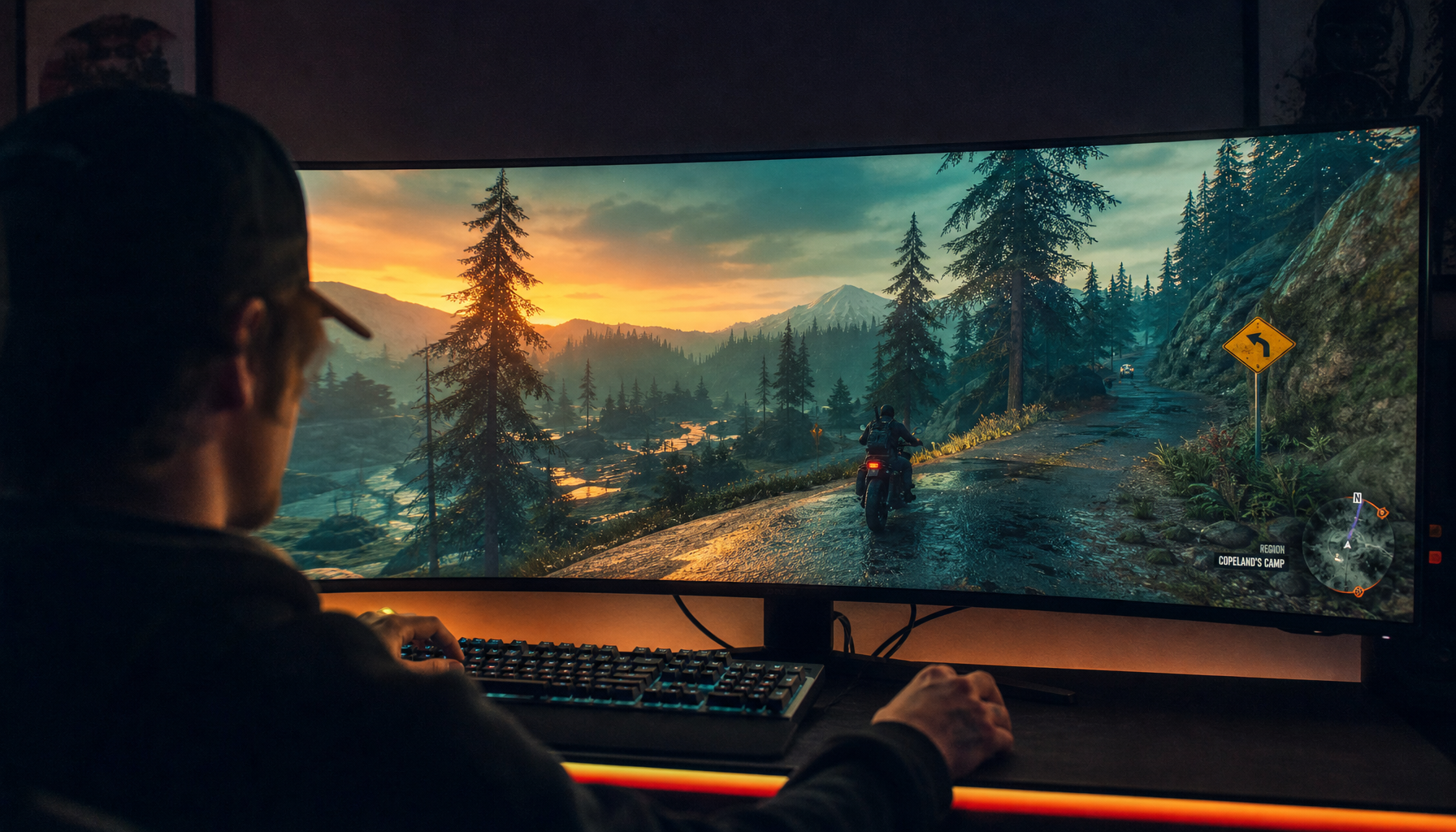
4K delivers roughly four times the pixels of 1080p, so the improvement in fine detail can be dramatic on larger screens. That benefit stands out when you sit close to a 32-inch monitor, use an ultrawide, or run a triple-screen rig where the image fills more of your field of view. In those setups, higher resolution is not just cosmetic. It reduces the sense that you are looking at a screen rather than into a world.
Simulation Games Are Often About Space, Not Just Motion
Strategy and simulation games benefit from larger or wider screens because they provide more room for UI and information. That matters because sim players often scan broad scenes rather than locking onto one fast-moving target. You may check a mirror, glance at tire temperatures, read a time delta, and watch corner entry within a few seconds. More resolution supports that layered viewing better than an extra 96 Hz of refresh rate.
For sim racing in particular, 1440p often makes the most sense on a 27-inch display. That pairing is practical: a larger panel exposes more of 1080p’s softness, while 1440p restores detail without demanding the kind of GPU budget that 4K often requires.
Why Faster Refresh Rates Matter Less After 144 Hz
The frame-time gap between 144 Hz and 240 Hz is only about 2.77 milliseconds, which is real but modest. In an esports match, that smaller delay and cleaner motion can affect tracking and reaction consistency. In a sim, the visual task is usually different. You are managing line choice, vehicle balance, situational awareness, instruments, or system depth over a broader time window. That makes clarity and readability more valuable more often.
Higher refresh helps in racing and sports games. The key distinction is that a sim benefits from smoothness, but it usually does not require ultra-high refresh to remain playable or highly enjoyable. Once motion feels stable at 120 Hz to 144 Hz, better image detail often becomes the next meaningful upgrade.
There is also a hardware reality. To benefit from 240 Hz, your system needs to sustain very high frame rates. Many simulation games are demanding in ways that do not scale cleanly to ultra-high frame rates, especially with weather, traffic, physics loads, or large maps. Chasing 240 Hz can force you back to 1080p or lower settings, which often hurts the exact visual cues sim players care about most.
Resolution, Size, and Viewing Distance Work Together
Pixel density matters more than screen size alone for perceived sharpness. That is why a 27-inch 1080p display often looks noticeably softer than a 27-inch 1440p display at a normal desk distance, while a 24-inch 1080p display can still look acceptable. If your sim setup uses a 27-inch to 32-inch screen, or a deeper cockpit-style seating position with the monitor filling much of your view, higher resolution pays off more quickly.

Monitor size, supported resolution, and viewing distance should align. In practice, that means 1080p still makes sense for smaller, budget-focused displays, but it becomes less appealing as screens get larger or games rely more heavily on dense visual information.
Setup style |
Where resolution helps most |
Where refresh helps most |
Best practical target |
24-inch desk setup |
Keeping image quality reasonable without raising GPU load too much |
General smoothness |
1080p at 120 Hz to 144 Hz |
27-inch all-around sim setup |
Sharper HUD, cleaner text, better world detail |
Smooth steering and camera motion |
1440p at 144 Hz |
32-inch immersive sim setup |
Strong gains in clarity and realism |
Useful, but secondary beyond 144 Hz |
1440p or 4K at 120 Hz to 144 Hz |
Triple-screen sim rig |
Better side-screen detail and less visual softness |
Smooth motion across all panels |
1440p at 120 Hz to 144 Hz if the GPU can handle it |
When Refresh Rate Should Still Take Priority
Higher refresh is the better buy when competitive speed matters most. If you mainly play twitch-heavy shooters, fighting games, or other reaction-driven multiplayer titles, the balance changes. That is why 1080p at 240 Hz still appears so often in esports-focused advice.
There is also a mixed-use case. 1080p remains the easiest path to very high frame rates. If your week is split between sim racing and fast competitive games, or between flight sims and shooters, a 1440p 144 Hz display is usually the safest value choice because it avoids extreme compromises in either direction.
Practical Buying Advice for Simulation Players
Most sim-racing advice lands on 120 Hz to 144 Hz, and that baseline is worth trusting. Get to “smooth enough” first, then invest in clarity. For many players, that means skipping a cheaper 1080p 240 Hz panel and choosing a better 1440p 144 Hz display instead.
Adaptive sync also matters because it keeps refresh behavior aligned with changing frame rates. In simulation games, that consistency often feels better than chasing a headline refresh number your system cannot maintain. A stable 100 to 144 FPS experience with variable refresh rate can feel more refined than an unstable push past 200 FPS.
Higher resolutions also add useful screen space for multitasking and side-by-side windows, which matters if your sim session includes telemetry apps, maps, tuning tools, voice chat, or streaming controls. That benefit is easy to overlook until you live with it.
The strongest value move for most simulation players is simple: buy enough refresh rate to keep motion clean, then spend the rest of your budget on the resolution and screen size that make the world easier to read. In sims, immersion is rarely won by the fastest spec on the box. It is won by the display that makes every corner, gauge, and horizon line look more convincing for hours at a time.