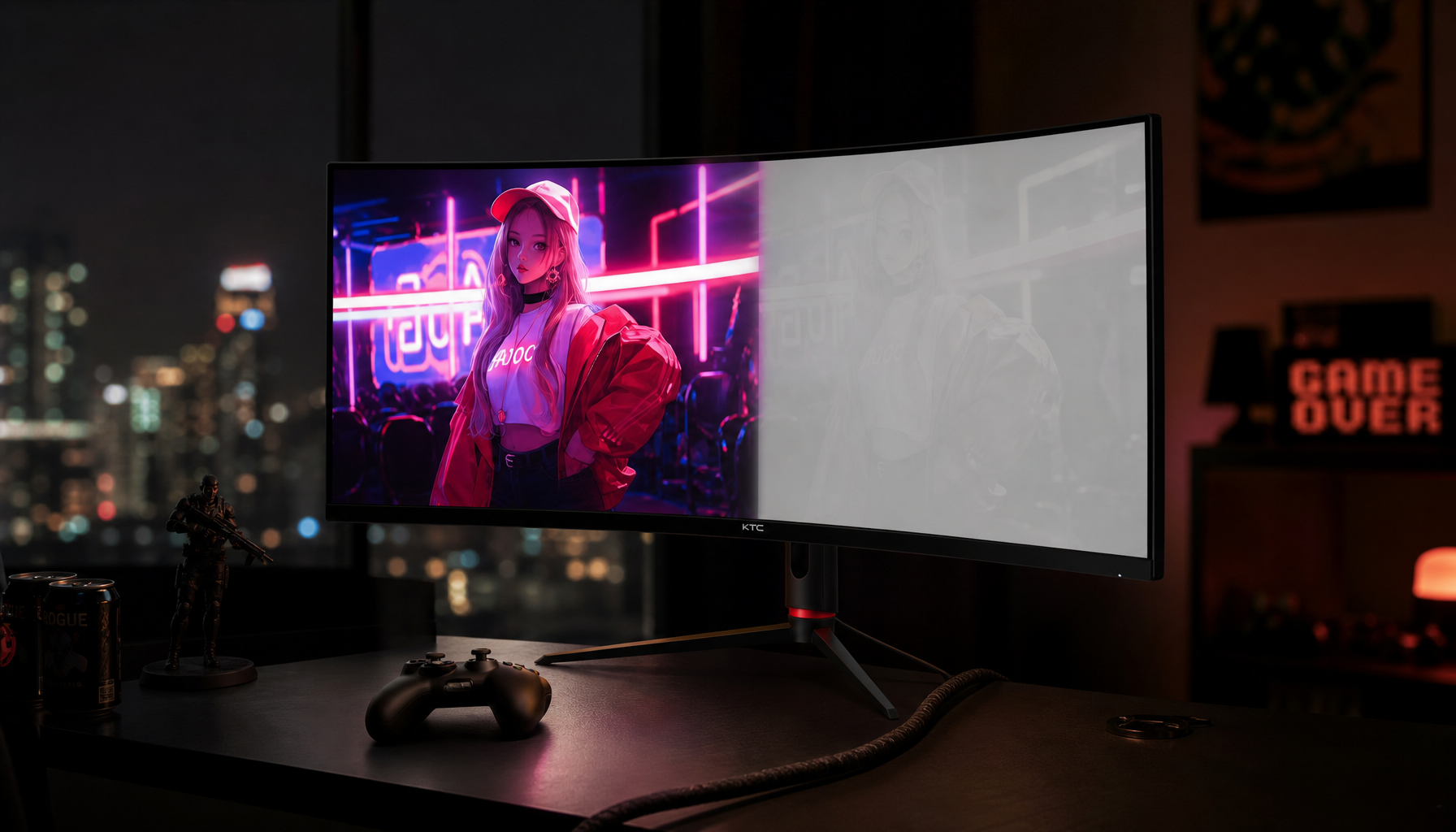
Manufacturers reduce Mini-LED haloing mainly by making dimming zones smaller, tuning the backlight more intelligently, and controlling how light spreads through the panel stack.
If your game HUD, mouse cursor, or movie subtitles seem to glow against a dark screen, the display is showing the limits of grouped backlight control rather than a simple defect. Newer Mini-LED monitors cut that distraction with denser backlights, better firmware, and smarter HDR behavior on fast gaming panels. The key is knowing which changes actually lower blooming and which specs only look good on a product page.
Why Haloing Shows Up Around Bright Objects
Small highlights are smaller than the light source behind them
Haloing happens when a bright object is smaller than the local dimming zone lighting it, so the monitor brightens a larger patch of the screen than the image really needs. That is why subtitles, crosshairs, stars, loading icons, and a white cursor on a black desktop are classic problem cases on gaming monitors: the LCD layer is trying to block extra light, but some of that light still leaks into nearby dark areas.

Real measurements show how light spill fades with distance
A lab’s measurements make the effect easier to picture. In its blooming test, a bright center pattern measured about 340 nits, while the surrounding glow was still about 0.20 nits at 0.04 in from the edge, then dropped roughly 50% to 60% at each step and was effectively gone after about 1.18 in. On a monitor, that means tiny HDR highlights can still create a visible glow even when the dark background itself is measuring near black.
What Manufacturers Change in the Backlight
More zones and better backlight layouts reduce the size mismatch
Full-array local dimming reduces blooming more effectively than edge-lit systems because the LEDs sit behind the whole panel instead of only around the edges. Mini-LED improves that further by using much smaller LEDs and pushing dimming control from a few dozen zones into the hundreds or thousands, which lets the backlight follow bright image details more closely on 27-inch, 34-inch ultrawide, and larger high-refresh-rate monitors. A 27-inch example is a Mini-LED gaming monitor, which uses 1,152 zones, but firmware tuning still matters as much as the hardware count.
Optical parts and stable drive electronics help keep light contained
Optical tuning and stable LED drive matter because zone count alone does not decide where light goes after it leaves the backlight. Manufacturers use diffuser films, lenses, reflective structures, constant-current circuits, voltage stabilization, and thermal compensation so adjacent zones look more uniform and transitions are less obvious. In practice, that means a good Mini-LED monitor is not just “more zones”; it is also better at keeping those zones predictable at different brightness levels and after the panel warms up.
Why Firmware Often Matters More Than One Extra Spec
The algorithm decides whether the monitor favors punch or restraint
Firmware tuning decides whether a monitor prioritizes higher peak brightness or lower visible blooming. Some implementations intentionally hold back small highlights to keep halos tighter, while others let highlights hit harder and accept more spill into neighboring dark zones. That tradeoff is especially important on HDR gaming monitors, where buyers want intense specular highlights without glowing subtitles or obvious blocks moving behind the cursor.
Even a high zone count can look bad if the control logic is weak
A 2025 community report shows why raw zone count is not enough: a user complained that blooming remained noticeable on an ultrawide Mini-LED monitor despite having more than 2,000 local dimming zones, and support indicated a firmware update was being worked on. That lines up with practical setup advice from local-dimming guides, where Medium or Normal often beats the most aggressive mode because High can deepen blacks at the cost of more obvious halos around subtitles and small bright UI elements on dark scenes.
Gaming Features Can Help or Hurt Halo Control
HDR and VRR modes do not always behave the same way
Some gaming modes can disable local dimming, which can make a display look flatter, darker, or more washed out even though the HDR badge is still active. For gamers shopping in the 144 Hz to 240 Hz range, that means halo control has to be checked in the exact mode they will use, including VRR on, HDR on, and the preferred refresh rate selected.
Brightness can make halos look worse even when HDR looks stronger
Higher brightness makes halos easier to notice because more backlight energy is spilling around the object when those zones fire. That is the core Mini-LED tradeoff on gaming monitors: the same high peak brightness that helps HDR punch through in a bright room can also make cursor glow, subtitle glow, and HUD glow more visible in a dark room. A recurring mitigation path is to reduce backlight intensity, try a less aggressive dimming preset, or use some ambient room lighting so the glow is less distracting.

Panel Choice Still Shapes How Much Blooming You Notice
Native contrast changes how much the halo stands out
Enthusiast reports on Mini-LED HDR monitors repeatedly note that higher-contrast LCD panels tend to mask blooming better than lower-contrast alternatives, because the panel starts from a darker baseline before local dimming even begins. That does not eliminate halos, but it can make them less obvious in dark games, especially when a bright object sits next to black letterbox bars, dark caves, or night-sky scenes.
Ultrawide layouts make the hard scenes more common
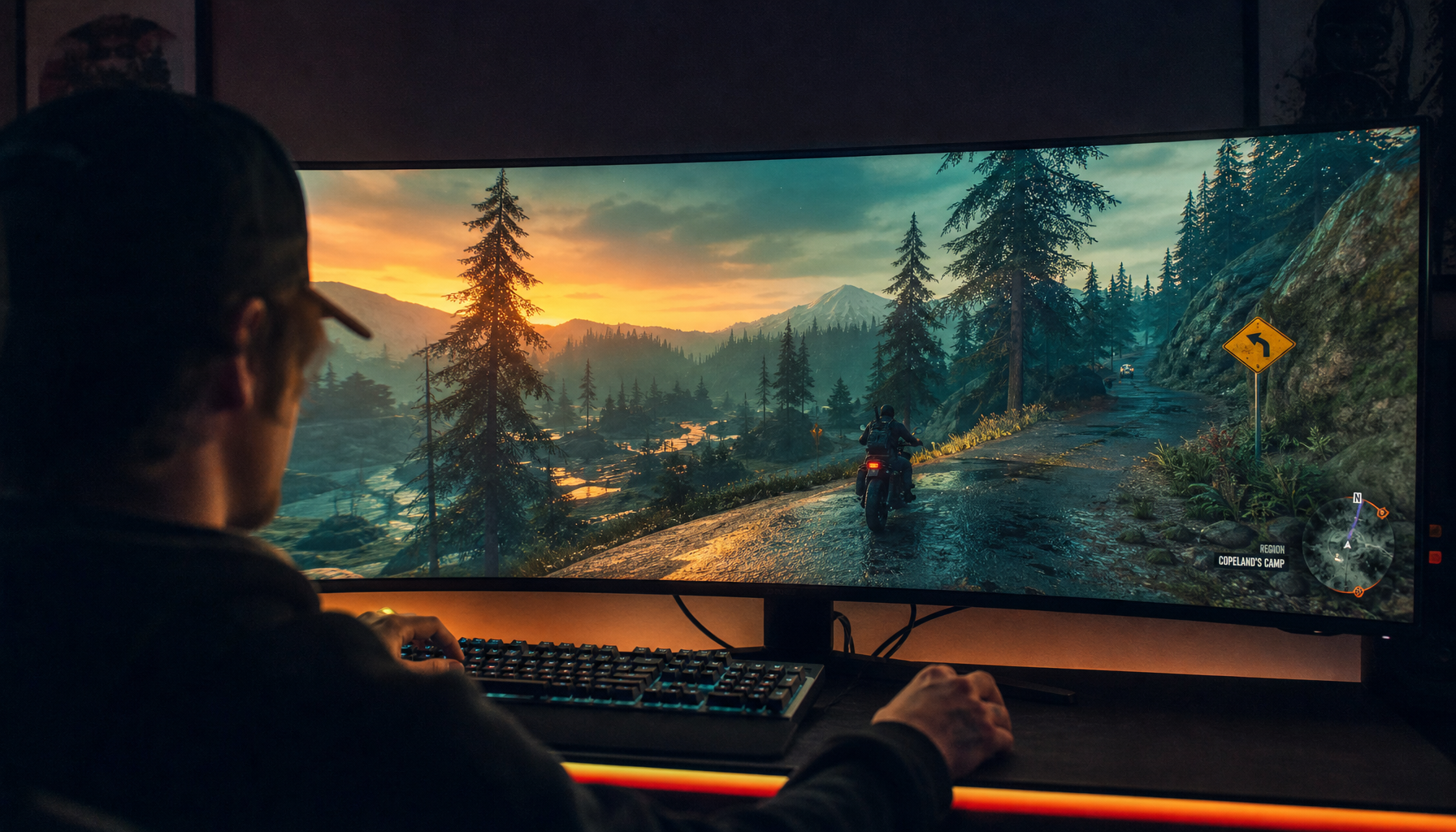
Ultrawide formats such as 21:9 and 32:9 create large dark regions around side HUD elements, subtitles, or isolated highlights, which can make blooming easier to spot than on a bright desktop wallpaper or a colorful esports title. On a 3,440 x 1,440 ultrawide or a 5,120 x 1,440 super ultrawide, buyers should pay extra attention to black-background tests because those layouts naturally produce more “small bright object on a dark field” situations.
How to Judge a Mini-LED Monitor Before You Buy
Use test scenes that expose the weakness, not demo scenes that hide it
Subtitle, cursor, and starfield scenes reveal local-dimming quality much faster than a bright HDR trailer. A useful evaluation routine for gaming monitors is simple: test a white cursor on a black screen, subtitles over a dark movie scene, fireworks, stars, and a dark game menu with bright HUD markers. Then repeat the same scenes with HDR on and off, VRR on and off, and local dimming set to Low, Medium, and High.

The best buying checklist mixes hardware, tuning, and use case
Zone precision is the first filter, but it should be read alongside panel contrast, dimming controls, and gaming-mode behavior. For a monitor that will handle both HDR games and day-to-day desktop use, the best result usually comes from a Mini-LED model with a full-array backlight, a high zone count, a usable Medium dimming mode, and no obvious HDR or VRR conflicts.
Parameter |
Why it matters for halo control |
What usually works better |
Common tradeoff |
Backlight type |
Sets how precisely the monitor can dim different parts of the screen |
Mini-LED FALD over edge-lit dimming |
Higher cost |
Zone count |
Smaller zones track bright objects more closely |
Hundreds to thousands of zones |
Not enough without good firmware |
Dimming algorithm |
Controls speed, aggressiveness, and highlight restraint |
Balanced tuning with smooth transitions |
Too aggressive can crush shadow detail |
Panel contrast |
Changes how visible the spill looks through the LCD layer |
Higher native contrast usually helps |
Viewing angles may vary by panel type |
Peak brightness |
Improves HDR impact in bright rooms |
High brightness with restrained dimming |
More visible halos in dark rooms |
User controls |
Lets you adapt the monitor to game, movie, or desktop use |
Low/Medium/High dimming presets |
Best setting can change by content |
Determines whether halo control stays active while gaming |
Stable HDR plus VRR implementation |
Some modes may disable local dimming |
FAQ
Q: Does a higher local dimming zone count always mean less blooming?
A: Usually it helps, because smaller zones follow the image more closely, but it is not a guarantee. Firmware quality, panel contrast, and how the monitor handles bright moving objects still matter.
Q: Why do subtitles and mouse cursors look worse than large bright areas?
A: They are much smaller than the lit area behind them, so the monitor has to brighten a larger zone than the object itself occupies. That mismatch is what creates the halo.
Q: Should gamers turn local dimming off?
A: For HDR gaming, turning it off usually gives up the main contrast advantage of Mini-LED. For SDR desktop work or very dark rooms where cursor glow is distracting, a lower dimming setting or disabling it can be the cleaner choice.
Practical Next Steps
If halo control is a priority, shop for a Mini-LED gaming monitor the same way you would judge motion handling: by testing the exact failure case. Ignore bright showroom footage and look instead at dark scenes with small highlights, then verify that the monitor behaves well at your actual refresh rate and HDR setting.
A practical shortlist should favor full-array Mini-LED backlights, higher zone counts, adjustable dimming strength, and stable HDR plus VRR behavior. If a display still shows obvious bloom in cursor, subtitle, or HUD tests, that usually points to firmware tuning or panel limitations rather than a missing marketing spec.
References
- A company: Mini-LED backlight control and flicker reduction
- A lab: Mini-LED blooming measurements
- A display site: FALD blooming basics
- A company: Local dimming zones and HDR impact
- Community report on Mini-LED blooming and firmware
- A forum: HDR mode disabling local dimming
- A platform discussion: Halo effect increasing with brightness
- A news platform discussion: Mini-LED tradeoffs versus OLED
- An encyclopedia: Ultrawide display formats
- Local dimming settings guide