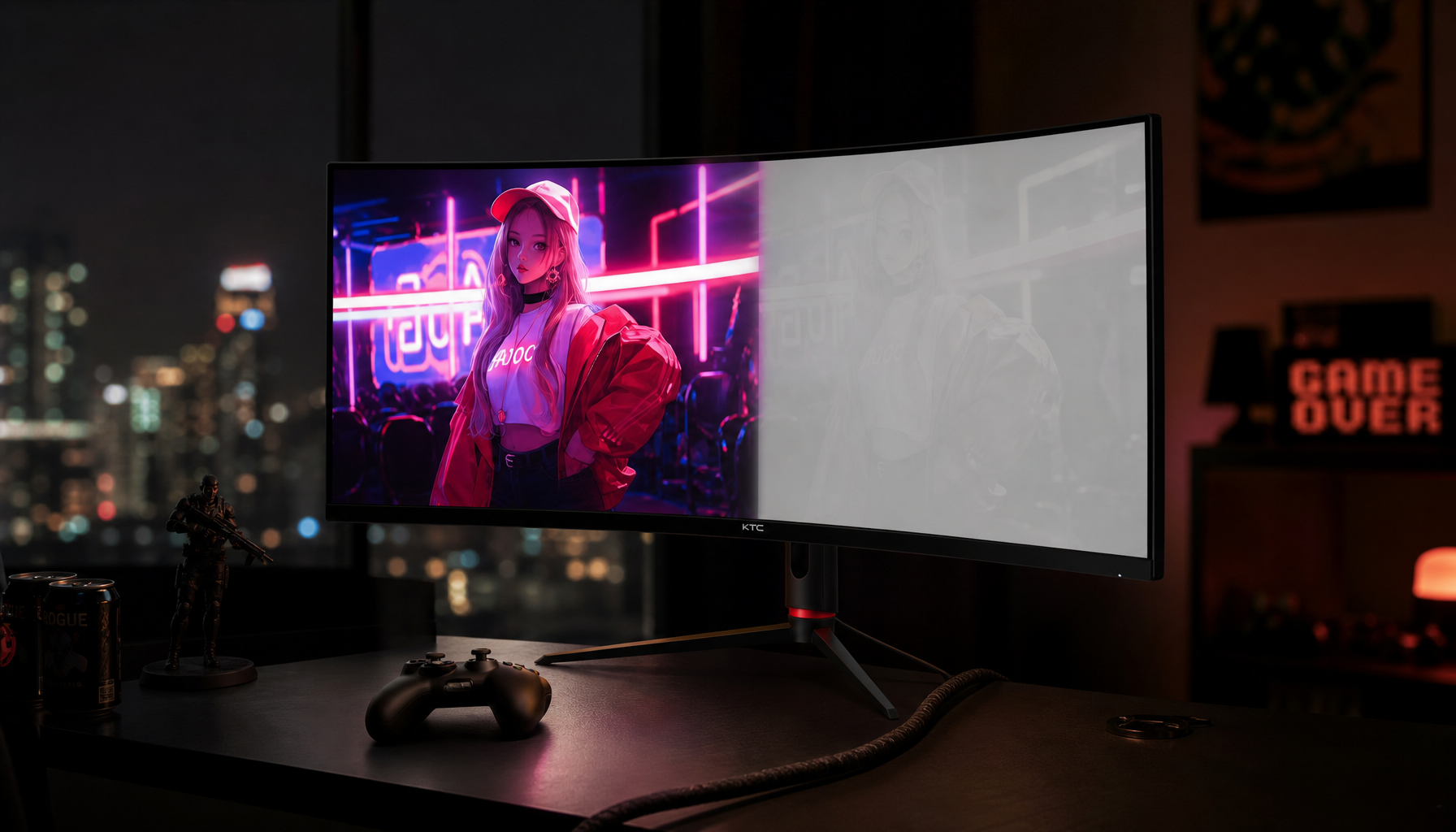
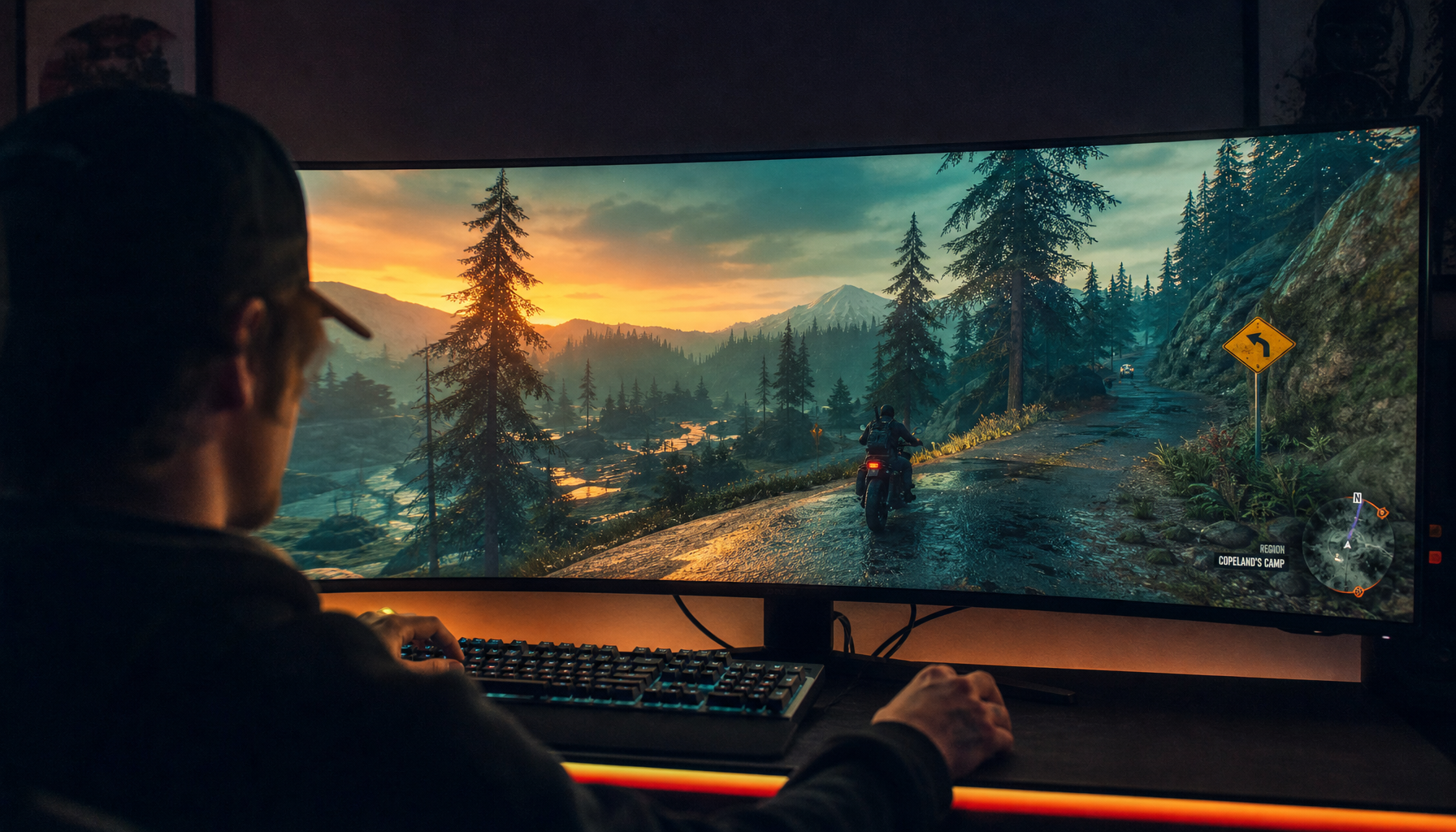
Yes, motion blur reduction can make some players feel more visually tired over long sessions, especially when it uses backlight strobing, lowers brightness, adds flicker, or clashes with unstable frame rates.
Do your eyes feel sharp for the first match, then heavy and irritated by hour three? A practical monitor setup can preserve the aiming benefit of blur reduction while reducing common fatigue triggers: dim output, flicker sensitivity, double images, and inconsistent frame pacing. You’ll get a clear way to decide when to use MBR, when to turn it off, and how to tune it for long-session comfort.
What Motion Blur Reduction Actually Does
Motion blur reduction, often labeled MBR or 1 ms MPRT, is a monitor feature designed to improve perceived motion clarity. Instead of leaving the backlight continuously on while frames persist, many monitors rapidly pulse the backlight between refreshes. This shortens the visible time of each frame, which can make fast movement look cleaner.
That matters in competitive games. When tracking a strafing opponent in a tactical shooter, hero shooter, or battle royale, less eye-tracking blur can make character edges, crosshair alignment, and recoil recovery easier to read. A display explainer notes that modern displays can create blur because frames are held until the next refresh, and eye-tracking motion blur can be reduced by limiting how long each frame is shown.
The catch is that clearer motion is not automatically more comfortable motion. Backlight strobing can reduce brightness, may not work well with variable refresh rate on many monitors, and can introduce flicker that sensitive users may feel as headaches after prolonged use. That is the core fatigue pathway.
Why Fatigue Can Build Over Several Hours
Flicker Sensitivity Can Accumulate

Backlight strobing is usually too fast to consciously see as blinking, but “not visible” does not mean “not felt” by every user. A display guide states that screen flickering is introduced when backlight strobing is enabled, and people sensitive to it may experience headaches after extended use.
In practice, this often shows up as a delayed problem. The first 30 minutes can feel excellent because target motion is cleaner. After two or three hours, the same setup may feel like pressure behind the eyes, a mild headache, or difficulty relaxing focus between rounds. That worsening pattern is a strong signal that MBR is not just improving clarity; it is also adding a sensory load your visual system has to tolerate continuously.
Reduced Brightness Can Make You Strain
MBR often dims the screen because the backlight is off for part of each refresh cycle. Some monitors remain bright with MBR enabled, while others become too dim for comfortable play.
This is especially relevant for office productivity displays and portable smart screens that double as gaming panels. A compact USB-C portable screen, a budget 144 Hz monitor, or a midrange IPS display may not have enough brightness headroom once strobing is enabled. If your room is bright and your MBR mode cuts perceived brightness, your eyes may compensate by working harder to detect enemies in shadows, read HUD elements, and track low-contrast motion.
Frame Pacing Problems Can Defeat the Benefit

MBR works best when the game’s frame rate is stable and closely matched to the strobe timing. Games tend to look best when refresh rate and frame rate are closely aligned, and many MBR modes cannot run at the same time as VRR. If your 240 Hz monitor is strobing while your game swings between 150 and 220 FPS, the image may feel less fluid even if individual frames look clearer.
That mismatch can create a strange kind of fatigue: your eyes get sharper edges, but your brain gets inconsistent motion. You may notice micro-stutter, tearing, double images, or the feeling that enemies are snapping rather than flowing across the screen. For a three-hour ranked session, that inconsistency can be more tiring than a slightly blurrier but steadier VRR experience.
MBR Is Not the Same as In-Game Motion Blur

It is important to separate monitor-side motion blur reduction from the game’s motion blur setting. In-game motion blur is a rendered visual effect that smears movement for cinematic feel. Game motion blur can blur objects or the whole screen during fast movement to create speed, realism, or smoother-looking lower frame rates.
Competitive players usually turn in-game motion blur off because it hides detail during fast camera movement. Monitor-side MBR does the opposite: it tries to make physical display motion clearer. Motion blur is apparent streaking when an image changes during an exposure, but gaming monitors add another layer because the panel’s refresh behavior and backlight behavior shape what your eyes perceive.
A good long-session setup usually starts with in-game motion blur off. Then you test monitor MBR separately. If your fatigue improves after disabling the monitor’s strobing mode, the issue was probably not the game’s cinematic blur effect; it was the display’s clarity mode interacting with your eyes, brightness, or frame pacing.
Pros and Cons for Multi-Hour Gaming
Setting Choice |
Best Use Case |
Main Benefit |
Main Fatigue Risk |
MBR on |
Stable high-FPS esports |
Cleaner tracking and less perceived blur |
Flicker sensitivity, dimmer image, double images |
VRR on, MBR off |
Variable-FPS games |
Smoother pacing with less tearing |
More sample-and-hold blur |
In-game motion blur off |
Competitive play |
Clearer camera turns and target visibility |
Less cinematic smoothness at low FPS |
Lower refresh strobing |
Monitors that strobe better below max refresh |
Better strobe quality and stability |
Requires FPS cap discipline |
For a simple real-world example, a 240 Hz monitor may look technically faster at its maximum refresh rate, but the MBR mode might be more stable at 144 Hz or 120 Hz depending on the implementation. Backlight strobing often works best below the monitor’s maximum refresh rate, such as 120 Hz strobing on a 144 Hz monitor or 144 Hz strobing on a 240 Hz monitor. If your GPU can hold 144 FPS but not 240 FPS, the lower tuned mode may feel cleaner and less tiring.
How to Tune MBR Without Sacrificing Your Eyes

Start With a Controlled A/B Test
Use one game, one map, one lighting condition, and one fixed play window. Play 30 minutes with MBR off and VRR on if available, then 30 minutes with MBR on and the same brightness target. Do not change sensitivity, color mode, sharpening, or overdrive at the same time.
Track concrete symptoms rather than vague impressions. If MBR gives you better target clarity but causes forehead pressure, watery eyes, or a need to squint after the second block, that is a bad long-session setting even if it feels faster in a five-minute aim trainer.
Match FPS to Refresh More Strictly
MBR rewards stability. If you use 144 Hz strobing, your system should hold about 144 FPS consistently. If it cannot, lower graphics settings, reduce refresh to a level your PC can sustain, or turn MBR off and use VRR. MBR quality depends on the system, monitor, game, settings, and implementation; that difference can separate a useful clarity mode from a tiring visual compromise.
For example, if your game fluctuates from 110 to 144 FPS on a 144 Hz strobed mode, try 120 Hz with an FPS cap your GPU can actually maintain. The motion may feel less like the monitor’s maximum spec, but the steadier cadence can be easier to process over a long night.
Raise Comfort Before Raising Aggression
If your monitor offers pulse width, strobe intensity, or clarity levels, avoid starting at the most aggressive setting. Stronger strobing often means clearer motion but lower brightness. Pulse width is a way to balance picture brightness against motion clarity, which is exactly the tradeoff long-session players should care about.
Set brightness high enough that dark areas are readable without crushing contrast or washing out the image. If the MBR mode still feels dim at comfortable room lighting, do not force it. A brighter non-strobed 240 Hz or 360 Hz mode can be a better value for your eyes than a dim strobed mode that only wins in a short motion test.
When You Should Turn MBR Off
Turn MBR off for long RPG, MMO, strategy, work, browsing, or mixed productivity sessions where motion clarity is not deciding the outcome. The benefit is usually too narrow, while the fatigue risk remains present. Portable smart screens are especially likely to be used in changing lighting conditions, so a dim strobed mode can become uncomfortable faster in a bright hotel room, dorm, or shared office.
Turn it off if you are sensitive to flicker, if headaches appear only with strobing enabled, if the image shows double edges, or if VRR matters more than absolute motion clarity. Many strobing-plus-VRR implementations can suffer from strobe crosstalk or overshoot, so a monitor advertising simultaneous sync and blur reduction still needs real testing.
Buying Guidance for Fatigue-Aware Gamers
Do not buy a monitor only because the box says “1 ms MPRT.” Manufacturers may advertise strobing response time without clearly stating gray-to-gray pixel response, so check both MPRT and GtG behavior in credible reviews. For long-session comfort, also look for brightness measurements with MBR enabled, adjustable strobe settings, strong overdrive tuning, and clean performance at refresh rates you can actually drive.
OLED and very high-refresh LCDs can also reduce perceived blur without relying as heavily on aggressive strobing. OLED panels have very fast response times, though sample-and-hold blur can still remain. For players sensitive to flicker, a fast non-strobed mode may be the more reliable path.
FAQ
Can MBR permanently damage my eyes?
The available evidence does not show that MBR permanently damages vision. The practical concern is comfort: flicker sensitivity, headaches, eye strain, and reduced performance over time. If symptoms are strong or persist after changing settings, treat it as a health issue and consult a qualified clinician.
Is MBR worth using for esports?
Yes, when your FPS is stable, the monitor’s strobe tuning is clean, and you do not feel fatigue. For short competitive sessions, MBR can improve tracking clarity. For multi-hour ranked play, comfort and consistency matter as much as peak sharpness.
Should office users leave MBR on?
Usually no. Office work benefits more from steady brightness, comfortable contrast, and flicker-free operation than from reduced motion blur. Save MBR for fast games where you can clearly feel the competitive benefit.
Clear motion should make you more confident, not more worn down. Use MBR like a performance mode, not a default identity for the monitor: test it, tune it, and turn it off when the clarity gain stops paying for the visual load.