Switching between displays with very different brightness levels can increase digital eye strain, headaches, dry-eye discomfort, and refocusing fatigue, especially when the room lighting changes too. The fix is usually not one perfect brightness number, but a consistent setup: match perceived brightness across screens, control glare, and choose monitor features that stay comfortable in your actual workspace.
Ever move from a bright gaming monitor to a dim laptop or portable monitor and feel your eyes tighten, burn, or lose focus for a moment? In controlled display research, screen brightness levels as different as about 52, 288, and 423 cd/m² produced different subjective fatigue responses in dark conditions, which is a useful reminder that brightness changes are not just cosmetic. You will learn how to set up work monitors, gaming displays, ultrawides, and portable screens so the transition between them feels easier on your eyes.
Why Brightness Switching Can Make Your Eyes Feel Tired
Digital eye strain is not usually caused by brightness alone. It is a combined effect of screen luminance, room lighting, glare, contrast, text size, viewing distance, posture, and blink rate. A clinical review describes digital eye strain as a group of ocular and vision-related symptoms that can include dry eyes, itching, watering, blurred vision, headache, light sensitivity, stiff neck, fatigue, and backache during prolonged screen use digital eye strain.
When you jump from a bright monitor to a dim portable display, your visual system has to adapt to a new light level, contrast level, and often a new text size. A 32-inch 4K gaming monitor at a vivid factory preset may look sharp and punchy, while a 15.6-inch portable monitor powered by a connector may look dimmer with smaller text. That mismatch can make you squint, lean forward, or blink less, which turns a simple brightness difference into a full eye-comfort problem.
The Adaptation Problem
Your eyes respond to relative brightness. A monitor that feels comfortable in a sunlit room can feel harsh at 10:00 PM in a dark bedroom, while the same brightness may be too low when sunlight hits the desk in the afternoon. Research on display use in a dark night environment tested a 4K adjustable-brightness display at 422.6 cd/m², 287.6 cd/m², and 52.4 cd/m² and found that lower screen brightness reduced subjective visual fatigue in that dark setting lower screen brightness.

That does not mean every monitor should be run dim all day. If the screen is too dim relative to the room, you may squint or lose contrast in text, spreadsheets, and game HUD elements. The practical goal is to reduce abrupt jumps: a bright work monitor, a dim laptop, and a portable side screen should all look similar when displaying the same white document.
Dryness Makes Brightness Changes Feel Worse
Brightness changes often feel worse after long sessions because screen use reduces blinking. Desk setup guidance notes that screen users may blink only about 3 to 7 times per minute, which can increase dryness and make glare or brightness transitions feel more irritating reduced blinking. This is why the same dual-monitor setup can feel fine at 9:00 AM but uncomfortable after a long afternoon of dashboards, code, video calls, and gaming.

A useful test is simple: after 20 minutes of reading text on one display, move to the other display and notice whether you blink hard, refocus slowly, or feel a pressure change around your eyes. If that happens repeatedly, the issue is probably not “bad eyes.” It is more likely a mismatch among brightness, contrast, scaling, distance, and lighting.
Common Display Switching Scenarios That Trigger Eye Strain
Different monitor categories create different brightness problems. A high-refresh-rate gaming monitor, an ultrawide productivity screen, a laptop panel, and a portable monitor can all be comfortable individually, yet uncomfortable when used together. The risk comes from inconsistency.
Gaming Monitor to Laptop Screen
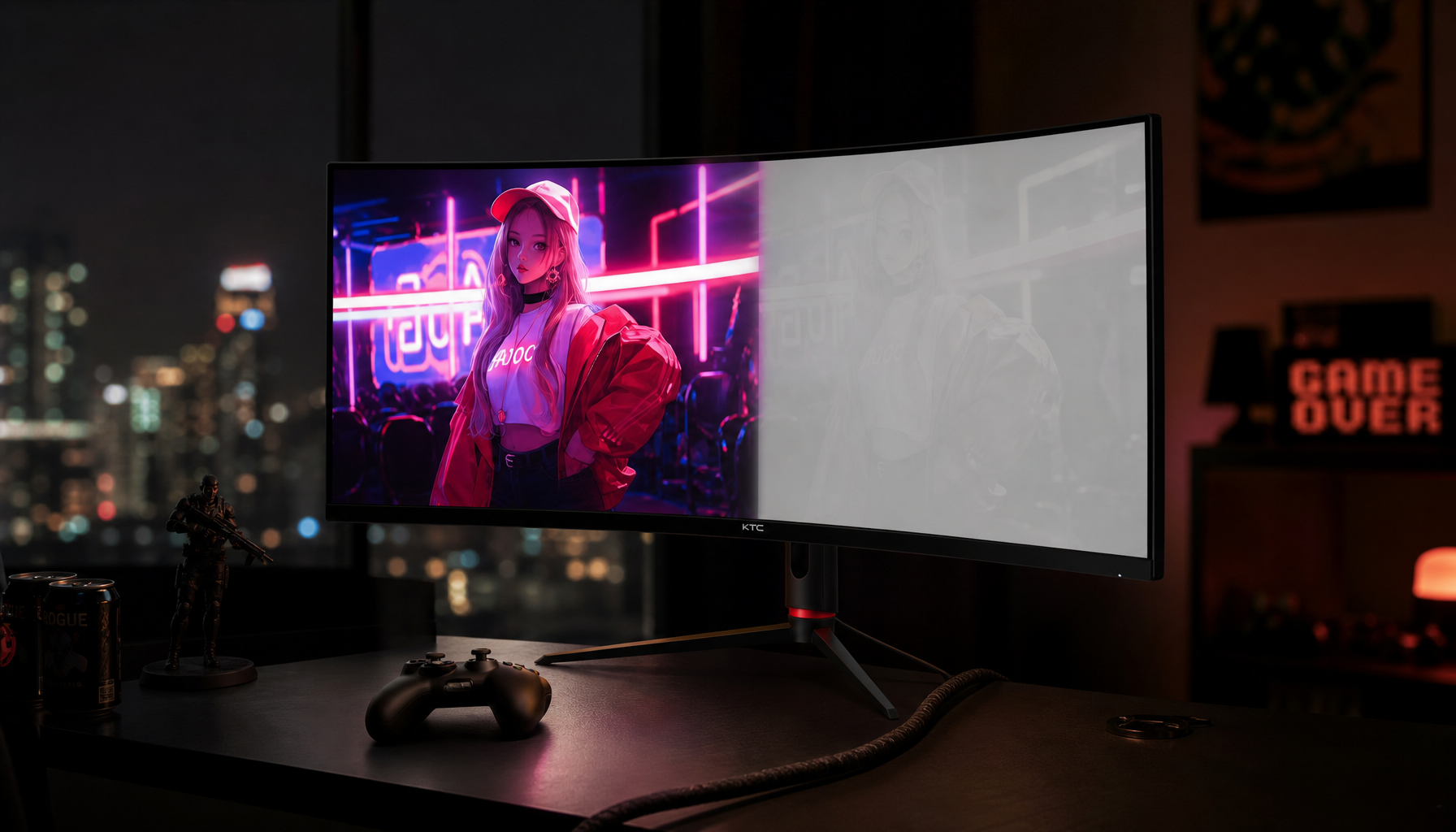
Gaming monitors often ship in vivid, high-brightness modes because they look impressive in retail lighting. Bright factory presets may exceed 300 nits and can contribute to glare stress, burning eyes, headaches, crushed blacks, or blooming halos during long use bright factory presets. If you then switch to a laptop at 40% brightness, your eyes have to adjust from a bright, contrast-heavy image to a smaller, dimmer display.

This is especially noticeable after gaming because many game scenes shift rapidly between dark interiors, bright skies, explosions, menus, and overlays. A stable manual brightness setting is usually better for competitive gaming because shifting brightness can change shadow detail, black levels, and target visibility. For general comfort, keep the gaming monitor from acting like a desk lamp.
Ultrawide Monitor to Side Monitor
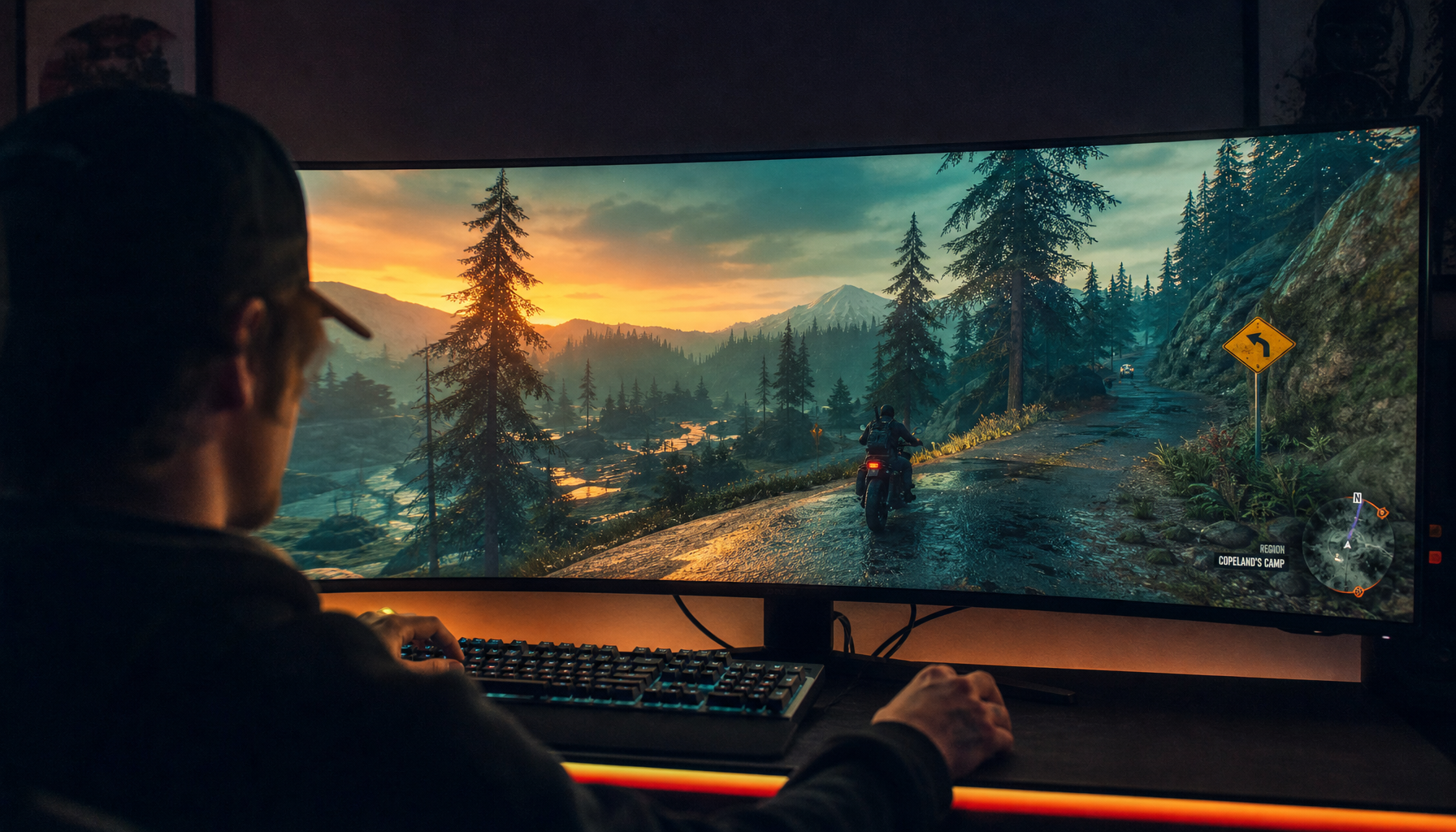
Ultrawide monitors create a different issue: one large screen can dominate your visual field. If a 34-inch ultrawide is set bright while a 24-inch side monitor is dim, every glance to the side becomes a lighting transition. This can be tiring when comparing documents, moving between a browser and a chat window, or editing video timelines across multiple panels.
For ultrawide setups, match apparent brightness before matching specs. Put the same white page or blank document on both displays and lower the brighter one until neither screen “jumps out” visually. If the side monitor is older, has weaker contrast, or uses a different panel coating, it may never match perfectly, but it should not feel like looking from a lamp to a shadow.
Portable Monitor in Changing Rooms
Portable monitors are convenient, but they often move between lighting environments: kitchen table in the morning, desk near a window at noon, hotel room at night, or couch setup after dinner. Ambient-based auto-brightness can improve comfort when lighting changes during the day, such as near windows, home offices, or portable monitor setups in different rooms ambient auto-brightness.

The tradeoff is that some portable displays use content-adaptive brightness to save power. That can cause visible pulsing when switching between a dark web page and a bright document. If you are reading, coding, or editing images, unstable brightness can be more annoying than a slightly imperfect manual setting.
Practical Brightness Targets for Multi-Monitor Comfort
There is no universal monitor percentage because 40% on one display may be brighter than 70% on another. Percentage sliders are not standardized across brands, panel types, or backlight systems. A better approach is to use target ranges, then fine-tune by appearance.
Suggested brightness targets are about 120 to 150 nits for bright offices, 100 to 120 nits for typical indoor rooms, and 80 to 100 nits for dark rooms brightness targets. If your monitor does not show nits in the menu, that is normal. Many indoor users land around 30% to 50% brightness, but the right value is the one that visually matches your room and your other screens.
Use the Paper Test
A quick setup check I use for mixed displays is the paper test. Open a white document on every screen, place a sheet of white paper next to the monitor, and adjust brightness until the screen is not much brighter than the paper. Home office brightness guidance recommends this kind of comparison because eyes respond to screen brightness relative to ambient light, not to the number shown in the monitor menu paper test.

Then compare the screens to each other. If the laptop looks gray and the external monitor looks glowing white, lower the monitor or raise the laptop slightly. If the portable monitor cannot get bright enough for the room, reduce room glare first rather than forcing your eyes to compensate.
Match Contrast and Text Size Too
Brightness matching will not solve everything if contrast and scaling are mismatched. Reading text exposes display differences because small fonts, poor contrast, and scaling gaps require more visual effort than watching video or playing a game. Practical setup guidance recommends contrast around 60% to 70% and text scaling around 125% to 150% on dense displays text scaling.
For a real desk example, a 27-inch 4K monitor often feels better at 150% scaling than at 100%, while a 24-inch 1080p monitor may be comfortable at 100% or 125%. If you use a 16-inch laptop beside a 32-inch monitor, do not force both to use the same scaling number. Make the text feel similarly readable at your normal distance.
How to Set Up Different Monitor Types
The best setup depends on how the display is used. A gaming monitor needs stable visibility, an ultrawide needs edge-to-edge consistency, a portable monitor needs flexible brightness, and a mixed laptop-monitor workflow needs matched apparent brightness.
Display setup |
Main eye-comfort risk |
Practical brightness approach |
Buying feature to prioritize |
High-refresh-rate gaming monitor |
Bright presets, glare, shadow crushing |
Use manual brightness for stable visibility; avoid vivid retail modes |
Flicker-free dimming, matte coating, good black-level control |
Ultrawide monitor |
Large bright field and side-to-side brightness differences |
Match the room first, then match side monitors by white-document appearance |
Uniformity controls, ergonomic stand, low-glare panel |
Laptop plus external monitor |
Different brightness, scaling, height, and text rendering |
Match apparent white level; adjust scaling separately on each screen |
Height-adjustable external monitor, sharp text rendering |
Portable monitor |
Dimness in bright rooms or pulsing from adaptive brightness |
Use ambient auto-brightness if stable; disable content-adaptive shifts for reading |
Adequate peak brightness, ambient sensor, matte finish |
Dual work monitors |
Constant glances between different panels |
Put both at similar luminance and contrast; align top edges |
Similar panel type, similar size, good stand adjustment |
Gaming and High-Refresh-Rate Displays
For gaming monitors, high refresh rate is not the same as eye comfort. A 144 Hz, 165 Hz, or 240 Hz screen can make motion feel smoother, but a harsh brightness preset can still leave your eyes tired after a long session. If you switch from a bright game to a dim chat window or second monitor, the transition can feel abrupt even though the refresh rate is excellent.
Set up separate modes if your monitor supports them. Use a stable gaming mode for competitive play, a lower-brightness desktop mode for browsing and work, and a darker evening mode if you play at night. Avoid aggressive dynamic contrast for long reading sessions because it can change brightness as content changes.
Ultrawide and Multi-Monitor Workstations
An ultrawide monitor can reduce the need for multiple displays, but it also places more light in your field of view. If the screen fills much of your desk, small brightness errors become more noticeable. Keep the monitor about an arm’s length away, typically around 20 to 24 inches, with the top edge at or slightly below eye level when practical viewing distance.
If you add a second vertical monitor beside an ultrawide, rotate brightness checks through your most common tasks: a white document, a dark code editor, a spreadsheet, and a video call. The goal is not laboratory-perfect calibration. The goal is that your eyes do not tense each time you glance across the setup.
Portable Monitors
Portable monitors should be judged by more than resolution and connector convenience. Look for enough brightness for daylight use, a matte or low-glare coating, stable dimming at low brightness, and a stand that can raise the screen close to laptop height. A very slim portable display that sits too low may cause neck strain even if the panel itself is good.
If the portable monitor has auto-brightness, test whether it is ambient-based or content-adaptive. Ambient-based adjustment responds to room light and is generally better for comfort. Content-adaptive brightness may save battery, but it can create unstable contrast when switching between bright documents and dark pages.
Room Lighting Matters as Much as Monitor Brightness
A monitor does not exist in isolation. Windows, wall color, desk lamps, overhead lights, and reflections all change how bright the screen feels. High contrast between a screen and nearby surroundings can contribute to eye fatigue and headaches, and home office lighting can change throughout the day because of daylight, blinds, lamps, and room surfaces home office lighting.

Do not solve every lighting problem by raising monitor brightness. If sunlight hits the panel at 3:00 PM, close blinds or shift the screen angle before increasing brightness. If the room is dark at night, add a soft bias light behind or near the monitor instead of running a bright display in a black room.
Morning, Afternoon, and Evening Settings
In the morning, raise brightness only enough to keep text clear. In the afternoon, manage glare before pushing the monitor brighter. In the evening, lower brightness and use gentle room lighting so the display is not the brightest object in the room.
For example, a home office setup might use 45% brightness on a 27-inch monitor at 10:00 AM, 55% with blinds partly closed at 2:00 PM, and 30% with bias lighting at 9:00 PM. Those percentages are only useful for that specific monitor, but the pattern is transferable: change the environment first, then tune the screen.
The 20-20-20 Rule Still Helps
Breaks are not a replacement for good monitor setup, but they reduce focusing fatigue and dryness. The 20-20-20 rule means looking at something 20 ft away for 20 seconds every 20 minutes 20-20-20 rule. This is especially useful when switching between a bright main monitor and a dim laptop, because it gives your focusing system a short reset.
If your symptoms include persistent pain, double vision, strong light sensitivity, or headaches that continue away from screens, treat that as a medical issue rather than a monitor-setting issue. Display adjustments can reduce strain, but they do not replace an eye exam or treatment for dry eye, uncorrected vision, or binocular vision problems.
Buying Guidance: Features That Reduce Brightness-Related Strain
When buying a monitor for long daily use, prioritize controllability over maximum brightness. A display with a huge peak brightness number can still be uncomfortable if it has poor low-brightness behavior, glossy reflections, awkward height, or unstable adaptive contrast. For most desk work, the better monitor is the one you can tune precisely to your room and your other displays.
Look for flicker-free dimming, a matte or low-glare coating, a wide brightness adjustment range, good text clarity, ergonomic height and tilt, and stable color modes. If you work across a laptop, ultrawide, and portable monitor, buying displays with similar panel characteristics can make daily switching easier. Similar size, resolution density, color temperature, and coating matter more than matching brand logos.
Auto-Brightness: Helpful or Distracting?
Auto-brightness can be helpful when it responds smoothly to room lighting. It is less helpful when it changes brightness based on content, especially during reading, gaming, photo editing, or video editing. Ambient-based auto-brightness adjusts a display’s light output to keep the screen readable as room lighting changes, while content-based adjustment changes brightness or contrast based on what is on screen auto-brightness.
For office work near windows, ambient auto-brightness can be worth having. For gaming, color grading, photo editing, and design review, fixed manual brightness is usually safer because it keeps shadows, highlights, exposure, and white balance stable.
Blue Light Controls Are Secondary
Blue light settings can make a display look warmer at night, but they should not be treated as the main fix for eye strain. If brightness is too high, glare is uncontrolled, text is tiny, or the display sits too close, a warm color mode will not solve the root problem. Use blue light controls as an evening comfort tool after brightness, contrast, scaling, and lighting are already set well.
For buying decisions, do not choose a monitor only because it advertises an “eye care” mode. Check whether the stand adjusts, whether the panel has a matte finish, whether low brightness is stable, whether text looks clean at your preferred scaling, and whether the monitor can match the rest of your setup.
Action Checklist for Easier Display Switching
- Set every screen to show the same white document, then match apparent brightness by eye.
- Use the paper test: compare a white page beside the screen and reduce brightness if the display looks much brighter.
- Keep most indoor monitors in a practical range, often around 30% to 50%, then adjust for the room rather than copying another person’s setting.
- Set contrast around 60% to 70% as a starting point, then fine-tune so text is clear without harsh edges.
- Use 125% to 150% scaling on dense displays when text feels small, especially on 4K monitors and laptops.
- Control glare with blinds, side-positioned windows, diffuse lamps, and screen angle before raising brightness.
- Take regular 20-20-20 breaks, especially during reading-heavy work across multiple displays.
FAQ
Q: Can switching between a bright monitor and a dim portable display cause headaches?
A: It can contribute to headaches, especially when the brightness mismatch is combined with glare, small text, poor contrast, dry eyes, or long sessions without breaks. The switch itself is usually not the only cause; it is the repeated visual adaptation plus the extra focusing effort.
Q: Should all my monitors use the same brightness percentage?
A: No. Brightness percentages are not standardized across monitors. A better method is to open the same white document on each screen and adjust until they look similarly bright from your normal sitting position.
Q: Is auto-brightness good for eye comfort?
A: Ambient-based auto-brightness can help if your room lighting changes throughout the day. Content-adaptive brightness is more likely to be distracting because it can pulse or change contrast when the image on screen changes, which is not ideal for gaming, reading, photo editing, or video work.
Practical Next Steps
The eye health implication of switching between bright and dim displays is usually digital eye strain, not permanent eye damage. The symptoms can still be disruptive: dry eyes, burning, light sensitivity, headaches, blurred vision, and difficulty refocusing after long sessions. The most effective fix is to make your display ecosystem consistent.
Start with the simple version: match apparent brightness across monitors, reduce glare, enlarge text where needed, and lower brightness in the evening. When buying your next gaming monitor, ultrawide, or portable display, choose one that gives you stable brightness control, low-glare viewing, ergonomic positioning, and enough adjustment range to fit the rooms where you actually use it.
References
- Effects of Paradigm Color and Screen Brightness on Visual Fatigue in Light Environment of Night Based on Eye Tracker and EEG Acquisition Equipment
- Eye Strain from Laptop & External Monitor: Causes & Fixes
- Right Monitor Brightness for Home Office: Reduce Eye Strain
- Digital Eye Strain: A Comprehensive Review
- Monitor Auto-Brightness: Good or Bad for Eye Comfort?
- Monitor Auto-Brightness: Good or Bad for Eye Comfort?