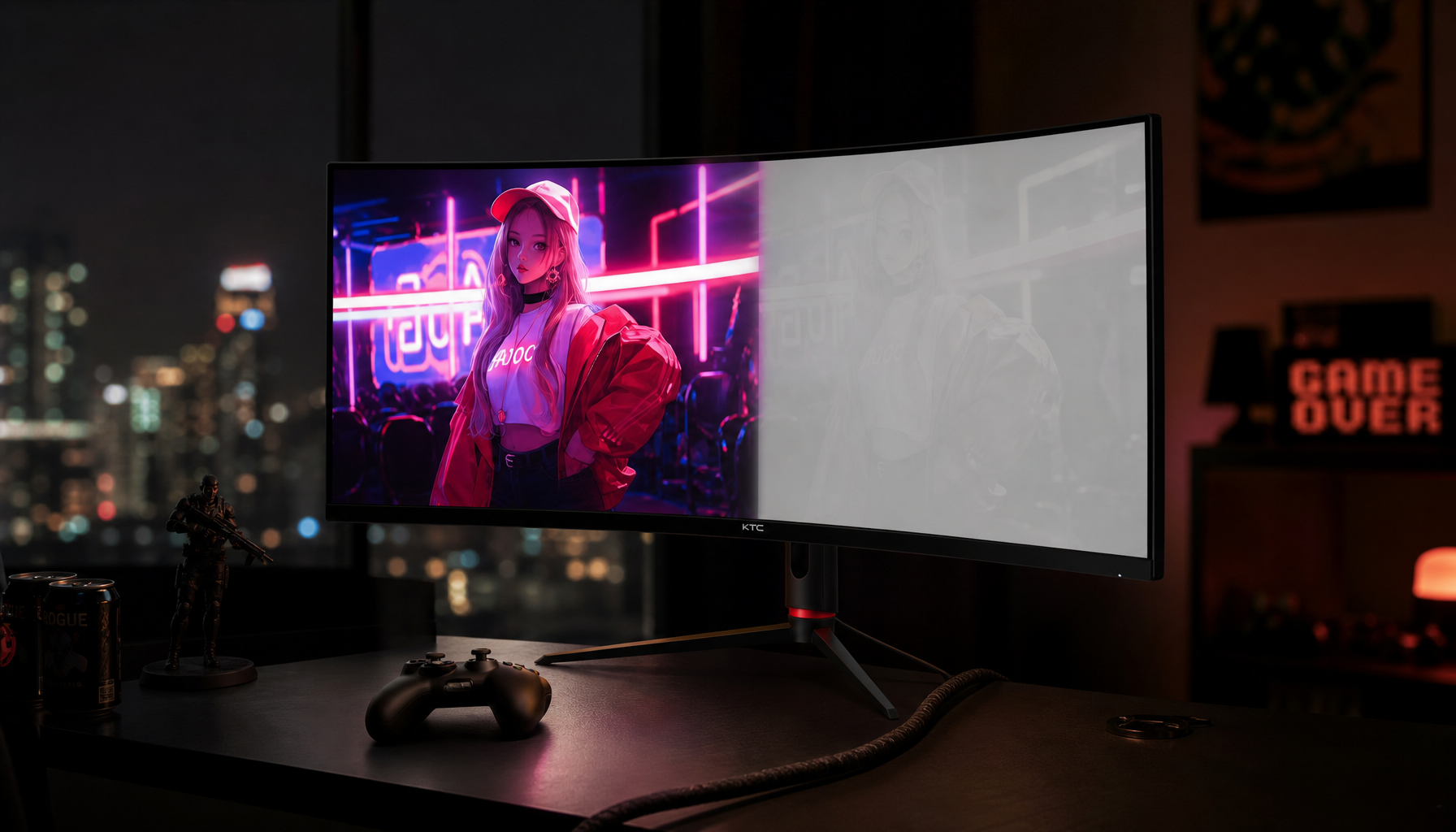
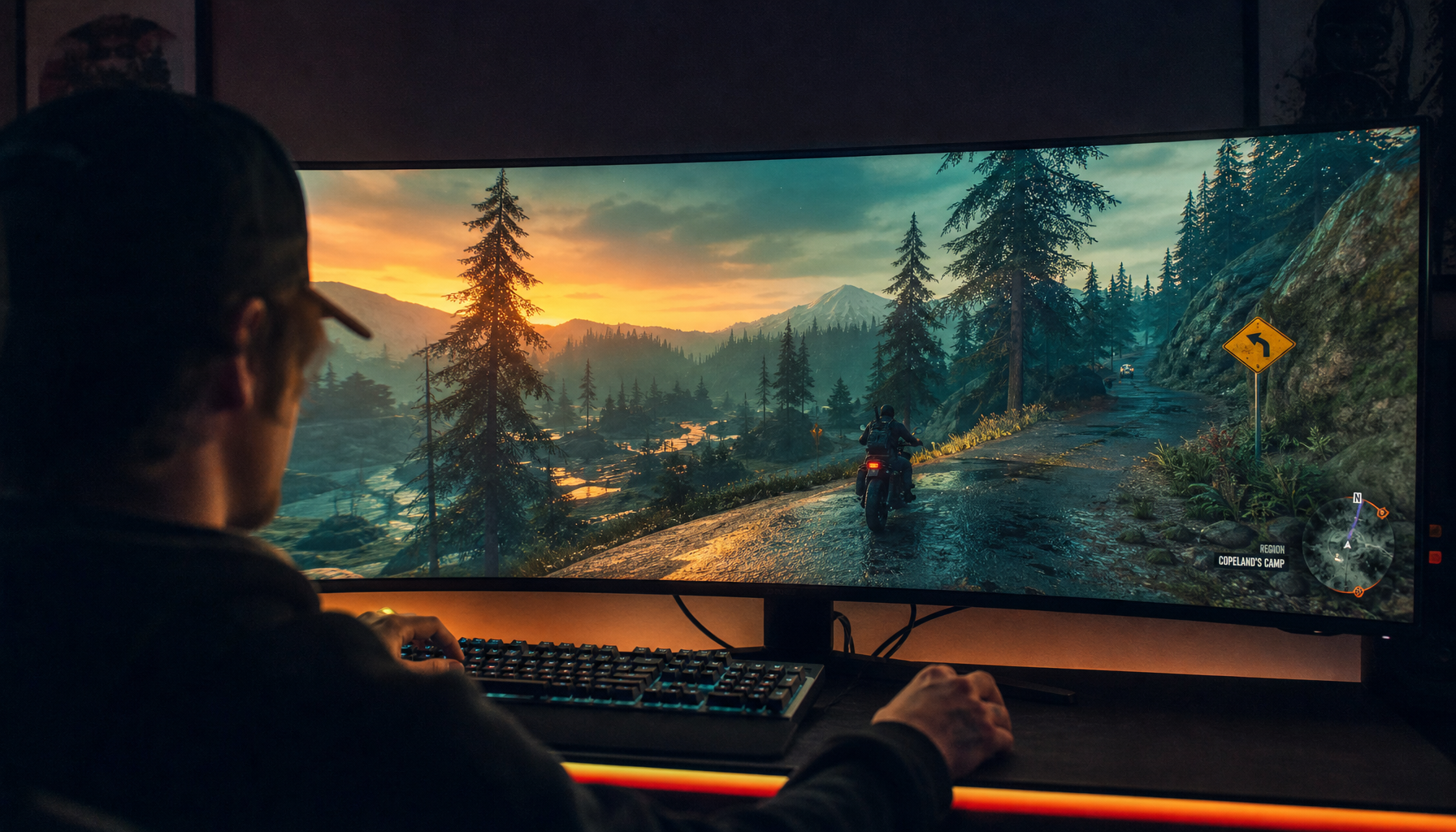
Local dimming controls light behind the image; ambient contrast enhancement controls how room light reaches your eyes. They work best together when the backlight, panel contrast, screen coating, and room brightness are treated as one system.
Ever notice a Mini-LED monitor look spectacular in a dark game, then suddenly show gray blacks, halos, or washed-out text when your desk lamp turns on? A 55-inch 4K Mini-LED LCD prototype with 2,304 zones has shown extremely high dynamic contrast in lab conditions, but real rooms can sharply reduce perceived contrast. The practical question is when to enable local dimming, when to rely on ambient contrast features, and how to avoid chasing inflated contrast specs.
 The Short Answer: One Controls Emitted Light, the Other Fights Reflected Light
Local dimming improves contrast from inside the display. In an LCD monitor, the pixels modulate a backlight rather than generating their own light, so dark areas can still leak light. Local dimming divides that backlight into zones and dims darker regions while keeping highlights bright.
Ambient contrast enhancement works from the outside. It includes anti-glare or low-reflection coatings, optical bonding, polarizers, automatic brightness adjustment, matte or semi-gloss surface choices, and room-light-aware image processing. These features do not create deeper native blacks in the panel. Instead, they reduce the contrast damage caused by light from windows, lamps, and overhead office fixtures bouncing off the screen.
The interaction is simple in principle and tricky in practice. Local dimming lowers the display’s black output, but ambient light raises the black floor your eyes actually see. If room reflections are strong, the monitor’s local dimming can be technically active yet visually muted.
Key Definitions Without the Spec-Sheet Fog
Local Dimming
Local dimming is a backlight control method for LCDs. Instead of lighting the whole screen evenly, the monitor brightens or darkens independent regions behind the panel. Mini-LED backlighting makes this more effective because smaller LEDs allow hundreds or thousands of zones in the same panel area.
The upside is clear in HDR games, movies, and creative review: brighter highlights, deeper shadow areas, and more perceived depth. The drawback is that each zone is still much larger than an individual pixel. A white cursor, subtitle, star field, or game HUD icon can light a whole zone and create blooming around it.
Ambient Contrast Enhancement
Ambient contrast is the contrast you perceive in the room, not just the contrast measured in a dark lab. Ambient light raises black-screen brightness and reduces perceived contrast, which is why the same monitor can look punchy at night and flatter at noon.
Ambient contrast enhancement features try to preserve clarity under real lighting. A better coating can reduce reflections. Higher sustained brightness can help the image overpower room light. Automatic brightness can keep white documents readable without forcing you to adjust the monitor all day. These tools are especially relevant for office productivity displays and portable smart screens, where lighting changes constantly.
How They Reinforce Each Other
Local dimming gives ambient contrast features a stronger image to protect. If a Mini-LED display can dim a dark game corridor while keeping a torch or muzzle flash bright, a good anti-reflective surface helps you see that separation instead of seeing your window reflected across the shadows.
The reverse is also true. Ambient contrast enhancement lets local dimming work less aggressively. In a bright office, a monitor may need higher overall brightness to stay readable. If the coating and reflection control are weak, the local dimming algorithm may chase darker blacks that your eyes cannot perceive through glare. That can increase visible pumping, haloing, or crushed shadow detail without a proportional benefit.
A practical example is a 27-inch HDR gaming monitor on a desk near a window. In a dark room, local dimming set high can make a space game look dramatic because black regions stay low while stars and cockpit lights pop. In afternoon light, the same setting may show less improvement because reflected light lifts the perceived black level. A moderate dimming setting plus better glare control often looks more stable than maximum dimming fighting a bright room.
Where the Conflict Starts
Blooming Becomes More Noticeable Around Small Bright Objects
Blooming happens when a bright object activates a dimming zone larger than the object. Full-array local dimming reduces this compared with edge-lit systems, but it cannot eliminate the zone-size problem on LCDs.
Ambient contrast features can either hide or expose blooming. In a bright room, glare may mask subtle halos, making blooming less visible while also lowering the whole image’s contrast. In a dim room with a clean screen surface, halos around subtitles, cursors, and HUD elements can become more obvious because your eyes are more sensitive to dark-scene errors.
High Brightness Can Help Contrast and Hurt Comfort
Bright HDR highlights are useful because they preserve separation under room light. But on office screens, too much brightness can create eye fatigue, especially with white documents, spreadsheets, and browser tabs. A monitor that looks impressive in HDR demos may feel harsh during eight hours of productivity work.
That is why local dimming should not be treated as a permanent better-image switch. For HDR gaming and video, enabling it usually makes sense. For SDR writing, coding, email, and document work, a lower dimming level or disabled local dimming often produces steadier whites, cleaner text, and fewer cursor halos.
Dynamic Contrast Claims Can Mislead Buyers
A massive advertised contrast number often reflects dynamic behavior, not the panel’s stable hardware contrast. Dynamic contrast ratio can describe brightness changes across different scenes, while static contrast is a more reliable indicator of what the panel can do at one moment.
This matters because ambient contrast enhancement does not rescue weak native contrast by itself. A glossy screen with high peak brightness may look vivid in a showroom yet struggle with reflections at home. A VA Mini-LED panel with stronger native contrast may show less blooming than an IPS Mini-LED panel with the same zone count because the LCD layer blocks more stray light before room reflections enter the equation.
Native Panel Contrast Still Matters More Than Many Spec Sheets Admit
The most useful nuance for buyers is that zone count is not a magic score. Research on HDR image quality has found that native panel contrast strongly affects perceived quality across local-dimming configurations. Comparisons between systems such as 1,000:1 and 4,500:1 native contrast with different zone counts reinforce a point experienced reviewers see often: more zones help, but weak panel contrast makes halos and washed blacks harder to hide.
Related display-testing research suggests the zone requirement can rise dramatically as panel contrast drops. In plain English, a lower-contrast LCD needs many more zones to suppress blooming to the same perceived level. That is why two monitors with similar Mini-LED marketing can behave very differently in real games.
Display Factor |
What It Improves |
What It Cannot Fix Alone |
More dimming zones |
Smaller halo regions and better highlight control |
Weak native contrast or poor algorithms |
Higher native contrast |
Deeper panel-level blacks and less visible blooming |
Reflections from a bright room |
Better coating |
Lower reflected light and clearer blacks in office lighting |
LCD backlight leakage |
Higher peak brightness |
Stronger HDR highlights and better daytime visibility |
Eye comfort during long desktop work |
Smarter dimming algorithm |
Better shadow detail and smoother transitions |
Physical zone-size limits |
Best Settings by Use Case
HDR Gaming and Movies
For cinematic HDR, enable local dimming and use the monitor’s HDR mode. The goal is to keep black areas dark while allowing bright highlights to hit with impact. Mini-LED systems are especially strong here because they can combine high brightness with localized backlight control.

In a dark room, start with medium or high local dimming, then check difficult scenes: subtitles over black, a flashlight in a cave, stars in space, and bright UI over dark menus. If halos distract you, reduce the dimming strength before reducing HDR brightness. If shadow texture disappears, the algorithm may be crushing blacks too aggressively.
Office Productivity
For spreadsheets, writing, coding, video calls, and web work, prioritize uniformity and comfort. Local dimming can make white windows shift brightness as content changes, and a white pointer over a dark theme can glow. A steady SDR mode with local dimming off or low is often the better productivity preset.
Ambient contrast enhancement matters more during office use. Position the screen away from direct window reflections, keep brightness high enough for text clarity, and prefer a coating that controls glare without making text sparkle. Portable smart screens benefit from this especially because they are often used in airports, coworking spaces, hotels, and coffee shops where lighting is unpredictable.

Creative Review
For photo, video, and HDR preview work, use local dimming only when it matches the content target. If you are grading HDR footage, local dimming is part of the viewing chain. If you are editing SDR assets or checking flat UI colors, aggressive local dimming can distort perceived uniformity.
A good workflow is to keep separate presets: one calibrated SDR productivity mode with stable brightness, and one HDR review mode with local dimming enabled. This reduces the temptation to judge everything through one dramatic but unreliable setting.
What to Look For Before Buying
Choose full-array Mini-LED over edge-lit dimming when HDR contrast is a priority. Full-array systems place controllable backlights behind the screen, giving the algorithm more precise control than edge-lit designs.
Do not buy from zone count alone. Check native contrast, coating quality, HDR certification, reviewer measurements, and user reports about blooming, backlight lag, and text clarity. A well-tuned 1,152-zone monitor can look better than a higher-zone model with poor processing.
Treat ambient lighting as part of the spec. A bright office, glossy screen, and dark content are a difficult combination. A dim room, controlled lighting, and high native contrast let local dimming show its strengths. If your display sits near a window, reflection control and sustained brightness may matter as much as the dimming algorithm.
FAQ
Should I Leave Local Dimming On All the Time?
Usually no. Leave it on for HDR games, movies, and high-contrast visual work. Use a lower setting or turn it off for SDR desktop tasks if you notice glowing cursors, uneven whites, or shifting brightness.
Does Ambient Contrast Enhancement Replace Local Dimming?
No. Ambient contrast features reduce reflected light and preserve visibility in the room. Local dimming improves the emitted image from the backlight. The best LCD HDR experience needs both.
Is OLED Better Than Mini-LED for Contrast?
OLED has per-pixel light control, so it avoids LCD blooming. Mini-LED counters with higher brightness, strong full-screen output, and no permanent burn-in risk for static desktop layouts. For mixed gaming and productivity, Mini-LED remains a strong choice when the panel contrast, coating, and dimming algorithm are well matched.
Bottom Line
Local dimming gives an LCD its HDR muscle, while ambient contrast enhancement keeps that contrast visible in the real world. For the best result, stop treating contrast as one number: match the monitor’s dimming system, native panel contrast, surface treatment, and room lighting to the way you actually play, work, and move between screens.