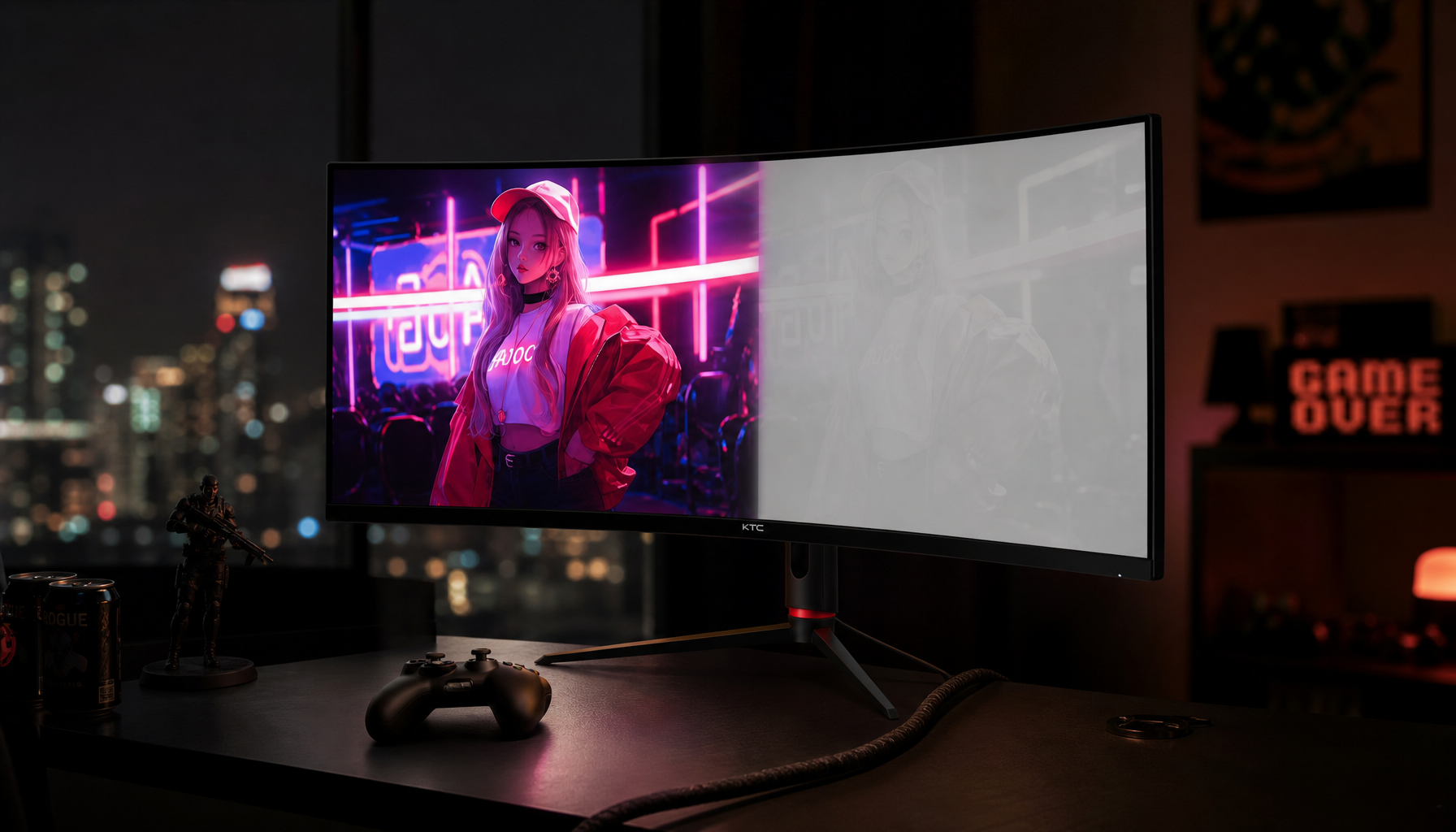
IPS glow moves with your viewing angle; backlight bleed stays fixed on the panel. Both show up most on dark screens, but one is a normal IPS behavior and the other is usually a pressure- or assembly-related LCD uniformity issue.

Does your new gaming monitor look great in bright scenes, then turn gray and cloudy during a dark loading screen? A five-minute black-screen check from your normal desk position can separate normal panel behavior from a defect worth returning. You’ll learn what each issue looks like, why it happens, and how to reduce it without chasing the wrong fix.
IPS Glow vs. Backlight Bleed: The Fast Difference
IPS glow is the soft haze you often see near the corners of an IPS monitor when the screen is dark, especially in a dim room or at high brightness. It changes as you move your head, sit closer, tilt the display, or shift off center. That movement is the key tell.
Backlight bleed is more like a fixed leak of light from the LCD structure. It usually appears along edges or corners as bright blotches, streaks, or “flashlight” patches. Backlight bleed is tied to how the LCD panel, bezel, backlight, and diffuser layers block or fail to block light, so the patch usually stays in the same place even when you move.
Test |
IPS Glow |
Backlight Bleed |
Changes when you move your head |
Yes |
Usually no |
Common location |
Corners, especially on large IPS screens |
Edges, corners, sometimes blotchy areas |
Typical look |
Soft gray, silver, yellowish, or bluish haze |
Brighter fixed patches, clouds, or flashlighting |
Main cause |
IPS viewing-angle behavior and panel light transmission |
Panel pressure, assembly tolerance, frame fit, or light leakage |
Panel types affected |
IPS-type panels |
Any LCD panel type |
Return-worthy? |
Usually only if extreme in normal use |
More likely if severe or distracting |
What Causes IPS Glow?
IPS glow comes from the way IPS panels control light. IPS displays use liquid crystals aligned in a way that supports strong color consistency and wide viewing angles, but a small amount of backlight can still pass through at certain angles. That is why a black screen can look clean in the center but hazy in the lower-left or lower-right corner when you sit close.
The effect gets stronger when the geometry works against you. A 32-inch monitor at a 2 ft desk distance puts the corners at a steeper angle than a 24-inch monitor at the same distance. That means the corner glow can appear even when you are sitting straight on, because your eyes are not equally centered to every part of the panel.
Brightness matters just as much. IPS glow becomes more obvious during dark games, space scenes, horror movies, and black loading screens, especially when the monitor is running bright in a dark room. For competitive gaming, that can make shadow detail feel washed out; for office work, it often disappears because documents, dashboards, and browser windows are not black enough to expose it.
The practical upside is that IPS still earns its place. IPS monitors remain popular for gaming and productivity because they typically offer stable color, crisp text, and strong viewing consistency for shared work, editing, and multitasking. The tradeoff is that dark-room contrast rarely feels as deep as OLED or a strong VA panel.
What Causes Backlight Bleed?
Backlight bleed happens when light escapes unevenly through the LCD stack or around the edges instead of being blocked cleanly. Common causes include frame pressure, imperfect assembly, panel layer alignment, transportation stress, or pressure from the stand, chassis, or mounting screws.
A small amount can be normal because mass-produced LCD panels are not perfectly uniform. Display makers often describe light leakage as an industry-wide LCD phenomenon that is most visible in dim rooms or on black backgrounds, and they often evaluate displays under typical office lighting rather than pitch-black test conditions. That distinction matters: a monitor that looks alarming in a dark room at 100% brightness may be acceptable at your real desk settings.
Severe bleed is different. If a bright patch is visible during normal gameplay, movie watching, design work, or office use, it is no longer just a test-screen annoyance. For a photo editor, a fixed bright edge can mislead shadow evaluation. For a gamer, bottom-edge flashlighting can break immersion in dark maps. For a portable screen, chassis flex or transport pressure can make the issue more noticeable after travel.
The Five-Minute Test That Separates Them
Set the monitor where you actually use it, with your chair at your normal distance and your eyes near the vertical center of the screen. Let the display warm up for a while, then set brightness to a realistic level instead of maximum. In many office and gaming rooms, that means somewhere below the factory default rather than a showroom-bright setting.

Show a full black image or a very dark test screen. Keep the room dim but not pitch black, because total darkness exaggerates both issues and makes the test less representative of normal use. Now move your head slowly left, right, up, and down. If the haze shifts, grows, shrinks, or seems to move from one corner to another, you are looking at IPS glow. If the bright patch stays locked to the same edge or corner, it is more likely backlight bleed.
For a real-world confirmation, open a dark game scene or a movie with black letterbox bars. A glow that only bothers you on a pure black test screen may not matter. A fixed bright patch that pulls your eye during ordinary content deserves closer scrutiny.
How to Reduce IPS Glow
The most effective first move is lowering brightness. A monitor set too bright in a dark room lifts the entire black floor, increases eye strain, and makes IPS glow more obvious. If the image becomes too dark after lowering brightness, adjust gamma or in-game shadow settings before simply pushing brightness back up.
Bias lighting helps more than many people expect. A soft light behind the monitor raises the room’s perceived black level without shining into your eyes, which makes corner haze less distracting. Bias lighting is often recommended for IPS users because it improves perceived contrast and pulls attention away from glow during dark scenes.

Ergonomics also matter. Sit slightly farther back if your desk allows it, keep your eyes near the screen’s vertical midpoint, and tilt the panel until the corners look balanced. On a 27-inch monitor, moving from about 2 ft to a little farther back can soften the corner-angle problem without making text too small for most users.
How to Reduce Backlight Bleed
Start with non-invasive fixes. Lower brightness, avoid crushing contrast settings, and test the monitor in normal room lighting. If the screen is mounted on an arm or wall bracket, check whether screws or brackets are applying uneven pressure. If the stand attachment feels unusually tight or the chassis is twisted, relieving that pressure can sometimes reduce the visible patch.

Some users report improvement after a new LCD has settled for a few days. In one documented example, a monitor with early bottom-edge bleed looked better after time and gentle edge adjustment, with changes shown in controlled black-screen photos. That does not prove every unit will improve, but backlight bleed over time can be influenced by pressure, temperature, shipping stress, and casing fit.
Be careful with physical fixes. Light pressure with a microfiber cloth may help in limited cases, but pressing hard, dismantling the display, or loosening unknown internal parts can damage the panel or void warranty coverage. If the bleed is obvious in normal content on a new monitor, a return or exchange is usually the cleaner move.
When Should You Return the Monitor?
Judge the display by your actual use, not by an overexposed phone photo. Camera images often exaggerate black-screen flaws because auto exposure brightens the entire scene. A useful photo comparison needs fixed manual exposure, the same room lighting, the same brightness setting, and the same distance.
Return or warranty support makes sense when a fixed bright patch is visible in normal use, covers a large area, sits near the center, or disrupts color-sensitive work. Excessive bleed can reduce contrast, dark-scene immersion, and color consistency, which matters more on a premium gaming monitor, editing display, or main productivity screen than on a budget secondary panel.
For IPS glow, replacement is less predictable. Another unit of the same model may be slightly better, similar, or worse because panel variance is real. If you are highly sensitive to dark-room glow, the better buying decision may be a VA monitor for deeper blacks, an OLED for true pixel-level black, or a Mini LED model with strong local dimming. Each has its own tradeoffs: VA can smear dark motion, OLED costs more and needs static-image care, and Mini LED can show blooming.
Pros and Cons of IPS Despite Glow
IPS is still a strong choice when your work depends on color stability, readable text, wide viewing angles, and fast gaming performance. It is especially compelling for hybrid setups where the same display handles spreadsheets, browser research, creative tools, and fast-paced games.
The downside is dark-room immersion. IPS black levels usually cannot match OLED, and corner glow can be distracting if you play cinematic games at night with the lights off. That does not make IPS bad; it means setup discipline matters. The right brightness, distance, tilt, and ambient light can turn an annoying panel into a reliable daily driver.
FAQ
Is IPS Glow a Defect?
Usually, no. IPS glow is a normal behavior of IPS-type panels, although some units and models show much more than others. If it dominates normal content rather than only black test screens, it may still be unacceptable for your needs.
Can Backlight Bleed Go Away?
Sometimes it can reduce slightly as panel pressure settles, but you should not count on it disappearing. If it remains fixed and distracting during normal use, treat it as a quality issue.
Do OLED Monitors Have IPS Glow or Backlight Bleed?
No. OLED pixels emit their own light, so there is no separate LCD backlight to leak. OLED has other considerations, including price, brightness behavior, and burn-in risk with static desktop elements.
What Is the Best Quick Diagnosis?
Use a black screen at normal brightness and normal seating distance, then move your head. Moving haze points to IPS glow; a fixed bright patch points to backlight bleed.
A strong display should serve the way you actually play, work, and watch. If the artifact only appears in an unrealistic dark-room test, tune the setup and move on; if it breaks immersion or accuracy in real content, use the return window or warranty with confidence.