Higher panel bit depth usually makes gradients look smoother, but the visible result depends on the whole display chain, not just the panel spec.
Have you ever noticed a sunset in a game turning into stripes, or a dark loading screen breaking into obvious steps instead of fading smoothly? That problem shows up most clearly in skies, shadows, grayscale ramps, and HDR scenes, and the difference between 6-bit, 8-bit, 8-bit + FRC, and 10-bit becomes much easier to spot there than in busy gameplay. This guide explains when panel bit depth really matters for monitor buying and when refresh mode, signal settings, and content quality matter just as much.

What Panel Bit Depth Actually Changes
More levels mean smaller visible jumps
Panel bit depth controls how many shades each red, green, and blue channel can represent. A 6-bit panel has 64 levels per channel, an 8-bit panel has 256, and a 10-bit panel has 1,024. In practical monitor terms, that means true 8-bit can show about 16.7 million color combinations, while true 10-bit can address about 1.07 billion. Those extra levels reduce the size of each step between similar tones, which is why higher bit depth tends to make grayscale ramps, blue skies, smoke, fog, and dark UI fades look smoother.
The effect is easiest to see in midtones, where the eye is more sensitive to step boundaries. Deep shadows and bright highlights can sometimes hide equal-sized steps better, but once a smooth tonal transition lands in the middle of the brightness range, rounding errors become much more obvious. That is why a monitor can look fine on solid colors and still show banding in real scenes.
Real scenes do not always reveal the difference
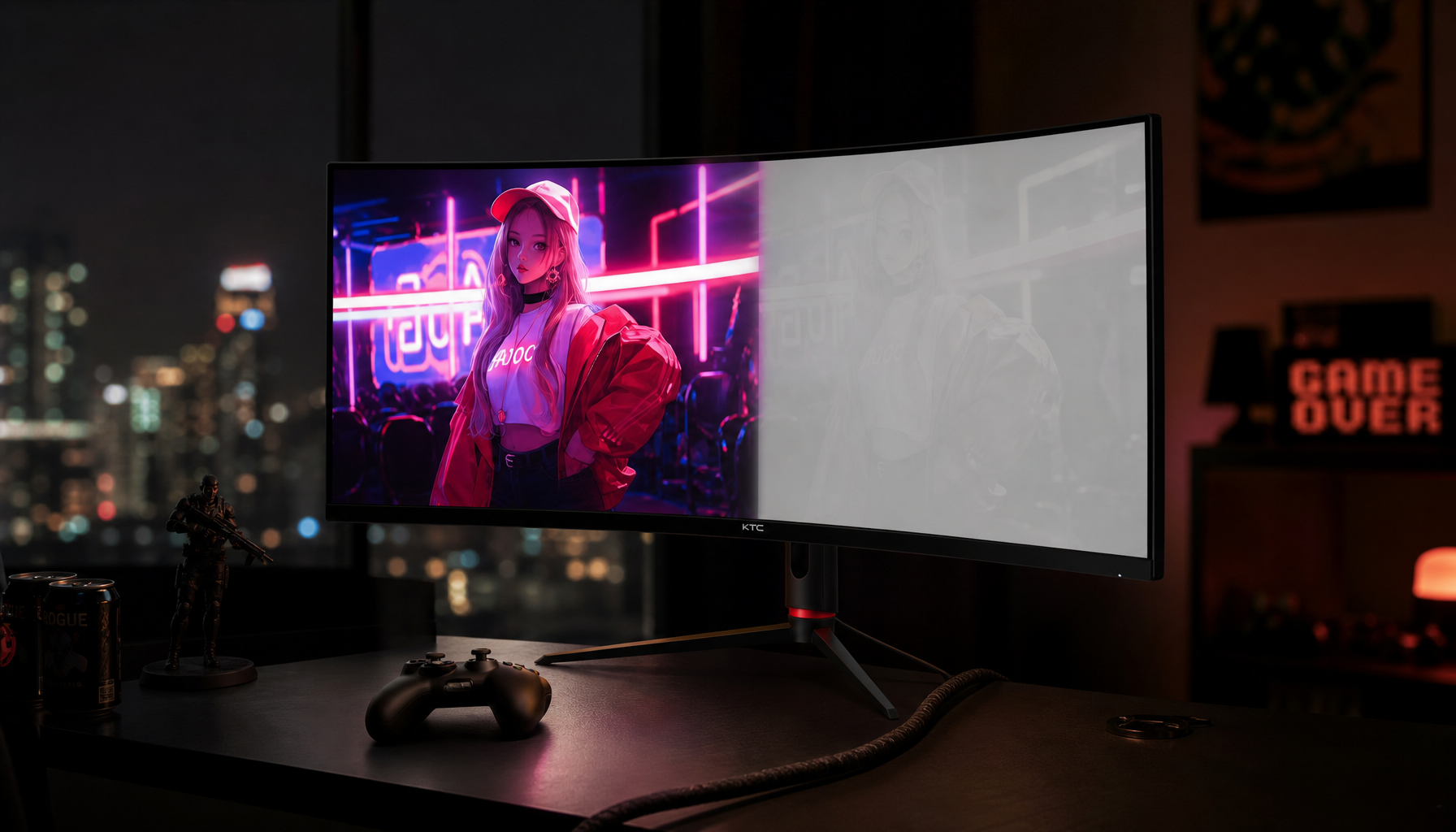
Bit depth matters most when the content contains large, low-detail gradients. A flat blue sky, a dim cave wall, or a soft radial menu background can expose banding quickly. By contrast, detailed textures, film grain, and compression noise can hide it. That is also why some users report that they can barely tell 6-bit, 8-bit, and 10-bit apart in certain movie scenes, even though a proper gradient test pattern shows a clear difference.
Dithering also changes what you see. Many monitors and GPUs add controlled noise or temporal alternation to break up hard boundaries between shades. That does not create true native steps, but it can make a limited panel look much smoother to the eye, especially in motion.
Where Banding Shows Up First on Monitors
Desktop gradients, games, and low-detail scenes
On a 25-inch 100Hz office monitor or a 27-inch 210Hz gaming monitor, banding usually appears first in grayscale wallpapers, game menus, dusk skies, fog effects, smoke, and shadow transitions. Computer-generated gradients often expose the problem more aggressively than photographs because the transition is cleaner and the step boundaries are easier to separate from the background image.

Dark gradients are especially revealing. Many users who complain about color banding are not talking about bright scenes at all; they are noticing striping in dark images, dark gray ramps, or black-to-gray fades. If a monitor looks acceptable on bright content but falls apart in dark scenes, that is still a meaningful image-quality weakness for gaming and movie use.
HDR and brighter displays raise the demand for precision
A 24-inch 180Hz HDR400 gaming monitor or a 27-inch 180Hz HDR1400 Mini LED gaming monitor puts more pressure on the gradient pipeline because higher luminance range makes step boundaries easier to expose. Traditional SDR assumptions were built around roughly 0 to 100 nits, while many modern LCD monitors reach 400 nits or more, and HDR content is commonly mastered in 10-bit for that reason.
That does not mean every HDR badge guarantees smoother gradients. If the source material is only 8-bit, or the GPU, cable, or monitor processing truncates the signal before it reaches the panel, a 10-bit-capable monitor cannot invent missing tonal detail. Higher bit depth helps most when the content and the signal path can actually use it.
Is 8-Bit + FRC Close Enough to True 10-Bit?
Why 8-bit + FRC often works well
8-bit + FRC uses temporal dithering to alternate between nearby shades so your eyes perceive an in-between value. In many SDR scenes, that works surprisingly well. For gaming monitors, ultrawide monitors, and general desktop use, a good 8-bit + FRC implementation can look close to true 10-bit from a normal viewing distance, especially when the content already contains texture or light noise.
That is one reason 8-bit + FRC remains common in monitor buying. It can deliver better apparent smoothness than plain 8-bit without the cost or performance tradeoffs that sometimes come with other panel choices. For most gamers, it is often the practical middle ground.
Where true 10-bit still pulls ahead
True 10-bit still has a visible edge in the hardest scenes: slow grayscale ramps, subtle HDR highlights, soft shadow roll-offs, and large low-detail backgrounds. It also matters more for editing, grading, or any workflow where you intentionally inspect tonal transitions instead of just enjoying the scene. If you lift shadows or move a gentle gradient into the midtones, hidden banding becomes much easier to spot.
The other advantage is consistency. FRC depends on implementation quality and viewing conditions. A strong 8-bit + FRC monitor can look excellent, while a weak one may still show patterning, noise, or uneven transitions. Severe banding is still more common on limited-depth panels, especially if they rely heavily on dithering.
Panel type |
Levels per channel |
Typical real-scene gradient result |
Best fit |
Main watch-out |
6-bit + FRC |
64 native, simulated intermediate shades |
Often acceptable in motion, but banding is easier to spot in dark ramps and skies |
Basic portable or budget displays |
More obvious posterization and dithering artifacts |
True 8-bit |
256 |
Usually solid for SDR desktop use and many games |
Mainstream office and gaming monitors |
Slight banding can still appear in smooth gradients |
8-bit + FRC |
256 native, simulated extra shades |
Often close to 10-bit in normal use |
Many modern gaming and ultrawide monitors |
Quality depends on the dithering implementation |
True 10-bit |
1,024 |
Best for subtle gradients, HDR, and tonal editing |
HDR-focused and creator-oriented displays |
Only helps fully when the whole pipeline is 10-bit |
Why the Full Display Chain Matters as Much as the Panel
Output settings can quietly ruin smooth gradients
A 27-inch 180Hz gaming monitor can still show obvious banding if the GPU is sending the wrong signal format. For PC use, Full Range RGB is usually the safest choice for preserving subtle shade detail. Limited RGB can compress the tonal range, and some YCbCr paths can reduce fine shade variation or chroma fidelity depending on the mode and monitor behavior.
Bandwidth also matters. Some monitors can accept 10-bit only at lower refresh rates, while higher refresh modes force 8-bit output, chroma subsampling, or other compromises. A 4K display running at 144 Hz, for example, may not behave the same way it does at 60 Hz. If your buying goal is smooth gradients, test the exact refresh rate, resolution, and cable type you plan to use.
Software and calibration can create banding on their own
Banding is not always a panel problem. Poor software color management, lookup table truncation, browser behavior, driver issues, and aggressive gamma or contrast adjustments can all create visible step boundaries. In some cases, trying to improve black depth or punchier contrast makes gradients worse by crushing shadow detail into fewer visible shades.
That is why a full 10-bit chain matters more than a single 10-bit spec. You need compatible content, software that outputs the extra precision, GPU support, a signal path that preserves it, and a display that can use it. If one stage falls back to 8-bit, the result will look like 8-bit no matter what the monitor box says.
High-Refresh, Ultrawide, and Portable Display Tradeoffs
High refresh rate can change image behavior
A 25-inch 300Hz vertical gaming monitor or a fast QHD gaming display may prioritize motion clarity first, and some high-refresh monitors do change gamma, contrast, or uniformity as refresh rate increases. In practice, that can make gradients look cleaner at 60 Hz than at 144 Hz or 240 Hz, even on the same panel. If a monitor only exposes 10-bit at 60 Hz, then a player using 165 Hz will not see the same smoothness during normal use.
That does not automatically make the higher refresh mode the wrong choice. Competitive gaming benefits from motion clarity far more than it benefits from slightly finer gradient steps. The key is to buy for the scene you care about most: esports motion, cinematic HDR, or balanced all-around use.
Larger and more mobile screens expose different weaknesses
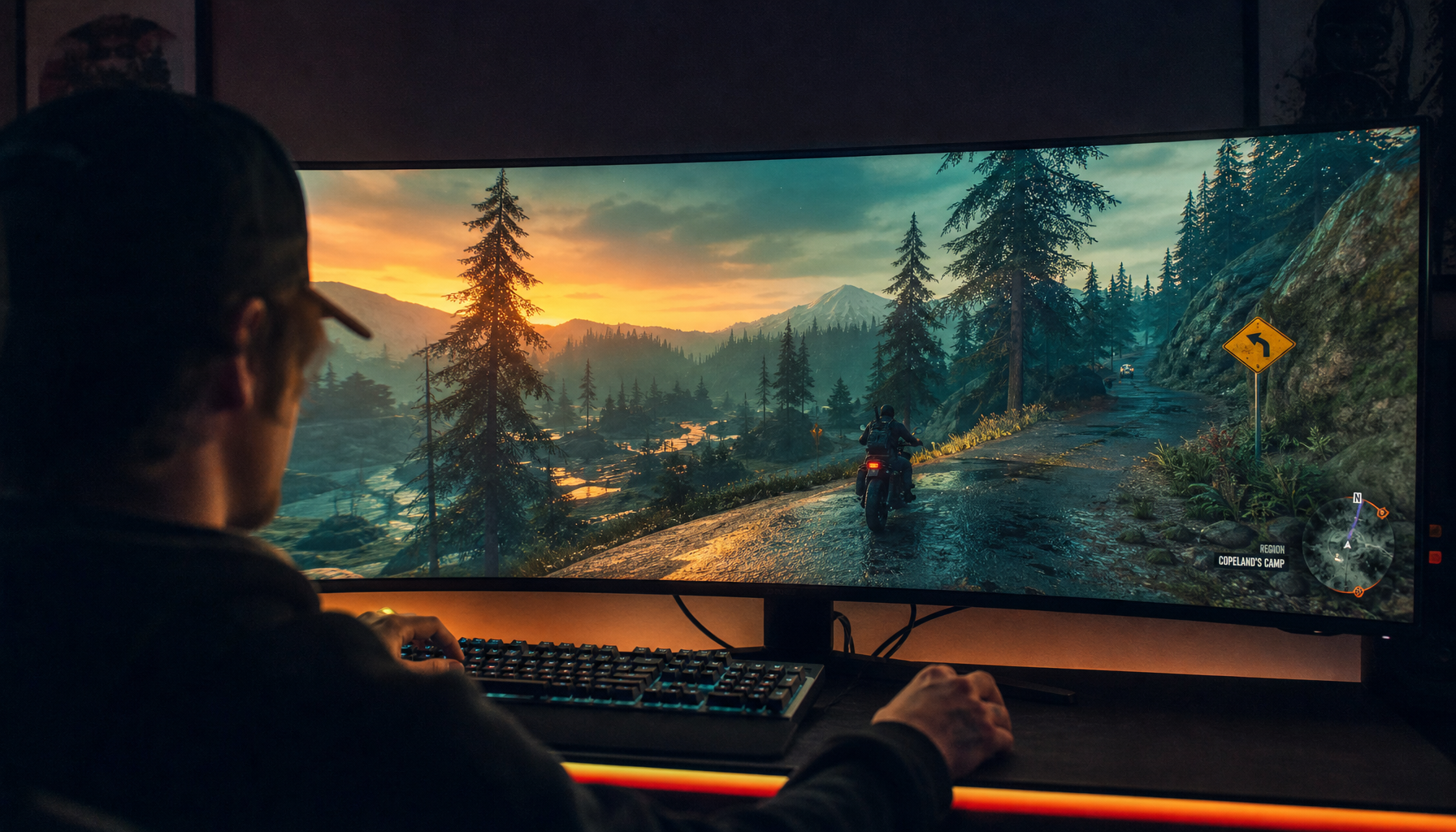
Ultrawide-style viewing makes banding easier to notice because a sky, fog bank, or gray desktop wash covers more screen area. The larger the smooth area, the easier it is for your eyes to catch a repeated tonal step. That is why gradient handling matters more on wide monitors used for immersive games, large spreadsheets, or video timelines.
A 25-inch portable touch-screen or a 27-inch mobile touch-screen has a different challenge. Portable displays often work within tighter power, brightness, and processing limits, so you should not assume the bit-depth claim tells the whole story. On these screens, dark ramps, gray fills, and HDR-like scenes are worth testing carefully before deciding they are smooth enough for travel editing or second-screen gaming.
How to Test Gradient Smoothness Before You Buy
Use proper patterns instead of random demo content
The fastest way to judge a monitor is to open fullscreen grayscale and color gradients and inspect them at your normal viewing distance, then again from slightly farther back to judge overall smoothness. Good tests include horizontal, vertical, diagonal, radial, and dual gradients in grayscale, red, green, blue, cyan, magenta, and yellow. A clean result should look continuous, without abrupt lines, tint shifts, or excessive noise in dark tones.
It also helps to test different step counts. A smooth grayscale ramp with 256 intervals should not show obvious jumps between adjacent steps. If you reduce the interval count, the bars should remain distinct rather than merging unpredictably. This gives you a practical way to separate mild banding from severe truncation.
Test the exact mode you will really use
Run the test at native resolution, your intended refresh rate, and the cable you plan to keep. Check SDR and HDR separately. Make sure the GPU is set to Full Range RGB where appropriate, and note whether switching between 60 Hz and high refresh changes the result. If gradients improve sharply when you lower refresh, that is useful buying information, not a minor detail.
Finally, test real content after the pattern tests. Use a dark game scene, a foggy sky, a grayscale wallpaper, and a streaming video with heavy compression. If the monitor bands only in one game, the source is probably the issue. If it bands on desktop gradients, test ramps, menus, and videos across multiple apps, the display chain or the monitor itself is more likely at fault.
FAQ
Q: Will a 10-bit monitor fix banding in every game?
A: No. Many games, videos, and apps introduce banding before the image even reaches the panel. If the content is compressed, rendered poorly, or output in 8-bit, a 10-bit monitor can reduce the visibility in some cases but cannot fully restore missing tonal information.
Q: Is 8-bit + FRC good enough for a gaming monitor?
A: Usually yes for mainstream SDR gaming and mixed desktop use. A good 8-bit + FRC monitor can look very close to true 10-bit in motion and from a normal seating distance. True 10-bit matters more for demanding HDR scenes, tonal editing, and users who are sensitive to gradient artifacts.
Q: Should you enable 12-bit output if the GPU allows it?
A: Usually there is no visible benefit for standard SDR or HDR10 monitor use. It is often harmless, but it does not create extra real-world gradation if the source, application, or display path is still effectively 8-bit or 10-bit.
Practical Next Steps
If smooth gradients are a buying priority, do not stop at the panel label. Check the effective bit depth, the refresh mode you actually plan to use, whether the display accepts 10-bit in that mode, and whether the monitor keeps Full Range RGB and full chroma without compromises. For most gaming monitors, a strong 8-bit + FRC implementation is enough. For HDR-focused displays, creator workflows, or scenes with large smooth fades, true 10-bit is more meaningful.
Use this shortlist when comparing monitors: - Prioritize gradient tests in grayscale, dark tones, and skies rather than relying on colorful demo footage. - Verify the real signal path at your target refresh rate, especially on high-refresh and 4K displays. - Treat severe desktop banding as a warning sign even if the spec sheet looks strong. - Expect portable and ultrawide displays to reveal gradient weaknesses differently because of size, brightness, and processing limits.
References
- Structured evidence notes supplied for this article, covering independent monitor gradient tests, HDR bit-depth behavior, dithering, calibration workflows, and real-user reports across office, gaming, ultrawide, and portable displays.
- 25-inch 100Hz office monitor
- 24-inch 180Hz HDR400 gaming monitor
- 27-inch 210Hz gaming monitor
- 27-inch 180Hz gaming monitor
- 27-inch 180Hz HDR1400 Mini LED gaming monitor
- 25-inch 300Hz vertical gaming monitor
- 25-inch portable touch-screen
- 27-inch mobile touch-screen