Viewing angle usually does not add real electronic input lag, but it can make actions feel delayed by weakening the visual feedback your eyes use to confirm movement, aim, clicks, and cursor travel. Better screen alignment, the right panel type, and motion settings that preserve clarity from your actual seat can make a fast monitor feel fast again.
Does your crosshair feel late when you lean back, or does your cursor seem to drag on a side monitor even though the PC is fast? A quick center-position check and monitor-angle adjustment can make movement cues look sharper without changing your GPU, mouse, or keyboard. This guide explains how viewing angle changes perceived responsiveness, when panel choice matters, and how to set up a gaming, office, or portable screen so feedback feels immediate.
Perceived Lag Is Not Always Input Lag
Input lag is the delay between a command and the visible result on the screen. Viewing-angle distortion is different: it changes what that result looks like once it reaches your eyes. The two problems can feel similar because both affect confidence. You press, swipe, flick, or click, then judge whether the screen answered quickly enough.
A monitor can have low hardware latency and still feel sluggish if you are viewing it from a poor angle. The brain does not measure only time; it also judges clarity, contrast, edge definition, and motion consistency. When those cues degrade, the response can feel less immediate even if the signal path has not changed.
The practical distinction matters because the solution is different. If real input lag is high, reduce processing, use the right refresh rate, and avoid latency-heavy display modes. If perceived lag comes from viewing-angle distortion, improve seating position, panel choice, screen orientation, and visual consistency.
What Viewing Angle Actually Changes
Viewing angle is the off-center position from which a screen remains acceptably visible before brightness, color, contrast, or clarity breaks down. In monitor specs, it is usually listed as horizontal and vertical coverage, such as 178°/178°, but that number does not mean every seat near the edge of the range looks identical to the center.
A monitor’s maximum off-center angle describes acceptable image quality, not perfect competitive precision. In practical desk use, the center position still gives the cleanest feedback because contrast, brightness, and color are most stable when your eyes are aligned with the panel.
The distortion is especially noticeable in three places. Dark areas can lose contrast, making enemies, cursor edges, gridlines, or spreadsheet highlights harder to read. Colors can shift, making state changes less obvious in games, editing tools, dashboards, and design software. Motion edges can also look smeared or uneven across the screen, making the same mouse flick feel cleaner in the center than at the far left or right.
How Distortion Turns Into Perceived Delay
Your hand does not wait for a spec sheet. It reacts to visual confirmation. When a crosshair, cursor, animation, or scrolling line becomes less distinct, your brain needs a little more confidence before it feels like the action landed. That extra interpretation time is perceived delay, even though the monitor electronics may be unchanged.
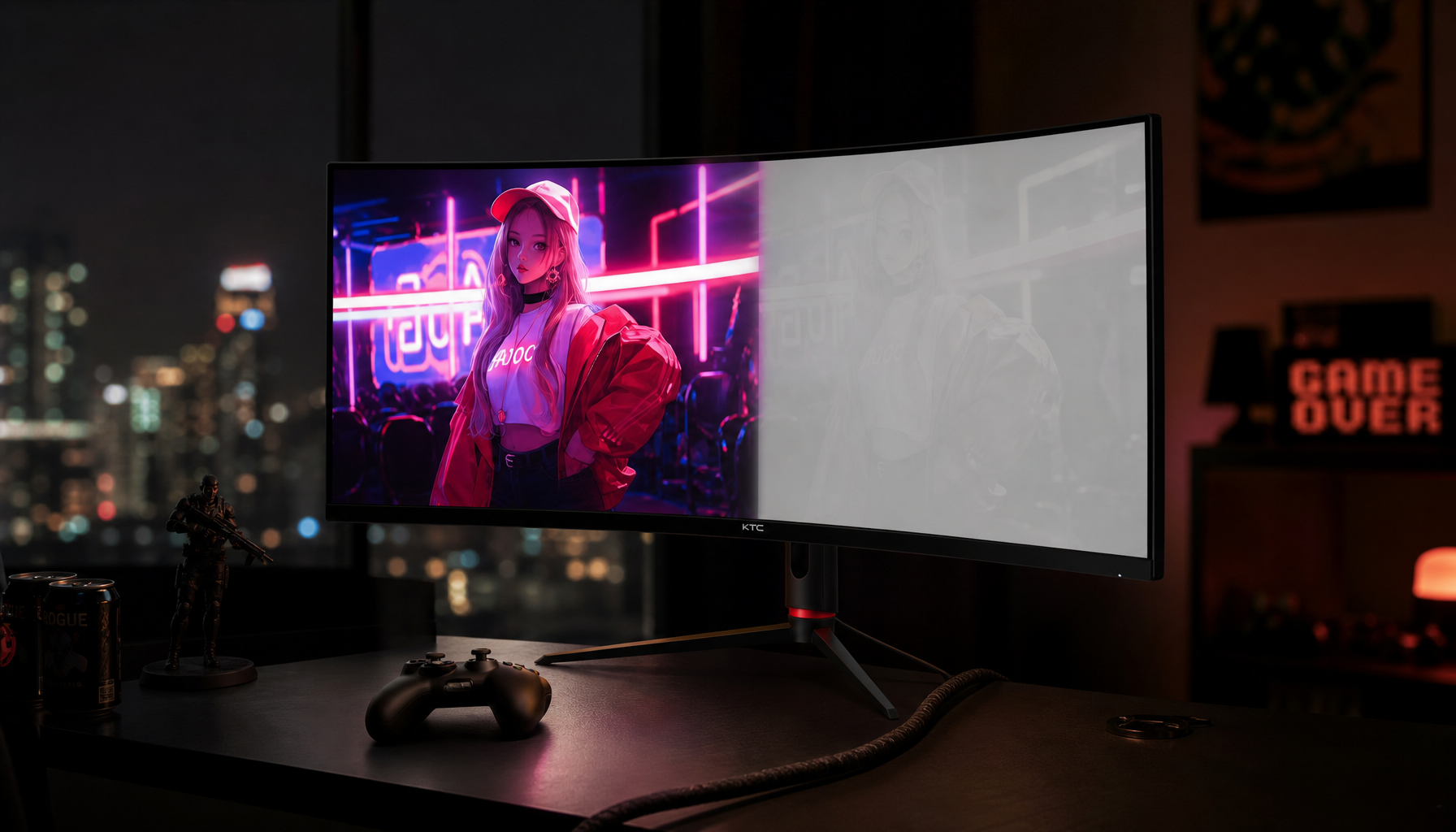
This is why a side monitor can feel less responsive than the main display even when both are connected by cable and running correctly. If the side panel is angled poorly, you may be seeing it outside its optimal viewing zone. Outside that zone, a screen can look dimmer, washed out, color-shifted, or lower in contrast, which makes feedback less decisive.
Place a dark-themed code editor or tactical shooter on the far edge of a large flat monitor. From a centered seat, the screen edge is already viewed at a sharper angle than the middle. If the panel loses contrast off-axis, the pointer trail, enemy outline, or caret movement may appear softer at the edge. The action did not arrive later; it arrived with weaker evidence.
Panel Type: TN, IPS, VA, and OLED Trade-Offs
Panel technology is the biggest hardware factor in how forgiving a monitor feels from imperfect angles. TN panels have historically been valued for speed, but they also tend to show the most obvious off-axis color and brightness shifts. IPS panels usually hold image consistency better from the sides. VA panels often deliver stronger contrast but can show more side-view washout than IPS and may show dark-transition trailing on some models. OLED usually performs very well off-axis because each pixel emits its own light.
Panel type is not a single-number verdict. IPS monitors generally maintain image consistency better when viewed off-center, while VA monitors usually have stronger contrast. Panel type alone does not determine input lag. A fast TN or VA monitor can feel excellent from the correct seat, while a wide-angle IPS can still feel wrong if it is misaligned, overprocessed, or running at the wrong refresh rate.
Panel type |
Viewing-angle behavior |
Responsiveness feel |
Best fit |
TN |
Narrower, with more visible color and brightness shifts |
Can feel very fast when viewed straight on |
Budget esports setups with a fixed seating position |
IPS |
Strong off-axis consistency and color stability |
Often feels steady across wider desks and multi-monitor layouts |
Gaming plus work, shared screens, content creation |
VA |
Better contrast than IPS, usually wider than TN but less consistent than IPS from the side |
Can feel immersive, though dark trails may affect motion perception |
Dark-room gaming, movies, mixed productivity |
OLED |
Very strong angle performance and fast pixel behavior |
Often feels highly immediate when refresh and processing are well tuned |
Premium gaming, HDR, visual immersion |

For a single-player ultrawide or mixed work-and-play desk, IPS, OLED, or a well-tuned VA display usually creates a more stable feedback loop across the screen. For a locked-in competitive station where you sit dead center, TN’s viewing-angle weakness may matter less than refresh rate, response tuning, and latency.
Refresh Rate and Motion Clarity Still Matter
Viewing angle can distort feedback, but it is only one part of perceived responsiveness. Refresh rate, pixel response, overdrive behavior, VRR stability, and motion blur all shape how quickly your eyes can verify action. A 60Hz monitor updates every 16.67 ms, while a 144Hz monitor updates about every 6.94 ms, so higher refresh rates reduce the time between possible visual updates.
Sample-and-hold displays create perceived blur because the eye tracks motion while each frame stays visible until the next refresh. That means a monitor can have a low gray-to-gray response number and still look blurry if refresh rate and motion presentation are weak. If you combine that blur with poor viewing angle, the effect compounds: softer motion plus weaker contrast makes feedback feel slower.
For a practical test, open a scrolling text window, a cursor-speed test, or a motion test. Sit centered first, then move to the side or raise and lower your head. If the moving object does not arrive later but becomes dimmer, more smeared, or harder to separate from the background, you are seeing visual feedback distortion rather than pure input lag.
Desk Geometry on Large and Ultrawide Displays

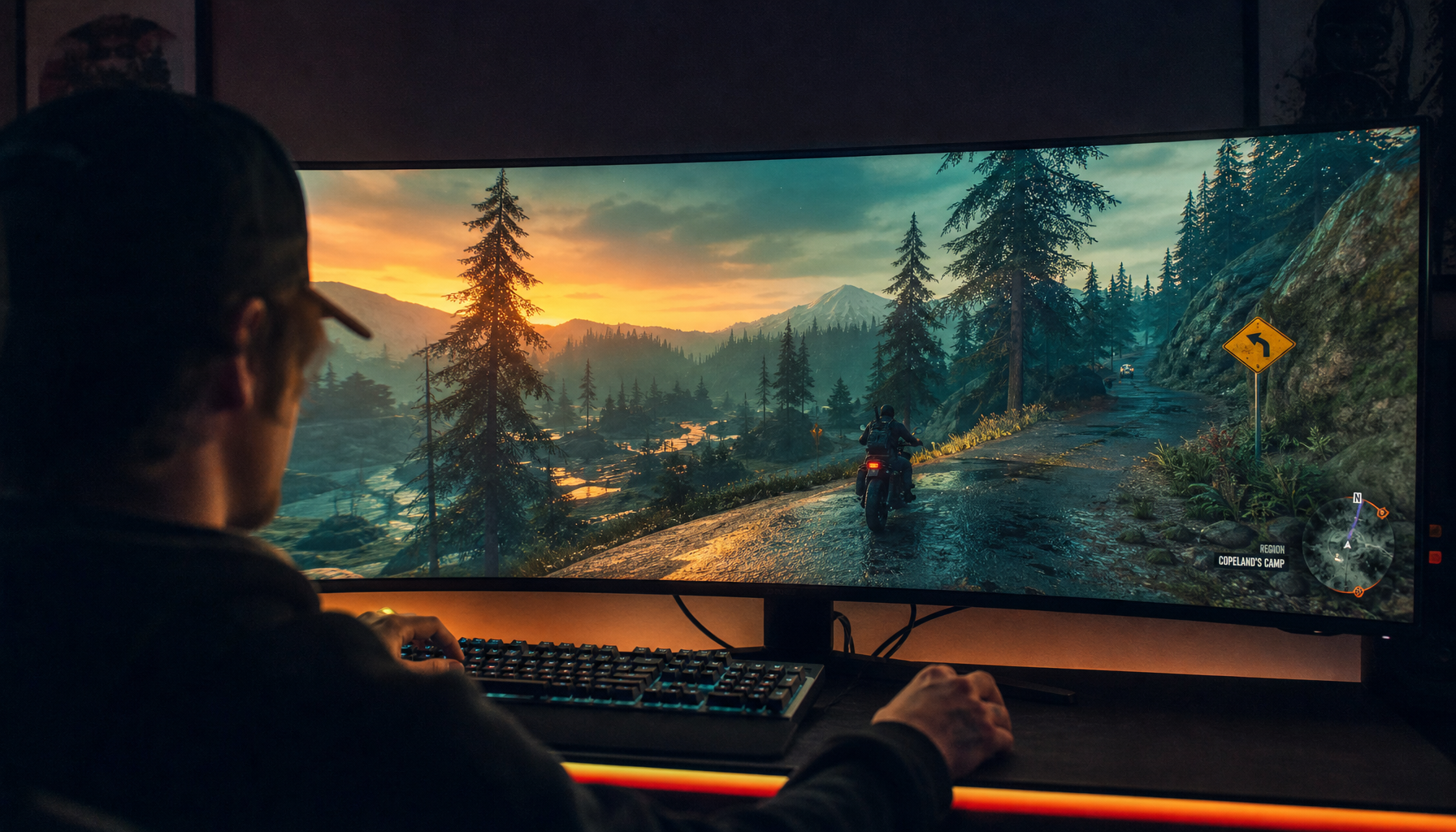
Large monitors create viewing-angle challenges even when you sit correctly. On a 32-inch flat display, the edges are physically farther from your eyes and viewed at a sharper angle than the center. On a 49-inch super-ultrawide, the far edges can feel like separate displays unless the panel is curved or your seating distance is increased.
Wide viewing angles matter because they preserve clarity, contrast, brightness, and color accuracy across multiple positions. In a gaming cockpit, trading desk, editing bay, or home office command center, the outer portions of the screen carry maps, chat, timelines, scopes, calendars, tool palettes, and system alerts. If those zones are washed out, your reaction time becomes less confident.
A useful setup rule is to aim the screen’s centerline toward your face. For dual monitors, angle each display inward so the center of each panel faces you. For ultrawide monitors, sit far enough back that you can scan the full width without turning your head sharply. For portable smart screens, avoid laying the panel too flat on a desk; a shallow vertical angle can create vertical viewing distortion that makes touch, cursor, and text feedback feel less crisp.
Gaming Scenarios: Why Aim Can Feel Off From the Wrong Seat

In gaming, perceived input lag is often delayed recognition. A washed-out enemy silhouette, softened health-bar change, or dim muzzle flash makes the game feel less responsive because your eyes need more time to confirm state. This is most obvious in fast shooters, racing games, rhythm games, and competitive titles where small visual changes drive timing.
A fast refresh display can reduce the gap between input and visible updates because higher refresh rates show more frames per second. But if you are viewing from a poor angle, the extra frames may not feel as useful because their content is less legible. Speed and visual integrity have to work together.
The most reliable gaming setup is direct viewing, native resolution, the highest stable refresh rate your system can sustain, low-latency mode where appropriate, and minimal image processing. On TVs, Game Mode often helps because it reduces extra processing. On monitors, avoid modes that add heavy sharpening, frame interpolation, dynamic contrast artifacts, or unnecessary scaling if they make motion feedback less predictable.
Office and Productivity Scenarios: Cursor Lag, Text Drag, and Side-Screen Fatigue
For productivity, viewing-angle distortion often shows up as cursor uncertainty rather than obvious gaming lag. You move the mouse to a side display, and the pointer seems less crisp. You scroll a spreadsheet, and row movement feels slightly harder to follow. You drag a window to the edge of a wide display, and the title bar looks less solid than it does in the middle.
A productivity monitor should support clearer visuals, screen space, ergonomic positioning, and flexible connectivity. Higher resolution improves text and image sharpness during long work sessions, but resolution cannot rescue a poor viewing angle. A 4K side monitor angled away from you can feel less precise than a lower-resolution screen aimed correctly.
For workstations, align the monitor you use most directly in front of you. Put secondary screens at a gentle inward angle rather than flat across the desk. Raise each display so your eyes meet the upper-middle area naturally, then tilt slightly upward or downward until whites and grays look even from top to bottom. If a portable USB-C screen is used beside a laptop, match its angle to your face instead of matching the laptop lid angle for symmetry.
How to Diagnose the Problem Without Special Gear
Start with a center-versus-edge comparison. Display a dark image with fine text, a medium-gray window, and a moving cursor. Sit normally and compare the center, corners, and side edges. If the cursor looks sharp in the middle but weaker near the edge, viewing geometry is part of the problem.
Next, perform a head-height check. Move your head a few inches up and down while watching the same content. TN panels often reveal vertical viewing-angle weakness quickly, while IPS and OLED are usually more tolerant. VA panels may preserve dark contrast well from the front but lose some consistency from side angles depending on the model.
Then test motion. Scroll text slowly, pan a game camera, or drag a white window across a dark background. If the motion looks clearer from one seat than another, the issue is not just latency. It is the quality of the visual feedback path from the panel to your eyes.
Practical Fixes That Improve Perceived Responsiveness

The first fix is physical alignment. Put your primary gaming or work area at the center of the display, not at the edge. If you use an ultrawide, place the game’s crosshair, spreadsheet focus area, or editing timeline where your eyes naturally face. For side monitors, angle them inward so the screen plane is closer to perpendicular to your line of sight.
The second fix is panel selection. Choose IPS or OLED when you need stable side viewing, shared viewing, multi-monitor work, or color-sensitive tasks. Choose VA when deeper blacks and immersive contrast matter more than perfect off-axis consistency. Choose TN only when the use case is centered, speed-driven, and cost-sensitive.
The third fix is refresh and motion tuning. Run the display at its highest useful refresh rate, use a wired connection, disable unnecessary processing, and tune overdrive conservatively. Aggressive overdrive can create inverse ghosting, which is another form of misleading feedback. A cleaner 144Hz image can feel better than a messy high-refresh mode with artifacts.
The fourth fix is lighting. Glare exaggerates viewing-angle problems because reflections reduce contrast before the panel’s own off-axis loss even enters the picture. Anti-glare coatings, brightness, and reflection handling are important selection criteria for well-lit spaces.
Pros and Cons of Prioritizing Wide Viewing Angles
Prioritizing wide viewing angles gives you more consistent feedback across a desk, better collaboration, easier multi-monitor placement, and less posture correction during long sessions. It also supports immersive displays, portable screens, and hybrid gaming-work setups where you do not always sit perfectly still.
The trade-off is that wide-angle performance is not the only performance metric. Some IPS monitors have weaker contrast than VA alternatives. Some OLED monitors cost more and may require care around static desktop elements. Some fast TN displays still appeal to competitive players who sit centered and value price-to-speed efficiency. The right decision is not wide angle at all costs; it is matching the panel to your seat, screen size, content, and speed target.
Buying Guidance for Gaming, Office, and Portable Screens
For competitive gaming, start with refresh rate, tested input latency, motion clarity, and a centered seating position. If you use a large panel, sit farther back or choose a curve that keeps the edges visually closer to your line of sight. If you also stream, edit, or use a second viewer position, IPS or OLED becomes more valuable.
For productivity, prioritize ergonomics, text clarity, USB-C or KVM features if your workflow needs them, and stable viewing angles. A 27-inch 4K IPS monitor is often a strong balance for office work because it combines sharp text with forgiving viewing geometry. For wide spreadsheets or creative timelines, ultrawide can be excellent, but only if the panel and curve keep the sides readable.
For portable smart screens, viewing angle is mission-critical because the screen position changes constantly. A portable display used beside a laptop, on a hotel desk, or in a presentation setup should maintain brightness and contrast when tilted. If the panel looks different every time you adjust the stand, touch targets, cursor movement, and text review all feel less reliable.
FAQ
Can viewing angle add actual milliseconds of input lag?
Usually no. Viewing angle normally changes the image you perceive, not the monitor’s signal-processing time. It can still make the screen feel slower because degraded contrast, color, and motion edges delay visual confirmation.
Is IPS always better for low perceived lag?
Not always. IPS is usually better for off-axis consistency, but real responsiveness also depends on refresh rate, response tuning, input latency, overdrive behavior, and the individual monitor. A well-tuned VA, OLED, or even TN can feel faster in the right setup.
Why does my side monitor feel worse than my main monitor?
The most common causes are a sharper viewing angle, lower refresh rate, different panel type, mismatched scaling, or poorer brightness and contrast. Angle the side monitor toward your face first; it is the fastest no-cost test.
A monitor feels fast when the signal arrives quickly and the visual result is clean enough to trust instantly. Keep your primary action centered, choose a panel that holds up from your real viewing position, and tune motion settings for clarity over marketing numbers. That is how a display stops feeling like a bottleneck and starts feeling like an extension of your hands.