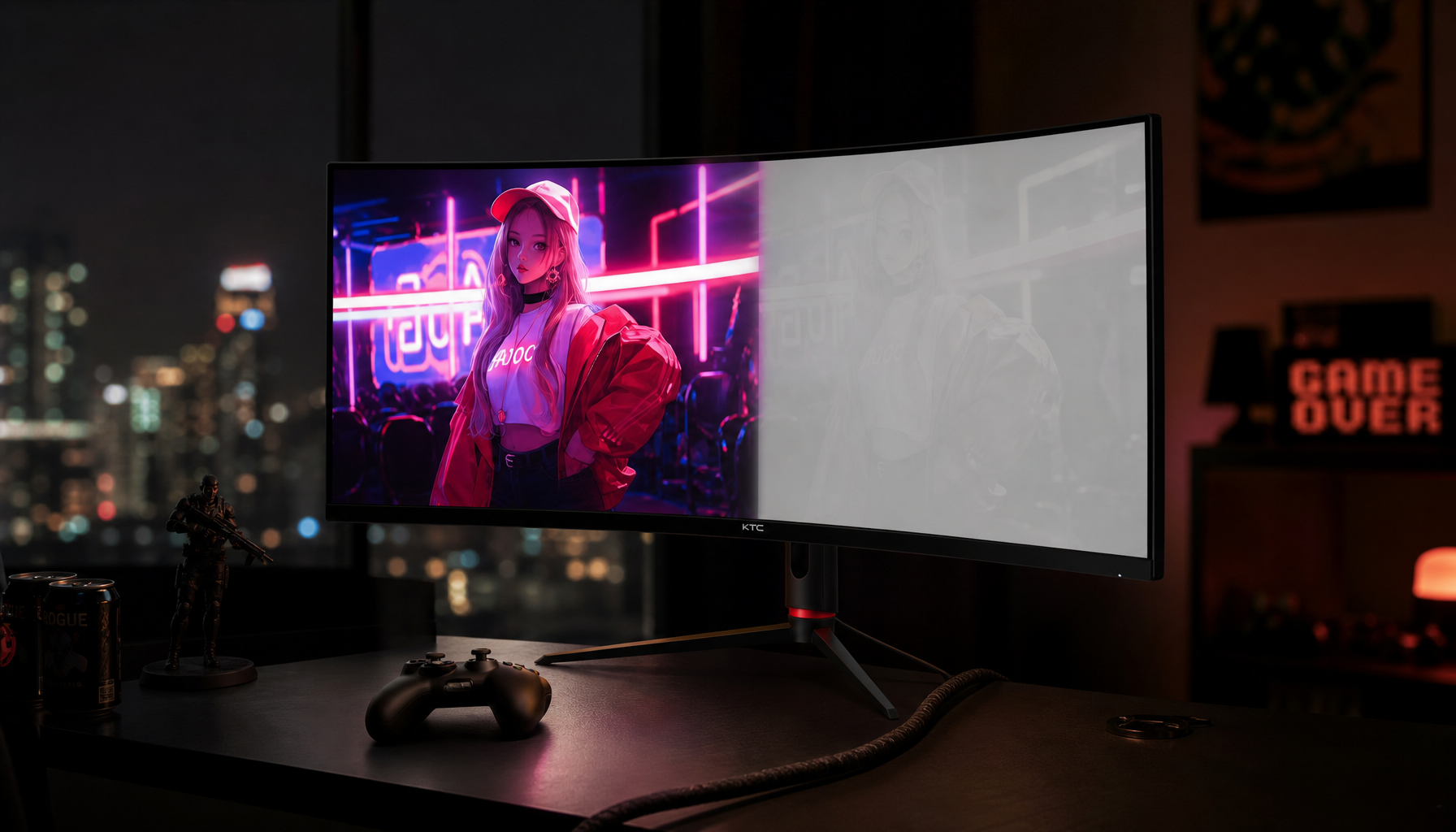
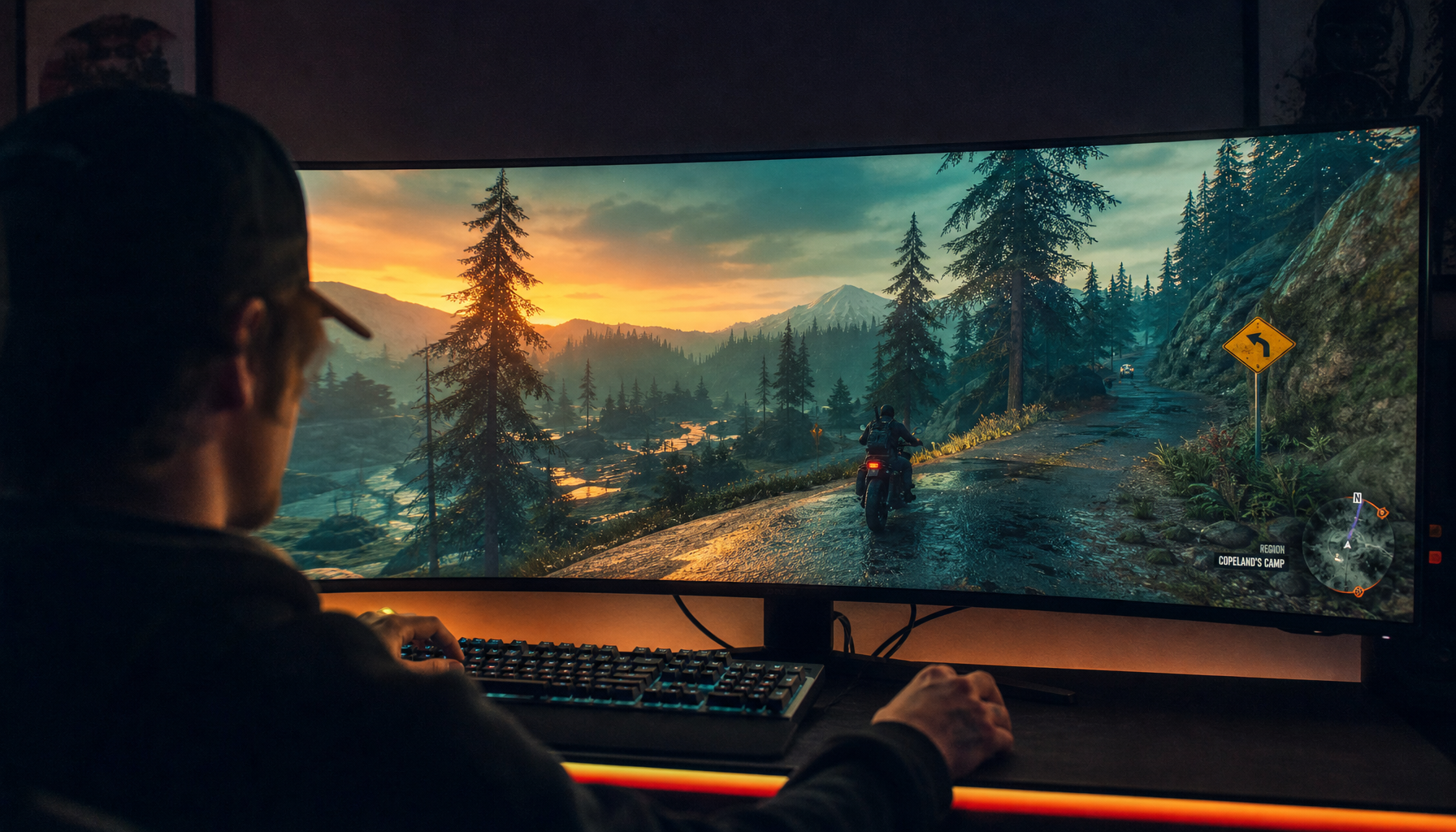
HDR does not make a monitor’s pixels faster, but it can make motion look clearer or messier by changing brightness, contrast, highlights, and eye comfort. In fast games, sports, and action footage, the result depends on HDR quality, refresh rate, response behavior, local dimming, and room lighting.
HDR Changes Visibility, Not Pixel Speed
HDR, or high dynamic range, expands the range between dark and bright image detail. Good HDR also uses wider color and higher bit depth than standard SDR. A monitor with real HDR can show brighter highlights, deeper-looking shadows, and smoother gradients, but HDR support alone does not guarantee better picture quality.
That distinction matters for motion blur. Blur is often caused by sample-and-hold display behavior, pixel response limits, frame rate, refresh rate, or motion processing. HDR does not rewrite those physical limits. A 144 Hz monitor still refreshes about every 6.9 milliseconds, and if the panel has slow dark transitions, HDR will not erase trails.
What HDR can do is change how easily your eyes separate moving edges. In a racing game at night, SDR may flatten a glowing brake light, the dark road, and the car body into a smaller contrast range. Good HDR can keep those regions more distinct, so the same motion feels easier to read. Poor HDR can do the opposite by clipping highlights, crushing blacks, or shifting brightness during motion.
Why HDR Can Make Fast Motion Look Clearer
Motion clarity is not only about milliseconds. It is also about edge contrast. Your eyes track moving objects by locking onto borders, shapes, luminance changes, and color separation. HDR improves perceived clarity when it gives those cues more room to stand out.
A practical example is a first-person shooter with muzzle flashes in a dark hallway. On a capable HDR monitor, the flash can look bright without erasing the enemy outline next to it. That makes target tracking feel cleaner even if the panel’s rated response time has not changed. A technical discussion of HDR frames dynamic range as the span between dark and bright luminance levels, where each “stop” doubles light energy, which helps explain why brighter highlights can coexist with visible shadow detail on better displays.
HDR can also help in sports and racing content. A sunny white jersey crossing a shaded background, reflective bodywork passing under stadium lights, or a hockey puck moving across ice all depend on contrast separation. When tone mapping is stable, HDR can keep bright objects from merging into the background.
Why HDR Can Make Blur Feel Worse
HDR can also make motion blur more noticeable because it increases contrast. A bright object moving across a dark background reveals ghosting more clearly than a low-contrast SDR image. If a VA panel has dark-level smearing, HDR night scenes may expose it. If overdrive is too aggressive, bright halos can become easier to spot around moving objects.
Response-time marketing is part of the trap. A “1 ms” label may refer to GTG or MPRT, and those measure different things. GTG describes pixel transition speed, while MPRT describes how long an image remains visible to the eye; 1 ms MPRT usually requires backlight strobing or black-frame insertion, which can reduce brightness and introduce flicker.
That creates a direct HDR trade-off. HDR needs brightness headroom. Motion blur reduction modes often reduce brightness. If your monitor loses 30% to 50% of peak brightness when strobing is enabled, HDR impact can collapse, especially in highlights. For competitive play, that may still be worth it. For cinematic gaming, it often is not.
Setting or Feature |
Motion Benefit |
HDR Trade-Off |
Higher refresh rate |
Smoother tracking and lower persistence blur |
Usually positive if bandwidth supports HDR |
Strong GTG response |
Less ghosting and cleaner edges |
Positive, especially in high-contrast HDR scenes |
Backlight strobing or BFI |
Lower perceived blur |
Lower brightness, possible flicker, weaker HDR punch |
Aggressive overdrive |
Faster transitions |
Can create inverse ghosting around bright HDR objects |
Local dimming |
Better HDR contrast |
May cause haloing or brightness shifts in motion |

HDR, Flicker, and Eye Comfort During Motion
Some blur-reduction technologies fight sample-and-hold blur by adding darkness between frames. That can sharpen motion, but it can also introduce flicker. Research on photosensitive epilepsy guidance notes that modern displays have new flicker sources, including PWM dimming, black-frame insertion, scanning backlights, and gaming motion-reduction modes; modern digital displays can create risks and discomfort patterns that older CRT-focused guidance did not fully anticipate.
For most users, the practical issue is fatigue rather than seizure risk. If fast HDR content looks crisp for 15 minutes but your eyes feel strained after an hour, the setup is not performing well for you. This is especially relevant on OLED and some portable displays that may use PWM dimming at lower brightness. Lowering brightness can make flicker more visible on some screens, while raising brightness too much can make motion feel harsh in a normal room.

A good test is simple: play a familiar fast scene for 10 minutes with HDR on, then repeat with HDR off at a comfortable SDR brightness. If HDR looks more detailed but your eyes work harder to follow movement, reduce peak brightness, disable strobing, or switch to a less aggressive game mode.
Tone Mapping Can Change Motion Perception
HDR monitors must adapt content to their own limits. If a game is mastered for 1,000 nits and your monitor peaks at 600 nits, tone mapping decides what gets preserved and what gets compressed. Done well, fast highlights retain detail. Done poorly, moving lights can clip into flat white shapes, making their edges harder to judge.
This is why simulated HDR modes are risky. Fake HDR effects can make images too bright, washed out, or inaccurate because they do not use real HDR metadata. In motion, that can reduce useful contrast instead of improving it.
Desktop users should also be selective. HDR is often best enabled for actual HDR games or video, not necessarily for all-day desktop work. For office use, SDR at a balanced brightness often gives cleaner text motion while scrolling spreadsheets, documents, and dashboards.
Fast Gaming: Should You Use HDR?
For competitive shooters, prioritize refresh rate, stable frame pacing, strong pixel response, and low input lag first. HDR is a bonus only if it does not compromise those fundamentals. A 240 Hz SDR mode with clean response can feel more responsive than a 144 Hz HDR mode with messy tone mapping or visible smearing.
For cinematic AAA games, HDR is often worth enabling when the monitor has strong contrast, enough brightness, and competent tone mapping. Open-world games, racing titles, sci-fi scenes, and night environments benefit most because HDR enhances depth and highlight detail.

For esports, use HDR only after testing visibility. If an enemy outline, crosshair, health bar, or dark corner becomes less readable, turn HDR off or adjust in-game HDR calibration. Winning the scene matters more than admiring the scene.
Office Displays and Portable Smart Screens
HDR on an office monitor is different from HDR on a gaming display. Productivity motion is usually scrolling, cursor movement, window dragging, video calls, and occasional playback. In those cases, overly bright HDR can make white backgrounds harsh and make scrolling feel less comfortable over long sessions.
Portable monitors add another variable: ambient light. Dynamic contrast and high-brightness modes can help in cafes, airports, and hotel rooms, but Dynamic Contrast Ratio is not the same as HDR. DCR changes backlight behavior based on content, while HDR depends on HDR content, wider color, brightness range, and tone mapping. DCR can add visual pop, but it may shift colors or cause halo effects around bright objects.
For a portable smart screen, use HDR for video or console gaming when plugged into power and sitting in controlled light. For document work, coding, or spreadsheet scrolling, a balanced SDR mode is usually more reliable.
Practical Tuning for Cleaner HDR Motion
Start with the monitor’s true performance mode, not the most vivid preset. Game mode often reduces processing delay, while vivid modes can oversaturate colors and exaggerate highlight clipping. Display presets commonly change brightness, contrast, color temperature, sharpness, refresh behavior, and blue-light filtering, and the right display mode should match the task rather than maximize every slider.
Then calibrate HDR at the system and game level. Set black level so dark detail is visible without turning blacks gray. Set peak white so bright test patterns remain distinct instead of becoming a solid block. If your game has separate paper-white and peak-brightness controls, lower paper white first when the whole image feels harsh.
Use overdrive carefully. The fastest setting often looks impressive in a static spec sheet but can create bright inverse ghosting in HDR. The middle overdrive setting is commonly the better real-world choice because it balances transition speed and artifact control.
Finally, match brightness to the room. If the screen looks dramatically brighter than the wall behind it, long-session motion may feel tiring. If reflections overpower dark scenes, raise brightness modestly or fix the lighting before blaming response time.
What to Look For When Buying
If HDR motion clarity matters, shop for the whole motion pipeline. Look for a high refresh rate, proven response performance, real HDR brightness, strong contrast, useful local dimming or OLED-level blacks, and reviews that test motion artifacts instead of only quoting manufacturer response numbers.
A 27-inch 1440p high-refresh monitor is still a strong value point for many gamers because it balances sharpness, frame rate, and desk comfort. Larger 4K and ultrawide displays can be more immersive, especially for racing, RPGs, flight sims, creative work, and multitasking, but they demand more GPU power to maintain high frame rates. General monitor buying guidance keeps returning to the same principle: choose around actual use, because gaming needs refresh rate and response behavior, while productivity needs clarity, ergonomics, and readable contrast.
HDR can make fast motion more readable, more dramatic, and more immersive, but only when the display has the speed and contrast control to keep up. Treat HDR as an image-quality amplifier: on a strong monitor it reveals detail; on a weak one it reveals the monitor’s limits. For the best result, tune HDR for visibility first and spectacle second.