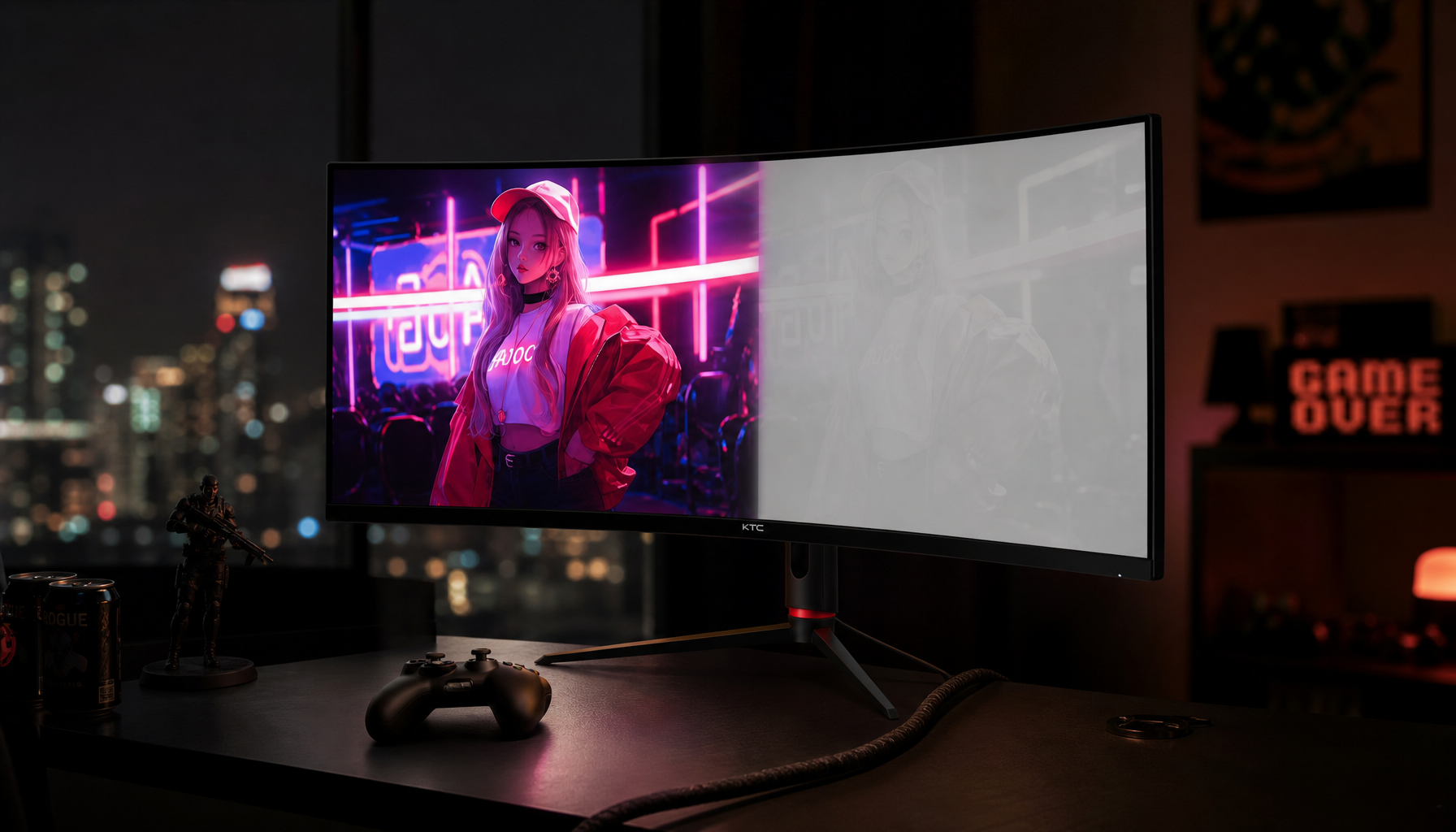
Content contrast ratio pushes a local dimming system to decide how deeply it should darken shadow zones while preserving bright highlights. The wider the bright-to-dark separation in a scene, the more likely you are to see either impressive HDR depth or artifacts such as blooming, black crush, and brightness pumping.
Ever notice a game menu look punchy, then a night scene with a bright HUD suddenly glows, flickers, or hides shadow detail? A practical tuning pass can usually reveal whether the monitor should run local dimming on low, medium, high, or off for your content mix. You will learn what the display is reacting to and how to choose settings that protect both immersion and visibility.
What Content Contrast Ratio Means
Contrast ratio is the relationship between the brightest white and darkest black a display can produce; a 1,000:1 monitor means white is 1,000 times brighter than black. In real viewing, content contrast ratio means the contrast inside the actual frame: a white cursor on a black desktop, subtitles over a dark movie, a sunlit window in a dim game corridor, or a bright spreadsheet on a gray background.
That distinction matters because local dimming is content-reactive. An LCD panel does not emit light by itself, so LCD panels rely on LED backlights shining through the liquid crystal layer. Local dimming divides that backlight into zones and changes their brightness in real time. When the image has a low content contrast ratio, such as an email window, the system can keep zones relatively even. When the frame has a high content contrast ratio, such as a torch in a cave, the algorithm has to decide whether to make the cave darker, the torch brighter, or both.

A simple example makes this clear. A monitor showing a full-screen document might have most of the screen sitting around mid-to-high brightness, so aggressive dimming adds little. A movie scene with a tiny 1,000-nit highlight against near-black surroundings gives the dimming engine a much harder job: one zone wants to be bright, nearby zones want to be nearly off, and the LCD layer still leaks some light.
Why High-Contrast Content Makes Local Dimming More Aggressive
Local dimming becomes more aggressive when the scene asks for deep blacks and bright highlights at the same time. The algorithm looks at zone brightness targets, average picture level, motion, highlight size, and often HDR metadata. If the scene is mostly dark with small bright objects, the monitor may dim surrounding zones strongly to lower black levels while boosting the highlight zone.
That is the core appeal of Mini LED and full-array local dimming. Global dimming adjusts the whole screen at once, while local dimming allows bright and dark areas to be controlled at the same time. Full-array designs can deliver far stronger simultaneous contrast than basic global dimming, but they also add processing, heat, circuitry, and cost.
In practice, high-contrast content exposes the monitor’s priorities. A conservative algorithm protects shadow detail and reduces haloing, but blacks may look elevated. An aggressive algorithm creates deeper blacks and stronger HDR pop, but it may crush near-black details or create visible glow around bright objects.
A Gaming Example
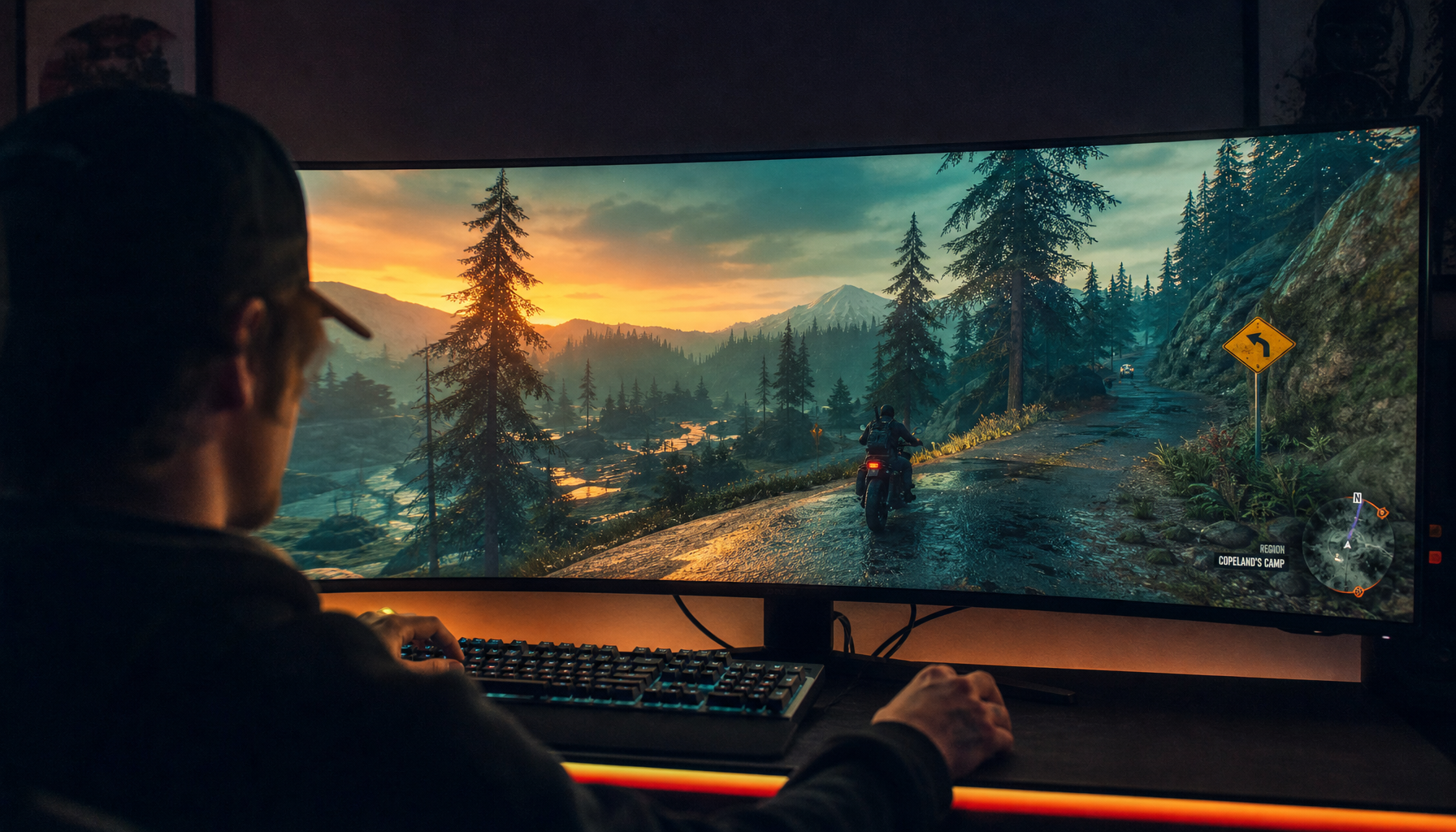
Imagine a competitive shooter map with a dark hallway and a bright doorway at the end. On a mild local dimming setting, the hallway stays readable, but the scene may look flatter. On a high setting, the doorway looks more intense and the hallway gets darker, which feels more cinematic but can hide an opponent standing in shadow. For competitive play, consistent visibility often beats dramatic contrast. For single-player HDR, the aggressive mode may be the better experience.

Native Contrast Sets the Floor
Local dimming does not erase the panel’s native contrast limits. It builds on them. IPS panels often have weaker native black depth than VA panels, while OLED avoids this backlight problem because pixels can shut off individually. That is why two Mini LED monitors with similar zone counts can behave differently in dark scenes.
Static contrast is usually the more trustworthy baseline than dynamic contrast because it measures bright and dark output under fixed conditions. Dynamic contrast numbers can look huge because they compare different brightness states over time, not necessarily black and white in the same frame. A claimed million-to-one ratio may sound dominant, but it does not guarantee clean local dimming in a starfield, game HUD, or movie subtitle test.
Ambient light also changes the result. Ambient contrast performance can fall sharply when room light reflects off the screen and lifts perceived blacks. A monitor that looks dramatic at night may look washed out in a bright office. For productivity displays and portable smart screens, surface coating, reflection control, and room placement can matter as much as the dimming menu.
Zone Count Helps, but It Is Not the Whole Story
More zones usually give the backlight finer control, especially around small highlights. A 1,152-zone Mini LED monitor can isolate a bright window better than an edge-lit display with a handful of vertical zones. Still, zone count alone does not determine quality. The algorithm, processor speed, panel leakage, diffuser design, firmware, brightness limits, and response behavior all shape the final image.
Blooming happens when light from a bright dimming zone spills into nearby dark areas, and cited research found that suppressing blooming below human perception required far more zones on lower-contrast LCDs than on higher-contrast LCDs. That is the nuance buyers often miss: a panel with stronger native contrast needs less help from the backlight, while a weaker panel may need many more zones to achieve similar halo control.
Here is the practical relationship:
Content Type |
Content Contrast |
Likely Dimming Behavior |
Best User Priority |
Spreadsheets, coding, web pages |
Low to moderate |
Mild zone changes |
Text clarity and stable brightness |
Dark games with bright HUDs |
High |
Strong dimming near shadows and highlights |
Balance visibility against HDR impact |
Movies with subtitles |
High localized contrast |
Dark zones plus bright subtitle zones |
Reduce blooming and subtitle glow |
HDR demo scenes and starfields |
Very high |
Maximum zone separation |
Test for haloing, crush, and flicker |
Photo and video editing |
Scene-dependent |
Can change tonal judgment |
Accuracy and repeatability |
How Aggressiveness Shows Up on Screen
The best local dimming looks invisible. Blacks deepen, highlights gain intensity, and the image feels more dimensional without drawing attention to the backlight. Weak implementations announce themselves through artifacts.
Blooming is the most familiar artifact. It appears as a glow around bright objects on dark backgrounds, especially subtitles, cursors, stars, crosshairs, and small UI elements. Black crush is the opposite failure: the monitor dims too hard and hides shadow texture. Brightness pumping happens when the image visibly rises or falls in brightness as the scene changes. Light trails can appear when a bright object moves and the backlight zones lag behind.

The content contrast ratio drives all of these. A bright full-screen hockey rink does not challenge the dimming engine the same way a white mouse pointer on a black desktop does. The first scene asks for high brightness across much of the screen. The second asks for a tiny bright object surrounded by darkness, which is exactly where zone boundaries become visible.
How to Tune Local Dimming for Real Use
Start by matching the setting to the job. For office productivity, writing, coding, and dashboards, local dimming can be unnecessary or even distracting because large white windows and dark UI panels can cause uneven brightness. A stable SDR mode with sensible brightness is usually more reliable for long sessions.
For HDR gaming, begin with the monitor’s recommended HDR mode and local dimming at a medium level if available. Mini LED guidance emphasizes choosing local dimming and HDR settings based on the monitor mode and content, and Mini LED monitors often expose multiple dimming strengths for that reason. Use a dark game scene with a bright HUD, a night sky, and a flashlight or doorway. If enemies disappear into shadows, lower the dimming level or adjust gamma. If blacks look gray and HDR lacks punch, raise dimming one step.
For movies, test subtitles. White subtitles on a black letterbox are a fast way to judge halo control. If the glow is distracting, reduce local dimming aggressiveness, lower peak brightness, or use a subtitle style with lower brightness if your player allows it.

For creative work, be careful. Local dimming can improve perceived contrast, but it can also change how dark tones and highlights appear from frame to frame. Photo editing, color grading, and UI design benefit from predictable luminance. Use local dimming only when the target output is HDR viewing, and verify important work with calibrated settings.
Pros and Cons of Aggressive Local Dimming
Aggressive local dimming can make an LCD feel dramatically more immersive. It lowers black levels, increases perceived depth, strengthens HDR highlights, and gives games and movies the visual separation that standard edge-lit monitors struggle to deliver. For a high-brightness Mini LED gaming monitor, this is often the reason to buy the panel in the first place.
The tradeoff is control. High aggressiveness can create halos, dim small highlights, hide shadow detail, or make desktop brightness feel unstable. It can also make two monitors with the same advertised contrast ratio feel completely different. That is why static contrast, local dimming quality, firmware maturity, and real scene behavior matter more than a single spec-sheet number.
Buying and Setup Guidance
If you are buying for immersive HDR gaming, prioritize a well-reviewed full-array or Mini LED implementation over headline dynamic contrast claims. Look for user controls that let you choose local dimming strength, because one setting rarely works for every use case. A mode that looks great in a dark RPG may be too aggressive for competitive shooters or office work.
If you are buying for office productivity or travel, do not overpay for local dimming unless HDR media is part of your routine. A clean 1,000:1 to 3,000:1 static contrast display with good coating, stable brightness, and sharp text can feel better for everyday work than a flashy dimming system that pulses behind documents.
If you already own the monitor, run three quick checks: a dark movie scene with subtitles, a game scene with bright HUD elements, and a full-screen white document beside a dark window. When the same setting handles all three without glow, crush, or pumping that bothers you, you have found the usable balance.
FAQ
Does Higher Content Contrast Always Mean Better HDR?
No. High content contrast gives HDR more room to impress, but the monitor has to control that contrast cleanly. A weak local dimming system can turn high-contrast content into blooming, crushed blacks, or unstable brightness.
Should Local Dimming Be On for Desktop Work?
Usually only if the implementation is subtle. For spreadsheets, browsers, code editors, and writing apps, aggressive local dimming often adds uneven brightness without a meaningful benefit.
Is OLED Better Because It Has No Local Dimming Zones?
For black levels and pixel-level contrast, yes. OLED can turn pixels off individually, so it avoids zone blooming. Mini LED LCDs can still be compelling when you want very high brightness, strong HDR impact, and no OLED burn-in concern.
Local dimming aggressiveness is not a magic “more is better” slider. It is a negotiation between the scene’s contrast, the panel’s native black level, the zone layout, and the algorithm’s priorities. For the best experience, tune it around the content you actually use: stable for work, balanced for competitive play, and more assertive when cinematic HDR is the goal.