Ultra-high refresh rates mainly improve what the creator feels locally: smoother motion, lower display delay, cleaner tracking, and more responsive controls. They do not automatically make a livestream or exported video smoother if the final output is still 30 FPS or 60 FPS.
Ever played smoothly on a 240Hz gaming monitor, then watched your stream recording and wondered why viewers did not see the same fluidity? The useful gain is usually on the creator side: a 60Hz display refreshes every 16.67 ms, while 144Hz refreshes about every 6.94 ms, which can make aiming, cursor movement, scrolling, and timeline work feel noticeably more immediate. This guide explains where high-refresh monitors actually help streaming and creation workflows, and where resolution, color, ports, or screen space matter more.
What Ultra-High Refresh Rates Actually Change
A monitor’s refresh rate is how many times per second the screen updates; a 60 Hz display updates 60 times each second. In practical monitor buying terms, 120Hz and 144Hz are now mainstream high-refresh options, 240Hz is common among competitive gaming displays, and 360Hz or higher is aimed at serious esports and latency-sensitive players.
The biggest everyday jump is usually from 60Hz to 120Hz or 144Hz. At 60Hz, the screen refresh interval is 16.67 ms; at 144Hz, it is about 6.94 ms. That means the display can show newer visual information nearly 10 ms sooner in ideal timing conditions, while moving from 144Hz to 240Hz reduces the interval from 6.94 ms to 4.17 ms, a smaller 2.77 ms gain.
Refresh Rate, FPS, and Response Time Are Not the Same
Refresh rate belongs to the monitor. FPS belongs to the PC, console, game engine, editing software, or capture pipeline. Pixel response time describes how quickly pixels change from one state to another, so a high-refresh panel with poor response behavior can still show blur or smearing.
For streamers and creators, the practical rule is simple: your system must feed the monitor enough frames to make the refresh rate useful. If a game runs at 90 FPS on a 240Hz monitor, the display is still fast, but much of its capacity is unused. If a video timeline is 30 FPS, a 240Hz screen can make the interface feel smoother, but it will not create extra motion detail in the footage itself.
Where the Latency Benefit Comes From
Higher refresh rates do not make human reflexes faster; they provide fresher visual information and clearer motion sooner. Display-side delay is only one part of the chain, which also includes the mouse, USB polling, CPU, GPU queue, sync settings, cable path, monitor processing, and panel output input lag chain.

That distinction matters when buying a monitor for content work. A 240Hz display can make a creator’s hands and eyes feel more connected to the system, but a slow encoder, overloaded GPU, low-bitrate stream, or inaccurate color panel can still limit the final result.
How High Refresh Rates Affect Live Streaming
For live streaming, the monitor and the viewer output are two separate experiences. A streamer can play at 144Hz, 165Hz, or 240Hz locally while the livestream is delivered at 60 FPS, because most gameplay streams are still sent to viewers at 30 FPS or 60 FPS gameplay streams. The audience sees the encoded frame rate, not every refresh your monitor displays.
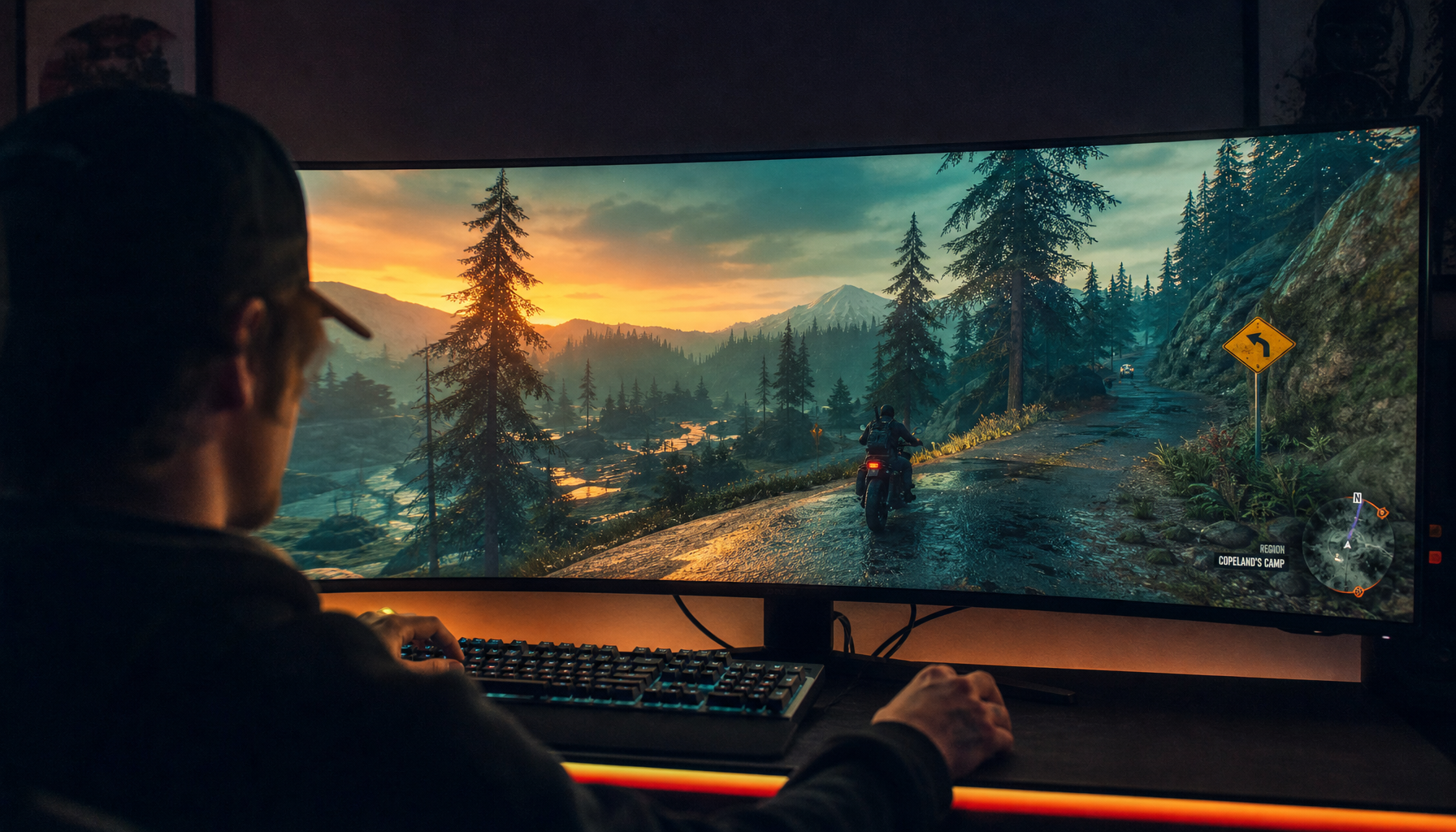
That does not make high refresh useless. For gameplay creators, local smoothness can improve tracking, camera control, recoil correction, and confidence while live. In a fast shooter, for example, a 144Hz monitor can make the creator’s movement and aiming feel cleaner even though the stream is still a 1080p60 output.
The Viewer Does Not See 144Hz or 240Hz
A common mistake is assuming that a 240Hz gaming monitor makes a stream look like 240 FPS. It does not. If the livestream is encoded and delivered at 60 FPS, viewers receive 60 frames per second.

A better way to think about it: the monitor affects the creator’s control surface, while the stream settings affect the audience. A 1440p 144Hz gaming monitor can be excellent for local play, but the output may still be best as a stable 1080p60 stream if the GPU and encoder need headroom stable 60 FPS output.
Frame Caps Can Improve Stream Stability
Ultra-high refresh monitors can tempt creators to let games run uncapped at 180 FPS, 220 FPS, or higher. That can backfire during live production because the GPU may spend too much effort rendering local frames and leave too little headroom for encoding, overlays, browser sources, alerts, and recording.
A practical streaming setup is to play on a 1440p 144Hz monitor, cap the game around 120 FPS or 141 FPS, and stream at 1080p60. This keeps motion responsive locally while reducing the chance of dropped frames, encoder overload, uneven frame pacing, or noisy recordings during action-heavy scenes.

Where Ultra-High Refresh Helps Content Creation
Ultra-high refresh displays are most helpful in creation workflows where the interface itself is constantly moving. Timeline scrubbing, fast cursor work, pen input, zooming around a canvas, scrolling through long documents, animating UI prototypes, and reviewing game capture all feel more fluid when the screen updates more often.
A company notes that higher refresh rates can improve responsiveness in games and make scrolling or digital pen input feel more natural more fluid and natural. For creators, that benefit shows up less as a final-quality boost and more as reduced friction: trimming clips feels tighter, cursor placement feels more precise, and motion review feels easier on the eyes.
Video Editing and Motion Graphics
For video editors, a 144Hz or 240Hz monitor can make the editing application feel smoother, especially when moving quickly through a dense timeline. It can also help when reviewing high-frame-rate gaming footage, screen recordings, or motion graphics intended for high-refresh playback.

However, most delivered video is still mastered at fixed frame rates such as 24 FPS, 30 FPS, or 60 FPS. A 240Hz monitor will not turn a 30 FPS export into a 240 FPS export. If the work is color grading, thumbnail design, talking-head editing, or brand review, color accuracy, panel consistency, resolution, and calibration usually matter more than the jump from 144Hz to 240Hz.
Design, Coding, and Multitasking
For mixed creator desks, high refresh can be useful, but it should not outrank basic workspace quality. A monitor setup for dense workflows should balance screen real estate, legibility, and ergonomics instead of simply maximizing refresh rate screen real estate.
A creator who edits video, writes scripts, manages chat, checks analytics, and monitors streaming software may benefit more from a clean dual-monitor layout than from one ultra-fast display. Give each screen a stable job: main gaming or editing monitor in front, secondary monitor for chat, notes, source folders, waveform scopes, or browser references.
Choosing the Right Monitor for Streaming and Creation
The best monitor choice depends on what actually bottlenecks your work. A competitive gameplay streamer has different needs from a video platform editor, a motion designer, a thumbnail designer, or a travel creator using a portable monitor.
If your workflow is game capture first, a 1440p 144Hz or 165Hz gaming monitor is often the practical sweet spot. If your workflow is editing and design first, a 27-inch 4K display or a color-accurate ultrawide may improve your daily output more than a 240Hz esports panel. If your desk is small or mobile, a portable monitor with reliable USB-C power and display support may be more valuable than a higher refresh ceiling.
Workflow Type |
Best Practical Refresh Rate |
Specs to Prioritize First |
Where Ultra-High Refresh Helps |
Main Tradeoff |
Gameplay streaming |
120Hz to 144Hz |
GPU headroom, 1080p60 output stability, VRR, fast response |
Smoother aiming, tracking, and camera control |
240Hz can strain rendering headroom if uncapped |
Competitive FPS streaming |
144Hz to 240Hz+ |
Low input lag, strong GPU, clean frame pacing |
Faster local visual updates and clearer motion |
Viewers still usually see 60 FPS |
Video editing |
60Hz to 144Hz |
Resolution, color accuracy, panel quality, ports |
Smoother timeline navigation and scrubbing |
Refresh does not improve final export smoothness |
Motion graphics and UI animation |
120Hz to 144Hz+ |
Accurate preview, CPU/GPU performance, resolution |
Easier motion review and cursor precision |
Software and footage frame rate may limit preview |
Thumbnail and design work |
60Hz to 120Hz |
Color accuracy, pixel density, uniformity |
Smoother zooming and canvas movement |
Color and sharpness matter more |
Dual-monitor creator desk |
120Hz to 144Hz primary |
Screen roles, desk depth, cable routing, scaling |
Stable play/edit screen plus support display |
Mismatched refresh rates may need tuning |
Portable creator setup |
60Hz to 120Hz |
USB-C, brightness, weight, stand quality |
Smoother field review and scrolling |
Battery and brightness can matter more |
Resolution Versus Refresh Rate
A 27-inch 1440p 144Hz monitor is a strong fit for streaming because it balances sharp gameplay, manageable GPU demand, and smooth local control. A 4K 144Hz monitor can look excellent, but pushing 4K gameplay, high refresh, recording, overlays, and live encoding at the same time can overload many systems.
For editors and designers, 4K can be more useful than 240Hz because it gives more workspace and clearer previews; the a brand 27” 4K 160Hz/1ms HDR400 Gaming Monitor, for example, is one way to compare a 27-inch 4K screen with a 160Hz ceiling against 240Hz-plus FHD options when creator work matters as much as esports speed. For coders, scriptwriters, and technical creators, a 27-inch 5K or 4K display can improve text clarity, but scaling needs to be tested carefully so menus, panels, and plug-ins remain readable.

Ultrawide and Dual-Monitor Setups
An ultrawide monitor can simplify a creator desk by putting the editor, preview, timeline, and asset browser on one large surface. A dual-monitor setup can be better for streamers because the main display can stay focused on the game or editing application while the second display holds streaming software, chat, alerts, recording controls, or notes.
The key is to avoid constantly moving windows around. A practical streaming desk might use a 27-inch 1440p 144Hz main monitor and a secondary 24-inch or 27-inch display for production tools. That layout often improves real workflow speed more than replacing the main screen with a 360Hz monitor while keeping a cramped support display.

Setup Details That Matter More Than the Spec Sheet
Buying the monitor is only part of the workflow. If the operating system, the GPU driver, the game, or the capture software is configured poorly, a high-refresh display can behave like a standard one or create avoidable production problems.
On a desktop operating system, refresh rate is set through Start > Settings > System > Display > Advanced display, and Dynamic Refresh Rate can automatically adjust refresh rate when the display supports VRR and is at least 120Hz Advanced display. After buying a high-refresh monitor, verify that the operating system is actually running it at the intended rate instead of leaving it at 60Hz.
Practical Setup Checklist
- Set the monitor to its advertised refresh rate in the operating system or your GPU control panel.
- Use the correct cable and port, such as DisplayPort or a USB-C display connection that supports the target resolution and refresh rate.
- Enable VRR or adaptive sync if your monitor, GPU, and workflow support it.
- Cap gameplay below the monitor ceiling when streaming, such as 120 FPS or 141 FPS on a 144Hz display.
- Stream at a stable output such as 1080p60 before increasing resolution or local frame rate.
- Assign each display a fixed job: gameplay or editing on the primary screen, chat and production controls on the second.
- Test a 20-minute recording before going live, then check for dropped frames, audio drift, stutter, and overheating.
Battery, Heat, and Portable Monitors
High refresh rates use more display power, which matters on laptops, tablets, and portable monitors. Lowering refresh rate can save battery by reducing display energy use save battery power.
For travel creators, a portable 120Hz monitor can be useful for smoother review and editing, but brightness, stand stability, USB-C reliability, and color quality may matter more on the road. A portable display that drains a laptop quickly or needs awkward cabling can slow down a shoot-day workflow even if the refresh rate looks good on the box.
Common Misconceptions About High-Refresh Creator Workflows
The first misconception is that a higher-refresh monitor improves every piece of content you export. It improves interaction with the workstation, not the inherent frame rate, bitrate, color, or sharpness of the final file.
The second misconception is that 240Hz is automatically better than 144Hz for all streamers. For many creators, 120Hz or 144Hz paired with a stable 60 FPS stream is the better balance because it protects encoder headroom and keeps gameplay responsive recommended balance.
When 240Hz or Higher Is Worth Paying For
A 240Hz or 360Hz monitor makes the most sense when competitive gameplay is the primary content format, the PC can consistently render high FPS, and the creator can still maintain clean recording or streaming output. This is especially relevant for esports-focused creators who need crisp local motion while aiming, flicking, or tracking fast movement.
It is less compelling for creators who mainly edit talking-head videos, design thumbnails, write scripts, manage product reviews, or produce tutorials. In those cases, a sharper 4K panel, better color accuracy, wider screen, stronger stand, USB-C connectivity, or a reliable second monitor may create a bigger improvement in daily work.
FAQ
Q: Does a 240Hz monitor make my livestream look like 240 FPS?
A: No. If your stream is encoded and delivered at 60 FPS, viewers see 60 frames per second. A 240Hz monitor can still make gameplay feel smoother to you locally, but it does not send 240 frames per second to the audience.
Q: Is 144Hz enough for streaming and content creation?
A: For most streamers and mixed creators, yes. A 144Hz monitor gives a large responsiveness jump over 60Hz, works well with 1080p60 streaming, and is usually easier on GPU headroom than chasing 240Hz or higher during a live broadcast.
Q: Should editors buy a high-refresh gaming monitor or a 4K creator monitor?
A: If you mostly edit, grade, design thumbnails, and review finished videos, prioritize resolution, color accuracy, panel quality, and ports. If you also stream fast gameplay or work with high-frame-rate motion, a 144Hz creator-friendly gaming monitor can be a strong middle ground.
Key Takeaways
Ultra-high refresh rate monitors change streaming and content creation workflows by improving local responsiveness, motion clarity, cursor feel, and confidence during fast work. The benefit is real, but it is mostly felt by the creator, not automatically seen by viewers.
For most creators, the best starting point is a 120Hz or 144Hz monitor with stable 60 FPS streaming output, good resolution, dependable color, and enough screen space for the actual workflow. Move to 240Hz or higher when competitive gameplay is central to the channel and the system can sustain high FPS without hurting encoding, recording, thermals, or production stability.