Ultra-high refresh rates reduce the display’s waiting time, but they do not automatically erase input lag. The best result comes from matching the monitor, GPU, sync mode, frame cap, and in-game settings so frames arrive quickly and consistently.
You buy a 240 Hz or 360 Hz gaming monitor, launch a fast shooter, and the mouse still feels heavier than expected. The numbers explain why: 240 Hz refreshes every 4.17 ms, but V-Sync, render queues, low FPS, pixel response, and display processing can add much more delay than the refresh interval saves. This guide breaks down which settings actually help, which ones trade smoothness for lag, and how to tune a high-refresh gaming display for the way you play.
Refresh Rate Lowers Display Wait Time, Not the Whole Latency Chain
A monitor’s refresh rate controls how often the panel can show a new image: 60 Hz updates about every 16.67 ms, 144 Hz about every 6.94 ms, 240 Hz about every 4.17 ms, and 360 Hz about every 2.78 ms. Those shorter windows are real, and they help motion feel more connected, but refresh rate only defines display update frequency, not the full path from mouse click to visible action.
That full path includes the mouse or controller, operating system, game engine, CPU, GPU render queue, synchronization behavior, monitor processing, panel response, and scanout. This is why a 240 Hz monitor can feel worse than expected if the game is running at 70 FPS with heavy graphics settings and traditional V-Sync enabled.

Why the Jump from 144 Hz to 240 Hz Is Helpful but Limited
Moving from 144 Hz to 240 Hz improves the refresh interval by roughly 2.77 ms. That matters in competitive games, especially when tracking targets or correcting aim, but latency settings can change delay by tens of milliseconds.
In practical terms, a player upgrading from a 144 Hz monitor to a 240 Hz display may notice smoother motion immediately. But if they leave high-latency sync settings, excessive buffering, or GPU-bound ultra settings in place, the system may still feel sluggish despite the faster panel.
Frame Rate and Pixel Response Decide What You Actually See
Ultra-high refresh displays work best when the PC or console can deliver frames fast enough to feed them. A game running at 60 FPS produces a new frame about every 16.6 ms, 120 FPS about every 8.3 ms, and 240 FPS about every 4.1 ms. A 240 Hz monitor can refresh every 4.17 ms, but if the game only produces a frame every 16.6 ms, the display cannot invent a truly lower-latency game loop.
Pixel response is a separate issue. Response time is how quickly a pixel changes, while input lag is how long an action takes to appear on-screen. A monitor can have low input lag but still show ghosting if pixels do not transition fast enough before the next refresh.
The Frame Window Problem
At 60 Hz, a 6 ms pixel transition fits comfortably inside the 16.67 ms refresh window. At 240 Hz, that same 6 ms transition is longer than the 4.17 ms window, so dark trails, smearing, or overshoot can become more visible. This is one reason some gaming monitors advertise very high refresh rates but still vary widely in motion clarity.

OLED gaming monitors often transition in under 1 ms, while many LCD gaming panels are closer to 5-10 ms depending on the transition and overdrive mode. A model such as a brand OLED 27” 2K 240Hz/0.03ms USB-C Gaming Monitor shows how strong panel specs can fit this category, but even a 27” 2K OLED display with 2560×1440 @ 240Hz and 0.03ms specs still needs sensible frame caps, sync mode, and game settings. OLED still has sample-and-hold blur in normal operation, but its fast pixel response can make 240 Hz or 360 Hz motion look cleaner than many LCD panels at the same refresh rate.

Overdrive Is Not Always “Set It to Fastest”
Overdrive pushes LCD pixels to change faster, but aggressive modes can create inverse ghosting, where bright or colored halos trail moving objects. This is especially noticeable when using variable refresh rate, because the optimal overdrive level at 240 Hz may not be the best level when the game drops to 110 FPS.
For most gaming monitors, start with the middle or “normal” overdrive mode, then test a dark scene with high-contrast motion. If the image smears, move up one step; if bright halos appear, move back down. The correct setting is the one that looks clean across your actual FPS range, not the one with the most aggressive label.
Low Latency Modes Reduce Queues, but They Cannot Fix Every Bottleneck
Low latency modes usually work by reducing how many frames wait in the render queue. That can make controls feel more immediate because the displayed frame is less stale. The benefit is largest when the GPU queue is a meaningful source of delay, and smaller when the game is CPU-limited, poorly optimized, or already frame-capped efficiently.
The difference can be large. In cited testing, V-Sync-off latency was around 59-61 ms, while in-game V-Sync measured around 102-103 ms. Another test reduced V-Sync latency from 109 ms to 95 ms by lowering pre-rendered frames to 1, showing how queued frames can matter even on a fast monitor.
Monitor Low-Lag Mode vs. GPU Low-Latency Mode
A monitor’s Game Mode or low-lag mode usually disables extra image processing. On gaming monitors, this may bypass smoothing, noise reduction, dynamic contrast, or scaler processing. On TVs and some portable displays, Game Mode can make an even bigger difference because non-game picture modes often add more processing.
GPU low-latency modes work earlier in the pipeline. They reduce render queue depth, limit buffering, or coordinate frame submission closer to display time. For competitive play, use both where appropriate: enable the monitor’s low-lag or Game Mode, then test the GPU driver’s low-latency setting or the game’s built-in latency reduction option.
When Low Latency Mode Can Feel Worse
Low latency modes are not magic. If a game is already GPU-bound at 98-100% usage, reducing the queue may improve latency but also make frame pacing feel less stable. If the game has a built-in low-latency technology, stacking driver-level and in-game latency modes can sometimes produce uneven results.
The practical method is simple: change one setting at a time and test the same map, scene, or benchmark run. Use both the FPS counter and your hands. If average FPS looks similar but aiming feels more direct, keep the setting; if frame pacing becomes choppy, back off.
Adaptive Sync, V-Sync, and Frame Caps Need to Be Set Together
Adaptive Sync, also called VRR, lets the monitor vary its refresh timing to match the GPU’s live frame output. Adaptive Sync usually lowers input lag compared with traditional V-Sync because frames do not have to wait for a rigid fixed refresh cycle.
VRR is most useful when FPS fluctuates below the monitor’s maximum refresh rate. For example, a 240 Hz display running between 180 and 235 FPS can feel smoother with Adaptive Sync because the panel follows the GPU instead of forcing uneven frame delivery. If the game runs at 360 FPS on a 240 Hz monitor, VRR cannot show every rendered frame one-to-one because the panel ceiling is still 240 updates per second.
The Best General Setup for High-Refresh Gaming Monitors
For a balanced high-refresh setup, use Adaptive Sync on, in-game V-Sync off in most cases, driver-level V-Sync on as a top-edge guard if recommended for your VRR stack, and a frame cap slightly below the monitor’s maximum refresh rate. Capping FPS slightly below refresh rate helps keep the game inside the VRR range instead of bouncing into the monitor’s ceiling.

Typical caps are 117 FPS for 120 Hz, 141 FPS for 144 Hz, 162 FPS for 165 Hz, and 237 FPS for 240 Hz. For 360 Hz, a practical starting cap is about 357 FPS if the game can hold it, though many players will choose a lower cap for steadier frame times, cooler operation, or reduced fan noise.
Setup Choice |
Best For |
Latency Impact |
Motion Impact |
Practical Recommendation |
Uncapped FPS, V-Sync off |
Esports players chasing the lowest delay |
Often lowest, but variable |
Can tear |
Use if tearing does not distract you and the game remains stable |
Adaptive Sync on with FPS cap |
Most high-refresh gaming monitors |
Low |
Smooth, reduced tearing |
Cap 2-4 FPS below max refresh for 120-240 Hz displays |
Traditional V-Sync on |
Tear-free casual play |
Can add significant lag |
Smooth when FPS is stable |
Avoid for competitive games unless no better option works |
Low latency mode on |
Competitive and responsive play |
Can reduce queued-frame delay |
Usually neutral |
Test per game, especially when GPU-bound |
Motion smoothing or interpolation |
Video-like smoothness in low-FPS content |
Adds lag |
Can add artifacts |
Avoid for competitive gaming |
Aggressive overdrive |
Fast LCD transitions |
Usually neutral for lag |
May create inverse ghosting |
Use the fastest clean setting, not always the fastest label |
Game Settings That Matter More Than the Monitor Spec Sheet
The first settings to lower are the ones that hit FPS hard while adding little competitive value. Shadows, volumetric lighting, ray tracing, high-end ambient occlusion, reflections, and excessive anti-aliasing often cost more latency than they return in visibility. Texture quality is different: if your graphics card has enough VRAM, high textures may improve image detail with less impact on frame rate than heavy lighting effects.
A useful target is not just high average FPS, but stable frame time. A 240 Hz monitor feels best when frames arrive near the 4.17 ms rhythm, but a game jumping between 3 ms and 12 ms frame times can feel uneven even if the average FPS looks impressive. For a 144 Hz ultrawide monitor, stable 120-141 FPS may feel better than uncapped swings between 90 and 170 FPS.
Competitive Shooter Starting Point
For shooters on a 240 Hz or 360 Hz monitor, start with the monitor at its highest refresh rate, Adaptive Sync on if you dislike tearing, in-game V-Sync off, a frame cap just below refresh if using VRR, and low or medium settings for shadows and heavy post-processing. Keep texture quality high only if VRAM headroom remains comfortable.

Disable motion smoothing, cinematic blur, film grain, and extra display processing. Generated frames can raise displayed FPS, but they do not shorten the game loop or improve the base input-response cadence. In competitive games, the frame you can control matters more than a synthetic frame inserted after the fact.
Single-Player and Ultrawide Starting Point
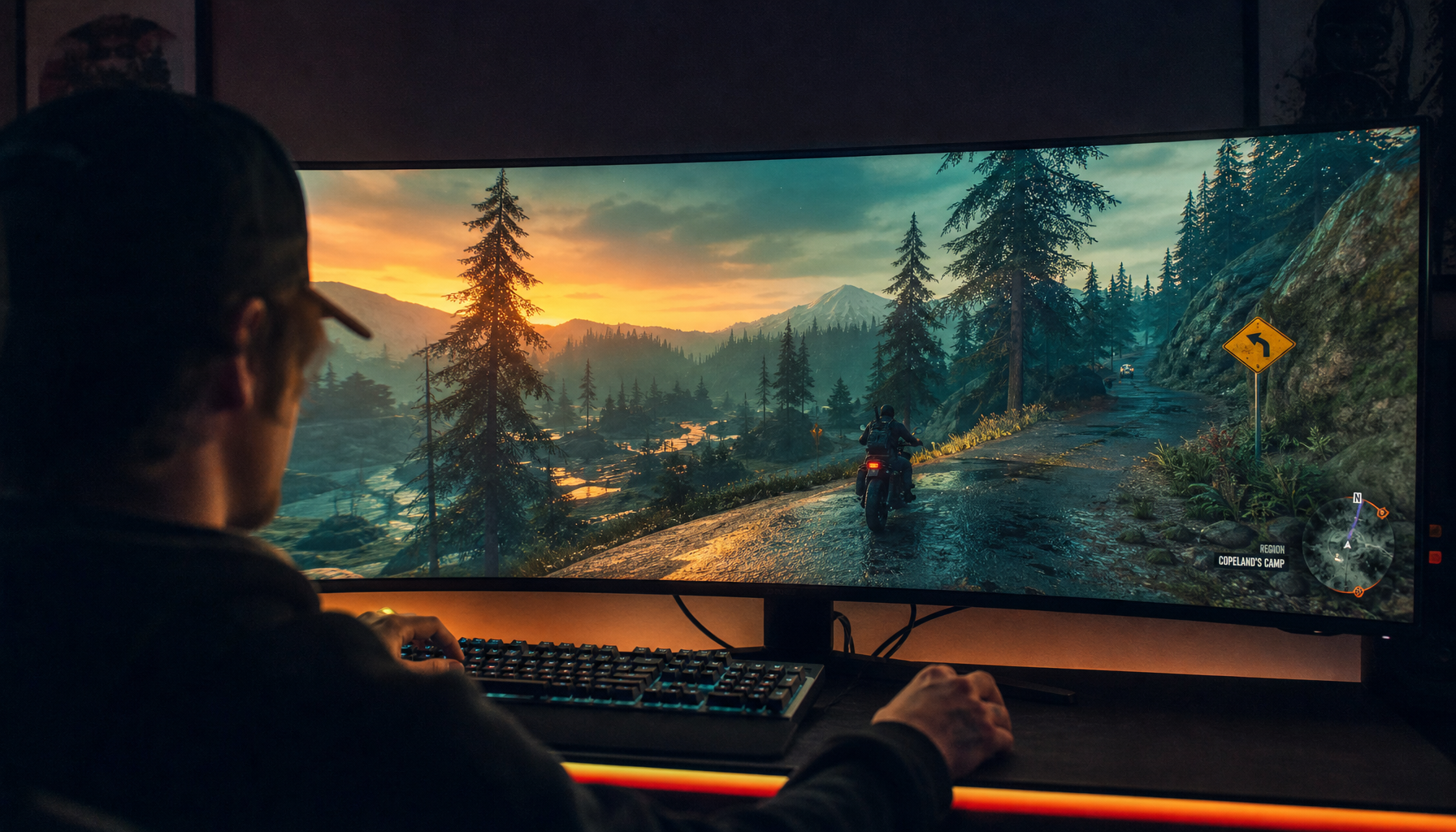
For single-player games on a 144 Hz, 165 Hz, or ultrawide gaming monitor, you can prioritize consistency and image quality more heavily. Adaptive Sync plus a sensible frame cap often gives the best balance because ultrawide resolutions place more load on the GPU, making locked 240 FPS unrealistic in many modern titles.
If your ultrawide display is 144 Hz and the game fluctuates between 95 and 135 FPS, VRR is usually more valuable than forcing traditional V-Sync. Lower the heaviest graphics options until frame pacing feels even, then raise visual settings one at a time.
What This Means When Buying a Gaming Monitor
A higher refresh rate is valuable, but it should not be the only buying criterion. A 240 Hz monitor with weak pixel response, poor overdrive tuning, or high processing delay can feel less clean than a well-tuned 165 Hz or 180 Hz model. For competitive gaming, look for low input lag, strong response behavior across the VRR range, practical overdrive modes, and a panel that your GPU can actually feed.
For esports-focused buyers, 240 Hz is a strong practical target, while 360 Hz and 540 Hz make sense only if the game and system can sustain very high FPS. Ultra-high-refresh panels are limited when FPS is low or latency-heavy settings delay frames before display.
Different Display Types, Different Priorities
For a 24- or 27-inch esports monitor, prioritize refresh rate, measured input lag, response tuning, and ergonomic adjustability. For an ultrawide gaming monitor, prioritize GPU match, VRR range, resolution, and frame pacing because the wider pixel count makes sustained ultra-high FPS harder.
For a portable gaming monitor, be realistic about power, connection bandwidth, and device performance. A compact 144 Hz or 165 Hz portable display can be excellent for a gaming laptop or handheld PC, but only if the device can output stable frames and the monitor supports a low-lag mode over the connection you plan to use.
FAQ
Q: Does a 240 Hz or 360 Hz monitor always reduce input lag?
A: It reduces the display refresh interval, but not always total input lag. If the game runs at low FPS, uses traditional V-Sync, builds a long render queue, or enables heavy image processing, those delays can outweigh the refresh-rate advantage. A 240 Hz monitor refreshes every 4.17 ms, but a 60 FPS game still creates new frames only about every 16.6 ms.
Q: Should I use Adaptive Sync, V-Sync, and a frame cap at the same time?
A: For many gaming monitors, the balanced setup is Adaptive Sync on, in-game V-Sync off, driver-level V-Sync on as a ceiling guard when appropriate, and an FPS cap 2-4 frames below maximum refresh. This keeps FPS inside the VRR range and reduces the chance of hitting the panel ceiling, where sync behavior can change.
Q: Should I enable motion smoothing or frame interpolation for games?
A: Usually no for competitive gaming. Motion smoothing can make displayed motion look more fluid, but it adds processing delay and may create artifacts, especially when base FPS drops below about 40-60 FPS. It is better suited to non-competitive viewing than mouse-driven games where control timing matters.
Key Takeaways
Ultra-high refresh rates are most effective when the rest of the pipeline supports them. A 240 Hz or 360 Hz gaming monitor gives the display more chances to show fresh frames, but the PC still has to produce those frames quickly, the sync mode has to avoid unnecessary waiting, and the panel has to transition pixels cleanly.
Use this checklist when setting up a high-refresh gaming display:
- Set the monitor to its highest supported refresh rate in the operating system and game.
- Enable the monitor’s Game Mode or low-lag mode, and disable extra image processing.
- Turn on Adaptive Sync or VRR if you want smoother pacing with low tearing.
- Use a frame cap slightly below max refresh, such as 141 FPS for 144 Hz or 237 FPS for 240 Hz.
- Keep in-game V-Sync off for competitive play unless a specific game requires it.
- Lower heavy graphics settings first: shadows, ray tracing, volumetrics, reflections, and post-processing.
- Test overdrive, low latency mode, and frame caps one change at a time using the same game scene.
The practical buying rule is simple: choose the fastest monitor your system can feed consistently, then tune settings for stable frame times and low processing delay. For esports, that often means a low-lag 240 Hz or faster display with clean response tuning; for ultrawide and portable gaming, it often means a slightly lower refresh target with better consistency, VRR behavior, and visual balance.
References
- AI Motion Smoothing & Monitor Latency: The Tradeoff
- Response Time & Refresh Rate: A Guide to Motion Clarity
- Input Lag vs. Refresh Rate: What Matters for Gaming
- Input Lag vs. Refresh Rate: What Matters for Gaming
- Adaptive Sync & Frame Rate Limiters: The Best Setup
- Adaptive Sync & Input Lag in Competitive Gaming