HDR and VRR solve different display problems, but they work best together when the monitor, GPU, cable, and settings support the same performance target.
Does your game look cinematic in bright scenes but tear or stutter when the action spikes? A properly matched HDR and VRR setup can preserve richer highlights while keeping frame pacing smoother, provided your monitor, GPU, cable, and settings all support the same output mode. This guide explains how to set it up, what tradeoffs to expect, and when to prioritize one feature over the other.
HDR and VRR Do Different Jobs
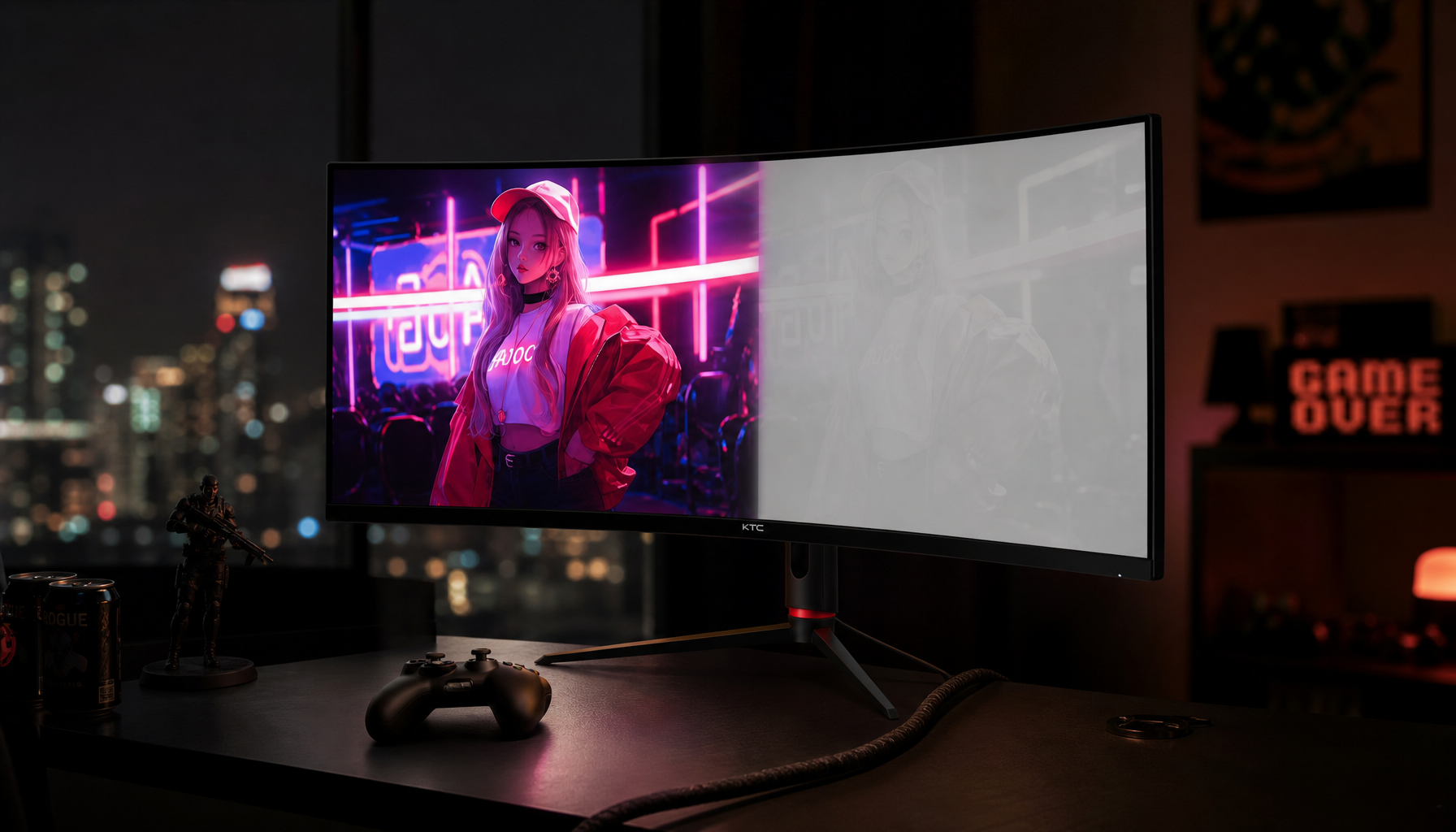
HDR, or high dynamic range, affects how bright highlights get, how deep shadows appear, and how much color information the display can show. On a good HDR monitor, sunlight, explosions, neon signs, and dark interiors can look more convincing because the screen has more range between its brightest and darkest parts. HDR can increase peak brightness, contrast, and color depth when the full hardware and content chain supports it.
VRR, or variable refresh rate, is about timing. Instead of forcing the monitor to refresh at a fixed cadence while the GPU delivers frames unevenly, VRR lets the display adapt its refresh rate to the game’s actual frame output. Many gaming displays include adaptive sync features to reduce tearing and improve responsiveness.
Put simply, HDR changes image quality; VRR changes motion behavior. When both are enabled, the goal is to get richer image output without sacrificing smooth frame delivery.
How HDR and VRR Work Together in Real Use
The interaction matters because both features demand more from the display pipeline. HDR may require higher bandwidth due to greater bit depth, wider color, and higher resolution. VRR needs a stable supported refresh range over HDMI or DisplayPort. If the connection cannot carry the full signal, the system may lower the refresh rate, reduce the color format, disable HDR, or make VRR unavailable.
A practical example is a 4K gaming monitor running at 144 Hz. With SDR, the setup may work easily over a suitable modern cable. With HDR enabled, the same resolution and refresh rate may require a stronger interface such as HDMI 2.1 or DisplayPort 1.4 with appropriate support from the GPU and monitor. Typical HDR setup guidance calls for HDMI 2.0/2.1 or DisplayPort 1.4a, along with compatible hardware and drivers.

This is why a monitor spec sheet should be read as a system promise, not a collection of isolated badges. “4K,” “HDR,” “144 Hz,” and “VRR” may all appear on the box, but the decisive question is whether they operate together on the input you plan to use.
Why HDR Quality Matters More Than the HDR Logo
Not all HDR is equally useful. Entry-level HDR monitors can accept an HDR signal but may lack the brightness, contrast, and local dimming needed to make HDR look meaningfully better than SDR. DisplayHDR 600 is a more practical starting point for a visible HDR upgrade, while DisplayHDR 400 can feel underwhelming.
Panel technology also changes the experience. OLED can deliver true blacks and very high contrast, while mini-LED and strong QLED designs can push brighter highlights. On QLED monitors, HDR expands perceived color and contrast, especially in scenes with mixed lighting. For bright rooms, a high-brightness QLED or mini-LED panel may hold up better against ambient light; for dark-room immersion, OLED’s black level can be more dramatic.
VRR will not fix weak HDR. If a display has poor HDR brightness or heavy blooming, VRR can still smooth motion, but highlights may look flat or halos may appear around bright objects. Conversely, excellent HDR will not fix tearing if VRR is disabled or unsupported at your chosen refresh rate.
The Performance Tradeoff: More Visual Data, Same Frame Budget
HDR does not automatically reduce frame rate in every game, but enabling HDR can expose the limits of your whole setup. The GPU must render the same scene, the operating system must output an HDR signal, and the monitor must process it at the selected refresh rate. If your game is already hovering near the low end of your VRR range, HDR plus higher resolution settings may make frame pacing feel less consistent.
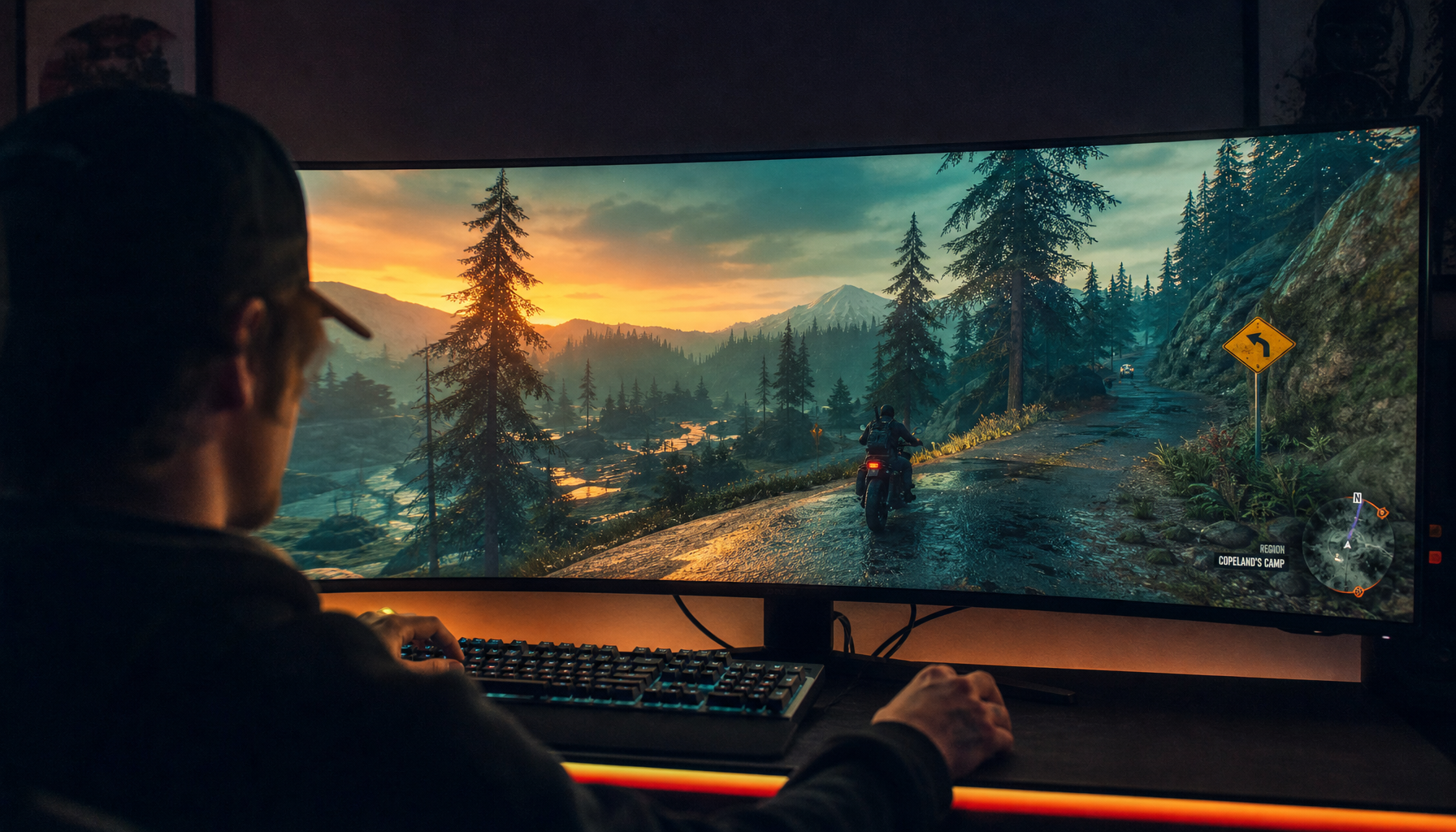
For example, a player running a demanding open-world title at 4K might see frame rates swing from 70 fps to 115 fps. VRR makes those swings feel smoother than fixed refresh operation because the monitor follows the GPU more closely. If HDR pushes the game into a lower performance band, dropping a heavy graphics preset may preserve the HDR look while keeping the frame rate inside the VRR window.
For competitive play, the priority often flips. Gaming monitors tend to emphasize higher refresh rates, low response times, and responsiveness. In esports titles, stable high frame rate and low input lag usually matter more than cinematic HDR. For single-player games, racing, RPGs, and HDR-rich media, the visual payoff is often worth tuning around.
Use Case |
Best Priority |
Practical Setup Choice |
Competitive shooters |
VRR, high refresh, low latency |
Use the fastest stable refresh mode and keep HDR only if it does not add delay or reduce clarity |
Cinematic single-player games |
HDR plus VRR |
Enable HDR, keep VRR on, and tune graphics so frame rate stays within the VRR range |
Office and mixed use |
Text clarity and comfort |
Use SDR or well-calibrated HDR only when it improves readability |
Console and PC hybrid desk |
Input compatibility |
Confirm HDMI/DisplayPort versions support HDR and VRR together |
System Setup: Where Problems Usually Start
HDR still depends on the full chain. You need an HDR-capable monitor, supported GPU, proper cable, current graphics drivers, and HDR-ready content. On a PC, HDR is less seamless than on many TVs because it depends on operating system support, compatible hardware, cables, drivers, and content.
Start by enabling VRR in your GPU control panel, then enable HDR in display settings. After that, launch a game with native HDR support and confirm the game detects HDR internally. If the desktop looks washed out, adjust the SDR-to-HDR brightness balance rather than assuming the monitor is defective.

For a hybrid work and gaming desk, treat monitor setup as part of the workspace design. Good desk planning depends on monitor selection, connectivity, layout, and lighting. That matters because HDR looks worse in uncontrolled glare, and VRR benefits are wasted if the monitor is connected through the wrong port or cable.
Pros and Cons of Running HDR With VRR
The main advantage is immersion without obvious motion penalties. A well-configured HDR plus VRR setup can make games feel richer while reducing tearing and uneven motion when frame rates fluctuate. On a 27-inch or 32-inch 4K display, that combination is especially convincing for story games, racing, flight, and open-world titles.
The downsides are setup complexity and inconsistency. Some monitors offer HDR but not enough brightness to make it worthwhile. Some systems expose HDR at one refresh rate but not another. Some games handle HDR beautifully, while others need manual brightness tuning. Portable smart screens and office-first monitors may accept HDR signals but still prioritize power efficiency, USB-C convenience, or text clarity over peak gaming performance.
There is also a content mismatch problem. HDR desktop use can make spreadsheets, browser windows, and code editors look too bright or uneven if the monitor’s tone mapping is aggressive. For long work sessions, a stable SDR mode may be more reliable, especially if your day involves text-heavy tasks and only occasional gaming.
Buying Advice: Match the Monitor to the Real Workload
If you want HDR and VRR together, do not buy from the logo row alone. Look for meaningful HDR capability, a refresh range that fits your GPU, and the right ports for your target resolution. Buyers who care about HDR should target DisplayHDR 600 or higher, while high-refresh gaming also benefits from DisplayPort or modern HDMI support.
For mixed work and play, a 27-inch or 32-inch QHD or 4K monitor is often the most balanced choice. For immersive simulation or multitasking, ultrawide displays can replace dual screens, though HDR uniformity and VRR behavior should be checked carefully. For color-critical work, some creator-focused HDR displays prioritize color accuracy, factory tuning, wide gamut, and creator workflows, which is different from pure esports speed.
A value-oriented buyer should decide which failure would bother them more: dull HDR or uneven motion. If you mostly play fast games, prioritize VRR range, refresh rate, and response behavior. If you mostly play cinematic games or watch HDR video, prioritize HDR brightness, contrast, local dimming quality, and panel type. If you do both, budget for a monitor that proves both at the same resolution and input you will actually use.
FAQ
Should HDR always be enabled with VRR?
No. Enable both for HDR-capable games that look better and still run smoothly. For desktop work, competitive play, or poorly mastered HDR games, SDR plus VRR may look cleaner and feel faster.
Does VRR improve HDR picture quality?
VRR does not improve brightness, contrast, or color. It improves frame pacing and reduces tearing. HDR quality still comes from the panel, backlight, tone mapping, and content.
Is HDR 400 enough for gaming with VRR?
It can work technically, but it may not look dramatically better than SDR. For a visible HDR upgrade, a stronger HDR tier, OLED, mini-LED, or a bright QLED panel is usually more convincing.
Which cable should I use?
Use the cable and port that support your full target mode. For modern 4K high-refresh HDR with VRR, that usually means a certified HDMI 2.1 or DisplayPort 1.4-class connection, depending on your monitor and GPU.
Final Word
HDR and VRR are not rivals. HDR makes the image more expressive; VRR keeps motion controlled when performance changes. The best monitor is the one that can run both together at your real resolution, real refresh rate, and real desk conditions without making you choose between immersion and responsiveness.