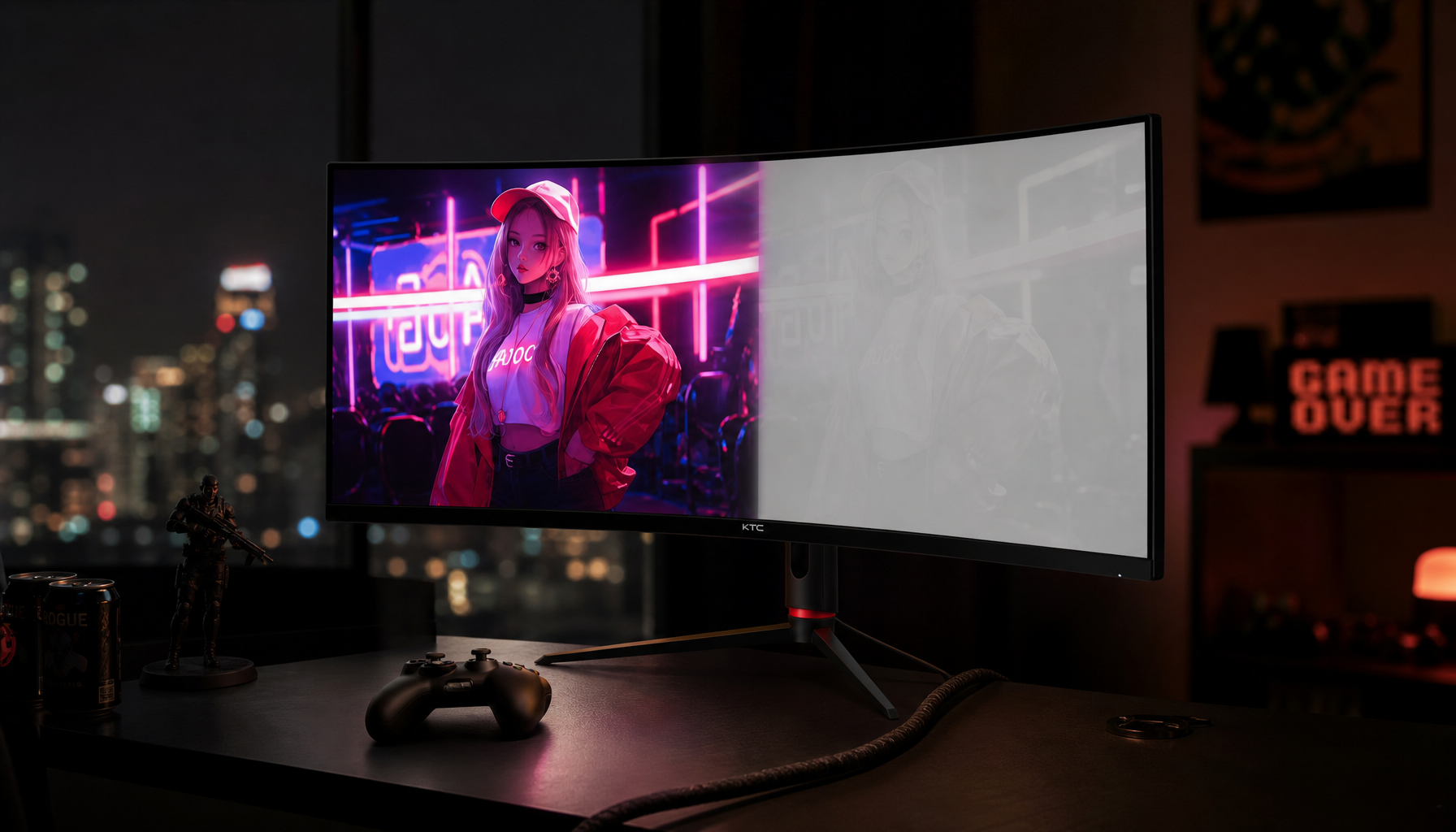
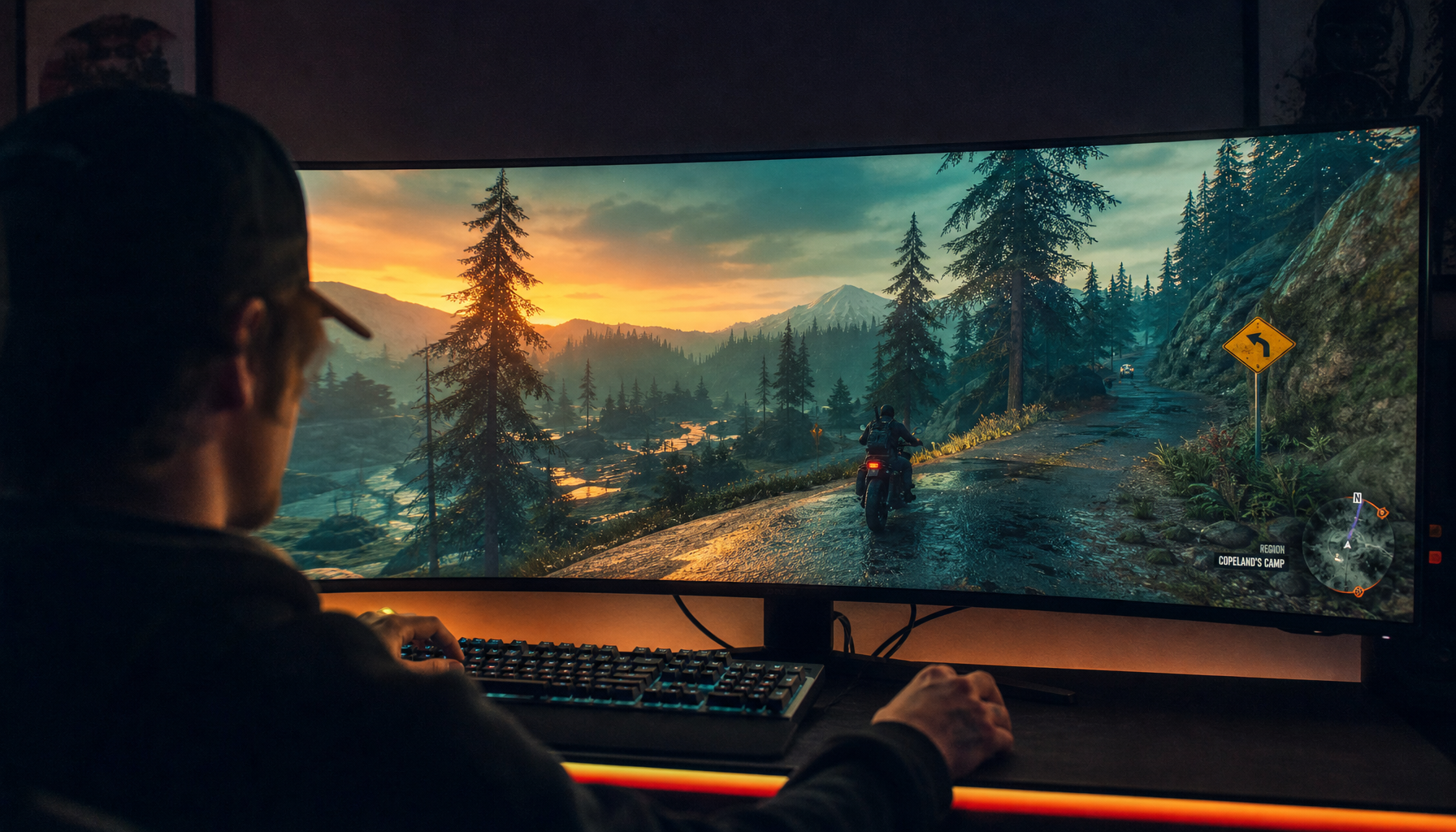
HDR does not directly make overdrive faster, but it can change the display mode, brightness behavior, tone mapping, local dimming, and preset logic around overdrive. For the cleanest motion, tune HDR, refresh rate, VRR, and overdrive as one system instead of treating each setting separately.
Does your game look punchier with HDR on, but suddenly show pale trails, bright halos, or a quick black screen when you switch modes? A practical tuning pass can usually separate real HDR benefits from avoidable motion artifacts by locking the refresh rate, testing medium overdrive, and comparing SDR with HDR in the same scene. You’ll get a clear way to choose settings for competitive play, cinematic games, office work, and portable screens without chasing every menu option.
HDR and Overdrive Are Separate, but They Collide in Real Use
HDR, or high dynamic range, expands brightness and color behavior compared with SDR, while overdrive pushes LCD pixels to transition faster between shades. The collision happens because HDR often activates a different monitor pipeline: tone mapping, wider gamut behavior, altered brightness control, local dimming, and sometimes a different picture preset. Switching display presets can change more than color, including brightness, color temperature, gamma, black level, gamut, overdrive, HDR tone mapping, local dimming, adaptive sync, and refresh behavior, which is why an HDR preset can feel like a different monitor rather than a simple brightness boost display presets.
Overdrive is the monitor’s response-time compensation system. It applies extra voltage to LCD pixels so they reach the target shade faster, reducing ghosting behind moving objects. The catch is that too much overdrive causes overshoot, also called inverse ghosting, where a bright or dark halo appears because the pixel has been driven past the target shade; this tradeoff is central to monitor overdrive.
In practice, HDR makes overshoot easier to notice on some displays because bright highlights, darker shadow transitions, and local dimming changes raise the visibility of transition errors. A white HUD element moving over a dark HDR sky is a classic stress test: the same overdrive level that looked acceptable in SDR may show a sharper pale edge or dark smear in HDR.
Why HDR Can Change Motion Clarity
HDR’s first impact is signal-level behavior. When an operating system, console, or game enters HDR, the monitor may resync because the signal format, transfer function, brightness mapping, and metadata behavior change. A brief black screen during that switch is usually normal, especially when crossing from SDR to HDR or from one refresh behavior to another, because the monitor, graphics hardware, and operating system need to renegotiate the mode.
The second impact is visibility. HDR does not necessarily increase pixel response speed, but it can make mistakes more obvious. Higher highlight brightness can expose bright overshoot trails, while deeper intended blacks can make VA-panel dark smearing easier to see. On a Mini LED monitor, local dimming can also add blooming or brightness pumping around moving objects, which users may mistake for overdrive artifacts.

The third impact is preset behavior. Many gaming monitors bind HDR to a specific picture mode. That mode may lock brightness, alter gamma controls, disable certain color settings, or change available response-time levels. Calibration guidance often treats picture modes as the right starting point because presets change many settings at once, and the same logic applies even more strongly when HDR enters the chain picture modes.
The Refresh Rate Math Behind the Problem
Pixel response must fit inside the refresh window. A 60 Hz monitor refreshes every 16.67 ms, while a 144 Hz monitor refreshes every 6.94 ms, so a pixel transition that looks fine at 60 Hz can blur across multiple frames at high refresh. This is why high-refresh HDR gaming is demanding: the panel must handle wide brightness swings, fast frame delivery, and precise tone behavior at the same time.
Use Case |
HDR State |
Refresh Target |
Overdrive Starting Point |
What to Watch For |
Usually SDR, HDR only if clean |
144 Hz to 240 Hz+ |
Medium or Fast |
Bright halos around crosshairs and enemy outlines |
|
Cinematic RPG |
HDR if the monitor has real contrast |
60 Hz to 165 Hz |
Weak or Medium |
Dark smearing, blooming, washed-out shadows |
HDR if stable |
120 Hz to 240 Hz |
Medium |
Trail edges on signs, lane markers, and score graphics |
|
Usually SDR |
60 Hz to 144 Hz |
Off, Low, or Normal |
Text fringing, cursor trails, eye fatigue |
|
HDR only if brightness is strong enough |
60 Hz to 144 Hz |
Medium |
Battery drain, dim HDR, connection bandwidth limits |
For a concrete example, a 144 Hz HDR game gives each frame less than 7 ms on screen. If your LCD’s darker transitions take longer than that, you see ghosting; if you raise overdrive too aggressively to compensate, you may see inverse ghosting. That is why Extreme, Fastest, or Premium response modes often look impressive in a static menu but worse during a real match.
VRR Makes the Best Overdrive Setting Move
Variable refresh rate is excellent for smoothness because it matches the display refresh to the graphics output, reducing tearing and stutter. The complication is that many monitors use fixed overdrive behavior even while frame rate changes. A setting that looks sharp at 144 FPS can become too aggressive near 60 FPS because the panel has more time per refresh, and the same voltage push can overshoot.
Some displays with dedicated variable-refresh hardware support variable overdrive, while many open-standard variable-refresh monitors rely on more basic response-time settings. The practical result is simple: test overdrive at both your best-case and worst-case frame rates. If your game runs between 70 FPS and 140 FPS, do not judge motion clarity only in an empty training map at 140 FPS.
A reliable first pass is to enable VRR, set the monitor to its highest stable refresh rate, choose Medium or Normal overdrive, and test a dark-to-light moving object. If you see long trails, step one level faster. If you see bright outlines, pale coronas, or color flashes, step one level slower. The best setting is the one with the least combined blur and overshoot, not the one with the most aggressive label.
HDR, Motion Blur Reduction, and Backlight Strobing
Backlight strobing, black frame insertion, motion blur reduction, or similar blur-reduction modes can improve perceived motion sharpness by reducing persistence blur. They also reduce brightness and can conflict with VRR on many monitors. Because HDR depends heavily on brightness range, strobing and HDR are often a poor pairing unless the monitor was specifically designed to handle both well.
This matters most on portable and midrange displays. Portable monitors often prioritize power, thin design, and simple cable setups; 60 Hz is enough for office work, while gaming models are better served by 120 Hz or 144 Hz when the source can drive them. Brightness also matters, with around 300 to 400 nits suited to brighter indoor use and 500 nits or higher more appropriate outdoors, so weak portable HDR can look dim even before strobing reduces light output further portable monitor.
For most buyers, VRR plus well-tuned overdrive is the better everyday motion clarity solution than HDR plus strobing. Strobing can be powerful for specific esports scenarios, but it is less flexible for mixed HDR gaming, console play, and office use.
Panel Type Changes the HDR-Motion Tradeoff
IPS, VA, OLED, and Mini LED displays do not react the same way. IPS usually gives balanced color and viewing angles with decent response behavior, but lower native contrast can limit HDR depth. VA can deliver stronger contrast, which helps cinematic HDR, but slower dark transitions may show more smearing in fast games. OLED has exceptionally fast pixel response and deep blacks, making motion and HDR feel immediate, though burn-in risk and price remain real considerations for static desktop use.

Non-OLED gaming monitors still make sense for players who want durability, high brightness, and lower cost. Current buying guidance often places 1440p as the sweet spot for 27- and 32-inch gaming monitors, with 144 Hz as a baseline for fast shooters and 240 Hz or higher for competitive players non-OLED gaming monitors. That context matters because HDR quality is only one part of the experience; a dim HDR label on a slow panel will not beat a well-tuned SDR image with clean motion.
For office users and hybrid setups, the best display may not be the most extreme HDR gaming model. A 27-inch QHD IPS screen with 100 Hz or higher refresh, USB-C, and accurate sRGB coverage is often a stronger daily tool than a spec-heavy monitor with weak HDR implementation computer monitor.
Practical Settings That Usually Work
Start with the stable foundation: native resolution, highest reliable refresh rate, correct cable, and VRR enabled if your monitor handles it cleanly. A high-bandwidth display connection is often required for common high-refresh modes, and newer high-bandwidth connections become important for higher-end 4K 120 Hz console or PC setups.
For SDR desktop work, keep HDR off unless you are actively viewing HDR content. Use the monitor’s Custom, User, sRGB, or Standard mode, set brightness for the room, keep sharpness low or default, and use Off, Low, Normal, or Medium overdrive. This avoids unnecessary wide-gamut oversaturation, washed-out desktop whites, and needless response-time artifacts while reading text.
For competitive games, use SDR first unless the game’s HDR is clean and visibility remains strong. Set the highest stable refresh rate, enable VRR, use Medium overdrive as the baseline, and only move to Strong or Fast if a moving-object test and real gameplay both show less blur without halos. Common gaming-monitor recommendations often land on Medium overdrive for general use because low settings can ghost while overly strong settings can create inverse ghosting gaming monitor settings.
For cinematic HDR games, prioritize contrast and tone mapping over raw response labels. Use HDR in the operating system, the game, and the monitor only when all three are behaving consistently. If shadows look gray, highlights clip, or motion has glowing edges, compare the same scene in SDR before blaming the game. Sometimes SDR with accurate gamma and clean overdrive is the better-looking mode.
For console gaming, run the console’s HDR calibration tool and match the monitor’s output mode to the game. A 60 Hz game does not need the same overdrive aggression as a 120 Hz shooter. If a 120 Hz HDR mode creates halos, drop overdrive one step before disabling HDR entirely.
When to Turn HDR Off
Turn HDR off when the monitor cannot deliver meaningful contrast, when SDR desktop apps look washed out, when HDR locks you into a bad overdrive mode, or when VRR plus HDR causes flicker or blackouts. HDR labels alone are not proof of performance; sustained brightness, local dimming, contrast, and color handling decide whether HDR is actually useful.
The same restraint applies to automatic mode switching. Context-aware monitors can switch settings such as refresh rate, overdrive, VRR, scaling, color behavior, and contrast, but the panel’s real capability still comes first. Automatic switching is useful when moving from spreadsheets to a full-screen game, but it can misread video editors, dashboards, or strategy games, so quick manual override remains valuable.
A Simple Test Routine
Use one repeatable scene instead of changing five settings at once. Pick a fast pan with bright objects over a dark background, such as a night race with white signs, a shooter map with pale walls and dark doorways, or an HDR title screen with moving highlights. Test SDR Medium overdrive, SDR Fast overdrive, HDR Medium overdrive, and HDR Fast overdrive, then choose the mode with the least visible trailing during actual motion.
If you want a more controlled check, use a browser-based moving-object test and compare overdrive levels at your real refresh rate. Then repeat at a lower frame-rate cap if you use VRR. The goal is not laboratory perfection; it is finding the setting that keeps enemy outlines, text overlays, reticles, and fast camera pans readable without adding artificial halos.
FAQ
Does HDR Increase Input Lag?
HDR itself is not automatically high-lag, but some monitors process HDR through heavier tone mapping or local dimming paths. If a game feels slower in HDR, compare the same refresh rate, VRR state, and overdrive mode in SDR before drawing conclusions.
Should Overdrive Be Set to Maximum for HDR Gaming?
Usually no. Maximum overdrive often increases overshoot, and HDR highlight contrast can make that overshoot easier to see. Medium or Normal is the best starting point for most LCD gaming monitors.
Is OLED Better Because It Does Not Need Overdrive?
OLED pixel response is dramatically faster than typical LCD response, so it avoids many LCD overdrive tradeoffs. The tradeoff shifts toward brightness behavior, automatic dimming, cost, and burn-in risk with static HUDs or productivity layouts.
Why Does My Screen Go Black When I Enable HDR?
A short blackout can be normal because the monitor and graphics hardware are resynchronizing the signal. If blackouts are long, random, or require unplugging cables, check firmware, graphics drivers, cable bandwidth, docks, adapters, sleep settings, and whether presets are changing refresh rate or VRR state.
HDR is worth using when it adds contrast and highlight detail without damaging motion clarity. Treat HDR, overdrive, VRR, refresh rate, and panel type as one performance stack, then tune for the content in front of you: speed for esports, tone quality for cinematic games, stability for work, and efficient brightness for portable screens.