HDMI 2.1 does not always require a new cable, but full-bandwidth features such as 4K at 120 Hz, 8K at 60 Hz, VRR, and eARC are safest with a certified Ultra High Speed HDMI cable and HDMI 2.1-capable ports on every device in the chain.
Is your new 4K 120 Hz monitor still locked at 60 Hz, or does your console flicker when you enable HDR and VRR? A quick cable-and-port check can often restore the mode your display was built to run. Here is the practical way to tell whether the cable, the port, or an intermediate device is holding your setup back.
The Short Answer: Ports Decide Features, Cables Decide Reliability
HDMI is both a device interface and a cable ecosystem. The port on your console, GPU, laptop, monitor, TV, soundbar, or AV receiver determines which HDMI features are available. The cable determines whether the signal can travel cleanly at the required bandwidth.

That distinction matters because HDMI cables are categorized by performance needs, while HDMI ports are built into devices with their own feature limits. A cable cannot turn an HDMI 2.0 port into an HDMI 2.1 port. Likewise, an HDMI 2.1 port can underperform if the cable cannot reliably carry the requested signal.
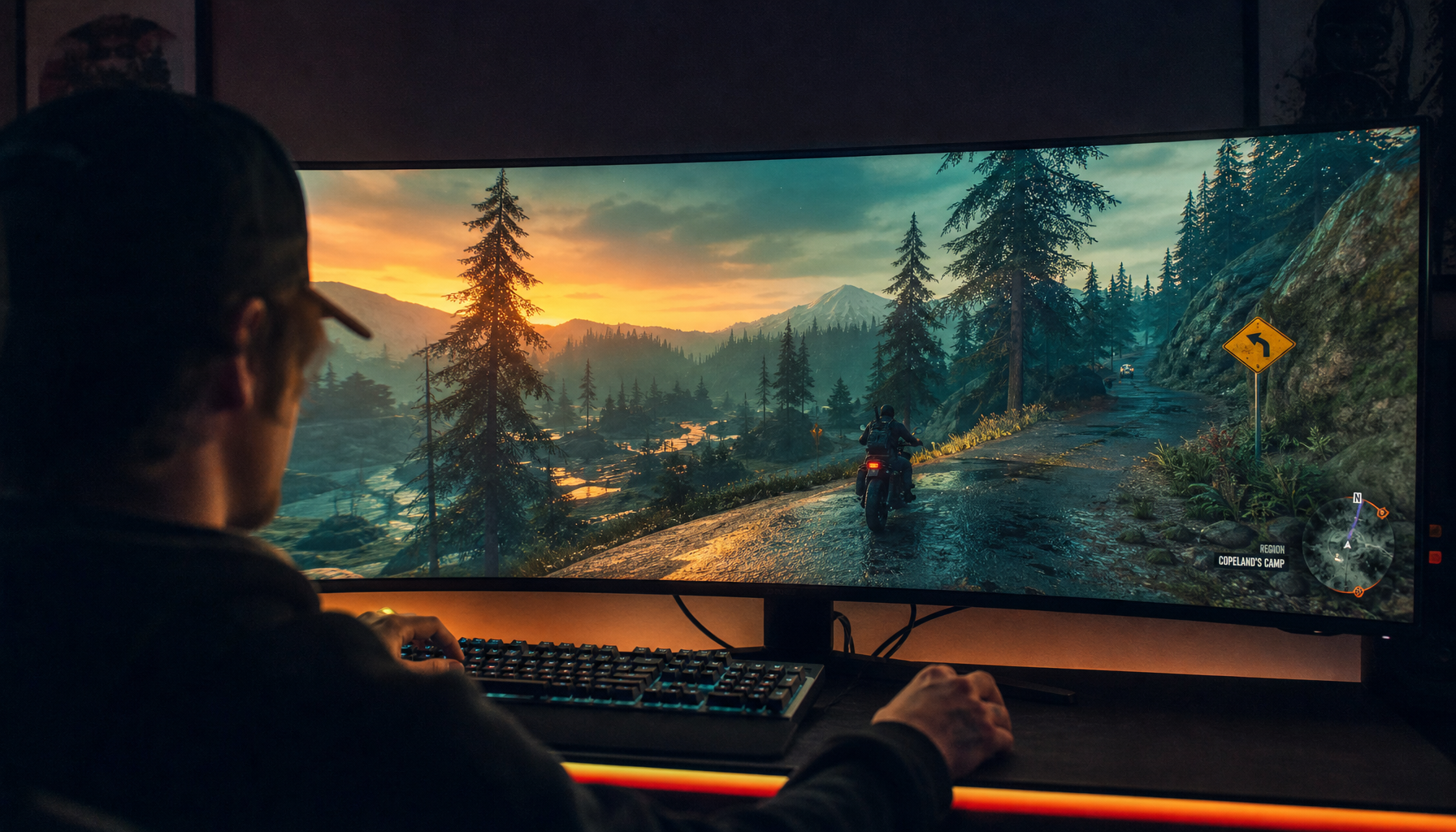
In a real desk setup, this often looks like a high-refresh gaming monitor connected to a modern GPU with an old cable pulled from a streaming box. The monitor and GPU may support 4K at 120 Hz, but the cable may only be comfortable at 4K 60 Hz. The fix is simple: match the whole signal chain to the mode you actually want.
What HDMI 2.1 Changes
HDMI 2.1 is mainly about bandwidth and feature headroom. HDMI 2.0 tops out at 18 Gbps, while HDMI 2.1 supports up to 48 Gbps, which opens the door to higher refresh rates, higher resolutions, and more demanding color formats.

For gaming monitors, that higher ceiling is the difference between “looks sharp” and “feels fast.” HDMI 2.0 is commonly enough for 4K at 60 Hz, office work, streaming, video calls, and many productivity displays. HDMI 2.1 becomes valuable when you want 4K at 120 Hz, 8K at 60 Hz, dynamic HDR, Variable Refresh Rate, Auto Low Latency Mode, or enhanced audio return through eARC.
The cable category associated with full HDMI 2.1 performance is Ultra High Speed HDMI. Ultra High Speed HDMI supports up to 48 Gbps and is designed for demanding formats such as uncompressed 8K 60 Hz and 4K 120 Hz.
Setup Goal |
Port Requirement |
Cable Recommendation |
1080p office display |
HDMI 1.4 or newer is usually enough |
High Speed HDMI is typically fine |
4K 60 Hz productivity or streaming |
HDMI 2.0-class capability |
Premium High Speed HDMI |
4K 120 Hz gaming |
HDMI 2.1-capable source and display |
Certified Ultra High Speed HDMI |
8K 60 Hz or advanced AV chain |
HDMI 2.1 across source, receiver, and display |
Certified Ultra High Speed HDMI, ideally short or active/fiber for long runs |
Why “HDMI 2.1 Cable” Is Not the Best Buying Phrase
The most reliable shopping phrase is not “HDMI 2.1 cable.” It is “certified Ultra High Speed HDMI cable.” That certification is tied to the 48 Gbps cable category, while HDMI-number marketing can be vague.
Monitor buying guidance is especially useful because HDMI 2.1 branding alone does not prove every HDMI 2.1 feature or full bandwidth is present. Some displays advertise HDMI 2.1 while supporting only a subset of features. Some ports may rely on compression. Some may offer 4K 120 Hz but not full RGB or 4:4:4 color at the bit depth you expect.
For a PC user reading small text all day, that nuance is not academic. Full 4:4:4 chroma keeps fine colored text and UI edges cleaner. A console user may care more about 4K 120 Hz and VRR. A soundbar user may care most about eARC. The right question is not “Does it say HDMI 2.1?” The right question is “Does this exact port and cable support the signal mode I will use?”
When You Do Not Need a New Cable
If your current cable already handles your target mode without flicker, blackouts, sparkles, audio drops, or forced refresh-rate limits, replacing it will not improve image quality. HDMI is digital; a working signal does not become sharper because the cable costs more.
For most office productivity displays, HDMI 2.1 is often unnecessary. A 27-inch 4K monitor at 60 Hz, a spreadsheet-heavy workstation, a video meeting display, or a portable screen used for presentations can run well on HDMI 2.0-class bandwidth. Premium High Speed HDMI is positioned for 4K at 60 Hz, which covers a huge share of everyday monitor and TV use.
The same is true for many streaming boxes and UHD disc setups. If the source outputs 4K 60 Hz HDR and the display accepts it cleanly, the practical upgrade value of a 48 Gbps cable is low unless you plan to move that cable into a higher-refresh gaming setup later.
When You Should Buy a New Cable
You should buy a certified Ultra High Speed HDMI cable when the target mode exceeds HDMI 2.0 comfort territory. That includes current consoles, high-end gaming PCs, 4K 120 Hz monitors, 8K TVs, advanced HDR workflows, and setups where VRR or eARC must work consistently.
A simple example: a 4K 120 Hz signal asks the cable to carry far more data than 4K 60 Hz. If 4K 60 Hz works but 4K 120 Hz causes dropouts, the cable is a prime suspect. The port could also be the limit, especially on monitors with mixed HDMI inputs, AV receivers that pass only older formats, or laptops whose HDMI output is wired to a lower-bandwidth controller.
Cable length also changes the reliability picture. Shorter HDMI cables are generally preferred for reducing signal problems, while longer runs need better construction or active designs. For a desktop monitor, a 6 ft certified cable is a clean choice. For a wall-mounted TV 25 ft away from an equipment rack, a passive copper cable may become the weak link, and active or fiber HDMI becomes more sensible.

The Whole Chain Has to Support the Mode
HDMI negotiation works like a performance agreement between connected devices. The source, cable, receiver or dock, and display settle on a mode they can all support. If one piece is weaker, the result falls back.

That is why a new cable alone may not unlock 4K 120 Hz. If your GPU has HDMI 2.0, the monitor’s HDMI 2.1 port cannot invent bandwidth. If your console runs through an older AV receiver, the receiver may cap the output before the signal reaches the TV. If a USB-C dock advertises HDMI but only supports 4K 60 Hz, an Ultra High Speed HDMI cable after the dock will not change that.
HDMI’s long history of backward compatibility is useful here because newer cables usually work with older devices. HDMI became the broad consumer display standard partly because it carries video and audio over one connection across TVs, monitors, consoles, PCs, and audio systems. Backward compatibility is convenient, but it also hides bottlenecks until you demand a higher mode.
Practical Buying Advice for Monitors, TVs, and Portable Screens
For a pro gaming monitor, choose the cable after choosing the target mode. If the monitor is 4K 144 Hz over HDMI, check the manual for the exact HDMI bandwidth, supported chroma, bit depth, and VRR behavior. Some PC setups may be better served by another display interface, especially for multi-monitor workstations, but HDMI 2.1 is the right path for current consoles and many TV-style gaming displays.

For an office productivity display, prioritize stable resolution, text clarity, and wake-from-sleep reliability over headline HDMI numbering. HDMI 2.0-class capability is enough for many 4K 60 Hz workflows. If you frequently switch between a work laptop, desktop PC, and console, an Ultra High Speed HDMI cable is a low-risk way to reduce future troubleshooting, but the ports still set the ceiling.
For portable smart screens, inspect the connector first. Some compact displays use Mini HDMI or USB-C video input rather than full-size HDMI. The connector shape is not the same as the speed rating, so a tiny plug can still be limited by the display electronics. Match the cable to the screen’s real resolution and refresh rate instead of buying the most expensive cable on the shelf.
Pros and Cons of Upgrading the Cable
Choice |
Pros |
Cons |
Keep your current cable |
Costs nothing, works fine for many 1080p and 4K 60 Hz setups |
May fail at 4K 120 Hz, VRR, 8K, or long distances |
Buy certified Ultra High Speed HDMI |
Best practical choice for HDMI 2.1 gaming and advanced AV |
Does not upgrade older ports or weak docks |
Buy a long passive cable |
Simple and inexpensive for modest signals |
Less reliable for high-bandwidth 4K 120 Hz or 8K |
Use active or fiber HDMI |
Better for long runs and equipment racks |
Directionality, cost, and power requirements may matter |
Quick Troubleshooting Before You Replace Hardware
Start by confirming the selected resolution and refresh rate in your PC, console, or TV settings. Then plug the source directly into the display, bypassing receivers, switches, capture cards, and docks. If the mode works directly but fails through another device, the middle device is the bottleneck.
If the mode still fails, swap in a short certified Ultra High Speed HDMI cable. If that fixes the issue, the old cable was not reliable at the target bandwidth. If it does not, check the port specifications on both ends. Many products have one or two high-bandwidth HDMI ports and other ports with lower limits, so moving the cable to the correct input can matter.
The performance-driven answer is simple: buy ports for features, buy certified cable for bandwidth, and verify the entire path. A new HDMI 2.1 cable is required only when your current cable cannot carry the mode you want, but for 4K 120 Hz, VRR, 8K, or eARC-heavy setups, a certified Ultra High Speed HDMI cable is the cleanest, most reliable starting point.