GPU architecture affects scaling efficiency by deciding how well a graphics card absorbs the extra pixel load when you move from 1080p to 1440p, ultrawide, or 4K. For monitor buyers, the practical question is not just “Can my GPU run this resolution?” but “Can it stay close to my display’s refresh rate without unstable frame times?”
Ever upgraded to a sharper or faster gaming monitor, only to find that your favorite game suddenly feels less smooth? A jump from 1440p to 4K raises pixel load by 2.25x, yet real FPS loss can range from roughly 35% to 55% depending on the game, settings, and GPU limits. This guide explains what those differences mean when choosing a high-refresh monitor, ultrawide display, or portable screen for your current graphics card.
What Scaling Efficiency Means for Monitor Buyers
Scaling efficiency describes how gracefully a GPU handles a higher monitor resolution. If a game runs at 140 FPS at 1440p, perfect pixel-based scaling to 4K would suggest a much lower number, but practical results often land around 70-90 FPS because games are not limited by pixels alone. The reason is that a frame can be constrained by shader work, CPU pacing, memory bandwidth, VRAM capacity, ray tracing, or post-processing rather than raw pixel count.
For display buying, this matters because refresh rate only helps when the GPU can feed the panel consistently. A 144Hz monitor refreshes every 6.94 ms, while a 60Hz display refreshes every 16.67 ms, so a system that cannot deliver frames evenly may show repeated frames, stutter, or tearing even if the average FPS looks acceptable in a benchmark. The cleanest experience usually comes when FPS stays near the monitor’s refresh rate, or when VRR keeps the display synchronized inside its operating range.
Why Resolution Jumps Do Not Scale Equally
Resolution increases are easy to count but harder to feel. Standard 1440p renders about 3.7 million pixels per frame, while 4K renders about 8.3 million pixels, making 4K more than twice as demanding by pixel count. A 27-inch 1440p monitor at about 109 PPI can look sharp at a desk, while a 32-inch 4K monitor at about 138 PPI is roughly 27% denser but carries about 126% more pixels to render.

That is why 1440p often feels like the balanced point for high-refresh gaming. It gives a clear sharpness upgrade from 1080p without pushing the GPU as hard as 4K, leaving more headroom for 144Hz, 165Hz, or 240Hz displays.
The GPU Architecture Factors That Matter Most
The most important GPU traits change as monitor resolution rises. At 1080p high refresh, the CPU and frame-time consistency often matter more than raw GPU power because the graphics card may be waiting on game logic or draw calls. At 1440p, shader throughput and raster performance become more important, while 4K and ultrawide monitors lean harder on memory bandwidth, cache, VRAM capacity, and upscaling support.
A balanced monitor upgrade should consider the whole output chain. Even if the GPU is fast enough, a display connection standard bandwidth can limit high-resolution, high-refresh output; one display connection standard version provides about 32 Gbps, enough for uncompressed 4K 120Hz or 1440p 240Hz, while a newer display connection standard version can reach up to 80 Gbps for uncompressed 4K 240Hz.
Shader Throughput and Raster Performance
Shader throughput helps when games use complex lighting, materials, effects, and post-processing. This is why two GPUs can scale differently from 1440p to 4K even when their average performance at 1080p looks close. A card with stronger compute and raster capability may lose less relative performance as the monitor resolution increases.
Raster performance still matters for traditional rendering, especially in esports titles and games that push high frame rates without heavy ray tracing. For a 1440p 165Hz or 240Hz monitor, a GPU that can maintain high raster output with stable lows often feels better than one that posts strong peak FPS but drops sharply in busy scenes.
Memory Bandwidth, Cache, and VRAM
Higher resolutions increase the amount of image data the GPU must move and store. Memory bandwidth and cache help keep the GPU fed, while VRAM capacity determines whether high-resolution textures, frame buffers, and ray tracing data fit without swapping or stuttering. This is especially important on 4K and 3440 x 1440 ultrawide displays.

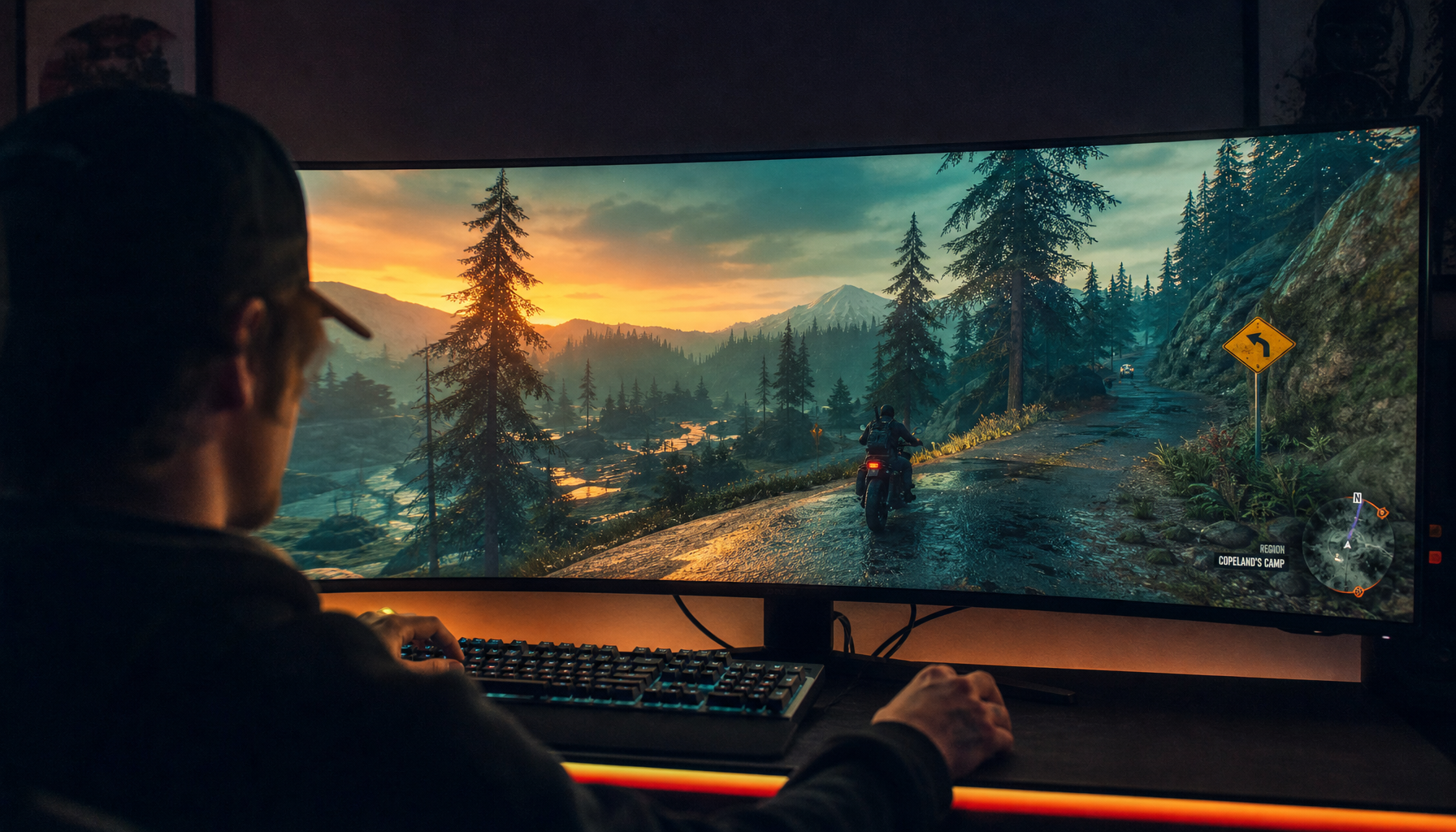
A practical ultrawide example shows the issue clearly: moving to a 3440 x 1440 QD-OLED monitor adds about 35% more pixels than standard 2560 x 1440, and a high-end graphics card saw an estimated performance hit around 20% while also exposing the limits of its 10GB framebuffer in demanding games. Delayed texture loading and stutters can appear even when the average FPS still looks usable.
How Common Monitor Resolutions Stress a GPU
Different monitor classes expose different bottlenecks. A 1080p 240Hz display usually stresses frame pacing, CPU performance, and low-latency output. A 1440p 165Hz or 240Hz monitor is more GPU-balanced. A 4K high-refresh display demands far more pixel throughput, memory bandwidth, and often upscaling support.
The best monitor choice should follow real FPS data from the games you actually play. A system producing 50-75 FPS fits well with a 75-100Hz VRR display, 80-140 FPS fits a 144Hz or 165Hz VRR monitor, and 150-240+ FPS is where 165Hz to 240Hz panels start making full practical sense.
For example, a 27-inch 4K 160Hz model such as the a brand 27” 4K 160Hz/320Hz 90W Gaming Monitor should be matched against whether your GPU can sustain usable frame rates at native 4K in the games you play, not just whether it can output the panel’s maximum refresh rate.

Monitor Class |
Pixel Load |
Common Bottleneck |
Best-Fit GPU Traits |
Practical Buying Guidance |
1080p 144Hz-240Hz |
About 2.1 million pixels |
CPU limits, frame-time variance |
Strong CPU pairing, low-latency rendering |
Good for esports and budget high refresh |
1440p 144Hz-240Hz |
About 3.7 million pixels |
Shader and raster workload |
Strong raster performance, good memory bandwidth |
Best balance for many gaming PCs |
3440 x 1440 ultrawide |
About 5.0 million pixels |
VRAM, bandwidth, shader load |
Larger VRAM, wide memory bus, upscaling support |
More immersive, but harder than standard 1440p |
4K 120Hz-165Hz |
About 8.3 million pixels |
Pixel load, memory bandwidth, ray tracing cost |
High-end GPU, large cache, strong upscaling |
Sharp image, higher GPU cost |
4K 240Hz |
About 8.3 million pixels at very high refresh |
GPU output and display bandwidth |
Flagship GPU, newer display connection standard, frame generation support |
Premium tier for buyers chasing peak smoothness |
Upscaling Changes the Monitor Upgrade Math
GPU upscaling can make high-resolution monitors more practical because the GPU renders internally at a lower resolution before reconstructing the final image. This is especially useful for 4K and ultrawide gaming monitors, where native rendering can push a card below the panel’s ideal refresh range. GPU-side methods usually have more rendering context, including frame data and game information, which can produce sharper HUDs, cleaner thin lines, and better texture detail than display-side scaling.

Monitor-side AI upscaling has a different role. It processes the finished incoming signal after the display receives it, which can help consoles, handhelds, laptops, media boxes, and portable monitors. For competitive PC gaming at 144Hz, 165Hz, or 240Hz, however, added display processing can increase latency, so buyers should check whether the monitor offers low-latency modes, 1:1 pixel mapping, or no-scaling options.
When Native Resolution Still Matters
Upscaling is useful, but it is not a free replacement for GPU headroom. Thin text, dense HUD elements, fine foliage, and shimmering edges can reveal weaker scaling modes, especially on large 4K monitors viewed from a desk. If you play competitive shooters, native 1440p at a stable 165-240 FPS may feel better than reconstructed 4K at inconsistent frame times.
For cinematic single-player games, the tradeoff is often different. A 4K 144Hz monitor with GPU upscaling and VRR can feel excellent if the system holds a consistent 80-120 FPS range, especially on OLED panels with fast pixel response.
Matching GPU Tiers to High-Refresh Displays
For entry-level GPUs, 1080p high refresh is usually the cleanest match. Cards in this class are better suited to 1080p 144Hz+ monitors than 4K displays, because the lower pixel load leaves enough headroom for smoother frame delivery. A stronger GPU can still help at 1080p, but only if the CPU and game engine can keep up.
For mid-range builds, 1440p is often the best upgrade path. GPU-monitor pairing guidance commonly places mid-range graphics cards or similar options with 1440p 144Hz to 240Hz displays, while newer upper-midrange cards are often positioned around the 1440p 165-240Hz sweet spot. High-end GPUs are the better fit for 4K high refresh, where the extra pixels, ray tracing cost, and memory demands quickly punish weaker cards.
Do Not Ignore the Cable and Port
A powerful GPU and expensive monitor can still underperform if the connection cannot carry the signal. One display connection standard version is enough for many 1440p 240Hz and 4K 120Hz setups, but buyers chasing uncompressed 4K 240Hz should look for a newer display connection standard support on both the GPU and monitor. Another display connection standard’s specs also vary by implementation, so check the monitor’s manual rather than relying only on the port shape.
Action Checklist Before Buying a Monitor
- Check your real FPS in your top three games at your current resolution using the settings you actually use.
- Decide whether you value sharpness, refresh rate, or ultrawide immersion most.
- Match the monitor refresh rate to realistic FPS: 80-140 FPS for 144Hz/165Hz, 150-240+ FPS for 165Hz/240Hz.
- Check GPU VRAM usage in demanding games before moving to 3440 x 1440 or 4K.
- Confirm display connection bandwidth for the resolution and refresh rate you plan to run.
- Prefer GPU upscaling for PC games when image quality and HUD clarity matter.
- Use VRR to reduce tearing and stutter when FPS varies below the monitor’s maximum refresh rate.
FAQ
Q: Why does my GPU lose less FPS in some games when moving from 1080p to 1440p?
A: The game may have been CPU-limited at 1080p, meaning the GPU had unused headroom. When you move to 1440p, the GPU works harder, but FPS may not drop proportionally because the CPU was already holding performance back.
Q: Is 4K always better than 1440p for gaming monitors?
A: No. 4K is sharper, especially on larger screens, but it has about 2.25x the pixel load of 1440p. For many buyers, 1440p at 165Hz or 240Hz gives a better balance of clarity, smoothness, and GPU cost.
Q: Should I use monitor upscaling or GPU upscaling?
A: For PC gaming, GPU upscaling is usually the better first choice because it has access to more rendering information before the final image is sent to the display. Monitor upscaling is more useful for consoles, handhelds, laptops, and portable monitors that output a lower-resolution signal.
Practical Next Steps
Start with the monitor resolution that your GPU can hold consistently, not the highest resolution it can launch. For most gaming desks, 1440p high refresh is the practical center; ultrawide 1440p needs more VRAM and bandwidth, while 4K high refresh belongs with high-end GPUs, strong upscaling, VRR, and the right display connection.
References
- GPU Monitor Pairing Guide for High Refresh Rate Displays
- GPU Can’t Keep Up With Monitor? How to Fix FPS Mismatch
- Monitor AI Upscaling vs. GPU Upscaling: A Gamer’s Guide
- Choosing the Perfect Monitor to Match Your Graphics Card
- I ditched my 4K monitor for 1440p, and I’m not going back
- My new ultrawide monitor humbled my GPU almost instantly
- 1440p vs 4K: GPU Performance & FPS Loss Explained